Scene 1 (0s)
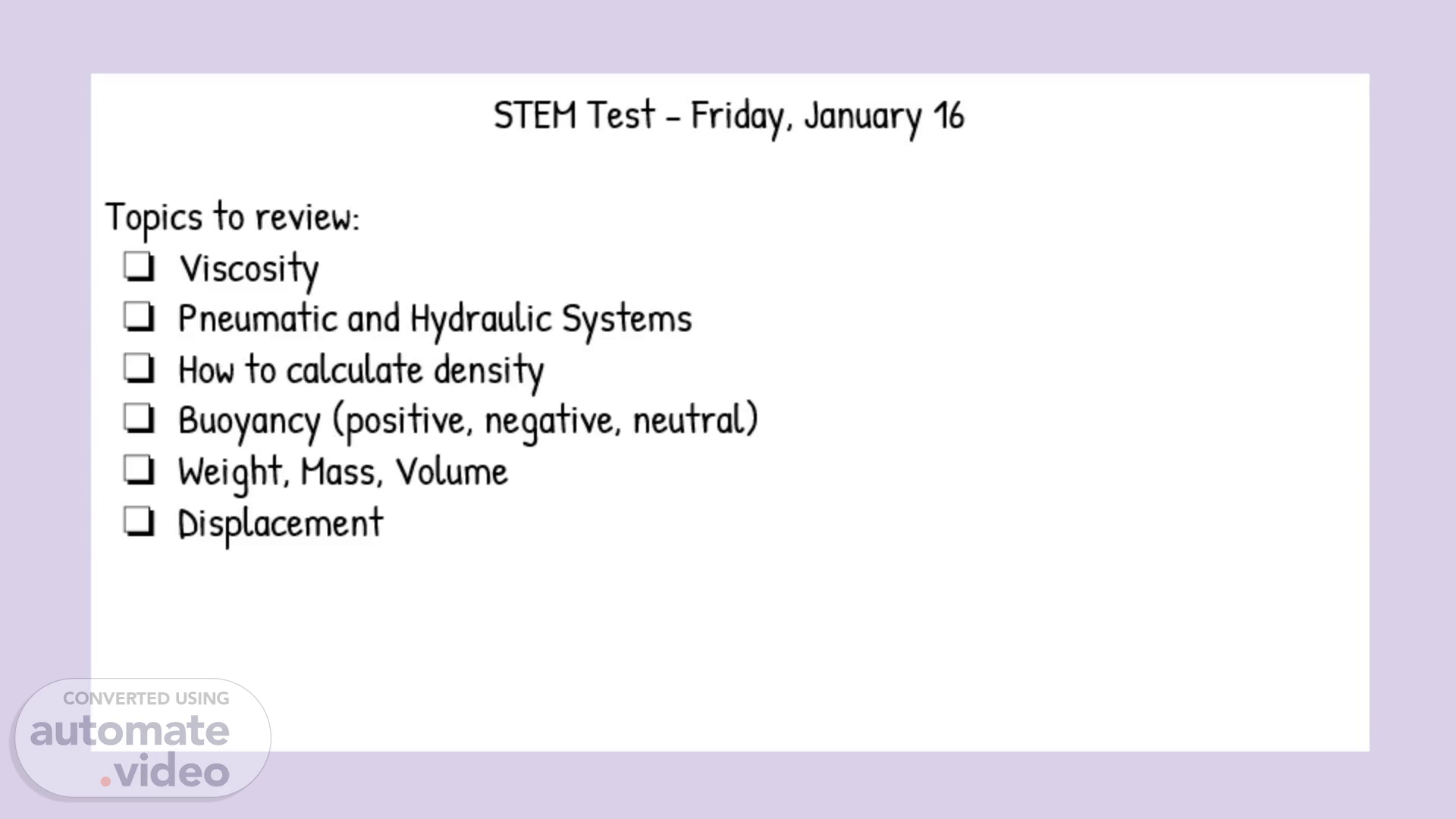
[Audio] S-T-E-M Test Friday, January 16 Topics to review: Viscosity Pneumatic and Hydraulic Systems How to calculate density Buoyancy (positive, negative, neutral) Weight, Mass, Volume Displacement.
Scene 2 (20s)
[Audio] Hydraulic and Pneumatic Systems Review Hydraulic Systems Hydraulic systems use pressurized liquid for mechanical motion. Hydraulic systems are usually more powerful than pneumatic systems because they have a higher energy density and higher working pressures. The liquids cannot be compressed easily, so there is no delay in movement. The hoses in hydraulic systems can be very heavy. Some examples of hydraulic systems are water towers, hydraulic lifts, and syringes. Hydraulic systems use pumps and valves to move the liquid. The valves regulate the movement of the fluid in the system. Hydraulic systems are closed. This means that liquid continually moves in a circuit..
Scene 3 (1m 9s)
[Audio] Pneumatic Systems Pneumatic and hydraulic systems are both fluid filled systems that act under Pascal’s law. A pneumatic system is filled with gas, while a hydraulic system is filled with liquid. Fluids can be very powerful! Pneumatic systems use pressurized air from an air compressor for mechanical motion. Pneumatic systems are often used where electric systems cannot be used due to safety concerns, such as for miners who work deep in an underground mine. An advantage of a pneumatic system is that since air is light, the hoses in pneumatic systems are very light. In addition, the equipment is less likely to be damaged by shock because the air in the pneumatics absorbs excessive force. Some examples of pneumatic tools are air compressors, air brakes on bikes, trains, or trucks, and pneumatic drills (jackhammers)..
Scene 4 (2m 2s)
[Audio] Which human body system is most similar to a hydraulic system? Which is most similar to a pneumatic system? Why? Explain Pascal’s law in your own words. The cardiovascular system pumps out blood, similar to how a hydraulic system pumps out water. Your lungs pump out air, similar to a pneumatic system. Pascal’s Law explains that when pressure is applied to water, it will be distributed evenly in the liquid. If the liquid is contained, it will go against the walls of the container..
Scene 5 (2m 34s)
[Audio] 3. How is mass different from weight? Mass is the amount of matter in an object, while weight is the gravitational heaviness of an object..
Scene 6 (3m 6s)
[Audio] Use the Word Bank to fill in the blanks below. Density Viscosity Buoyancy Pneumatic Hydraulic Displacement ________________________ is the upward force that a fluid exerts on an object. ________________________ is the ratio of mass to volume. ________________________ is a measure of a fluid's resistance to flow. ________________________ occurs when something takes the place of something else. ________________________ is the word used to describe compressed air or gas under pressure. ________________________ describes liquid that is under pressure or in a confined space. Buoyancy Density Viscosity Displacement Peumatic Hydraulic.
Scene 7 (3m 31s)
[Audio] 5. Define fluid. Which state(s) of matter are considered fluids? 6. What is particle theory? Fluid is a type of matter that is almost flowy like. Both gas and liquids are considered to be fluids. Particles are always in movement. Particles of the same type are the same size. Higher heat means faster particles. Particles have space in between them. Everything is made of particles. Particles are attracted to each other..
Scene 8 (4m 41s)
[Audio] 7. 0.9 0.00125 1.5. 7.. [image] A common unit of measurement for water's density is 1 g/ml or 1 g/cma. calculate the density of each object. write your answer in grams per cubic Mass Density = Volume centimetre. Mass: 450 g Volume: 495 cma Mass: 5 kg Volume: 4000 cma Mass: 750 g Volume: 500 cma Mass: 1000 g Volume: 2 cma.
Scene 9 (5m 1s)
[Audio] 8. A metal block has a mass of 1100 grams and has dimensions of 8.5 centimeters by 6 centimeters by 10 centimeters. Use this information to find the density of the metal block. 1100/510 2.16.
Scene 10 (5m 22s)
[Audio] Links to practice quizzes: https://play.blooket.com/play?hwId=6960f209a70495a0effd3f40.