Scene 1 (0s)
TERM 3 WEEK 2 – Distance Learning Lesson 6. [image] VIRGINIA.
Scene 2 (25s)
[Audio] What makes an argument convincing—ideas or evidence? Why?.
Scene 3 (47s)
[Audio] Today, we're going to learn how to break down an argument in a speech. By the end of this lesson, you'll be able to: Identify the claim Find reasons and evidence And explain the call to action Let's start with a quick question.".
Scene 4 (1m 14s)
[Audio] "To understand arguments, we need four key terms: A claim is the main argument A reason explains why the claim is true Evidence is the proof—facts or examples A call to action tells the audience what to do These four parts appear in almost every strong speech.".
Scene 5 (1m 39s)
[Audio] "Strong arguments follow a clear structure: 👉 Claim → Reason → Evidence → Call to Action Think of it like building a case: You say something You explain it You prove it Then you ask people to act".
Scene 6 (1m 52s)
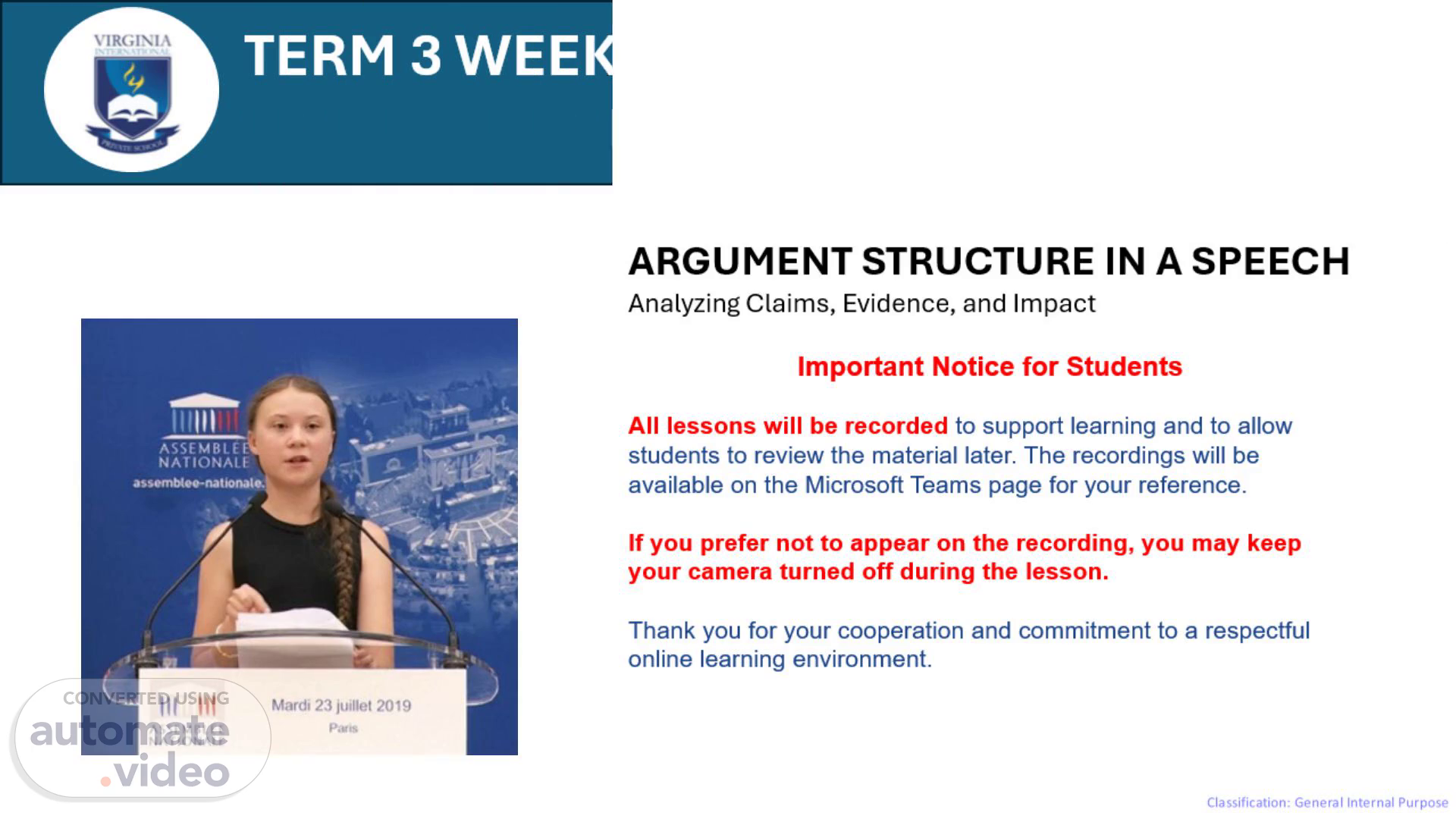
[Audio] 🎤 SLIDE 4 – MODELING (Greta) 👉 This is your I DO Teacher Script: "Let's apply this to Greta's speech." 👉 Read: "You have stolen my dreams…" 👉 Say: "We will break this into 4 parts." 👉 Ask: "What is she trying to prove here?" ✔ Guide: "Leaders are failing young people" 👉 "That is the claim".
Scene 7 (2m 15s)
[Audio] "When I'm looking for the claim, I ask: 👉 What is the main message the speaker wants me to believe? Here, Greta is making a very strong statement about the situation. So I'm thinking—this could be the claim, because it shows her main argument.".
Scene 8 (2m 31s)
[Audio] "Now I look for the reason. 👉 Why does the speaker believe this is happening? Here, she is explaining what leaders are prioritizing. So this could be the reason, because it explains why the problem exists.".
Scene 9 (2m 45s)
[Audio] "Now I'm looking for evidence. 👉 Where is the proof? I notice: Reference to science And numbers These are strong clues that this could be evidence, because they support the argument with proof.".
Scene 10 (2m 57s)
[Audio] "Finally, I look for the call to action. 👉 What does the speaker want people to do or feel? This is usually at the end of the speech. Here, the speaker is pushing for action and change—so this could be the call to action.".
Scene 11 (3m 14s)
ENGAGE Topic / Learning Intention EXPLAIN EXPRESS EVALUATE.
Scene 12 (3m 37s)
ENGAGE Topic / Learning Intention EXPLAIN EXPRESS EVALUATE (online).
Scene 13 (3m 59s)
[Audio] "Hi everyone—this part of the video will show you exactly how to complete your assignment step by step. Please keep your worksheet open while watching, because I'll guide you through each part." "Let's start with Part 1. Here, you need to match each term to its correct definition." "Don't guess—look for keywords like proof, main idea, or what the speaker wants you to do." "This is the most important part of the task. You will read the speech and identify the four parts of the argument." Clear Instructions: "As you read: Underline the claim Circle the reason Put a box around the evidence Highlight or double underline the call to action" HOW to think (this is key 👇) "When you're annotating, don't rush. Instead, ask yourself: 👉 What is the speaker trying to prove here? → this helps you find the claim 👉 Why is the speaker saying this is true? → this helps you find the reason 👉 Where is the proof? → this helps you find the evidence 👉 What does the speaker want people to do? → this helps you find the call to action" Important Reminder: "You may find more than one example—and that's completely fine. Focus on clear and strong examples.".
Scene 14 (5m 13s)
[Audio] "Now move to Part 3. Here, you are organizing your ideas." Key Instruction: "For each part: 👉 You must write from the text 👉 Not just your own opinion" Process Guidance: "When filling the table: Go back to your annotations Choose the best example for each category Write it clearly in the correct box" Common Mistake Warning: "Make sure you: ❌ Don't write just one word ❌ Don't leave it blank ❌ Don't guess 👉 Always go back to the text." 💬 PART 4 – CRITICAL THINKING (NO ANSWERS, JUST HOW) "Now for Part 4—this is where you explain your thinking." Question 1 Guidance: "When answering: 👉 Focus on the connection between evidence and reason Ask yourself: How does the proof support the idea? Does it make the argument stronger?" Question 2 Guidance: "For the second question: 👉 Think about structure Ask yourself: Why does the speaker save the call to action for the end? What effect does that have on the audience?" Sentence Support (NOT answers): "You can start your answers like: 👉 The evidence supports the reason because… 👉 The speaker places the call to action at the end to…".
Scene 15 (6m 24s)
A paper with lines and text AI-generated content may be incorrect..
Scene 16 (6m 32s)
[Audio] "Once you are done: Check that all parts are complete Make sure your answers are clear Then upload your work on Teams" 🎯 FINAL MESSAGE (IMPORTANT) "Take your time with this task. This is not about getting it perfect—it's about understanding how arguments work. If you get stuck, go back to the text and ask yourself the guiding questions.".