Scene 1 (0s)
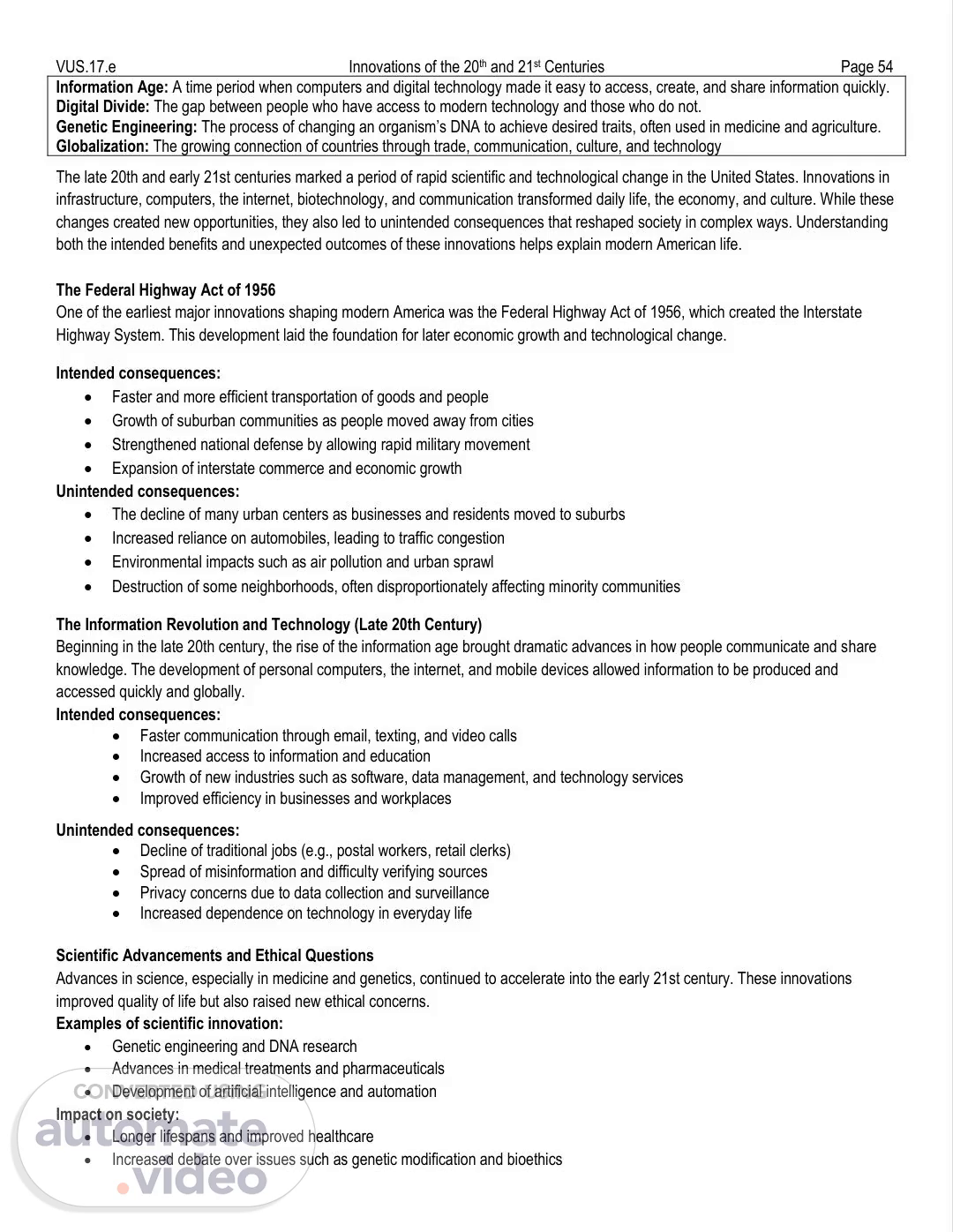
[Audio] VUS.17.e Innovations of the 20th and 21st Centuries Page 54 Information Age: A time period when computers and digital technology made it easy to access, create, and share information quickly. Digital Divide: The gap between people who have access to modern technology and those who do not. Genetic Engineering: The process of changing an organism’s D-N-A to achieve desired traits, often used in medicine and agriculture. Globalization: The growing connection of countries through trade, communication, culture, and technology The late 20th and early 21st centuries marked a period of rapid scientific and technological change in the United States. Innovations in infrastructure, computers, the internet, biotechnology, and communication transformed daily life, the economy, and culture. While these changes created new opportunities, they also led to unintended consequences that reshaped society in complex ways. Understanding both the intended benefits and unexpected outcomes of these innovations helps explain modern American life. The Federal Highway Act of 1956 One of the earliest major innovations shaping modern America was the Federal Highway Act of 1956, which created the Interstate Highway System. This development laid the foundation for later economic growth and technological change. Intended consequences: Faster and more efficient transportation of goods and people Growth of suburban communities as people moved away from cities Strengthened national defense by allowing rapid military movement Expansion of interstate commerce and economic growth Unintended consequences: The decline of many urban centers as businesses and residents moved to suburbs Increased reliance on automobiles, leading to traffic congestion Environmental impacts such as air pollution and urban sprawl Destruction of some neighborhoods, often disproportionately affecting minority communities The Information Revolution and Technology (Late 20th Century) Beginning in the late 20th century, the rise of the information age brought dramatic advances in how people communicate and share knowledge. The development of personal computers, the internet, and mobile devices allowed information to be produced and accessed quickly and globally. Intended consequences: Faster communication through email, texting, and video calls Increased access to information and education Growth of new industries such as software, data management, and technology services Improved efficiency in businesses and workplaces Unintended consequences: Decline of traditional jobs (for example, postal workers, retail clerks) Spread of misinformation and difficulty verifying sources Privacy concerns due to data collection and surveillance Increased dependence on technology in everyday life Scientific Advancements and Ethical Questions Advances in science, especially in medicine and genetics, continued to accelerate into the early 21st century. These innovations improved quality of life but also raised new ethical concerns. Examples of scientific innovation: Genetic engineering and D-N-A research Advances in medical treatments and pharmaceuticals Development of artificial intelligence and automation Impact on society: Longer lifespans and improved healthcare Increased debate over issues such as genetic modification and bioethics.
Scene 2 (3m 56s)
[Audio] VUS.17.e Innovations of the 20th and 21st Centuries Page 54 Rising costs of healthcare and inequality in access to treatment Social Media and Civil Rights Movements In the early 21st century, social media platforms such as Twitter, Facebook, Instagram, and TikTok transformed how people organize and advocate for change. Modern civil rights movements have used these tools to raise awareness and mobilize supporters. Intended consequences: Rapid sharing of information about social injustices Ability to organize protests and movements quickly Greater visibility for marginalized groups and voices Increased civic engagement, especially among young people Unintended consequences: Spread of false or misleading information Online harassment and cyberbullying Polarization and echo chambers that reinforce existing beliefs Performative activism (support without meaningful action) Innovations and American Culture Technological changes across this time period have had a major influence on American culture, particularly through media, entertainment, and communication. Cultural impacts: Expansion of digital media (streaming services, online news, social platforms) Increased representation of diverse voices in art, film, and literature Shift from traditional media (newspapers, television) to digital platforms Globalization of culture through shared media and ideas Challenges: Decline of local journalism and traditional news outlets Overconsumption of media and shortened attention spans Difficulty distinguishing fact from opinion in digital spaces Economic and Social Effects Innovations across this time period reshaped the American economy and social structure. Positive outcomes: Creation of high paying jobs in technology fields Growth of global trade and communication Increased educational opportunities through online learning Negative outcomes: Greater economic inequality between skilled and unskilled workers Loss of manufacturing jobs due to automation Digital divide between those with and without access to technology From the Interstate Highway System to social media, innovations in the late 20th and early 21st centuries transformed American society in powerful ways. While these developments were intended to improve communication, transportation, health, and economic growth, they also produced unintended consequences such as inequality, ethical dilemmas, and cultural challenges.