Scene 1 (0s)
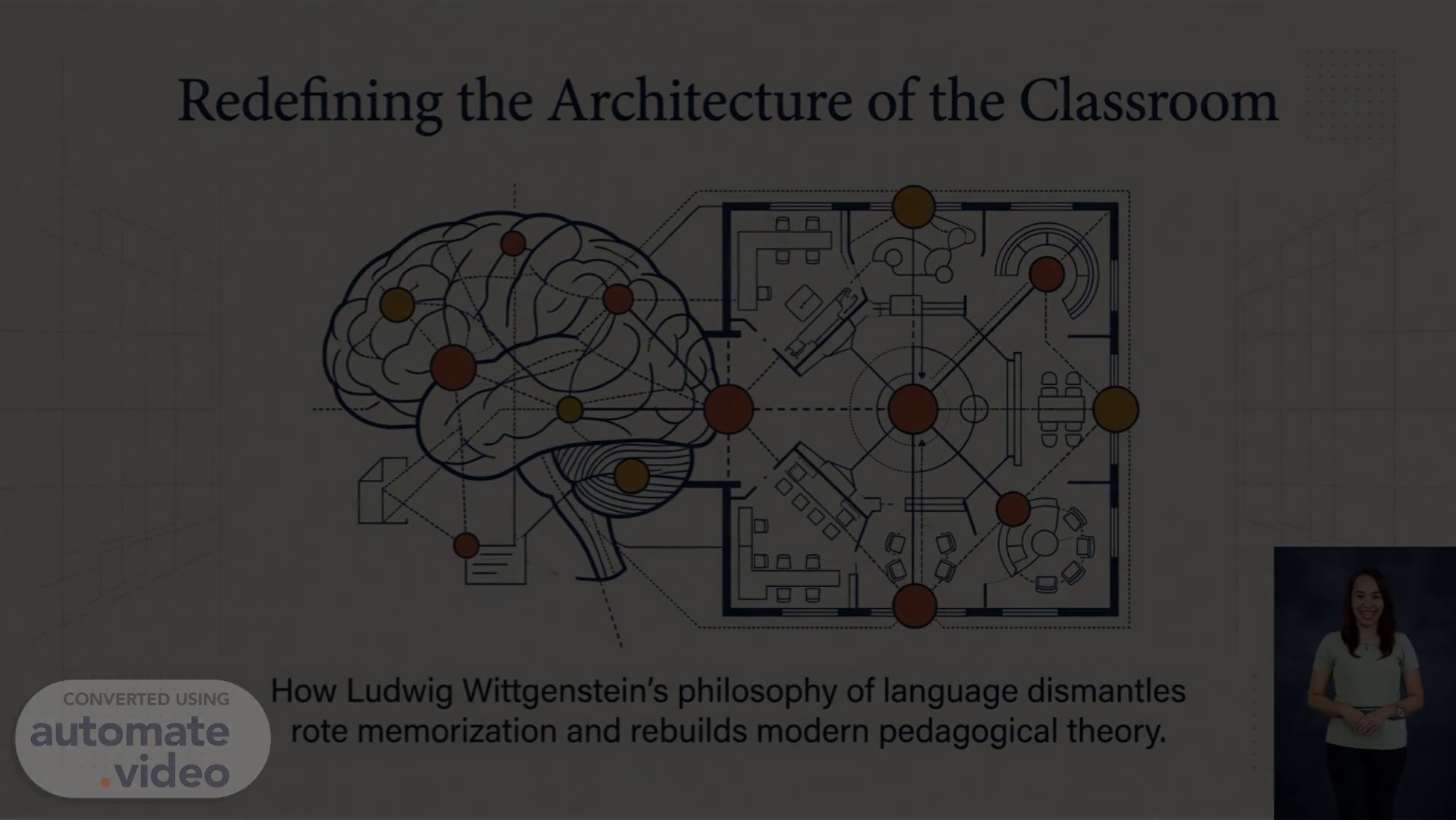
Redefining the Architecture of the Classroom How Ludwig Wittgenstein's philosophy of language dismantles rote memorization and rebuilds modern pedagogical theory. NotebookLM.
Scene 2 (11s)
[Audio] The concept of meaning is central to Wittgenstein's philosophy. According to him, meaning is not something that exists independently, but rather it emerges from the way language is used in everyday life. Meaning is not fixed, but rather it depends on the context in which language is employed. This idea has significant implications for how we approach learning in the classroom. The teacher should focus on understanding how concepts function in real-life situations. The teacher should create a learning environment that encourages students to think critically and apply their knowledge in practical ways. By doing so, the teacher can help students develop a deeper understanding of the material and prepare them for success in an increasingly complex world..
Scene 3 (1m 2s)
[Audio] The philosopher Ludwig Wittgenstein believed that meaning is derived from use. According to this philosophy, students truly comprehend a concept when they are able to apply it in various contexts, such as communication, reasoning, or problem-solving. For instance, teaching students about fractions involves having them apply the concept to real-life scenarios, like measuring ingredients for a recipe or dividing a pizza among friends. Through this method, students develop a more profound understanding of the concept and its practical applications. This approach fosters critical thinking and enables students to connect concepts with everyday experiences. Wittgenstein emphasized that 'the meaning of words is their use in the language-game,' which implies that meaning is not solely defined by definitions, but rather by how language is used to communicate and interact with others..
Scene 4 (1m 59s)
[Audio] The importance of understanding language in its practical applications cannot be overstated. Language plays a crucial role in shaping our perceptions and influencing our actions. The way we use language determines how we perceive reality. To illustrate this point, let us consider an example. Imagine a person who has been taught to believe that a certain object is always round. However, when confronted with evidence that contradicts this belief, they are unable to adjust their thinking. This inability to adapt is a result of the rigid application of language rules. Similarly, in the classroom, students often struggle to apply their knowledge in new and unfamiliar contexts. They may have learned about fractions in one context, but find it difficult to apply them in another context, such as calculating the area of a rectangle. This highlights the need for a more nuanced approach to teaching language, one that takes into account the complexities of real-world applications..
Scene 5 (3m 2s)
[Audio] The Wittgensteinian classroom is characterized by interaction among students and between students and teachers. Students learn through dialogue, questioning, and participation. The classroom environment is designed to foster shared understanding and the construction of meaning through collaborative efforts. By focusing on interaction, students develop essential skills such as critical thinking, problem-solving, and effective communication. These skills are crucial for success in all areas of life, including academics, careers, and personal relationships. Students who participate in a Wittgensteinian classroom tend to achieve higher levels of academic achievement and exhibit greater confidence and self-esteem..
Scene 6 (3m 49s)
[Audio] The teacher's role in a Wittgensteinian classroom is to facilitate learning by guiding students in using language effectively. The teacher does not simply transmit knowledge but instead helps students to understand the meaning behind it. This involves clarifying any confusion and encouraging deeper understanding. The teacher takes an active role in teaching, helping students to see the relevance of what they are learning to their own lives and experiences. This enables students to take ownership of their learning and to think critically about the world around them. The teacher's guidance helps students to develop critical thinking skills and to make connections between different ideas and concepts..
Scene 7 (4m 33s)
[Audio] The teacher should focus on facilitating a collaborative learning environment that values dialogue and discussion. This environment encourages students to ask questions and engage in critical thinking. The teacher should also provide opportunities for students to practice their analytical skills through various activities and exercises..
Scene 8 (4m 54s)
[Audio] The application of Wittgenstein's philosophy of language in the classroom has been a topic of discussion among educators. Learning can become more meaningful when students are able to apply ideas in real-life scenarios. This shift from memorization to active engagement with knowledge is at the heart of Wittgenstein's approach to learning. The traditional methods of teaching that focus on rote memorization and regurgitation of information need to be moved away from. Instead, opportunities should be created for students to actively engage with the ideas and concepts, putting them into practice in real-world situations. By doing so, students gain a deeper understanding of the material and develop valuable skills that can be applied in various aspects of their lives. Wittgenstein's philosophy emphasizes the importance of language in shaping our understanding of the world around us. In the classroom, the language used by teachers can significantly impact how students perceive and interact with the material. Teachers have a responsibility to choose their words carefully and create a language-rich environment that encourages critical thinking and active engagement with the subject matter. When students are given the opportunity to apply ideas in real-life scenarios, they become active learners instead of passive recipients of information. This leads to a more meaningful learning experience and equips students with the necessary skills to navigate the complex and ever-changing world outside of the classroom. Teachers should strive to create a classroom environment that reflects the actual use of knowledge, rather than just presenting information. By embracing Wittgenstein's philosophy of language, educators can redefine the way learning takes place in the classroom..
Scene 9 (6m 52s)
[Audio] The teacher acts as a facilitator, not a lecturer, in a collaborative classroom setting. The teacher's role is to guide students through meaningful interactions and discussions, allowing them to explore their own ideas and perspectives. The teacher does not provide answers or solutions, but instead encourages students to think critically and come up with their own solutions. This approach helps students develop essential life skills such as communication, problem-solving, and conflict resolution. The teacher provides support and guidance, but also gives students the freedom to make their own decisions and take ownership of their learning. By doing so, the teacher creates an environment that promotes active learning, creativity, and intellectual curiosity..
Scene 10 (7m 44s)
[Audio] The Wittgensteinian approach to teaching emphasizes the importance of language in shaping our understanding of the world. Students are encouraged to think critically and reflectively about their own learning processes. By analyzing how language is used to construct meaning, students gain insight into the ways in which knowledge is formed through context, culture, and society. This approach promotes a collaborative environment where students work together to explore complex ideas and concepts. Interactive dialogue and questioning facilitate the development of essential skills such as critical thinking, problem-solving, and effective communication. As students engage with the material, they begin to identify connections between seemingly disparate concepts, leading to a more nuanced understanding of the subject matter. The Wittgensteinian approach ultimately enables students to take ownership of their learning, becoming more autonomous and self-directed learners..
Scene 11 (8m 45s)
[Audio] The Wittgensteinian classroom is characterized by its emphasis on meaning through use. Students are encouraged to interact with each other and with teachers through dialogue and discussion. This approach fosters critical and reflective thinking skills, enabling students to analyze complex information and develop problem-solving strategies. Students are also encouraged to explore real-world applications of the knowledge they acquire, making connections between theoretical concepts and practical experiences. As a result, students become more engaged and motivated, leading to improved academic performance. The key to a successful Wittgensteinian classroom lies in creating an environment that encourages open communication and facilitates meaningful interactions among students and teachers..
Scene 12 (9m 36s)
[Audio] In summary, Wittgenstein's philosophy teaches us that learning is not limited to fixed knowledge, but rather involves actively using and comprehending ideas within their context. By implementing these principles, educators can establish classrooms that foster critical thinking skills in students. This approach encourages students to think deeply and critically about the world as well as recognizes that knowledge is influenced by culture, society, and our immediate surroundings. Thus, education is more than just transmitting facts, but also promoting a deeper understanding of the intricate connections between people, places, and things. By adopting this perspective, educators can aid their students in becoming more nuanced thinkers, better equipped to navigate the complexities of the modern world. Thank you, and I am now available for any questions..