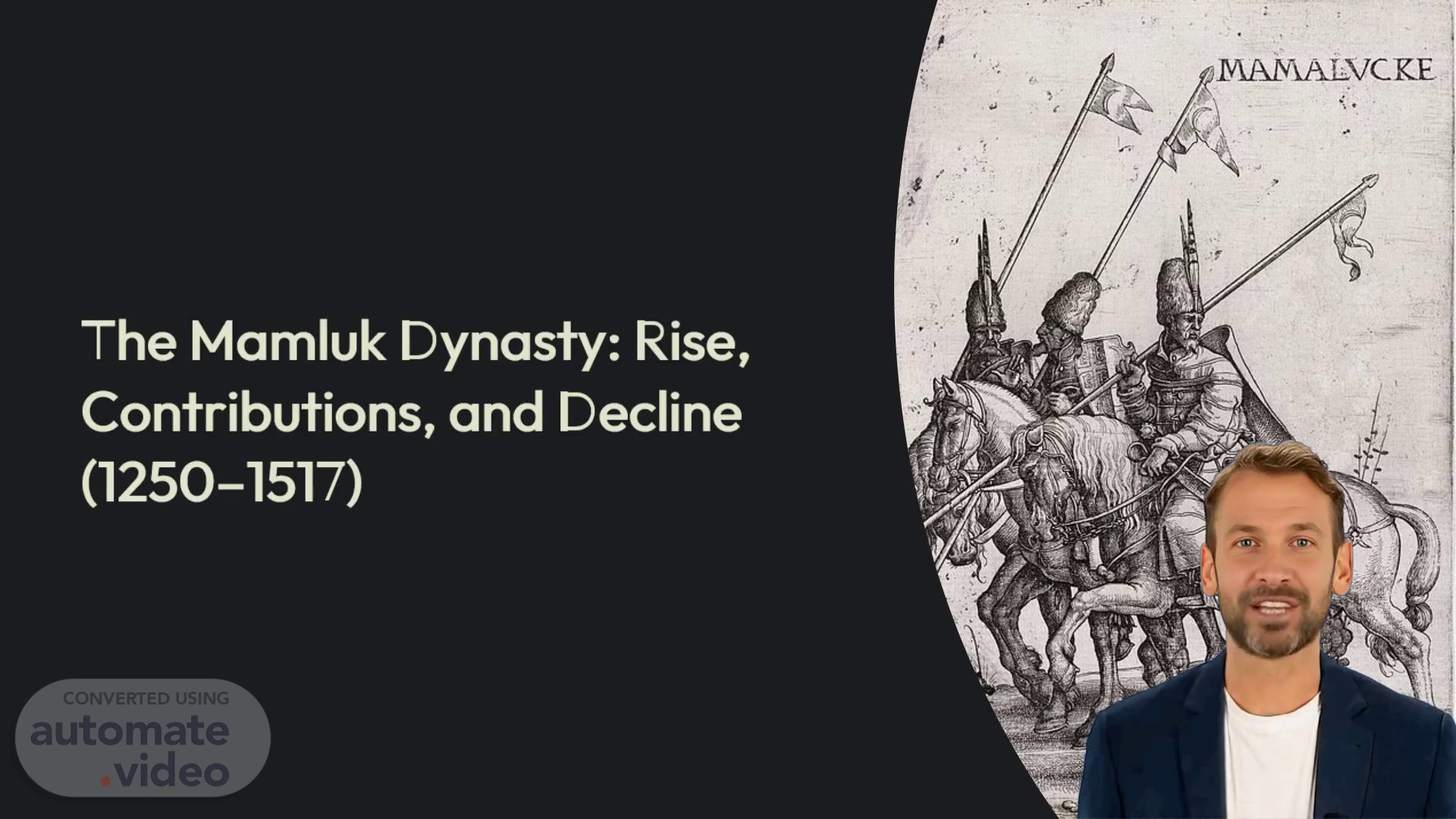
The-Mamluk-Dynasty-Rise-Contributions-and-Decline-1250-1517
Scene 1 (0s)
[Virtual Presenter] The Mamluk Sultanate was a powerful and influential empire that existed from the 13th to the 16th century in Egypt and Syria. The Mamluks were a group of slave-soldiers who rose to power through their military prowess and strategic alliances. They established a strong and centralized government, with a clear hierarchy and system of laws. The Mamluks also developed a sophisticated system of administration, which included a network of officials and administrators responsible for collecting taxes, maintaining law and order, and overseeing the economy. This system allowed them to maintain control over their vast territories and ensure the stability of their empire. The Mamluks were known for their military strength and bravery, as well as their administrative skills. They played a crucial role in defending Egypt against foreign invaders, including the Mongols and the Crusaders. The Mamluks also made significant contributions to the arts and culture, producing some of the most famous works of Islamic art and architecture. Their capital city, Cairo, became a center of learning and intellectual inquiry, attracting scholars and intellectuals from all over the world. Despite their many achievements, the Mamluk Sultanate began to decline in the 15th century due to internal conflicts and external pressures. The sultanate faced challenges from neighboring kingdoms and empires, including the Ottoman Empire, which eventually conquered Egypt in 1517. However, the Mamluks left behind a lasting legacy, shaping the course of history in the region and influencing the development of subsequent empires. The Mamluk Dynasty continued to exist until the 16th century, when it was finally dissolved by the Ottoman Empire. The legacy of the Mamluks can still be seen today, in the many architectural and artistic treasures they left behind. Theirs was a remarkable story of transformation and resilience, one that continues to captivate historians and scholars around the world..
Scene 2 (2m 7s)
[Audio] We find ourselves at a pivotal moment in history, as we delve into the captivating story of the Mamluk Dynasty, which ruled Egypt and the Middle East from 1250 to 1517. Our focus today is on the origins of this powerful dynasty, which would leave an indelible mark on the region's politics and culture. Let's explore the fascinating journey of the Mamluks, who rose from humble beginnings as slave soldiers to become the very rulers of Egypt. Theirs is a tale of remarkable skill, loyalty, and ultimately, sovereignty. We begin by examining the Mamluks' roots, tracing their origins to the Kipchak Turkic and Circassian slave soldiers who initially served the Ayyubid dynasty. It was within this context that these skilled warriors first made their presence known, demonstrating a remarkable aptitude for warfare and a deep commitment to their masters. Their prowess in battle was undeniable, earning them a reputation as saviours of Islam, and it was this reputation that would eventually pave the way for their ascension to power. As we continue our journey through the history of the Mamluk Dynasty, we will uncover the complexities and challenges they faced, as well as their lasting contributions to the region's cultural and political landscape. Join me as we explore this captivating chapter in history. Let's learn more about the Mamluk Dynasty. The Mamluks were originally slave soldiers from the Kipchak Turkic and Circassian tribes. They first served the Ayyubid dynasty. Their military prowess and loyalty earned them a reputation as saviours of Islam. They eventually seized control of Egypt and the Middle East. Their rule lasted from 1250 to 1517. During their reign, they made significant contributions to the region's politics and culture. We will explore their rise, contributions, and decline in more detail. Next, we will examine the Mamluks' early years and their transition from slave soldiers to rulers. Their early years were marked by a series of military campaigns and the establishment of their power base. We will also look at the key figures who played a crucial role in their rise to power. The Mamluks' military campaigns were instrumental in establishing their authority and paving the way for their eventual dominance of the region. Their early years set the stage for their later successes and failures. We will explore these early years in more detail. Next, we will examine the key figures who played a crucial role in the Mamluks' rise to power. These figures include notable military leaders, administrators, and politicians who helped shape the Mamluk Dynasty's destiny. We will explore their roles and contributions in more detail. The Mamluks' military campaigns were instrumental in establishing their authority and paving the way for their eventual dominance of the region. Their military prowess and strategic alliances were key factors in their success. The Mamluks' early years were marked by a series of military campaigns and the establishment of their power base. Their military campaigns were instrumental in establishing their authority and paving the way for their eventual dominance of the region. We will explore the Mamluks' early years in more detail. Next, we will examine the key figures who played a crucial role in the Mamluks' rise to power. These figures include notable military leaders, administrators, and politicians who helped shape the Mamluk Dynasty's destiny. We will explore their roles and contributions in more detail. The Mamluks' military campaigns were instrumental in establishing their authority and paving the way for.
Scene 3 (5m 57s)
[Audio] The Mamluks established a highly organized and efficient military structure, which enabled them to dominate the medieval Islamic world. This unique martial organization allowed them to excel against various threats, including those posed by the Crusaders and Mongols. The Mamluks' ability to recruit new slave soldiers continuously integrated fresh talent into their elite ranks, further solidifying their position. However, this system also created instability, as power struggles and coups became common occurrences. Sultans frequently faced deposition or assassination by ambitious emirs. The Mamluk Sultanate can be broadly categorized into two distinct periods: the Bahri Mamluks, who primarily consisted of Turks, laid the groundwork for the subsequent era..
Scene 4 (6m 46s)
[Audio] The Mamluk Sultanate was a Muslim dynasty that ruled Egypt from the 13th century until its eventual collapse in the 16th century. The Mamluks were a slave-soldier caste who rose to power through their military prowess and administrative skills. They established a strong and efficient government, which enabled them to maintain control over Egypt and Syria for nearly two centuries. The Mamluks were known for their military victories against the Crusaders and other enemies, and they played a significant role in shaping the Islamic world during this period. The Mamluk Sultanate was eventually dissolved due to internal conflicts and external pressures, leading to the rise of the Ottoman Empire..
Scene 5 (7m 29s)
[Audio] We established the Abbasid Caliphate in Cairo in 1261, thereby conferring significant religious legitimacy on our rule and securing our position in the Islamic world. Our patronage of Islamic scholarship was marked by a commitment to academic excellence, where we elevated Al-Azhar University to a preeminent centre for Sunni learning and intellectual exchange. We were master builders, leaving behind an indelible architectural legacy that includes intricate mosques, madrasas, and significant urban development projects across Egypt and Syria. Under our rule, the economy flourished, marked by periods of economic prosperity. This cultural and economic flourishing was a hallmark of our rule, and a testament to the enduring impact of the Mamluk Dynasty on the regions we governed. Our legacy extends far beyond our own time, influencing the trajectory of Islamic scholarship, architecture, and urban development for generations to come. Through our patronage of Al-Azhar University, we nurtured a vibrant centre of Sunni learning, where scholars from across the Islamic world could gather to discuss, debate, and advance their understanding of Islamic thought and practice. We were patrons of the arts and sciences, supporting a rich cultural landscape that included poets, artists, and scholars who contributed significantly to the Islamic Golden Age. Our architectural achievements, from the intricate mosques of Cairo to the grand madrasas of Damascus, reflect the ingenuity and craftsmanship of the Mamluk people, and serve as a testament to their enduring legacy in the Islamic world. As a result, our rule was marked by a unique blend of cultural, economic, and intellectual achievements, which had a lasting.
Scene 6 (9m 22s)
[Audio] The Mamluk Sultanate achieved several key strategic successes during its time in power. One notable achievement was the successful expulsion of the remaining Crusader forces from their Levantine strongholds by the late 13th century. This consolidation of Islamic control over the region marked a significant milestone in the Mamluks' rise to prominence. Furthermore, they extended their political and military influence into various regions, including Nubia, the Arabian Peninsula, and parts of Anatolia. These achievements demonstrate the Mamluks' regional power and reach. Additionally, their naval defence efforts helped protect vital trade routes in the Red Sea, safeguarding against the emerging threat of Portuguese incursions and maritime expansion..
Scene 7 (10m 12s)
[Audio] The Mamluk architectural influence can be seen in various monuments and buildings across India and Egypt. The Qutb Minar, a prominent landmark in Delhi, showcases the Mamluk architectural style. The minaret stands at 73 meters tall and was built in 1220. Its unique design reflects the Mamluk style, characterized by its tapering shape and use of red and yellow sandstone. In Cairo, the Mamluk Sultanate had a profound impact on the city's architecture. Mosques, madrasas, and palaces were constructed during this period, showcasing the rich cultural heritage of the Mamluk Dynasty. The Mamluk architectural legacy in both cities demonstrates their significant contributions to Islamic art and architecture. The use of geometric patterns, calligraphy, and intricate stone carvings added an extra layer of beauty to these structures. These architectural achievements serve as a testament to the Mamluk Dynasty's enduring impact on the cultural landscape of the Indian subcontinent and the Middle East..
Scene 8 (11m 15s)
[Audio] The Mamluk Dynasty was founded by Sultan Al-Nasir Muhammad I in 1250. The dynasty lasted until its final collapse in 1517. The Mamluks were a powerful force in Egypt and Syria during the Middle Ages. They ruled over a vast territory that included parts of modern-day Jordan, Israel, Palestine, Lebanon, and Syria. The Mamluks were known for their military prowess and their ability to defend their territories against external threats. However, despite their military strength, the Mamluks faced numerous challenges that threatened their very existence. One major challenge was the rise of the Ottoman Empire. The Ottomans posed a significant threat to the Mamluks, as they had already conquered much of the Middle East and North Africa. The Mamluks also faced internal conflicts and succession crises within their own ranks. The lack of clear succession procedures led to power struggles and internal conflicts. These succession crises weakened the Mamluk Dynasty, making it increasingly difficult for them to maintain their grip on power. The Mamluks struggled to adapt to changing circumstances, including the rise of new powers such as the Safavid Empire. The Mamluks were eventually forced to surrender to the Ottoman Empire in 1517, marking the end of the Mamluk Dynasty..
Scene 9 (12m 40s)
[Audio] We see that the Mamluk Dynasty's inability to adapt to changing circumstances led to their downfall. Fiscal strain and failed reforms created an environment where the Mamluks were ill-prepared for modern warfare. Their reliance on outdated military tactics proved detrimental, ultimately contributing to their demise. The Ottoman Sultan Selim I took advantage of this weakness and launched a decisive campaign, leading to the defeat of the Mamluks. The battles of Marj Dabiq and Ridanieh were pivotal moments in this process, sealing the Mamluks' fate and ending their 267-year rule. The consequences of the Mamluks' inability to innovate and adapt had far-reaching effects, shaping the course of Middle Eastern history. We can learn from this example, understanding the importance of embracing change and innovation to ensure long-term survival. The Mamluks' story serves as a cautionary tale, highlighting the dangers of complacency and the importance of staying ahead of the curve. Lasting legacies often require a willingness to evolve and adapt to the changing landscape. The Mamluks' failure to do so had devastating consequences, ultimately leading to their downfall. We can apply this lesson to our own contexts, recognizing the value of innovation and adaptability in the face of uncertainty. The Mamluks' story serves as a reminder that the ability to adapt and innovate is crucial for long-term success. The Mamluks' inability to adapt to changing circumstances led to their downfall. Fiscal strain and failed reforms created an environment where the Mamluks were ill-prepared for modern warfare. Their reliance on outdated military tactics proved detrimental, ultimately contributing to their demise. The Ottoman Sultan Selim I took advantage of this weakness and launched a decisive campaign, leading to the defeat of the Mamluks. The battles of Marj Dabiq and Ridanieh were pivotal moments in this process, sealing the Mamluks' fate and ending their 267-year rule. The consequences of the Mamluks' inability to innovate and adapt had far-reaching effects, shaping the course of Middle Eastern history. We can learn from this example, understanding the importance of embracing change and innovation to ensure long-term survival. The Mamluks' story serves as a cautionary tale, highlighting the dangers of complacency and the importance of staying ahead of the curve. Lasting legacies often require a willingness to evolve and adapt to the changing landscape. The Mamluks' failure to do so had devastating consequences, ultimately leading to their downfall. We can apply this lesson to our own contexts, recognizing the value of innovation and adaptability in the face of uncertainty. The Mamluks' story serves as a reminder that the ability to adapt and innovate is crucial for long-term success. The Mamluks' inability to adapt to changing circumstances led to their downfall. Fiscal strain and failed reforms created an environment where the Mamluks were ill-prepared for modern warfare. Their reliance on outdated military tactics proved detrimental, ultimately contributing to their demise. The Ottoman Sultan Selim I took advantage of this weakness and launched a decisive campaign, leading to the defeat of the Mamluks. The battles of Marj Dabiq and Ridanieh were pivotal moments in this process, sealing the Mamluks' fate and ending their 267-year rule. The consequences of the Mamluks' inability to innovate and adapt had far-reaching effects, shaping the course of Middle Eastern history. We can learn from this example, understanding the importance of embracing change and innovation to ensure long-term survival. The Mamluks' story serves as a cautionary tale, highlighting the dangers of complacency and the importance of staying ahead of the curve. Lasting legacies often require a willingness to evolve and adapt to the changing landscape. The Mamluks' failure to do so had devastating consequences, ultimately leading.
Scene 10 (16m 52s)
[Audio] The Mamluks played a significant role in preserving Arabic-Islamic culture during the Middle Ages. They safeguarded this culture from the destructive influences of the Mongols and the Crusaders. The Mamluks were able to protect the cultural heritage of the Islamic world through their military campaigns and administrative policies. These efforts ensured that the cultural heritage of the Islamic world continued to thrive even after the decline of the Mamluk dynasty. The Mamluks demonstrated remarkable resilience and determination in their pursuit of power. Their ability to adapt to changing circumstances and navigate complex political relationships helped them maintain their position as guardians of Islamic civilization. The Mamluks' legacy can still be seen today in the many monuments and artifacts that remain from their time. The Mamluks' impact on the region was profound, shaping the course of history in the Middle East..