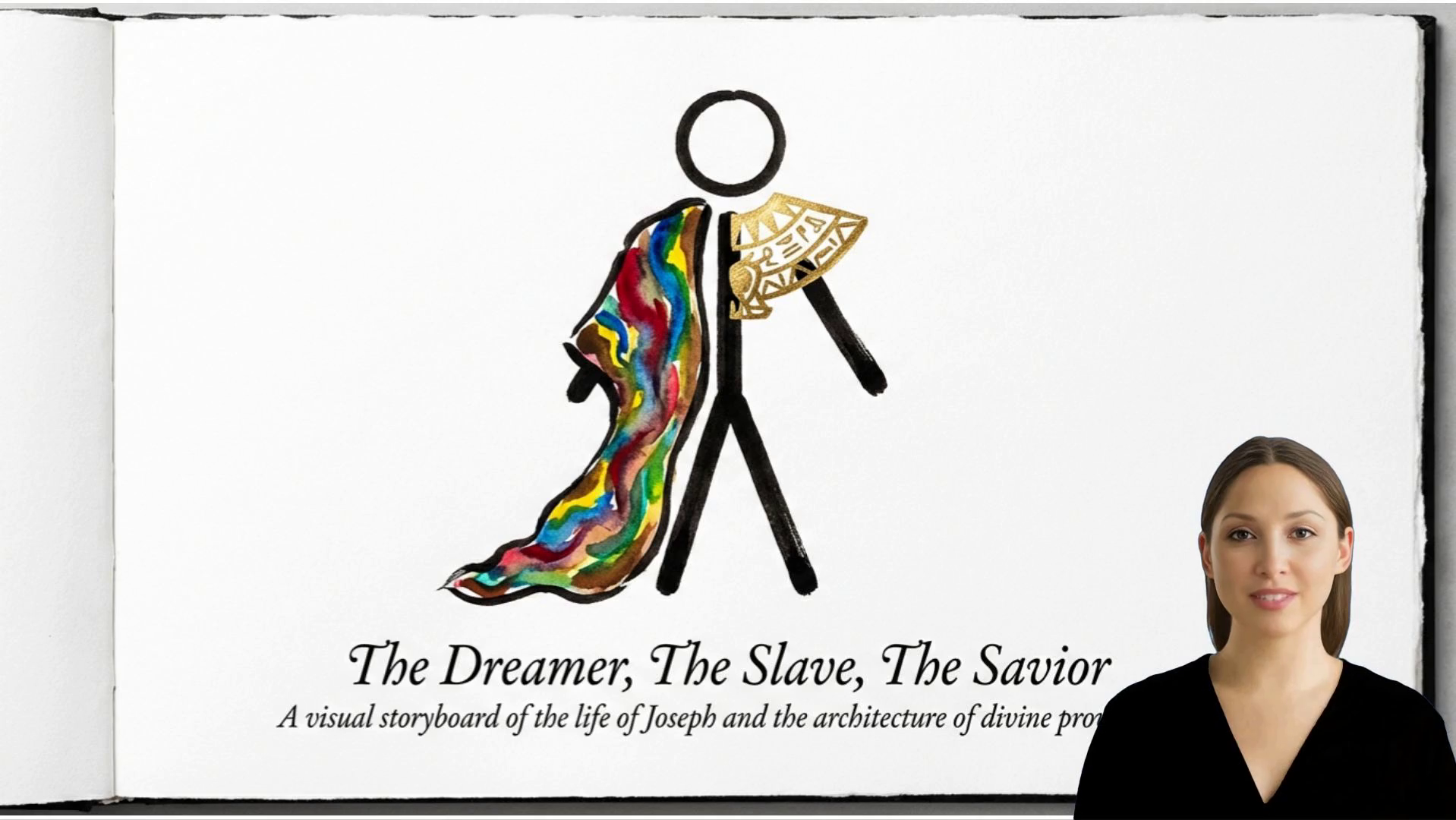
Scene 1 (0s)
[Virtual Presenter] Joseph was born into a family that had been enslaved by the Egyptians for generations. As a young man, he had a series of vivid dreams that foretold his future. These dreams were seen as a sign of divine providence, guiding him towards his destiny. One of these dreams predicted that he would be sold into slavery, but another dream indicated that he would rise above his circumstances and become a leader. The role of the dreamer in Joseph's story is significant because it highlights the importance of listening to one's intuition and trusting in the guidance of the divine. The Egyptian slave masters saw Joseph as a threat to their power and sought to eliminate him. They accused him of trying to seduce their wife, Potiphar's wife, which led to his imprisonment. However, God intervened on Joseph's behalf, protecting him from harm and ultimately leading him to freedom. This event marked the beginning of Joseph's journey towards becoming the savior figure in his family. As Joseph navigated his new life in Egypt, he encountered many challenges and hardships. Despite these difficulties, he persevered and continued to trust in God's plan. He eventually rose through the ranks to become a trusted advisor to Pharaoh, the ruler of Egypt. His leadership skills and wisdom earned him great respect among the Egyptians, who came to see him as a symbol of hope and inspiration. Through his experiences, Joseph learned valuable lessons about perseverance, humility, and the importance of staying true to one's values. He also discovered the value of forgiveness and mercy, as demonstrated by his decision to spare the lives of those who had wronged him. Ultimately, Joseph became a powerful example of divine providence in action, demonstrating that even in the darkest of times, there is always hope for redemption and transformation..
Scene 2 (2m 1s)
[Audio] Joseph's life followed a U-shaped trajectory, with ups and downs, but ultimately leading to his fulfillment of a divine plan. This teaches us that even in the face of adversity, we must remain steadfast in our faith and trust in divine providence..
Scene 3 (2m 17s)
[Audio] Joseph. Scene 1: The Favored Son & The Dreams Jacob's overt favoritism toward his seventeen-year-old son—symbolized by the coat of many colors—sparks deep family resentment. When Joseph shares his prophetic dreams of supremacy over his family, the brothers' jealousy curdles into hatred..
Scene 4 (2m 22s)
[Audio] Joseph. Scene 2: Betrayglfor Silver Reuben's plan to save Joseph fails. Judah convinces the brothers to sell Joseph into slavery to passing traders for the price of a slave. The brothers use goat's blood and the torn coat to deceive their father into believing Joseph was killed by a wild beast. pop. eces of Silvert.
Scene 5 (2m 27s)
[Audio] The Bible says that Joseph had integrity, which means he did not compromise on his values. He was an overseer in Potiphar's household, but he remained faithful to God. When Potiphar's wife tried to seduce him, Joseph resisted her advances, calling them a sin against God. He was then falsely accused of trying to rape her and put in prison. Despite being in a difficult situation, Joseph continued to be faithful to God. His integrity helped him to endure the hardships of prison life. In the end, he was exonerated and became a leader in Egypt. His story teaches us that holding onto our integrity is essential, especially when faced with temptation and adversity. We can learn from Joseph's example by striving to maintain our integrity, just like he did..
Scene 6 (3m 21s)
[Audio] Joseph had been imprisoned for many years, but he continued to serve God faithfully. He was given a new task by the chief cupbearer, who asked him to interpret the dreams of both the cupbearer and the baker. Joseph interpreted the dreams correctly, predicting the cupbearer's release from prison and the baker's promotion to a high position..
Scene 7 (3m 41s)
[Audio] Joseph's interpretation of Pharaoh's dream helped him gain a significant role in Egypt's economy. He implemented a tax reserve system during the seven years of abundance, collecting resources and storing them for use during the years of famine. The seven years of famine brought severe scarcity and suffering, but Joseph's wise economic management ensured that there was enough reserve to sustain the population. Through his centralization of resources, exchange of goods, and control over labor, Joseph consolidated all power to Pharaoh. His actions saved the known world from starvation and strengthened Pharaoh's position as a ruler..
Scene 8 (4m 21s)
[Audio] The Director's Note highlights an intriguing connection between Joseph's story and the historical period known as the Hyksos era. This era saw the rise of Semitic "Shepherd Kings" who ruled over the Nile Delta. Interestingly, the native Egyptian Pharaohs during this time period also interacted with Joseph's family, specifically welcoming them to Goshen. The reason behind this welcome is rooted in the cultural attitudes towards shepherds, which were viewed as detestable by native Egyptians. In contrast, the Hyksos Pharaohs adopted a more open-minded approach, allowing Joseph's family to settle in Goshen. This parallel between ancient history and biblical narrative underscores the complexity and richness of the biblical account. By examining these historical connections, we can gain a deeper understanding of the themes and motifs present in Joseph's story..
Scene 9 (5m 17s)
[Audio] The character's name is "Aurora". Aurora was born on a cold winter morning, January 15th, 1995. She was born in a small town in the United States. Her parents were both scientists who worked for NASA. They were very supportive of their daughter's interests and encouraged her to pursue her passions. As she grew older, Aurora became increasingly fascinated with space exploration and the mysteries of the universe. She spent countless hours studying astronomy and physics, devouring books and attending lectures by renowned experts in the field. Her parents, seeing her dedication and enthusiasm, nurtured her curiosity, providing her with access to cutting-edge technology and resources that allowed her to explore the cosmos in depth. By the time she reached high school, Aurora had already begun to make a name for herself as a rising star in the scientific community. Her passion for space exploration led her to create innovative solutions to complex problems, earning her recognition from her peers and professors alike. As she entered adulthood, Aurora continued to push the boundaries of human knowledge, making groundbreaking discoveries that expanded our understanding of the universe. Her work has inspired countless others to follow in her footsteps, leaving an indelible mark on the world of science..
Scene 10 (6m 45s)
[Audio] Joseph had been hosting a feast for his brothers who had returned with Benjamin. He had arranged the seating at table 1 according to their ages. They were all seated and waiting for food to be served. However, the seating arrangement was not what they expected. At table 2, they were forced to sit separately from the Egyptians. This was a strict cultural taboo against eating with Hebrews. The Egyptians did not want to eat with them. The brothers were tense and uncomfortable. They did not know why they were being treated this way..
Scene 11 (7m 19s)
[Audio] Joseph had a dream that he was the ruler of Egypt. He told his father Jacob about it, but Jacob dismissed it as mere fantasy. Later, when Joseph was sold into slavery by his brothers, he found himself in a foreign land, far from home. He rose to become a trusted advisor to Pharaoh, who ruled over Egypt. Despite being a slave, Joseph used his intelligence and charisma to gain favor with the Egyptians. He became a master builder and engineer, overseeing many large-scale projects. However, his brothers eventually discovered his whereabouts and plotted against him. They conspired to kill him, but were thwarted by Potiphar, the captain of the guard. Meanwhile, Joseph had risen to great heights, becoming a high-ranking official in the Egyptian government. He was known for his wisdom and fairness, earning the respect of his peers. Eventually, the time came for Joseph to return to his family, but he was held back by his responsibilities in Egypt. His brothers, however, continued to plot against him, and they eventually convinced Potiphar to imprison Joseph. Despite this setback, Joseph remained steadfast, using his wisdom to help those around him. Years later, his brothers came to Egypt seeking refuge, and they were met with hostility. The brothers were forced to beg for food, and they were eventually caught by Joseph. When they saw Joseph, they were filled with fear and regret. Joseph, however, showed them mercy and compassion, forgiving them for their past transgressions. He invited them to stay with him, and he provided for their needs. This act of forgiveness and mercy was a turning point in the lives of Joseph's brothers, leading to a profound transformation. They began to see the error of their ways and to understand the harm caused by their past actions. As they stayed with Joseph, they underwent a process of healing and redemption, ultimately leading to reconciliation with their brother. The story of Joseph's forgiveness and mercy is a testament to the transformative power of love and compassion. It shows that even in the darkest of times, there is always hope for redemption and forgiveness. The story also highlights the importance of empathy and understanding in breaking down barriers and building bridges between people. By embracing these qualities, we can create a more harmonious and peaceful world. The story of Joseph serves as a reminder that we all have the capacity for growth, change, and transformation. We can choose to respond to challenges with anger, resentment, and hurt, or we can choose to respond with love, compassion, and forgiveness. Ultimately, the choice is ours. The story of Joseph teaches us that forgiveness is not just a virtue, but a necessity. Without forgiveness, we risk perpetuating cycles of violence and hatred. Forgiveness, on the other hand, has the power to heal wounds, mend relationships, and bring people together. It is a fundamental aspect of human nature, and it is essential for creating a more compassionate and loving society. The story of Joseph reminds us that forgiveness is not something we do for others, but rather something we do for ourselves. When we forgive, we free ourselves from the burdens of resentment and anger, and we open ourselves up to new possibilities and experiences. Forgiveness is a journey, not a destination. It requires effort, patience, and dedication, but the rewards are immeasurable. By choosing to forgive, we.
Scene 12 (11m 13s)
[Audio] Joseph and Jesus share several key characteristics that make them similar types of Christ. Both men were deeply loved by those around them - Joseph was the favored son of his father, and Jesus was the beloved Son of God. They both experienced betrayal - Joseph was sold into slavery by his brothers for twenty pieces of silver, while Jesus was betrayed by Judas for thirty pieces of silver. Furthermore, they both suffered unjustly - Joseph was falsely accused and sentenced to death along with two other prisoners, while Jesus was falsely accused and crucified between two thieves. However, despite these hardships, both men were ultimately elevated to positions of great honor. Joseph was reunited with his family and became a powerful leader in Egypt, while Jesus was resurrected and exalted to the right hand of the Father as the Savior of the world. The typology matrix highlights the deliberate design of divine providence in the lives of Joseph and Jesus..
Scene 13 (12m 19s)
[Audio] The Joseph narrative is a powerful example of how God can turn even the most difficult circumstances into opportunities for growth and redemption. Through his story, we see that God's plan is not limited by our understanding or control, but rather it is a seamless integration of our darkest moments into His larger design. In the face of jealousy, false accusations, and suffering, Joseph remained faithful and ultimately rose to a position of great influence and authority. His story teaches us that even in the midst of darkness, there is always hope for forgiveness and restoration. By embracing this message, we can find comfort and strength in knowing that God is always working to save the world and forgive the broken..