Scene 1 (0s)
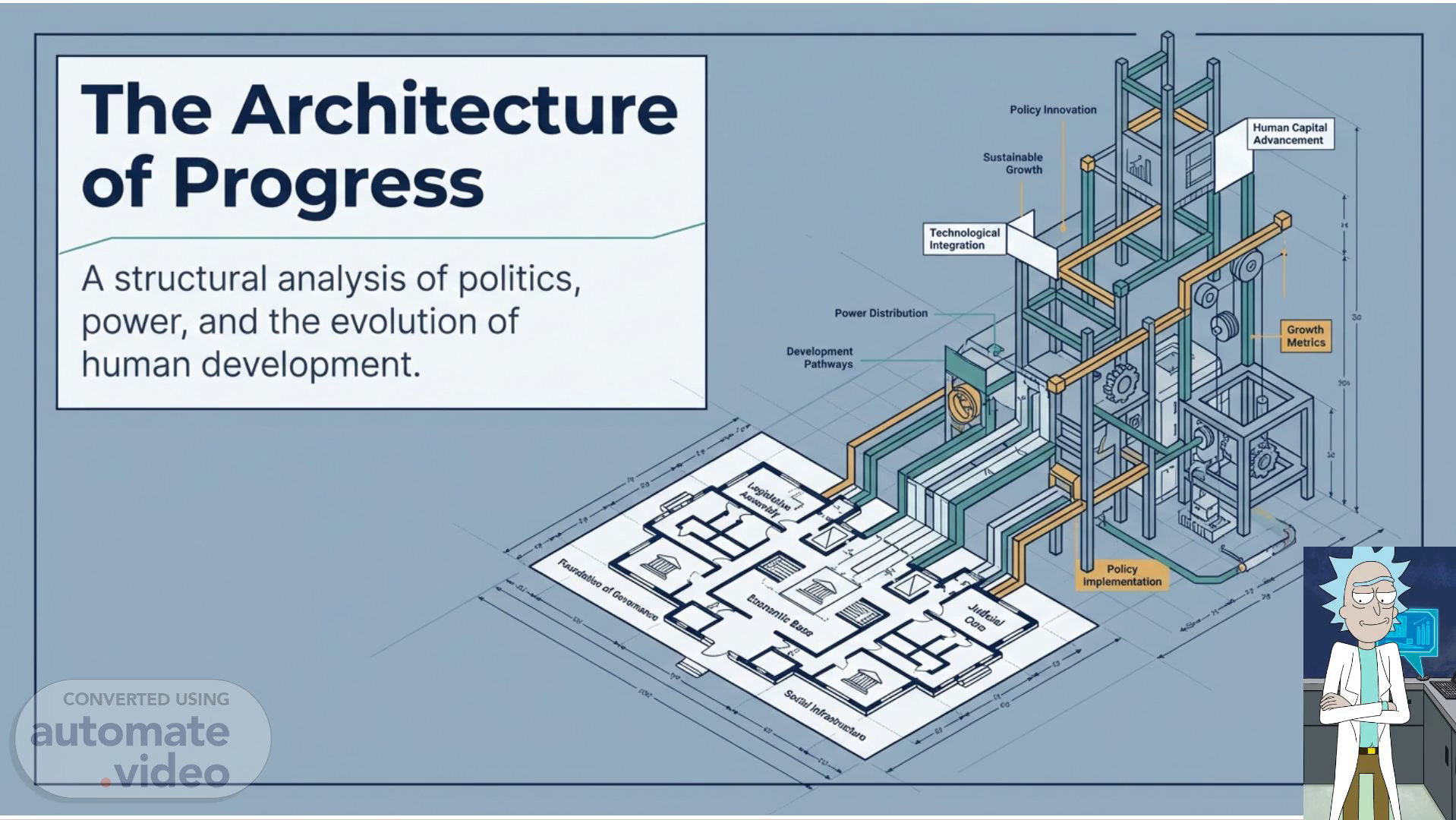
The Architecture of Progress A structural analysis of politics, power, and the evolution of human development. Policy Innovation Human Capital Advancement Sustainable Growth Technological Integration Power Distribution Development Pathways - Growth Metrics Policy implementation NotebookLM.
Scene 2 (10s)
The Foundation: Lasswell's Allocation Engine Definition Pivot Moving past institutional definitions to Harold Lasswell's behavioral concept: Politics is the study of influence and the influential. The Engine's Purpose Disagreement centers on how limited resources are distributed. Politics is the mechanism for resolving this conflict. The Output The influential manipulate their environment to secure most of what society provides, while the masses receive the remainder. Scarce Resources Conflict / Disagreement 00 (4 The Influential (Elite) Difference of Opinions $0 The Masses NotebookLM.
Scene 3 (29s)
The Unequal Distribution of Societal Values Deference (Respect) Highly Inequitable Only a few reach positions of status and high hierarchy. Income (Wealth) Highly Inequitable Per capita income is clustered at the top, historically driven by owners of land and means of production. Skills (Capabilities) Variable Power Skills grant specific influence; charismatic oration grants broad deference, wlrile technical specialization grants niche power. Aristocrats, Plutocrats & Bourgeoisie Professionals & Middle Class Proletariat & Working Class Safety (Security) Relatively Equitable Both the influential and the masses are broadly exposed to natural disasters and vioience, though the upper class maintains better protection. NotebookLM.
Scene 4 (51s)
The Blueprint: Growth vs. Development Economic Growth 214.2% 12.6% 16.5% 15.8% 10.1% 6.1% 4.2% 3.6% 2.3% 1.8% 0% • Focus: Quantitative changes and statistical values. • Indicators: GDP, GNP, numerical output. • Advocates: Historically prioritized by the IMF and World Bank. • Nature of Change: Numerical increases without altering social structures. Economic Development Education DEVELOPMENT HUB Infrastructure Inclusion • Focus: Qualitative changes and deliberate policy interventions. • Indicators: Human capital, critical infrastructure, social inclusion, health, and literacy. • Key Insight: Economists like Amartya Sen argue growth is merely one aspect of development. • Nature of Change: Systemic restructuring to improve actual human wellbeing. NotebookLM.
Scene 5 (1m 21s)
The Historical Triggers of Development Capitalist Disappointment Capitalism promised progress but created sharp, volatile divisions between the haves and have-nots. 19th Century The Intervention Development emerged as a deliberate intervention by the West to reconstruct social order and prevent mass rebellion. Global Instability Two-thirds of the world faced mass poverty and acute hunger, posing an existential threat to developed nations. Post-WWII The Intervention The Global North deployed development as a stabilization tool, recognizing that intertwined destinies meant third-world chaos threatened first-world order. The Identity Void Colonization stripped the Global South of identity, forcibly shifting production from sustenance to cash crops. Post-Colonial Era The Intervention Offered as compensation by the North, and utilized by nationalist leaders to dissolve militant groups and fulfill independence promises. t'40tebookLM.
Scene 6 (1m 49s)
The Ideology of Developmentalism The Premise Assumes a single, universal answer to underdevelopment, equating development strictly with industrialization and ignoring local context. The Mechanism Replaces domestic choice with external expertise. Operates like a clinical diagnosis where institutions attach strict conditionalities based on a country's desperate need for capital. The Backlash Imposing rigid Structural Adjustment Programs frequently leads to domestic crises (e.g., Argentina 2001) as masses rebel against the resultant inequalities and widened wealth gaps. International Experts (IMF / World Bank) Identical Prescriptions: Free Markets & Subsidies Removal Developing State Identical Prescriptions: Free Markets & Subsidies Removal Developing State Identical Prescriptions: Free Markets & Subsidies Removal Developing State NotebookLM.
Scene 7 (2m 12s)
The Master Theory Matrix: Liberal vs. Marxist Models —J Mechanism of Underdevelopment Core Strategy Action & Social Change Liberal View (Almond, Coleman, Pye) A natural historical starting point. Progress occurs through successive stages from primitive to modern. Keep economies open to free trade and international competition. Rely heavily on market forces to drive efficiency. Differentiation: Driving progress through increasing specialization and the complex division of labor in society. Marxist & Neo-Marxist View (Lenin, Frank, Baran) o An engineered state. Advanced capitalist nations systematically engineered the underdevelopment of the Third World through colonial exploitation. Developing nations cannot access the capital the West stole. Therefore, they must deliberately delink from capitalist economies. Protectionism: Suppliers of raw materials must form protective cartels (e.g., OPEC) to prevent further value extraction. NotebookLM.
Scene 8 (2m 42s)
The Linear Path: Rostow's 5 Stages of Economic Growth Preconditions for take-off. Developing a technological mindset, skills, and infrastructure. Intensive manual labor, lack of technology, primitive production. 5. Mass Consumption Society fulfills basic needs and transitions to the widespread use of durable consumer goods. 0 2. Transitional Stage 4. Drive to Maturity Industrialization takes root. Productivity and technological advancement rise sharply. 1. Traditional Stage 3. Take-Off Self-sustaining growth. Structural constraints are removed. An active entrepreneurial class emerges. NotebookLM.
Scene 9 (3m 4s)
The Dependency Engine: Core and Periphery The Dependency Premise Underdevelopment is not a transitional stage; it is o permanent state enforced by international power relations and economic rigidities. External Control Third World domestic policies, politics, and culture are heavily dictated by their dependence on rich Western countries. The Policy Remedy Protect notional products through tariffs and quotas. Reinforce domestic industrialization via import substitution rather than remaining an exploited raw- material exporter. The Global North (Core) The Global South (Periphery) NotebookLM.
Scene 10 (3m 24s)
Spectrum of Alternative Architectures Material Individual Market Society Model Hi hly urbanized, high mo#ility, and per capita income. Requires traversing Rostow's economic stages via free enterprise. Moral Welfare State Model State acts as a safety net to compensate those failed by open markets. Funded by progressive taxation to provide social security and healthcare. Gandhian Model Collective Socialist Model Ranges from Revolutionary (Marxist class struggle) to Évolutionary (achieving welfare and civil liberties through democratic policy rather than overthrow). Re•ects material accumulation. Po itics is an instrument for moral goals. Focuses on the "spirit of renunciation" to prevent environmental harm. NotebookLM.
Scene 11 (3m 46s)
The Human Edifice: Development as Freedom The Core Philosophy Championed by Amartya Sen. Development is the process of expanding the real freedom of people, not merely raising GDP. Development is an end in itself, not just a means. The Two Pillars of Freedom Evaluative Reason: Development must be assessed solely on whether human freedom is enhanced. Effective Reason: Attaining development is entirely dependent on the free agency of the people to participate in economic, social, and political life. Economic Unfreedom Denying access to labor markets keeps people in bondage, forcing survival labor in hostile environments without utilizing actual human capabilities. Free Agency 0 NotebookLM.
Scene 12 (4m 12s)
The Environmental Constraint: Sustainable Development The Catalyst The rapid operation of machines and massive energy consumption required to satisfy modern demands led to large-scale, unsustainable environmental degradation. 8. Present Needs Sustainability Pivot Future Generations The Brundtland Report (1987) Formally defined sustainable development as: meeting the needs of the present generation without compromising the ability of future generations to meet their own needs. Environmentalism Paradigm Shift Demands a redefinition of the human-nature relationship. Humans must act as partners within the ecosystem, not masters of the natural world, to prevent irreversible exploitation. NotebookLM.
Scene 13 (4m 33s)
The Capabilities Engine: Structural-Functional Analysis Citizen Needs (5 Differentiation & Secularization: Specialized structures emerge for specific functions, driven by a rational, analytical culture rather than traditionalism. Structures (Differentiation & Secularization) Regulative Enforcing laws and maintaining security to protect individual freedoms. Extractive Generating state income through efficient taxation to fund infrastructure and welfare. Distributive Equitably allocating state resources to prevent societal chaos and disparity. Responsive Meeting citizens' needs, which in turn earns the state legitimacy and acquiescence from the populace. NotebookLM.
Scene 14 (4m 53s)
The Dual Architecture: Nation vs. State Building THE NATION Nation Building (Identity): The process of transferring loyalty from smaller tribes to a central identity. Driven by culture, blood, emotional bonds, and social solidarity beyond physical boundaries. THE STATE The Synthesis For true development, individuals must first identify as a nation (patriotism), which legitimizes the physical state machinery governing them. State Building (Machinery): The evolution of a common center of power to establish law and order. Focuses on physical borders, administrative authority, defense, and welfare services. NotebookLM.
Scene 15 (5m 15s)
The Unified Architecture of Political Development Sustainable Freedom (Sen & Brundtland) Ideological Models (Liberal, Marxist, Welfare) Structural Capabilities (Almond & Powell) The Political Allocation of Values (Lasswell) Development is not merely the accumulation of capital or the building of infrastructure. It is a deliberate, structurally engineered process. Politics dictates the allocation of influence. This influence shapes the State's regulative and extractive capabilities. The State chooses an ideological blueprint, aiming to transform raw economic growth into true human agency, without borrowing from the future. NotebookLM.