Scene 1 (0s)
[Audio] Today we are going to speak about "Two main global seed banks" . What is a seed bank? A seed bank (or germplasm bank) is a secure, specialized facility that stores seeds from wild and cultivated plants in cold, dry conditions (often ) to preserve genetic diversity and ensure plant survival for future generations. They act as "backups" against extinction caused by climate change, disease, or disasters..
Scene 2 (29s)
[Audio] Here we are talking about two main global seed banks. First, Savlbard global seed vault and then the millennium seed bank..
Scene 3 (39s)
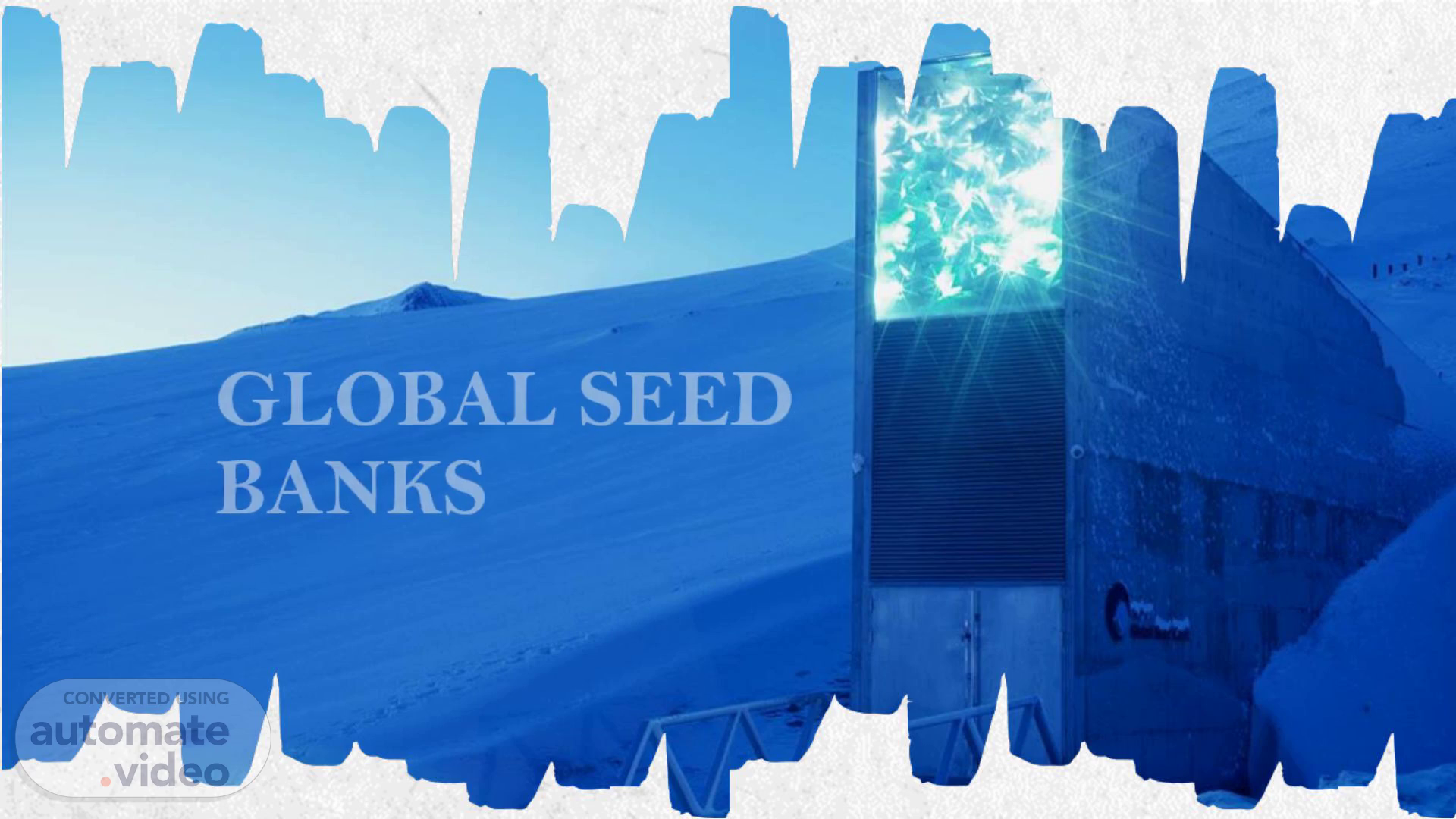
[Audio] Svalbard Global Seed Vault - Safeguarding Seeds for the Future.
Scene 4 (46s)
[Audio] The vault sits deep inside a mountain on Spitsbergen, which belongs to the Arctic region called Svalbard under Norway. Scientists and engineers selected this location after studying many possibilities, and it turned out to be nearly perfect for seed preservation. Here's why: • The mountain is geologically stable, meaning earthquakes are very unlikely. • The area has natural permafrost, which keeps the surroundings permanently frozen. • The vault is built about 130 meters inside the mountain and sits high above sea level, so even melting ice caps won't flood it. • Even if electricity stops, the frozen rock around it keeps seeds cold for weeks, and it could take centuries for temperatures to reach freezing point. That level of planning shows they designed this place thinking about extremely long-term survival, not just decades..
Scene 5 (1m 40s)
[Audio] So the Svalbard Global Seed Vault is basically humanity's long-term safety locker for crops. The idea is simple but very powerful. Around the world, thousands of gene banks store seeds from different plants like rice, wheat, vegetables, and fruits. These seeds represent farming knowledge humans have built over more than 13,000 years. The problem is that gene banks themselves are vulnerable. Wars, disasters, funding problems, or simple human mistakes can destroy them. So this vault exists as a backup of backups. The vault currently acts as a backup for roughly 1,750 gene banks worldwide. It protects agricultural biodiversity, which is essential for developing crops that can resist pests, diseases, and climate change. Another interesting rule is that genetically modified seeds are not allowed to be stored there under Norwegian law.
Scene 6 (2m 36s)
[Audio] The vault is run through cooperation between three partners: • The Norwegian government built and owns the facility • The Crop Trust helps pay operating costs and supports countries that want to deposit seeds • The Nordic Genetic Resource Center manages daily operations and maintains records Interestingly, storing seeds there is free. The goal is global food security, not profit..
Scene 7 (3m 2s)
[Audio] Stores over 1.35 million seed samples (accessions). Represents more than 13,000 years of agricultural history. Capacity to store about 4.5 million seed samples..
Scene 8 (3m 16s)
[Audio] The idea didn't appear suddenly. In 1984, Nordic countries were already storing seeds in an abandoned coal mine nearby. Later, global concern about protecting crop diversity grew. A major turning point happened when the International Treaty on Plant Genetic Resources for Food and Agriculture was introduced. This treaty encouraged countries to share plant genetic resources and protect agricultural biodiversity. A conservation scientist named Cary Fowler strongly promoted the idea of a global backup vault. After feasibility studies confirmed the Arctic location was suitable, construction began. The facility officially opened in 2008, though seeds had already started arriving earlier that year..
Scene 9 (4m 4s)
[Audio] Mission - Serves as backup for global gene banks. Helps preserve agricultural biodiversity. Supports recovery of lost seed collections. Functions as a backup for approximately 1,750 seed banks worldwide. Genetically modified seeds are not allowed..
Scene 10 (4m 26s)
[Audio] Seeds are sealed in special three-layer foil packets that prevent moisture and oxygen from entering. These packets are then placed in containers and arranged on shelves inside cold storage rooms. The rooms are kept at about –18°C. At this temperature, seeds stay alive but inactive, which slows aging dramatically. On average, each packet holds about 500 seeds, and the entire facility can store up to 4.5 million different seed samples. Ownership and access rules The vault works exactly like a bank locker system. Norway owns the building, but countries and research institutions still own the seeds they deposit. This system is called a "black box" arrangement. Only the depositor can request their seeds back, and nobody else can access them. Researchers usually obtain seeds from the original gene banks, not directly from the vault. This is the only time seeds have been officially withdrawn so far, and it proved the vault works exactly as intended. Problems and improvements In 2016, unusually warm temperatures caused water to enter the entrance tunnel. The water froze before reaching the seeds, so nothing was damaged. After that, engineers improved waterproofing and drainage systems to prevent future incidents. Extra scientific and cultural features Each seed box includes nanofilm sheets storing detailed information about the seeds. The vault also has an artistic installation called Perpetual Repercussion, which reflects Arctic light and helps mark the vault's entrance. Next to the vault, there is also a facility called the Arctic World Archive, which stores important global data on special film designed to last about 1,000 years..
Scene 11 (6m 16s)
[Audio] During the Syrian civil war, a research centre lost access to its gene bank. The organisation International Center for Agricultural Research in the Dry Areas had stored backup seeds in the vault. They withdrew those seeds, planted them in Lebanon and Morocco, and successfully regenerated the crops. Some seeds were later returned to the vault again..
Scene 12 (6m 40s)
[Audio] Millennium Seed Bank partnership (msbp). Millennium Seed Bank partnership (msbp).