Scene 1 (0s)
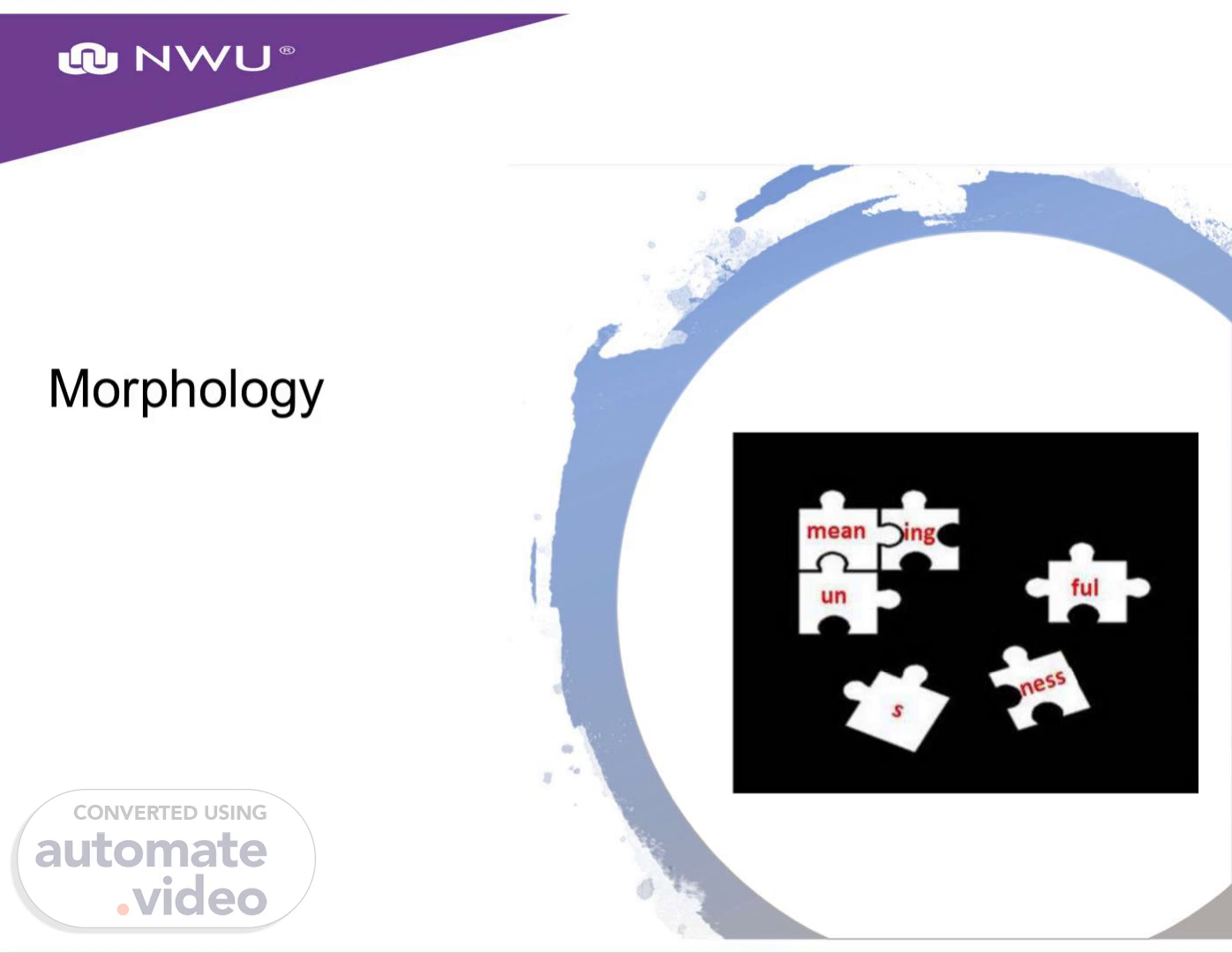
Morphology.
Scene 2 (3s)
Unit Outcomes On completion of this study section you should be able to: • Identify the root of a word; • Identify bound and free morphemes; • Identify affixes (prefixes and suffixes); • Indicate whether affixes are derivational or inflectional; • Indicate the conversion caused by adding the affix; • Indicate whether an affix is neutral or non-neutral..
Scene 3 (13s)
What is a morpheme? • It is the smallest unit of meaning in a language. • A whole word or parts of words can be a morpheme. • Example: “Small” is a word and a single morpheme because the entire word has one meaning. • Example: “Smallest” is one word, but it is made up of two meanings: +. The superlative morpheme means “the most.” Thus, the word “smallest” means “the most small.” • The number of syllables in a word doesn’t affect the number of morphemes. • Example: “Cats” has two morphemes: + plural morpheme, yet it is made up of one syllable..
Scene 4 (31s)
How many morphemes are in each of the words? • Dog • Dogs • Elephant • Establish • Establishment • Child • Children • Childish • Childishness.
Scene 5 (37s)
How many morphemes are in each of the words? • Dog • Dogs • Elephant • Establish • Establishment • Child • Children • Childish • Childishness.
Scene 6 (43s)
Types of morphemes • Free • Bound • Inflectional • Derivational.
Scene 7 (47s)
Root/Base/Stem • The meaningful core of a word • All affixes are attached to the base. • All words have at least one base. • Not all bases are free morphemes; bound bases also occur. (dis+sent = dissent). • There was dissent in the ranks. • *There was (sent) in the ranks..
Scene 8 (57s)
Free vs Bound Free morphemes • Morphemes that can stand alone as words • Example: in inactive Bound morphemes • Morphemes that are incapable of standing alone as words. • They can be inflectional or derivational • Example: and in inactive They are written with a hyphen to indicate where they attach to other words..
Scene 9 (1m 7s)
In, In-, and In- • In as a preposition, derivational prefix meaning not, or as a derivational prefix meaning really. • I live in Mahikeng. preposition • It was an insincere apology. derivational prefix meaning not • This gas is inflammable. derivational prefix meaning really (intensifier).
Scene 10 (1m 17s)
Bound Morphemes Inflectional morphemes • Formed through affixation and vowel change. • Example: Mouse - Mice • used to show grammatical relationships, such as verb tense and number (plurals) • do not change the word class of the root word • Example: in baker’s.
Scene 11 (1m 26s)
Bound Morphemes Derivational morphemes • morphemes that create a new word by adding affixes (prefix/suffix) • Note vowel change is missing from derivational morphemes • do change the word class • Example: in baker.
Scene 12 (1m 33s)
Bound Morphemes - Tip • If you cannot tell the difference between derivational and inflectional morphemes try this: • Open your dictionary and look up the words king, kingdom, and kingly. Could you find them? • Now try finding kings and king’s. Could you find them?.
Scene 13 (1m 43s)
Inflectional Morphemes • There are eight inflectional morphemes in English • All eight inflections are suffixes. • There are two for nouns, four for verbs, and two for adjectives/adverbs..
Scene 14 (1m 50s)
Inflectional Morphemes.
Scene 15 (1m 54s)
Derivational Morphemes • Affixes: morpheme attached to the beginning or end of a word. • Prefix: morpheme attached to the beginning of a word (unable, republish) • Suffix: morpheme attached to the end of a word (baker, actively).
Scene 16 (2m 2s)
Table 4.6 Some English derivational affixes Affix Sutti*g• -ins' -(at)ion -inS2 -(i)al -(i)an 2 •ity in. 2 Change A Adv Examples fix-able, do-able, understand-able the sleep-ing giant, a blaz-ing fire assert-ive, impress-ive, restrict-ive refus-al. dispos-al, recit-al claim-ant, defend-ant realiz-ation, assert-ion, protect-ion teach-er, work-er the shoot-ing the danc•ing adjourn-ment. treat-ment, amaæ-ment king-dom. fief-dom faith.ful. hopeful. dread-ful president.ial. nation-al Arab.ian. Einstein-ian. Minneqn-an cub-ic, optimist-ic, moron-ic penni•less. brain-less poison-ous, lecher-ous hospital-ize. vapor-ize green-ish, tall-ish activ-ate, captiv.ate dead-en, black-en, hard-en modem-ize, national-ize quiet-ly, slow-ly, careful-ly stupid-ity, prior-ity happi-ness, sad-ness anti-hero, anti-depressant ex-president, ex-wife, ex-friend deactivate, de-mystify dB-continue, dis-obey mis-identify, mis-place re-think. re-do, re-state un-tie, un-lock, un-do in-competent, in-complete un-happy, un-fair, un-intelligent.
Scene 17 (2m 30s)
Neutral vs Non-neutral affixes • Neutral • Has no effect on the pronunciation of the base word • Non-neutral • Affects the vowel or consonant segment of a base word, or the location of the syllable stress of the base word.
Scene 18 (2m 39s)
Allomorphs • Allomorphs are variants of a morpheme • Example:tolerable,possible, •regular,legible. • The morphemes in the brackets above all mean the same thing: “not.” Thus, they are variants of the same morpheme..
Scene 19 (2m 48s)
The Zero Allomorph • An inflection on nouns or verbs presumed to be present although invisible. • Example: In “three sheep” and “He hit a home run,” the plural of sheep and the past tense of hit are said to be realized as zeros ( + ; +)..
Scene 20 (2m 58s)
Steps for analysing a word • Identify the morphemes and the root of a word • Determine whether morphemes are free or bound • Identify affixes • Determine whether affixes are inflectional or derivational • In the case of derivational affixes, indicate the conversion of the root word • Determine whether affixes are neutral or non- neutral.
Scene 21 (3m 7s)
Class Exercise.
Scene 22 (3m 11s)
Betrayal It was a grave betrayal on his part. Morphemes + Base Bound / Free Der / Infl Function/ Conversion Neutral / Non-neutral.
Scene 23 (3m 17s)
Betrayal It was a grave betrayal on his part. BETRAY + AL Morphemes + Base free + bound Bound / Free + derivation Der / Infl verb noun Function/ Conversion + neutral Neutral / Non-neutral.
Scene 24 (3m 23s)
Given The gift she has given me means the world to me. Morphemes + Base Bound / Free Der / Infl Function/ Conversion Neutral / Non-neutral.