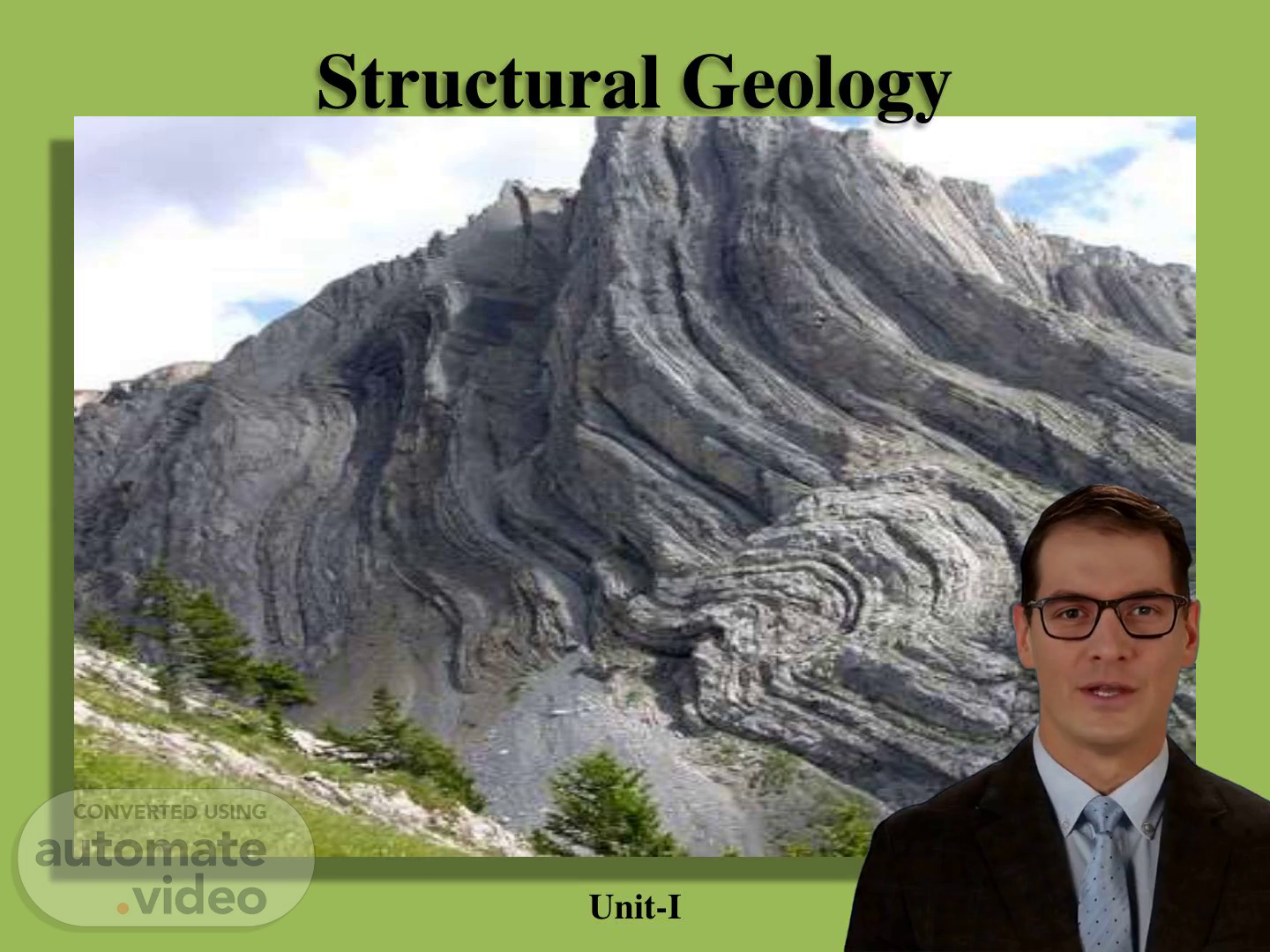
Scene 1 (0s)
[Virtual Presenter] Structural Geology Unit I. Structural Geology Unit I.
Scene 2 (5s)
[Virtual Presenter] Structural Geology Structural Geology Introduction, Causes of Development of Structures, Structural Elements Folds, Faults, Joints, Unconformity, Dip, Strike, Outcrop Patterns, Outliers and Inliers..
Scene 3 (24s)
[Virtual Presenter] Introduction Structural geology is the study of factors such as origin, occurrence, classification, type and effects of various secondary structures like folds, faults, joints, rock cleavage and are different from those primary structures such as bedding and vesicular structure, which develop in rocks at the time of their formation..
Scene 4 (51s)
[Virtual Presenter] Outcrop Any Geological formation exposed on the surface is called an outcrop..
Scene 5 (59s)
[Virtual Presenter] Strike and Dip Strike refers to the direction in which a geological structure is present. The strike direction may be defined as the direction of the trace of the intersection between the bedding plane.
Scene 6 (1m 12s)
[Virtual Presenter] Strike and Dip. Strike and Dip.
Scene 7 (1m 17s)
[Audio] Dip literally means slope or inclination. In structural geology dip is expressed both as direction and amount. The dip direction is the direction along which the inclination of the bedding plane occurs..
Scene 8 (1m 34s)
[Audio] Strike and Dip. Strike and Dip.
Scene 9 (1m 40s)
[Audio] Folds Folds are one of the most common geological structures found in rocks. When a set of horizontal layers are subjected to compressive forces, they bend either upward or downward. The bend noticed in rocks are called folds. In terms of their nature too, folds may occur as single local bends or may occur repeatedly and intricately folded to the tectonic history of the region..
Scene 10 (2m 5s)
Folds.
Scene 11 (2m 11s)
Folds.
Scene 12 (2m 16s)
[Audio] Classification and Types of Usually, folds are classified on the basis of Symmetrical Character Upward or Downward Bend Occurrence of Plunge Uniformity of Bed Thickness Behavior of the Fold Pattern with Depth..
Scene 13 (2m 32s)
[Audio] Classification and Types of Folds Anticline and Syncline When the beds are bent upwards, the resulting fold is called anticline. This fold is convex upwards. Naturally, in such a fold, the older beds occur towards the concave side, In a simple case, the limbs of anticline slope in opposite directions with reference to its axial plane. But when the anticline is refolded, the inclined character of limbs will be complicated..
Scene 14 (3m 1s)
[Audio] Anticline and Syncline Syncline is just opposite to anticline in its nature, in other words when the beds are bent downwards the resulting fold is called syncline. This fold is convex downwards. In this the younger beds occur towards the concave side and, in a simple type of syncline, its limbs dip towards each other with reference to the axial plane..
Scene 15 (3m 26s)
[Audio] Anticline and Syncline. Anticline and Syncline.
Scene 16 (3m 32s)
Anticline and Syncline.
Scene 17 (3m 38s)
[Audio] Classification and Types of Folds Symmetrical and Asymmetrical Folds When the axial plane divides a fold into two equal halves in such a way that one half is the mirror image, then the fold is called as symmetrical fold. If the compressive forces responsible for folding are not of the same magnitude, asymmetrical folds are formed..
Scene 18 (4m 3s)
[Audio] Symmetrical and Asymmetrical folds. Symmetrical and Asymmetrical folds.
Scene 19 (4m 9s)
[Audio] Classification and Types of Folds Plunging and Non Plunging Folds The plunge of a fold has already been described as the inclination of the fold axis to the horizontal plane. Based on this, in other words whether the axis of a fold is inclined or horizontal, the folds are grouped as plunging folds or non plunging folds. In geological maps, when strike lines are drawn for both the limbs, for a non plunging fold, they will be mutually parallel and for a plunging fold they will be either converging or diverging but not parallel..
Scene 20 (4m 50s)
[Audio] Classification and Types of Folds. Classification and Types of Folds.
Scene 21 (4m 57s)
[Audio] Plunging and Non Plunging Folds. Plunging and Non-Plunging Folds.
Scene 22 (5m 3s)
[Audio] Classification and Types of Folds Open and Closed Folds Depending on the intensity of deformation, the beds of the fold may or may not have uniform thickness. If the thickness of beds is uniform throughout the folds, it is called an open fold. On the other hand, in a fold, if the beds are thinner in the limb portions and thicker at crest and trough, such a fold is called closed fold..
Scene 23 (5m 29s)
[Audio] Classification and Types of Folds. Classification and Types of Folds.
Scene 24 (5m 36s)
[Audio] Similar and Parallel Folds Based on whether the shape of folds remain the same or altered with depth, folds are grouped as similar or parallel folds. In the case of similar folds, the shape or pattern of folds remain the same at depths also. But in the case of parallel folds, the crest and trough become pointed or angular.
Scene 25 (5m 58s)
[Audio] Classification and Types of Folds Miscellaneous Folds Overturned Fold Usually, in simple folds, the limbs show the order of superposition. But when one of the limb is overturned, the order of superposition of beds in that limb will be in reverse order and such a fold is called an overturned fold..
Scene 26 (6m 20s)
[Audio] Overturned Fold. Overturned Fold.
Scene 27 (6m 26s)
[Audio] Classification and Types of Folds. Classification and Types of Folds.
Scene 28 (6m 32s)
[Audio] Cheveron folds: Usually the crest and troughs of beds are smoothly curved. But some folds have sharply bent, angular crest and troughs, such folds are known as “ Chevron folds”..
Scene 29 (6m 46s)
[Audio] Cheveron Folds. Cheveron Folds.
Scene 30 (6m 52s)
[Audio] Classification and Types of Folds Isoclinal Folds Usually the folds have inclined limbs, in other words the limbs will be mutually diverging or converging with reference to axial planes. But in some folds, the limbs will be mutually parallel to a great extent. Such folds are called isoclinals folds. These folds may be vertical inclined or horizontal..
Scene 31 (7m 16s)
[Audio] Classification and Types of Folds. Classification and Types of Folds.
Scene 32 (7m 22s)
[Audio] Fan Folds Usually in simple anticlines, the limbs dip away from one another and in simple synclines they dip towards each other. But in the case of fan folds, this trend is just the opposite, in other words in anticlines of fan folds, the limbs dip towards each other with reference to their axial plane. In synclines of this kind, the limbs dip away from each other. As the term suggests, these folds are fan shaped..
Scene 33 (7m 51s)
[Audio] Classification and Types of Folds. Classification and Types of Folds.
Scene 34 (7m 57s)
[Audio] Domes and Basins Usually, a fold will have two distinct limbs. But some folds do not have any such specific limbs and appear as beds locally pushed up or down, in other words their shapes appear as dome or basin. In a dome, which resembles an upper hemisphere, the dips are found in all sides from the common central top point. Thus, this is a type of anticline. In the basin, which is like a bowl, the slopes are just opposite.
Scene 35 (8m 30s)
[Audio] Domes and Basins. Domes and Basins.
Scene 36 (8m 36s)
Domes.
Scene 37 (8m 41s)
Basins.
Scene 38 (8m 47s)
[Audio] Classification and Types of Folds Geanticlines and Geosynclines The anticlines and synclines with a normal shape but a very large magnitude are called Geanticlines and Geosynclines..
Scene 39 (9m 1s)
[Audio] Geanticlines and Geosynclines. Geanticlines and Geosynclines.
Scene 40 (9m 7s)
[Audio] Classification and Types of Folds Drag Folds These are the minor asymmetrical folds within major folds but confined only to incompetent beds which are sandwiched between competent formations. These develop because of the shearing/ dragging effect..
Scene 41 (9m 25s)
[Audio] Drag Folds. Drag Folds.
Scene 42 (9m 31s)
[Audio] Mechanisms of Folding Folding of rocks takes place by different ways of accommodation of stress. In many cases, slips or shear occur in between the beds. The process is similar to slipping of cards which occurs when the set is fold. If they are not allowed to slip over one another, folding of the set cannot take place. This is the way in which folding generally occur in the case of hard and competent rock like quartzites. In another kind of folding, folds are characterized by thinning of the limbs and thickening of crest and troughs. This takes place commonly in weak and incompetent rocks like shales..
Scene 43 (10m 9s)
[Audio] Mechanisms of Folding. Mechanisms of Folding.
Scene 44 (10m 15s)
Mechanisms of Folding.
Scene 45 (10m 21s)
Mechanisms of Folding.
Scene 46 (10m 26s)
[Audio] Causes and Effects of Folding Most of the important folds, as already pointed out, are due to tectonic causes. But a few folds of a minor type are due to non tectonic causes, Mainly, the compressive and shear type of tectonic forces are responsible for the folding phenomenon. Igneous intrusion of viscous magmas such as laccoliths and lopoliths also contribute to folding. Non tectonic causes like landslides, creeping, differential compaction, isostatic setting and glaciations too are responsible for some folds. These are minor in terms of frequency of occurrence and magnitude..
Scene 47 (11m 6s)
[Audio] Causes and Effects of Folding. Causes and Effects of Folding.
Scene 48 (11m 12s)
[Audio] When a folded area is affected by weathering and erosion, interesting topographic features are produced as follows, immediately after folding, anticlines by virtue of their upward bending appear as hills and synclines due to downward warping appear as valley. During folding in the crest portions, the geological formation are subjected to tensional forces and hence numerous fractures appear there. Because of these fractures, crest portions are eroded quickly leading to conspicuous degradations locally..
Scene 49 (11m 45s)
[Audio] Causes and Effects of Folding On the other hand, trough portion are highly compressed and hence offer a greater resistance to erosion. Thus, they stand out in the long run at a greater elevation, while the adjacent parts degrade fast. The net result of this response to erosion is that the anticlines will change over to valleys, while synclines change 'over to hills.. This paradoxical phenomenon is popularly expressed as “anticlinal valleys and Synclinal hills” The anticlinal valley are the typical example of inliers and the synclinal hill are example of outlier..
Scene 50 (12m 24s)
[Audio] Faults From the Civil engineering point of view, faults are the most unfavorable and undesirable geological structures at the site for any given purpose, in other words for location of reservoir; as foundations site for construction of dams, importance bridges or huge buildings, for tunneling; for laying roads, railways tracks, et cetera This is because faults considerably weaken the rocks and render the sites in which they occur as unfavorable places for all constructional purposes. Further, as long as the faults are active, the site is unstable and susceptible to upward, downward or sideward movement along the fault plane, thereby making the places highly hazardous for foundation purposes. Thus, by virtue of the harm they are capable of causing, faults are necessarily investigated with special care in dealing with any major construction..