Scene 1 (0s)
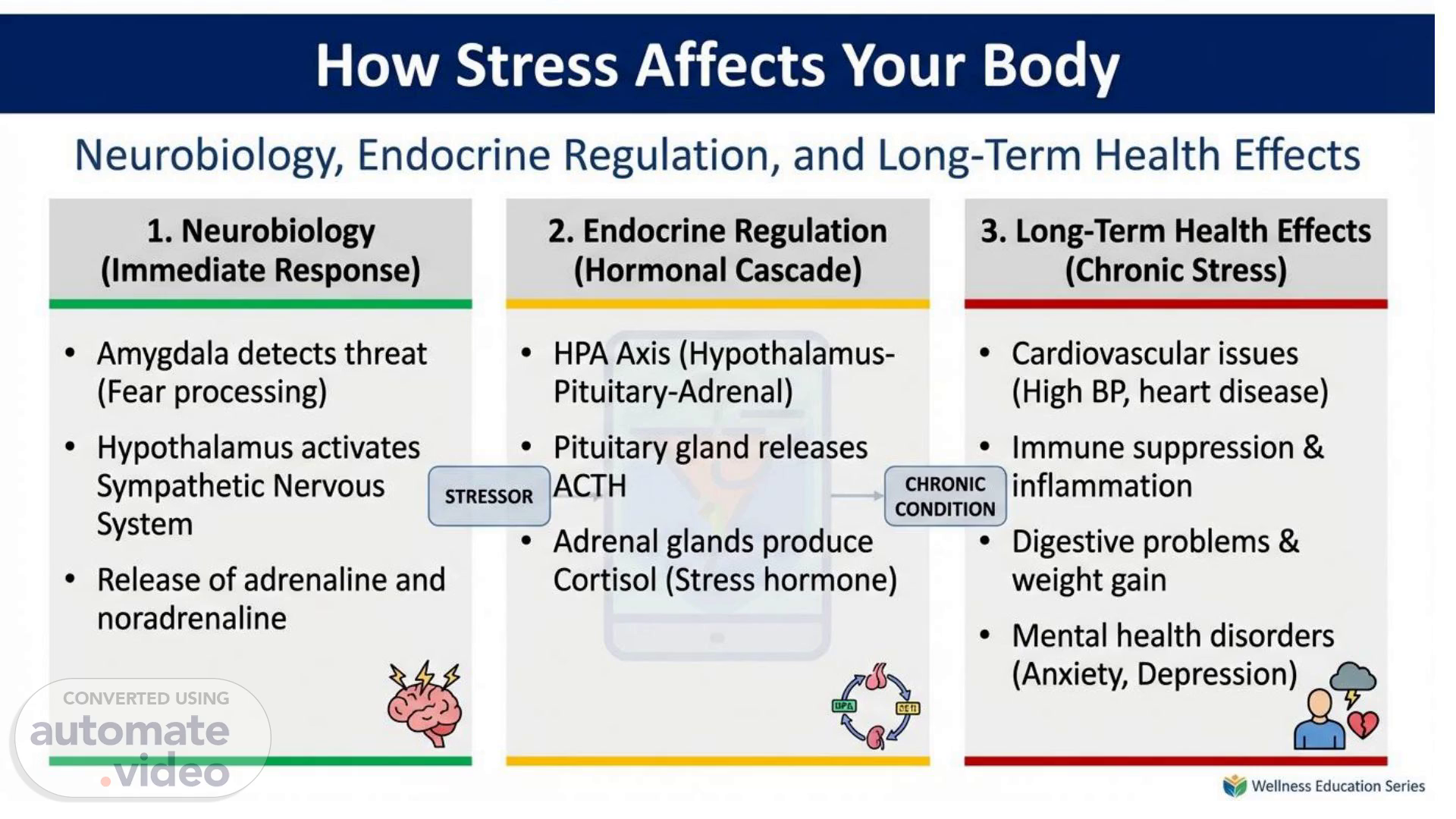
How Stress Affects Your Body Neurobiology, Endocrine Regulation, and Long-Term Health Effects 1. Neurobiology 2. Endocrine Regulation (Immediate Response) (Hormonal Cascade) • Amygdala detects threat • HPA Axis (Hypothalamus- (Fear processing) Pituitary-Adrenal) • Hypothalamus activates • Pituitary gland releases Sympathetic Nervous STRESSOR System • Release of adrenaline and noradrenaline ACTH CHRONIC CONDITION • Adrenal glands produce Cortisol (Stress hormone) 3. Long-Term Health Effects (Chronic Stress) Cardiovascular issues (High BP, heart disease) Immune suppression & inflammation • Digestive problems & weight gain • Mental health disorders (Anxiety, Depression) Wellness Education Series.
Scene 2 (19s)
Infographic PowerPoint What Is Stress? Stress is the bodVs adaptive physiological response to a perceived threat or demand that disrupts homeostasis. Key Concept Temperature Homeostasis Blood Pressure Glucose Hormones Internal Stability (balance) Stress Triggers (Brain Perception) Dangerous Uncertain Uncontrollable Overwhelming Important Distinction Acute Stress Short-term adaptive response Chronic Stress Prolonged dysregulation Educational Resource.
Scene 3 (30s)
The Evolutionary Purpose of Stress Stress evolved as a survival mechanism. In early humans: • Predator threat • Environmental danger fff • Immediate physical survival Ancestral challenges: Physical, immediate, life-or-death. Stress response allowed: Faster reaction Heightened awareness Increased strength • Improved survival probability e Biological Advantage: Quick energy, focused attention, fight-or-flight. Problem today: Modern stressors are psychological (deadlines, finances, social pressure), but the body still responds as if survival is at risk. Mismatched Response Educational Series: Understanding Stress Response I Slide I of I.
Scene 4 (52s)
The Brain Initiates the Stress Response • The stress response begins in the brain. • Key structures: Amygdala - detects emotional threat • Prefrontal cortex - decision-making, regulation Hypothalamus - command center of endocrine system • When a threat is perceived: Amygdala s threat Amygdala Hypothalamus activates autonomic O pathways activates endocrine pathways Prefrontal cortex Hypothalamus Hormonal cascade begins.
Scene 5 (1m 6s)
The Sympathetic Nervous System (SNS) First response system: immediate and rapid. Sympathetic Nervous System Hypothalamus Epinephrine (adrenaline) Adrenal Medulla Norepinephrine Increased heart rate Bronchodilation (faster breathing) Pupillary dilation Reduced digestion Increased blood flow to muscles SECONDS Time frame: seconds..
Scene 6 (1m 16s)
The HPA Axis (Hormonal Stress Pathway) Second response system: slower but sustained. • HPA = Hypothalamic—Pituitary—Adrenal Axis. • Step-by-step cascade: d • Time frame: minutes. • Cortisol = primary long-term stress hormone. Hypothalamus releases CRH (Corticotropin-Releasing Hormone) Pituitary releases ACTH (Adrenocorticotropic Hormone) Adrenal cortex releases cortisol.
Scene 7 (1m 29s)
Cortisol: The Central Stress Hormone Increases blood glucose stimulates gluconeogenesis in liver Breaks down fat and protein -5 provides energy substrates Suppresses immune response -5 reduces inflammation Maintains blood pressure O O Short-term: adaptive Chronic exposure: harmful.
Scene 8 (1m 41s)
Cardiovascular Effects of Stress Acute stress: Increased cardiac output Increased blood pressure Vasoconstriction Mechanism: Chronic stress leads to: Persistent hypertension Endothelial dysfunction Increased arterial stiffness Elevated risk of atherosclerosi Continuous sympathetic activation damages vascular lining..
Scene 9 (1m 53s)
Stress and the Immune System Acute stress: • Short immune activation • Temporary inflammatory boost Chronic stress: • Suppressed adaptive immunity • Reduced lymphocyte function • Increased systemic inflammation • Slower wound healing Mechanism: STRESS Cortisol ADRENAL GLANDS Cytokine production T-cell proliferation • Cortisol inhibits cytokine production and T-cell proliferation..
Scene 10 (2m 4s)
Stress and the Brain Chronic cortisol exposure affects: Hippocampus • Memory formation • Can shrink with prolonged stress Prefrontal cortex • Executive function • Decision-making declines Amygdala • Becomes hyperactive • Result. O Memory impairment Increased anxiety • Emotional dysregulation.
Scene 11 (2m 15s)
Stress and Mental Health Chronic stress is associated with: o Major depressive disorder Generalized anxiety disorder Panic disorder Burnout syndrome Educational Resource I @ 2024 Mechanism: Neurotransmitter imbalance (serotonin, dopamine, norepinephrine) Neuroinflammation.
Scene 12 (2m 25s)
STRESS AND METABOLISM CHRONIC CORTISOL CAUSES: CHRONIC STRESS OH o HO CORTISOL o PROMOTES GLUCONEOGENESIS (Glucose production) PROMOTES FAT REDISTRIBUTION INCREASED ABDOMINAL FAT DEPOSITION ELEVATED BLOOD GLUCOSE INSULIN RESISTANCE RISK OF METABOLIC SYNDROME MECHANISM: Cortisol promotes gluconeogenesis and fat redistribution. a CLINICAL IMPLICATION: Stress contributes to obesity and Type 2 diabetes..
Scene 13 (2m 37s)
Stress and Reproductive Hormones Energy Chronic stress suppresses: GnRH (Gonadotropin-Releasing Hormone) LH and FSH Shift Reproduction Survival Effects: Irregular menstrual cycles Reduced fertility 20 Lower testosterone Estrogen and testosterone Sexual dysfunction Stress shifts energy away from reproduction toward survival..
Scene 14 (2m 49s)
Stress and Sleep Elevated cortisol disrupts circadian rhythm. Effects: Sleep Deprivation Vicious Cycle Increased Cortisol REM EDUCATIONAL SLIDE I STRESS MANAGEMENT Delayed sleep onset Reduced REM sleep Fragmented sleep.
Scene 15 (2m 58s)
Allostatic Load • Allostasis = adaptation through change. • Allostatic load = cumulative physiological wear and tear. Chronic stress leads to: Hormonal dysregulation Immune imbalance Cardiovascular strain Q Accelerated aging Chronic Stress Hormonal dysregulation Immune imbalance 4 Y Allostatic Load Cardiovascular 6 strain Accelerated aging This explains why long-term stress shortens lifespan..
Scene 16 (3m 10s)
Why Chronic Stress Is Dangerous The problem is not stress itself — It is prolonged activation without recovery. Key concept: The body never returns to baseline. Stuck in activation Baseline This leads to: Persistent inflammation Cellular damage Telomere shortening.
Scene 17 (3m 23s)
Can the Damage Be Reversed? Yes — partially. • Regular exercise reduces cortisol baseline. • Mindfulness decreases amygdala activation. • Social connection improves immune resilience. • Sleep restores hormonal balance. • Neuroplasticity allows recovery..
Scene 18 (3m 35s)
Evidence-Based Stress Reduction Scientifically supported methods: Aerobic exercise Cognitive behavioral strategies Controlled ..........> breathing (vagal stimulation) Adequate sleep aaao Meditation Structured routines These lower HPA activation. EDUCATIONAL RESOURCES.
Scene 19 (3m 44s)
Takeaways O Stress is a biological survival mechanism. O Acute stress is adaptive. O Chronic stress disrupts nearly every organ system. O Cortisol plays a central role in long-term damage. F* O Recovery and regulation are possible..
Scene 20 (3m 56s)
Stress is inevitable — but chronic stress is preventable. Understanding the biology gives us the power to protect our health. INEVITABLE STRESS (ACUTE) ACUTE CHALLENGE • Short-term "Fight or Flight" response Natural, temporary adaptation • CHRONIC STRESS (PREVENTABLE) PERSISTENT BURDEN Long-term HPA Axis disregulation UNDERSTANDING BIOLOGY: Neuroplasticity & Regulation PROTECTED HEALTH & RESILIENCE.