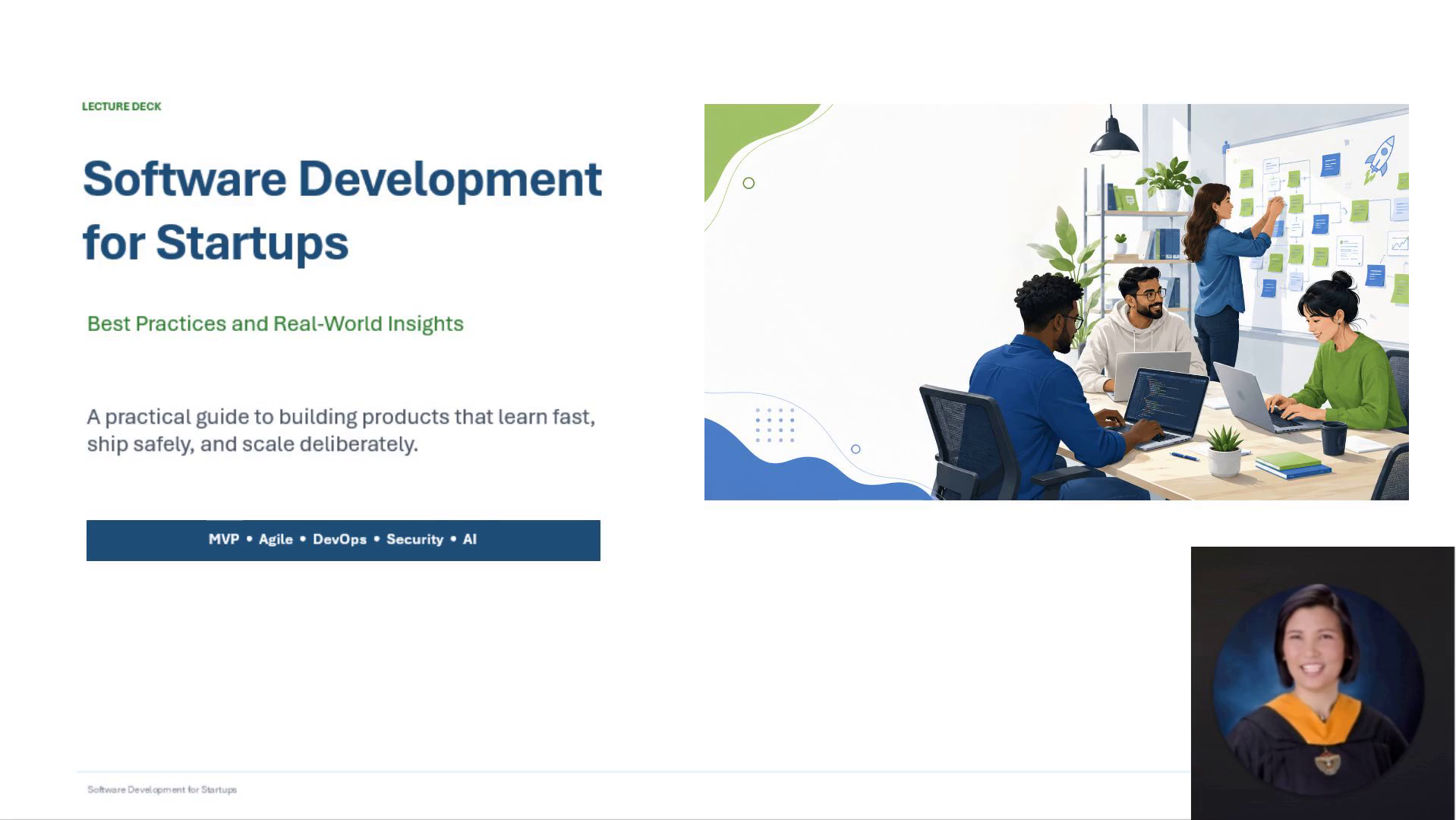
Software Development for Startups: Best Practices and Real-World Insights
Scene 1 (0s)
LECTURE DECK. Software Development for Startups. Best Practices and Real-World Insights.
Scene 2 (51s)
Why Startup Software Development Is Different. The main constraint is uncertainty, not only time..
Scene 3 (1m 39s)
Start With Product-Market Fit, Not Perfect Code. Before scaling software, validate the problem and demand..
Scene 4 (3m 2s)
MVP: Build the Smallest Test That Teaches. An MVP is a learning instrument, not a low-quality product..
Scene 5 (4m 45s)
[Audio] The development team must prioritize tasks based on the acceptance criteria and the learning goals or business outcomes associated with each task. The prioritization process should focus on specific outcomes and measurable results. The development team should use a decision-making framework to guide their decisions. This framework should include factors such as cost, complexity, and risk. By using this framework, the development team can make informed decisions about which tasks to prioritize and when to allocate resources. The development team should also consider the impact of their decisions on the overall project timeline and budget. By prioritizing tasks based on these factors, the development team can ensure that they are working towards specific, measurable outcomes..
Scene 6 (5m 36s)
[Audio] Engineering practices that support speed include version control, single source of truth, small PRs, review faster, automated testing, continuous integration and delivery, deploying safely, using feature flags, releasing gradually, knowing what failed, and technical debt being visible, intentional, and revisited. These practices enable teams to work efficiently and effectively, reducing confusion and increasing feedback speed. By adopting these disciplines, teams can maintain clarity and focus, even as they navigate complex projects. This clarity allows teams to move quickly and adapt to changing circumstances, ultimately driving innovation and progress..
Scene 7 (6m 23s)
[Audio] Architecture decisions should be documented in order to facilitate communication among team members and stakeholders. Architecture decisions are made by the development team, but they must be communicated effectively to others who may not have the same level of technical expertise. Documentation helps to establish a shared understanding of the technology stack and the reasons behind design choices. The architecture of an organization can be thought of as a complex system, comprising multiple components and subsystems. The architecture of an organization is often influenced by factors such as budget constraints, regulatory requirements, and technological advancements. These factors can lead to trade-offs between different aspects of the architecture, such as simplicity, observability, and deployability. Startups typically require simpler architectures due to limited resources and rapid growth. In contrast, larger organizations may prioritize more complex architectures that accommodate their needs and scale. However, even large organizations can benefit from simple architectures, especially when dealing with legacy systems or rapidly changing environments. A modular monolith architecture is often recommended as a starting point for new projects. This architecture combines the benefits of both monolithic and modular approaches. It provides clear boundaries between different components, while also allowing for greater flexibility and scalability. Modular monolith architecture is particularly useful for startups and small teams, as it enables easier maintenance and scaling. It also facilitates collaboration among team members, as it provides a clear understanding of how different components interact. In addition to the modular monolith architecture, other architectural styles such as microservices and event-driven architecture can also be effective. Microservices architecture involves breaking down the application into smaller services, each with its own specific function. Event-driven architecture involves using events to communicate between different components. Both of these styles offer advantages in terms of scalability and maintainability. However, it's essential to consider the trade-offs involved in adopting any new architecture style. For example, microservices architecture can introduce additional complexity, while event-driven architecture may require significant investment in infrastructure. Ultimately, the choice of architecture depends on the specific needs and goals of the project. It's crucial to evaluate the pros and cons of each option carefully, considering factors such as simplicity, observability, and deployability. By doing so, developers can make informed decisions about the architecture of their applications..
Scene 8 (9m 20s)
[Audio] The four DORA metrics are a useful tool for engineers to deliver health to their products. These metrics provide a clear picture of the performance of an organization's software development process. The first metric is deployment frequency, which measures how often the team ships new versions of its software. This metric is essential because it indicates whether the team is actively working on improving the product by releasing updates regularly. The second metric is lead time for changes, which calculates the time it takes for changes to go from development to production. This metric helps identify areas where the team can improve its efficiency and reduce delays. The third metric is change failure rate, which measures the percentage of changes that fail during deployment. This metric highlights the importance of testing and validation processes to ensure that changes are thoroughly tested before being released to users. The fourth metric is throughput, which represents the total amount of work completed by the team over a given period. This metric provides insight into the productivity and efficiency of the team. By using these four metrics, organizations can gain valuable insights into their software development process and make data-driven decisions to improve their overall health..
Scene 9 (10m 40s)
[Audio] The security measures implemented by startups are often inadequate due to limited resources and lack of expertise. However, this does not mean that they cannot implement effective security measures. With careful planning and consideration, startups can establish a solid foundation for their security. Startups have several options for establishing a security baseline. One option is to follow established guidelines from reputable sources such as OWASP and NIST SSDF. These guidelines provide a framework for implementing security measures that are tailored to the specific needs of each startup. Another option is to conduct an internal audit to identify vulnerabilities and weaknesses in their current systems. This will help them to prioritize their efforts and allocate resources more effectively. Startups must also consider the importance of trust. If compromised, trust is difficult to regain. Therefore, it is essential to establish a well-defined security baseline that includes strong authentication and roles, keeping secrets outside the repository, and implementing regular backups and restore tests. Additionally, input validation and access control, along with logs, monitoring, and incident response plans, are crucial components of a robust security framework. By thinking in layers – prevent, detect, respond, and recover – startups can develop a comprehensive security strategy. This involves identifying potential threats and taking proactive steps to mitigate them. For example, using encryption to protect sensitive data, implementing multi-factor authentication, and regularly updating software and systems. Furthermore, startups can utilize guidelines from organizations like OWASP and NIST SSDF to ensure that their security measures are aligned with industry standards..
Scene 10 (12m 34s)
[Audio] The startup team should be cross-functional, meaning all members have different skills and expertise. However, this does not mean that ownership cannot be visible. Ownership refers to who has responsibility for what tasks and projects. In order to maintain accountability, it is essential that ownership is clearly defined and communicated. This can be achieved through good rituals such as weekly planning sessions, daily check-ins, and regular retrospectives. These rituals help to clarify roles and responsibilities, reduce confusion, and increase feedback speed. Written decisions also play a crucial role in maintaining accountability by providing a paper trail and ensuring that everyone is on the same page, even if team members change over time. This helps to maintain accountability and ensures that decisions are made with careful consideration. By striking a balance between less bureaucracy and greater accountability, startups can achieve a high level of efficiency and effectiveness..
Scene 11 (13m 36s)
[Audio] In this class, we will be discussing slide number 11 which highlights common mistakes in software development. These mistakes not only involve technical aspects but can also affect the product, team, and process. I would like to know which trap you think is the most prevalent in school projects or capstones. It is often the case that building too much too soon or hidden technical debt are the traps that most students encounter during their development process. However, there is a positive aspect to this, as there are practical actions we can take to avoid these traps. For instance, to avoid building too much too soon, we can conduct a smaller MVP experiment to test our product before investing too much time and resources. For those who fall into the trap of the feature factory, prioritizing outcomes over output can be a helpful solution. Lastly, when tempted to scale too early, starting with a simple architecture before expanding can be beneficial. Hidden technical debt can be a major obstacle in software development, but we can mitigate its impact by making it visible and scheduling it for future maintenance. Additionally, it is essential to prioritize security from the very beginning and not as an afterthought. Incorporating a day-one baseline can ensure that security is not overlooked. By understanding and being aware of these avoidable patterns, and by taking small but practical actions, we can develop products that are efficient, secure, and scalable. Thank you..
Scene 12 (15m 8s)
[Audio] AI plays a significant role in the software development process for startups. It can greatly increase efficiency by quickly creating drafts and prototypes. However, it should not be viewed as an authority and instead, support human decision making. To protect sensitive information, confidential or private customer data should not be shared when using external tools. It is also important to thoroughly review and test all generated code before implementation, with extra scrutiny for security-sensitive code. As professionals, it is crucial to be prompt in decision making and thoroughly evaluate the use of AI in the code and data. While AI can be useful for tasks such as generating boilerplate code and test cases, ultimately, it is the responsibility of humans to ensure correctness and mitigate potential risks. We must integrate AI responsibly and remember that the final say and ownership of the code and architecture belong to us as humans. Let us continue to connect our skills and knowledge with responsible use of AI in our work..
Scene 13 (16m 20s)
[Audio] We have now reached slide number 13 and will be discussing the redesign plan for our AI Resume Checker project for graduating students. Our initial plan involved building multiple features before showing it to users, but in order to ensure the success of our project, we need to challenge our assumptions and focus on creating a lean MVP. This will involve dividing into groups and spending 10 to 15 minutes redesigning the plan. Each group's task is to identify the riskiest assumptions, create a lean MVP, choose success metrics, and incorporate engineering and security practices. During the sharing, it is encouraged to define the evidence that will determine our next steps - whether to continue, pivot, or stop. The expected output from each group includes a one-page action plan with three metrics and a decision rule, a simple architecture diagram, and five practices to prevent chaos. Additionally, each group will pitch their redesign in just two minutes, highlighting the first test and the evidence that could potentially change the plan. This exercise will not only refine our project, but also develop critical thinking and problem-solving skills. Let's begin!.
Scene 14 (17m 35s)
[Audio] As we near the end of our presentation, let us reflect on the core mindset that successful startups embody. It is important to have speed, but it is not solely about moving quickly. It is about learning at a rapid pace. This is vital in creating products that can evolve and scale intentionally. In the realm of software development for startups, a strong engineer is not simply someone who can write code. They also possess the mindset to decrease uncertainty, safeguard users, and construct systems that can adapt and grow. As students in higher education, I encourage you to apply this mindset to your own projects. Whether it is a capstone, thesis prototype, or early product idea, keep in mind the fundamental principles discussed today. Remember to validate before scaling, and to build with the purpose of learning rather than solely focusing on shipping. Keep your architecture simple and only add complexity when evidence demands it. In terms of discipline, utilize lightweight methods such as tests, continuous integration and deployment, code reviews, and proper documentation. These may seem burdensome at times, but they are crucial in maintaining the trust of your users. Finally, as we continue to innovate and incorporate AI into our products, let us do so responsibly. Let us not outsource our judgment and always prioritize the well-being of our users. Thank you for your attention and I hope you will consider implementing these key principles into your own projects. This concludes our presentation on software development for startups..
Scene 15 (19m 15s)
[Audio] As our presentation comes to a close, I hope you have gained a thorough understanding of the key components of software development for startups. It is crucial to remember that success in this field is achieved by quickly learning, safely shipping, and deliberately scaling. However, this is only the first step of your journey as a software developer. There will always be more to learn and improve upon. For those of you eager to continue your learning, I suggest exploring some useful resources that were referenced in this lecture. Firstly, the Agile Manifesto and Principles serve as the foundation of the agile methodology, emphasizing adaptability and collaboration. Additionally, The Lean Startup methodology and Minimum Viable Product (MVP) explanation can serve as a guide for your product development process. For a deeper understanding of startup strategies, I highly recommend the Y Combinator Startup Library and their insights on planning an MVP. Furthermore, for those interested in staying updated with the latest trends and best practices in software development, be sure to check out the Google Cloud DORA - Accelerate State of DevOps Report, OWASP Top Ten Web Application Security Risks, and NIST SP 800-218 - Secure Software Development Framework. Finally, to get a glimpse into the future of software development, take a look at the CB Insights report on why startups fail and the GitHub Octoverse 2025 on software development trends and AI. It's important to note that these sources are simply a starting point for your continuous learning and growth as a software developer. Adapt the frameworks to fit your startup's stage and risk level, and use them to guide your decision-making rather than replacing it. With that, I extend my thanks to all of you for your attention and wish you the best of luck with your future endeavors. Thank you..