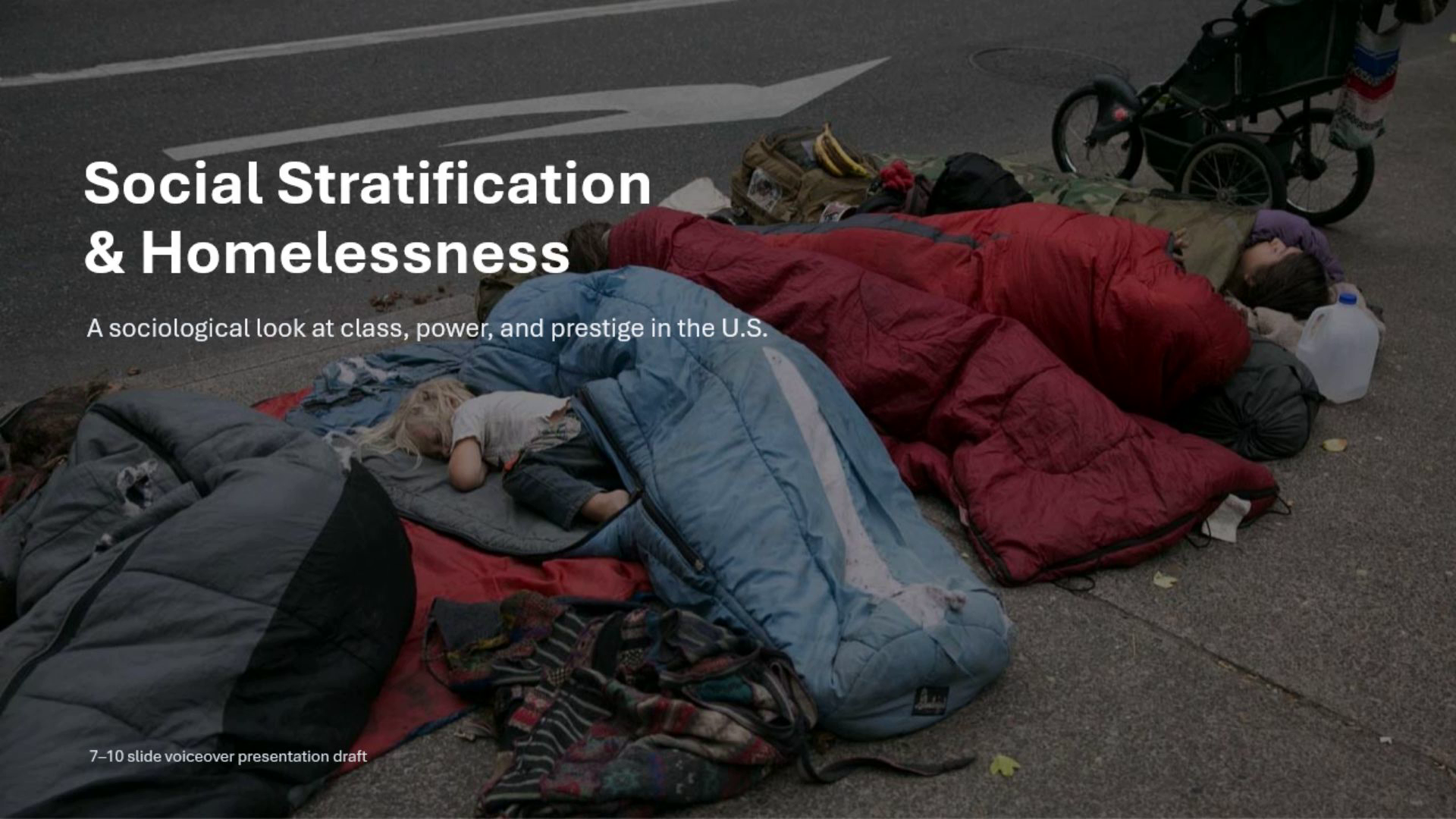
Social Stratification and Homelessness


Scene 1 (0s)
[Audio] For this presentation, I am discussing social stratification and applying it to homelessness in the United States. I chose homelessness because it shows how wealth, power, and prestige can affect people's life chances and access to resources..
Scene 2 (5s)
[Audio] Social stratification is a system where people are ranked in society. This is more than income. It connects to education, family background, occupation, power, and resources. For homelessness, stratification matters because a person's class position can affect whether they can afford stable housing or recover after a crisis..
Scene 3 (34s)
[Audio] The three organizing principles are wealth, power, and prestige. Wealth is important because it provides resources and security. Power affects who can make decisions or influence policy. Prestige affects how people are viewed and treated by others. These principles often overlap and can reinforce each other..
Scene 4 (1m 5s)
[Audio] There are different stratification systems, including slavery, caste, estate, and class systems. The United States is usually described as a class system because social position is tied to income, wealth, education, and occupation. Even though the class system is more open than caste or slavery, not everyone has the same opportunities to move up..
Scene 5 (2m 19s)
[Audio] I chose homelessness because it is one of the clearest examples of social stratification today. A person without stable housing often faces barriers in employment, health, safety, and education. This topic is meaningful to me because it reminds us that social problems are not only individual choices; they are also connected to larger systems and access to resources..
Scene 6 (3m 33s)
[Audio] When applying the three principles, wealth is connected to housing affordability and financial security. Power is connected to who has influence over housing policy, services, and law enforcement responses. Prestige is connected to stigma. People who are homeless are often judged, and those labels can make it harder for them to get support..
Scene 7 (4m 53s)
[Audio] The HUD 2024 Annual Homelessness Assessment Report found that 771,480 people were experiencing homelessness on a single night in January 2024. That was the highest number ever recorded in this report and an increase from 2023. This data helps show that homelessness is a current social issue connected to broader patterns of stratification..
Scene 8 (5m 22s)
[Audio] A stratification perspective suggests that solutions should not only focus on individual behavior. Communities also need affordable housing, mental health care, substance-use support, employment help, and policies that reduce barriers. Permanent supportive housing is one example of a structural response for people experiencing chronic homelessness..
Scene 9 (5m 46s)
[Audio] This topic matters because homelessness affects real people and is connected to larger social structures. For the AI disclosure, I used ChatGPT to help organize the presentation, draft wording, and create speaker notes. I would still be responsible for reviewing the content, checking the sources, and making sure the final work reflects my own understanding..
Scene 10 (6m 50s)
[Audio] This slide lists the sources used for the presentation. The assignment requires at least three scholarly sources including the textbook. I included the textbook, a scholarly journal article by Desmond, and the National Academies report, plus HUD data and the AI citation..