Scene 1 (0s)
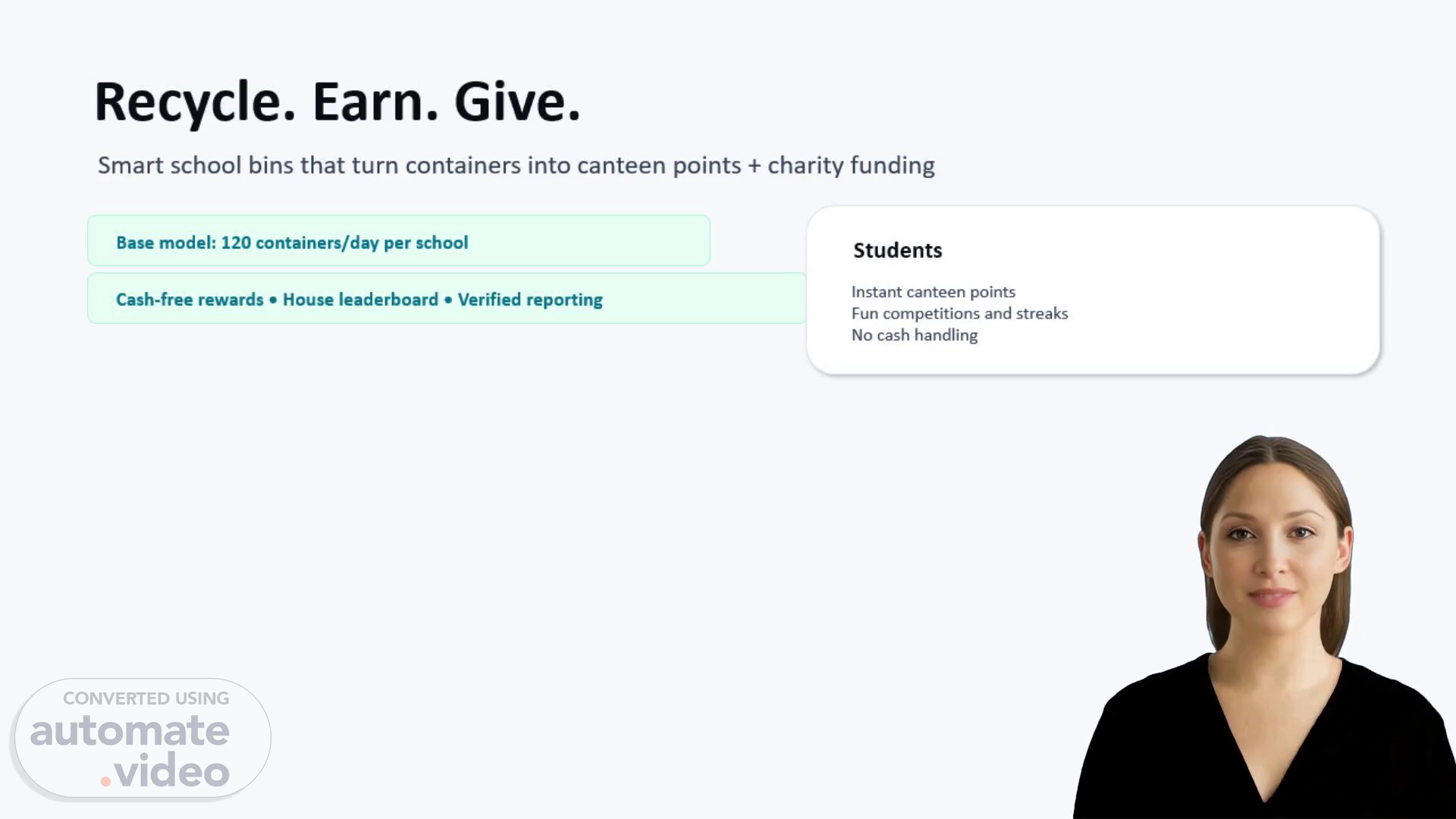
[Virtual Presenter] The Smart School Recycling Network is an initiative designed to assist Australian schools in recycling more efficiently. This network allows students to earn canteen points and contribute to charitable causes by returning recyclable containers to designated bins. The system operates on a straightforward principle: every time a student collects a recyclable item, they receive points that can be exchanged for prizes such as fun competitions and streaks. Furthermore, this system enables schools to generate revenue through regular donations and minimizes waste on campus. Sponsors can participate by displaying their brand on school bins and monitoring the effects of their sponsorship. The primary objective of the Smart School Recycling Network is to foster a clean and healthy environment while offering students a chance to interact with their local community..
Scene 2 (59s)
[Audio] The machine verifies the item and splits its value into three parts: points, charity, and power reserve. The total value created each year is calculated based on the assumption that 120 cans or bottles are collected daily and 200 days are used annually. A point system is also established, with one point equivalent to one cent of canteen credit and one container worth four points, which equates to one dollar credit when 25 containers are collected. Students can redeem their accumulated points instantly, updating their wallet balance, and use them to purchase items from the canteen like they would with regular store credit..
Scene 3 (1m 46s)
[Audio] The system allows for a competitive environment where houses compete against each other. In this "Charity vs Charity" mode, students earn points not only for collecting cans but also for their house's overall performance. The current leaderboard shows the standings for each house - Green, Blue, Red, and Gold. The Green House leads with 1,840 points, followed closely by the Blue House with 1,712 points. The Red House is third with 1,504 points, while the Gold House trails behind with 1,296 points. But it's not just about individual house scores; engagement loops encourage teamwork and collaboration among classes. These include weekly "house vs house" challenges, term trophies, and assemblies, as well as sponsor-funded double-point weeks and class streaks with badges. To ensure transparency and accountability, what gets verified includes container counts by house and class, canteen credits issued and redeemed, charity funds accrued, and sponsor impressions and impact..
Scene 4 (2m 58s)
[Audio] The unit economics analysis of the program reveals that the total value generated annually by each school can be broken down into three main components: canteen credits, charity funding, and power reserve. The values are calculated based on the assumption of 120 containers being collected per day and 200 school days per year. The breakdown is as follows: Canteen credits: $960 Charity funding: $1,200 Power reserve: $240 These figures represent the annual outcomes per school, providing insight into the financial performance of the program. The unit economics analysis also shows that the program generates significant revenue from the sale of recyclable materials. The revenue generated is substantial enough to cover the costs associated with collecting and processing these materials. In fact, the program has been able to generate more than sufficient revenue to cover its operational costs, making it a financially viable option. The program's financial viability is further supported by the fact that the cost of recycling is significantly lower than the cost of producing new materials. This makes recycling an attractive option for businesses looking to reduce their environmental impact. The program's success can also be attributed to the fact that it provides a valuable service to the community. By recycling and reusing materials, the program helps to conserve natural resources and reduce waste. This not only benefits the environment but also contributes to the overall well-being of society..
Scene 5 (4m 43s)
[Audio] The organization has conducted an analysis of its programs across all Australian schools. The analysis reveals that there are significant opportunities for growth in both company profits and charitable donations. The data indicates that if more schools adopt the program, it will lead to higher profits and greater charitable giving. The charts provided demonstrate the relationship between school adoption rates and financial outcomes. The findings suggest that by increasing adoption rates, the organization can improve its market position and increase revenue. The organization's model suggests that the potential upside lies in the adoption of the program by a large number of schools. A high level of participation would result in substantial increases in company profits and charitable donations. The data also shows that student canteen credits will increase significantly with higher adoption rates. The charts illustrate this trend, showing a direct correlation between school adoption rates and student canteen credit gains. The organization believes that its programs offer a unique value proposition that sets them apart from competitors. The data supports this claim, as the analysis reveals that the organization's programs are more effective than those of its competitors in terms of generating revenue and improving student outcomes. The findings suggest that the organization should focus on increasing adoption rates among schools to maximize its potential for growth. The organization is committed to expanding its reach into new markets and increasing its presence in existing ones. To achieve this goal, the organization needs to develop strategies for increasing adoption rates among schools. The data provides valuable insights into the factors that influence school adoption decisions, including the role of leadership, communication, and support. The organization should consider these factors when developing its strategies to increase adoption rates..