Scene 1 (0s)
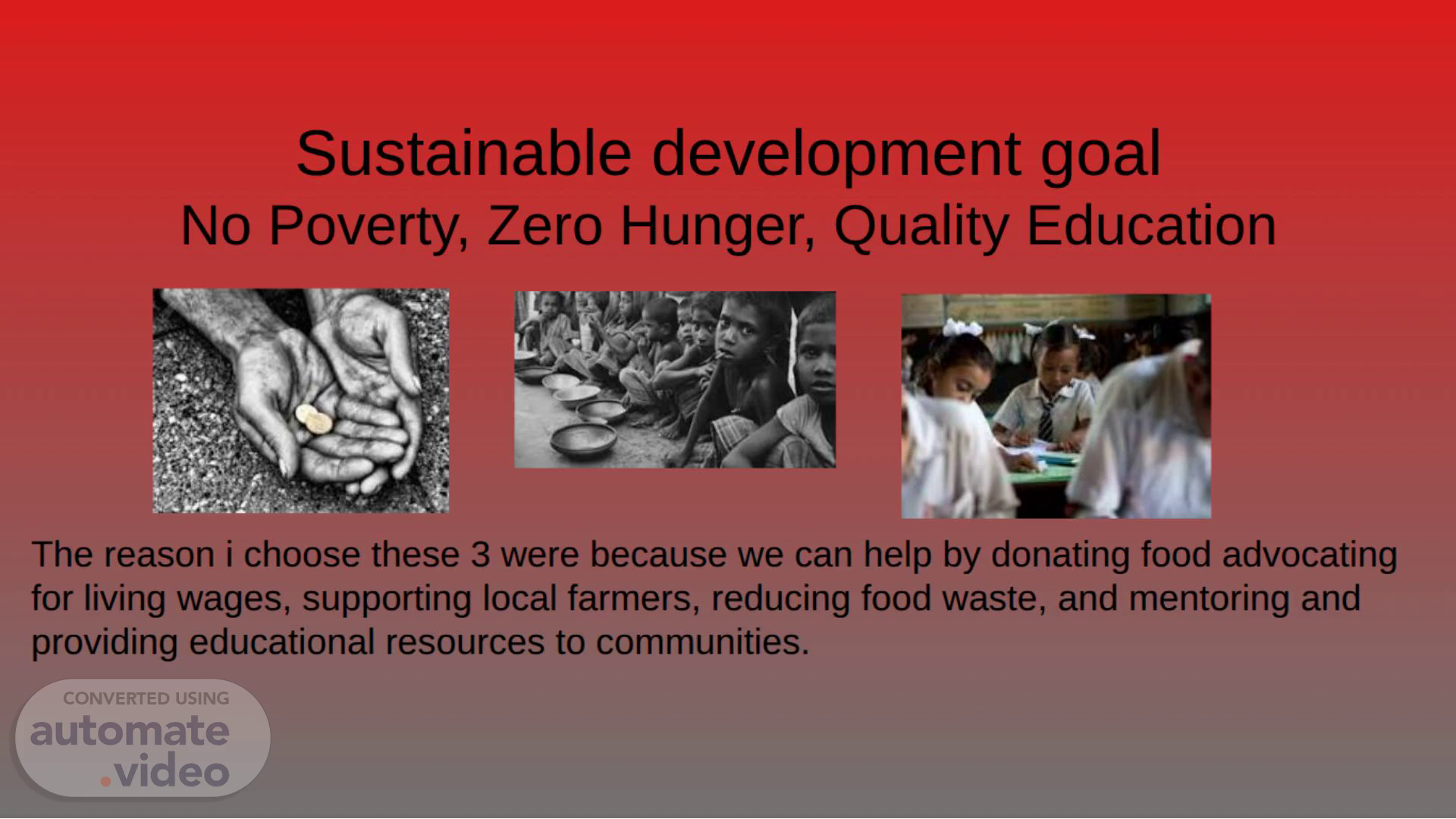
Sustainable development goal No Poverty, Zero Hunger, Quality Education The reason i choose these 3 were because we can help by donating food advocating for living wages, supporting local farmers, reducing food waste, and mentoring and providing educational resources to communities..
Scene 2 (6m 50s)
Quality Education Goal 4 remains a critical enabler for sustainable development, yet progress falls short of targets. Improvements in upper secondary completion rates have slowed, while learning outcomes in many countries are declining. Troubling regional disparities exist in early childhood development, and sub-Saharan Africa is at a particular disadvantage. Despite modest improvements in literacy, hundreds of millions of people remain illiterate, and women are disproportionately affected. Teacher qualification challenges persist and there has been minimal improvement since 2015. The rise of digital societies necessitates the integration of technology into education, in order to ensure that young people and future generations have access to relevant, high-quality content that prepares them for the demands of a rapidly evolving labour market. Ensure inclusive and equitable quality education and promote lifelong learning opportunities for all.
Scene 3 (7m 22s)
Out-of-school numbers are growing in sub-Saharan Africa The article explains that millions of children and teenagers in Sub-Saharan Africa are still unable to attend school, making it one of the regions with the highest number of out-of-school youth in the world. UNESCO reports that poverty, conflict, lack of teachers, and poor school infrastructure are major reasons why students are missing out on education. Girls are especially affected, with many unable to complete secondary school. The report also highlights how the COVID-19 pandemic worsened educational inequalities across the region.UNESCO and the African Union are encouraging governments to invest more in schools, teacher training, and digital learning to help achieve Sustainable Development Goal 4: Quality Education for all. Source: UNESCO Global Education Monitoring Report NUMBER OF SECONDARY-SCHOOL AGE GIRLS OUT-OF-SCHOOL IN SUB-SAHARAN AFRICA.
Scene 4 (7m 56s)
Early Childhood Missing pre-primary education hinders cognitive development, creating learning gaps before school even starts. Adolescent Dropouts Older youth face pressure to leave school early for work or marriage, halting education. Adult Literacy: Older generations often lack digital and basic literacy, limiting their modern employment opportunities. Lifelong Learning Age stereotyping can discourage older adults from pursuing continuous upskilling and university education. AFRICA 2026 -—1,584,985,258 1.584985259 YEAR ABCOEEGHWKLMNOPOPSIUVWYZ.
Scene 5 (8m 17s)
QUALITY EDUCATION IN SUB-SAHARAN AFRICA 1. THE PROBLEM oua FUTURE OUR DREAMS OUR EWCATION X POOR INFRASTRUCTURE X LACK OF TEACHERS X FEW LEARNING MATERIALS X HIGH DROP-OUT RATES X LIMITED OPPORTUNITIES Many children in Sub-Saharan Africa face poor infrastructure, few teachers, and limited resources, making it hard to get a quality education and build a better future. 2. THE SOLUTION CATION EMPOWERS COMMUNITIES OUR PLAN: v' TRAIN TEACÆRS v' BIRD SCHns v' PROWE MATERIALS TECHtöLOGY v' ENGAGE COMR.JNITY Communities, governments, and partners work together to train teachers, build schools, provide learning materials, use technology, and support every child to stay in school and learn well. OUR 3. THE RESULT EDUCATED TODAY, LEADERS TOMORROW v' BETTER LEARNING v' MORE OPPORTUNITIES STRONGER COMMUNITIES BRIGHTER FUTURES Quality education transforms lives— creating skilled, confident leaders, stronger communities, and a brighter, more prosperous future for Sub-Saharan Africa..
Scene 6 (8m 49s)
Push Factors Severe Teacher Shortages: Sub-Saharan Africa faces a massive deficit of roughly 15 million teachers, causing heavily overcrowded classrooms. Language Barriers: Close to 80% of children are instructed in languages they do not speak at home, severely disrupting early learning outcomes. Funding & Infrastructure Deficits: Inadequate public funding leaves many rural or under-resourced public schools without basic text books, electricity, or clean water. Pull Factors Top-Tier School Districts: Access to heavily funded public schools, renowned universities, and elite private institutions. Specialized Programs: Availability of advanced curricula like International Baccalaureate (1B), Advanced Placement (AP), or specialized STEM academies. Safe Learning Environments: Low crime rates, supportive counseling services, and inclusive, community-driven school cultures..
Scene 7 (9m 18s)
Public Service Alert The Threat is Real, and It is in Our Classrooms.Across sub-Saharan Africa, severe, climate-induced drought is actively sabotaging the region's progress toward Sustainable Development Goal 4 Quality Education. Decades of academic growth are unraveling as extreme weather patterns intensify. I.
Scene 8 (9m 33s)
I CLIMATE I I POPULATION I I MIGRATION I I (Direct School Closures) I SDG4 I EDUCATION I (Resource Depletion) (Overcrowds Hubs) I REGIONAL I I INTERACTION I Extreme Climate events destroy agricultural livelihoods in sub-Saharan Africa, forcing the rural Population to engage in survival-driven Migration toward urban areas. This sudden influx intensifies Regional Interaction as displaced families and host communities compete for heavily strained local infrastructure and public services. Ultimately, this rapid population shift completely overwhelms urban classrooms, triggering severe resource shortages and high dropout rates that directly derail SDG 4 (Quality Education)..
Scene 9 (9m 53s)
NGO: Education Cannot Wait Education Cannot Wait works to generate greater political, operational and financial commitment to meet the educational needs of millions of children and youth affected by crises Recent Project (2025) Education Cannot Wait expanded its education programs across Africa, reaching more than 7.4 million children through teacher training, foundational learning programs, gender-equality initiatives, learning materials, and psychosocial support for students affected by conflict and poverty. How this helps. Training more teachers Providing quality learning materials Increasing access to education for girls Supporting schools in crisis-affected areas Helping children stay in school and improve literacy and learning outcomes across Sub-Saharan Africa..
Scene 10 (10m 20s)
Every Child Learning, Every Community Growing 1. Collect School Supplies: Organize community drives to collect books, notebooks, pencils, and other learning materials for students in need. 2. Support Local Tutoring Programs: Recruit volunteers to provide after-school tutoring and reading assistance for students who need extra help. 3. Raise Funds for School Improvements: Hold community fundraisers to help schools purchase technology, repair classrooms, and provide educational resources..
Scene 11 (10m 41s)
Script Hello everyone. Today I will be talking about Sustainable Development Goal 4, which is Quality Education, and how it relates to Sub-Saharan Africa. Quality Education aims to ensure that all children have access to inclusive, and quality learning opportunities. In many parts of Sub-Saharan Africa, students face challenges such as overcrowded classrooms, a lack of school supplies, poverty, and limited access to trained teachers.The news article I selected highlights the importance of improving education in the region. The article explains how educational programs are helping children gain better access to learning and creating opportunities for future success. This is important because education helps reduce poverty, improve health, and strengthen communities. One organization working toward this goal is Education Cannot Wait. Their mission is to provide quality education to children affected by crises and poverty. A recent project supported millions of children across Africa through teacher training, educational resources, and learning support programs. Their work directly supports SDG 4 by helping students stay in school and receive a better education.For my regional interaction comic, the first panel shows the problem: many communities lack adequate educational resources. The second panel shows governments, organizations, and communities working together to improve schools and provide learning opportunities. The third panel shows the result: more children attending school, improved literacy rates, and stronger communities.To support this goal on a local level, my slogan is, "Every Child Learning, Every Community Growing!" My first step is to organize school supply drives. My second step is to support tutoring and mentoring programs. My third step is to raise funds for educational resources and school improvements.ln conclusion, Quality Education is essential for creating opportunities and improving lives. By supporting educational programs both globally and locally, we can help ensure that every child has the chance to learn and succeed. Thank you for listening..