Scene 1 (0s)
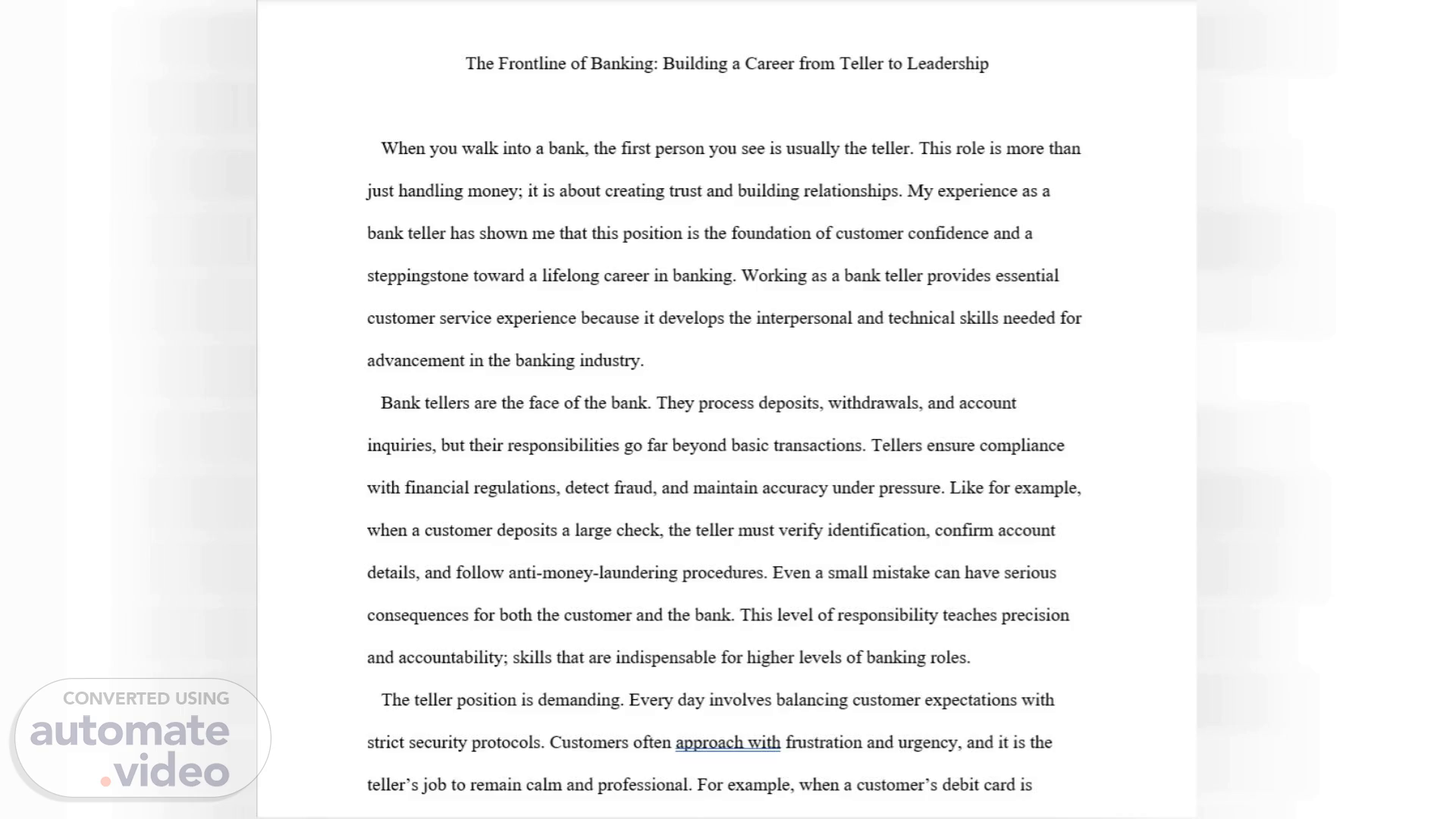
[Audio] . The Frontline of Banking: Building a Career from Teller to Leadership When you walk into a bank, the first person you see is usually the teller. This role is more than just handling money; it is about creating trust and building relationships. My experience as a bank teller has shown me that this position is the foundation of customer confidence and a steppingstone toward a lifelong career in banking. Working as a bank teller provides essential customer service experience because it develops the interpersonal and technical skills needed for advancement in the banking industry. Bank tellers are the face of the bank. They process deposits, withdrawals, and account inquiries, but their responsibilities go far beyond basic transactions. Tellers ensure compliance with financial regulations, detect fraud, and maintain accuracy under pressure. Like for example, when a customer deposits a large check, the teller must verifr identification, confirm account details, and follow anti-money-laundering procedures. Even a small mistake can have serious consequences for both the customer and the bank. This level of responsibility teaches precision and accountability; skills that are indispensable for higher levels of banking roles. The teller position is demanding. Every day involves balancing customer expectations with strict security protocols. Customers often fi-ustration and urgency, and it is the teller's job to remain calm and professional. For example, when a customer's debit card is.
Scene 2 (3m 33s)
the issue clearly, and offer solutions such as verifying funds or suggesting alternative payment methods. These challenges are what make the role rewarding. They develop resilience, problem solving abilities, and emotional intelligence. These qualities are not only valuable in banking but also transferable to leadership positions. Many branch managers and loan officers began their careers as tellers because the role provides firsthand experience with customer needs and operational processes. Starting as a teller opens doors to numerous opportunities within the banking industxy. Internal promotion paths often include personal banker, assistant manager, and branch manager roles. Each step requires a deeper understanding of financial products and customer relationship management; skills that originate at the teller window. Take for example, a teller who consistently meets performance goals and demonstrates strong customer service may be offered in opening new accounts or assisting with loan applications. These experiences prepare employees for roles that involve advising customers on mortgages, investments, and retirement planning. Banks value loyalty and experience, making career progression attainable for those who demonstrate commitment and competence. For individuals like me, who aspire to build a lifelong career in banking, the teller position is not a dead end but a launchpad for success..
Scene 3 (4m 19s)
Some argue that frontline roles like teller positions are becoming obsolete due to digital banking and automation. Mobile apps and ATMs allow customers to deposit checks, transfer funds, and pay bills without visiting a branch. Although human interaction remains vital for tmst and relationship building. Customers still seek personalized advice, reassurance during financial uncertainty, and assistance with complex transactions; services that cannot be fully automated. For example, when a customer faces fraud on their account, they often prefer speaking to a person who can empathize and guide them through the resolution process. Rather than eliminating tellers, technology complements their role, allowing them to focus on higher value interactions such as educating customers about digital tools or helping them choose the right financial products. To thrive in banking, tellers should cultivate digital proficiency, product knowledge, and strong communication skills. Networking and mentorship are also key to moving into personal banking and managerial roles. My plan is to take relevant certifications, seek cross training opportunities, and develop deeper rapport with customers to set the stage for promotion. For example, learning about mortgage lending or investment accounts can make a teller more valuable to the branch and open doors to advisory positions. These steps will help me achieve my goals in building a career that lasts until retirement..
Scene 4 (5m 9s)
Being a teller is more than a job; it is a foundation. This role fosters essential customer service, compliance, and communication skills that prepare individuals for management and advisory positions. Despite technological advancements, face to face interaction remains irreplaceable for complex financial needs. As I work toward a lifelong career in banking, I recognize the teller's experience as a critical first step. Human skills; especially empathy, precision, and adaptability; remain indispensable. My goal is not to leave the bank; it is to rise within it and contribute to increasingly strategic roles until I am able to retire. One of the most overlooked aspects of banking is the emotional connection between customers and employees. While numbers and transactions drive the industry, trust and relationships sustain it. A teller often becomes the first point of reassurance when customers face financial stress. For example, during the COVID-19 pandemic, many customers visited branches seeking guidance on loan deferments or stimulus deposits. Tellers were not just processing requests; they were listening, empathizing, and explaining complex policies in simple terms. These moments highlight why human interaction remains irreplaceable. Technology can handle speed and convenience, but it cannot replicate empathy or judgement in sensitive situations..
Scene 5 (5m 55s)
Tellers play a critical role in identifying opportunities for growth within the bank. By observing customer behavior and asking the right questions, a teller can recommend products that meet financial goals, such as savings accounts or small business loans. This proactive approach benefits both the customer and the bank, strengthening loyalty and profitability. In this way, the teller position is not only operational but strategic, serving as a bridge between customer needs and the bank's services. As I look toward my future in banking, these experiences remind me that success in this industxy is built on more than technical skills; it requires emotional intelligence, adaptability, and a genuine commitment to helping people. These qualities will guide me as I move from the teller window to leadership roles, ensuring that I contribute to a banking environment where technology and human connection work hand in hand..