Scene 1 (0s)
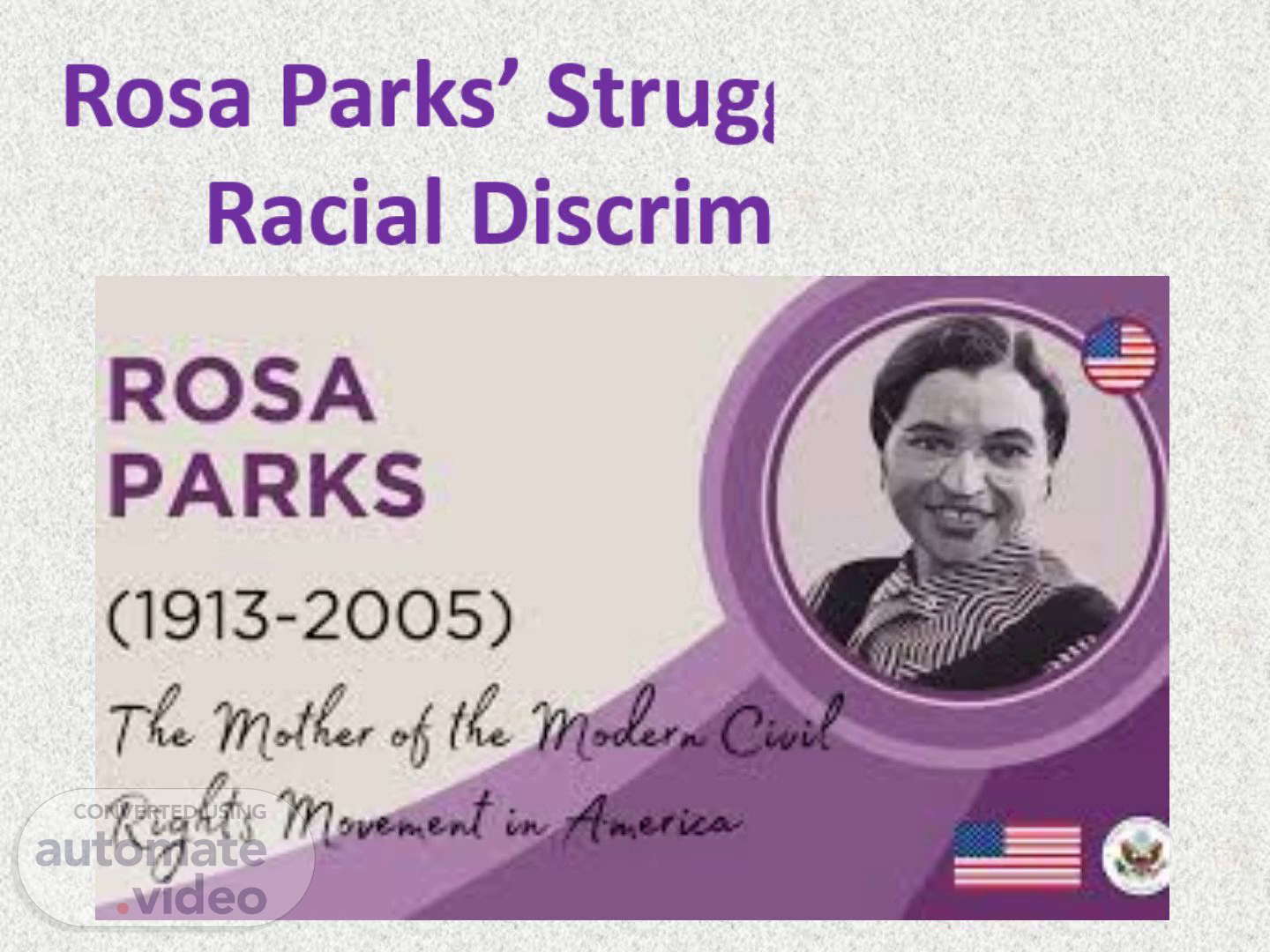
Rosa Parks’ Struggle Against Racial Discrimination.
Scene 2 (7s)
Rosa Parks, an African American woman, holds a special place in American history because of her struggle for freedom and equality..
Scene 3 (18s)
At a time when the basic rights were denied to Black citizens, she managed to face the racial discrimination of White people by teaching them to be more tolerant and respectful..
Scene 4 (30s)
Her story reminds us that one brave decision can make a difference and help build a more just society..
Scene 5 (40s)
On December 1st, 1955, Rosa Parks went home by a city bus..
Scene 6 (48s)
She sat in the middle of the bus, for Black people were allowed to sit as long as White citizens were not standing..
Scene 7 (58s)
When the bus driver noticed that all the seats were full, he ordered the passengers in the middle to move to the back of the bus..
Scene 8 (1m 10s)
Rosa Parks rejected to leave her seat, so the angry bus driver went out of the bus and returned with policemen..
Scene 9 (1m 20s)
Mrs. Parks was arrested and sent to jail for the night..
Scene 10 (1m 31s)
On the next day, her husband Raymond Parks went to pick up his wife from prison..
Scene 11 (1m 41s)
After Rosa Parks’ arrest, the African Americans agreed to boycott city buses on Monday, December 5th, and Martin Luther King was chosen to lead the boycott..
Scene 12 (1m 52s)
The boycotters chose to walk, take taxis, and ride their bicycles to get to work..
Scene 13 (2m 1s)
Slowly, the bus company began to lose money because 75% of its riders were Black..
Scene 14 (2m 12s)
Because the boycotters were shopping closer to home, the White shopkeepers were also losing money..
Scene 15 (2m 21s)
Finally, one year after Rosa Parks’ refusal to give up her seat, the Supreme Court ruled — on November 13th, 1956 — that racial laws were not fair..
Scene 16 (2m 34s)
As a result, the Montgomery Bus Boycott, which lasted for 381 days, ended on December 20th, 1956..
Scene 17 (2m 45s)
Today, Rosa Parks is known as a national heroine and as a brave woman who fought for freedom..
Scene 18 (2m 54s)
I have learned many lessons from Rosa Parks’ story..
Scene 19 (3m 3s)
First, racial discrimination causes conflicts and riots between races, and it may even lead to wars among nations..
Scene 20 (3m 14s)
Second, intolerance is a bad practice because it brings about violent reactions from the oppressed citizens..
Scene 21 (3m 23s)
Therefore, the citizens who are exposed to intolerance must stand for their rights and fight against any kind of discrimination..
Scene 22 (3m 33s)
They can also boycott intolerant people since boycott is a peaceful way to regain their civil and human rights..