Scene 1 (0s)
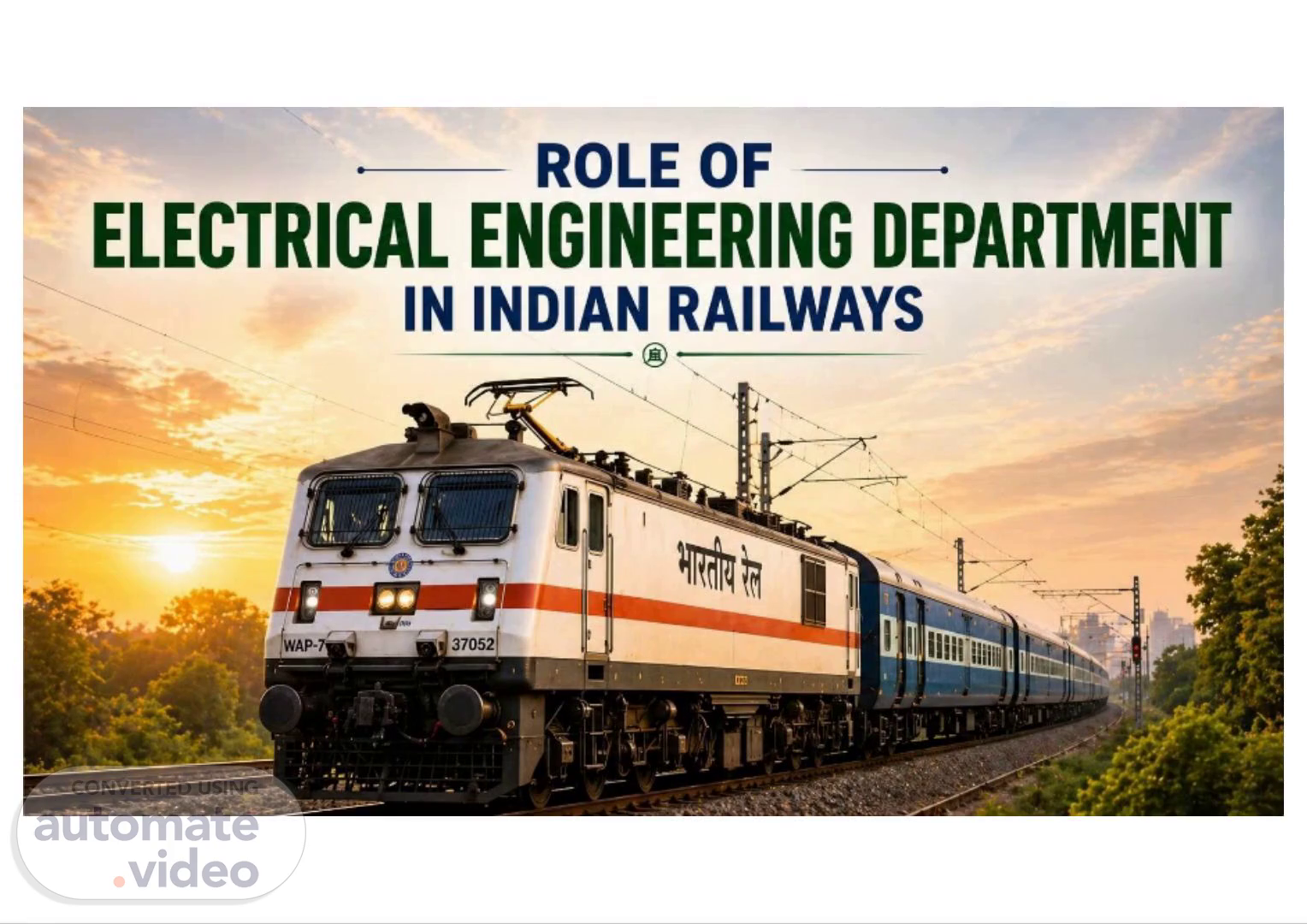
ROLE OF ELECTRICAL ENGINEERING DEPARTMENT IN INDIAN RAILWAYS 37052.
Scene 2 (1m 56s)
[Audio] The Indian Railways has a rich history dating back to 1853 when the first passenger train ran from Bori Bunder in Mumbai to Thane, covering a distance of 34 kilometers. At that time, coaches were used and they relied on oil lamps for lighting. One lamp was fixed per coach and it had to be removed after sunset and reinstalled before sunrise due to safety concerns. The lamps were mounted on the ceiling and could only be accessed from the roof. This early setup indicates how far the railways have come since then. The Electrical Engineering Department in Indian Railways played a significant role in the transition from oil lamps to modern electrical systems. The department's efforts led to the widespread adoption of electric traction, resulting in smoother and faster journeys. Today, Indian Railways stands among the largest electrified railway networks in the world, with the Electrical Engineering Department at the forefront of powering these networks. The transformation has been remarkable, and it is essential to acknowledge the contributions of the Electrical Engineering Department in achieving this success..
Scene 3 (3m 8s)
[Audio] The introduction of the gas lighting system in Indian Railways marked a significant milestone in the history of the organization. The system provided brighter and clearer light, better visibility, and an enhanced travel experience. The benefits of the gas lighting system included more reliable and safer journeys. The widespread adoption of the system led to further innovations in the railway sector. The improvements made by the gas lighting system had a lasting impact on the railway network. The system was instrumental in paving the way for future technological advancements..
Scene 4 (3m 45s)
[Audio] The introduction of electric train lighting using 24V DC batteries in 1897 marked a significant milestone in the evolution of coach lighting in Indian Railways. This innovation provided bright and steady light to the coaches, enhancing the overall passenger experience. The use of 24V DC batteries became widespread by 1902, becoming a standard in many regions of Indian Railways. The benefits of this technology were numerous, including safer and more reliable lighting, reduced maintenance compared to oil/gas lighting, and enhanced comfort for passengers. This early adoption of electric lighting set the stage for further innovations in the electrical engineering department of Indian Railways..
Scene 5 (4m 32s)
[Audio] Electric lighting replaced oil lamps in railway stations and coaches. The use of axle-driven dynamos and batteries enabled train lighting to become a reality. Over time, the system was gradually improved for greater reliability and passenger comfort. In 1907, the installation of fans further advanced the technology..
Scene 6 (5m 15s)
[Audio] The early years of electrical services in Indian Railways were marked by limited roles for electrical personnel. Their main responsibilities were focused on general services like station lighting and fans, with little involvement in train operations. However, this all changed with the introduction of the first electric train on February 3rd, 1925, operating on a 1500 V DC system between Bombay Victoria Terminus and Kurla. This marked the beginning of large-scale electrical operations in Indian Railways. Initially, electrification was limited to suburban sections to manage increasing urban traffic, with cities like Mumbai and Madras (Chennai) being electrified in 1925 and 1931 respectively. The Electrical Department's status evolved over time, moving from being considered a minor department under the Mechanical Department to becoming a more prominent entity. Today, the Electrical Department plays a vital role in powering trains and connecting people across India. Its journey is one of progress and transformation, from humble beginnings in general services to its current position as a key player in Indian Railways..
Scene 7 (6m 33s)
[Audio] The period post-independence saw significant expansion and modernization in Indian Railways. The shift from DC to AC electrification marked a major milestone, enabling faster and more efficient train operations. The introduction of electric locomotives further transformed the rail network, with notable examples including the WAM-I locomotive designed and built by Chittaranjan Locomotive Works. This era also witnessed the expansion of electric traction across major routes, paving the way for improved passenger comfort and reduced emissions. The development of centralized power systems and advanced technologies such as head-on generation enabled higher speeds, longer trains, and enhanced reliability..
Scene 8 (7m 21s)
[Audio] The Indian Railways has made significant progress in strengthening its electrical services over the years. One major milestone was the first mainline AC section becoming operational on December 15, 1959, between Rajkharswan and Dongoaposi. Another key development was the establishment of the Central Organisation for Railway Electrification (CORE) in 1979, which marked institutional growth. In 1951, a dedicated project office was set up, laying the groundwork for CORE's creation. By 1976, the Howrah-Delhi route had been fully electrified with a 25kV AC section operational since December 15, 1959. The departmental independence gained in 1987, with the creation of the Member (Electrical) post on the Railway Board, represented a major step towards recognition, autonomy, and stronger decision-making for electrical services. This milestone marked a journey of vision, dedication, and progress from pioneering sections to institutional strength..
Scene 9 (8m 33s)
[Audio] The Indian Railways has undergone significant changes since the 1970s and 1990s. These changes included rapid electrification and technological advancements. The shift from steam engines to electric locomotives and diesel locomotives resulted in large-scale replacements. Temporary transitions between these technologies also took place. Improved overhead equipment systems, reliable power supply networks, and enhanced passenger amenities were introduced during this period. Air conditioning was first introduced in coaches, providing a major improvement in comfort. The Rajdhani Express, which was launched in 1969, featured air-conditioned coaches, making it one of the first trains to do so. This era marked a significant transformation in the way Indians traveled by train..
Scene 10 (9m 24s)
[Audio] The Indian Railways underwent significant changes during the 1990s and 2010s, marked by the widespread introduction of air-conditioned coaches and high-power locomotives. This era saw major advancements in passenger comfort and efficiency. The introduction of AC 2-tier and AC 3-tier coaches enabled passengers to travel in greater comfort. Additionally, two electric locomotives were introduced, along with high-power locos such as the WAP-5 locomotive. Centralized power systems, including End-on Generation (EOG) and Head-on Generation (HOG), were also implemented. These technological upgrades led to higher speeds, longer trains, improved reliability, stronger locos, smarter systems, and superior comfort. The WAP-7 locomotive was a key part of this transformation, playing a crucial role in powering India's modern railway network..
Scene 11 (10m 27s)
[Audio] The Indian Railways has been working on modernizing its electrical infrastructure since 2009. The first phase of this effort was completed in 2010. Since then, the department has made significant progress in transitioning to fully electrified and energy-efficient systems. One notable achievement is the near 100% electrification of broad-gauge routes across India. Another key accomplishment is the transition to advanced technologies such as regenerative braking in locomotives, which saves energy and improves efficiency. Modern trains like the Vande Bharat Express have also been introduced, offering passengers full air-conditioning and all-weather comfort. Furthermore, the Indian Railways has implemented smart grid and SCADA systems, enabling real-time monitoring and reliable operations. Automatic doors have also been introduced, providing convenience, safety, and faster boarding..
Scene 12 (11m 32s)
[Audio] The Electrical Engineering Department plays a crucial role in maintaining the efficiency and reliability of Indian Railways. The department currently handles several critical functions, including electric traction, train lighting and air-conditioning, power supply to stations, renewable energy integration, and maintenance of high-voltage systems. These responsibilities enable the department to drive innovative train operations, enhance passenger comfort, and maintain a stable power supply to stations and offices. Moreover, the department's focus on renewable energy promotes a sustainable future for Indian Railways. By integrating solar power into its operations, the department contributes to the country's development and growth. Overall, the Electrical Engineering Department is essential to powering progress and connecting India..
Scene 13 (12m 27s)
[Audio] The Indian Railways has undergone a remarkable transformation over the years. The journey began in the 1800s with the introduction of oil lamps, marking the beginning of illumination. This was followed by the introduction of steam engines in the 1900s, which drove progress and systems. In the 1950s and 1960s, the transition to diesel locomotives marked a significant step towards modernization. The 1970s and 1980s saw the emergence of electric traction, with the introduction of advanced technologies such as AC coaches and high-power locos. By the 1990s and 2000s, the focus shifted to comfort, speed, and efficiency management, with the introduction of air-conditioned coaches and advanced onboard electronics. Today, Indian Railways stands among the largest electrified railway networks in the world, with its electrical department playing a crucial role in this transformation. The journey continues, with the modern era bringing smart, sustainable, and future-ready solutions, including extensive electrification, reliable power supply networks, and advanced onboard electronics. As we move forward, the emphasis is on environmental sustainability, with lower emissions, cleaner energy, and a greener and more sustainable future..
Scene 14 (13m 59s)
[Audio] The Electrical Department has made significant contributions to Indian Railways by transforming the way trains are powered and connecting communities across the country. One key achievement is the nearly 100% electrification of broad-gauge routes, which enables faster trains, higher capacity, and reduced dependence on imported fuels. The department has also introduced high-power electric locomotives, such as the WAP and WAG series, which power both freight and passenger trains. In addition, they have implemented modern amenities like air-conditioning in coaches, smart monitoring systems, and charging points. Furthermore, the department is working towards renewable energy integration through solar panels on stations and buildings, which reduces the carbon footprint and moves towards green energy. These efforts aim to build a greener, faster, and more comfortable India..
Scene 15 (14m 55s)
[Audio] Electric trains are better than diesel trains because they produce no emissions at the point of use, which reduces noise pollution and improves air quality. Furthermore, electric trains help achieve India's climate goals by using renewable energy sources. Moreover, electric trains can carry heavier loads and travel faster, making them a more environmentally friendly option for Indian Railways. On the other hand, diesel trains release toxic pollutants like carbon dioxide, nitrogen oxides, and particulate matter into the atmosphere, resulting in air and noise pollution that harms the environment and human health..
Scene 16 (15m 36s)
[Audio] The Electrical Department plays a crucial role in maintaining India's rail network. The department is responsible for providing electricity to all railway stations and ensuring that the railways are powered by clean energy sources. One of its main objectives is to reduce the country's reliance on fossil fuels. To achieve this, the department has been instrumental in introducing electric traction systems, which have enabled faster and more efficient trains. Additionally, the department has implemented measures to increase the use of renewable energy sources, such as solar and wind power. These efforts have not only improved the environment but also helped to reduce the cost of operating the railways. Furthermore, the department has worked to improve the reliability and efficiency of the electrical distribution system, resulting in fewer power outages and increased passenger satisfaction. By focusing on these areas, the Electrical Department has become an essential component of India's transportation infrastructure..
Scene 17 (16m 40s)
[Audio] The Electrical Engineering Department of Indian Railways is responsible for maintaining the safety and efficiency of the railway network. The department is headed by a Director who oversees the overall strategy and direction of the department. The Director is assisted by several Deputy Directors who oversee specific areas such as maintenance, engineering, and operations. The department is divided into several sub-departments, including the Maintenance Division, the Engineering Division, and the Operations Division. The Maintenance Division is responsible for the upkeep of the railway tracks, signals, and other equipment. The Engineering Division is responsible for designing and constructing new railway infrastructure, including electrification systems. The Operations Division is responsible for the day-to-day operation of the railway network, including scheduling and maintenance of trains. The department is equipped with state-of-the-art facilities and technology, including advanced computer systems, simulation software, and specialized tools. The department employs a diverse range of personnel, including engineers, technicians, and administrative staff. The department works closely with other departments within Indian Railways, including the Mechanical Engineering Department, the Civil Engineering Department, and the Signal and Telecommunications Department. The department is committed to providing excellent customer service and ensuring that passengers have a comfortable and enjoyable journey. The department is also committed to reducing carbon emissions and promoting sustainable energy sources. The department is working to improve the efficiency of the railway network through the use of advanced technologies and innovative solutions. The department is led by a Director who is responsible for overseeing the overall strategy and direction of the department. The Director is assisted by several Deputy Directors who oversee specific areas such as maintenance, engineering, and operations. The department is divided into several sub-departments, including the Maintenance Division, the Engineering Division, and the Operations Division. The Maintenance Division is responsible for the upkeep of the railway tracks, signals, and other equipment. The Engineering Division is responsible for designing and constructing new railway infrastructure, including electrification systems. The Operations Division is responsible for the day-to-day operation of the railway network, including scheduling and maintenance of trains. The department is equipped with state-of-the-art facilities and technology, including advanced computer systems, simulation software, and specialized tools. The department employs a diverse range of personnel, including engineers, technicians, and administrative staff. The department works closely with other departments within Indian Railways, including the Mechanical Engineering Department, the Civil Engineering Department, and the Signal and Telecommunications Department. The department is committed to providing excellent customer service and ensuring that passengers have a comfortable and enjoyable journey. The department is also committed to reducing carbon emissions and promoting sustainable energy sources. The department is working to improve the efficiency of the railway network through the use of advanced technologies and innovative solutions. The department is led by a Director who is responsible for overseeing the overall strategy and direction of the department. The Director is assisted by several Deputy Directors who oversee specific areas such as maintenance, engineering, and operations. The department is divided into several sub-departments, including the Maintenance Division, the Engineering Division, and the Operations Division. The Maintenance Division is responsible for the upkeep of the railway tracks, signals, and other equipment. The Engineering Division is responsible for designing and constructing new railway infrastructure, including electrification systems. The Operations Division is responsible for the day-to-day operation of the railway network, including scheduling and maintenance of trains. The department is equipped with state-of-the-art facilities and technology, including advanced computer systems, simulation software, and specialized tools. The department employs a diverse range of personnel, including engineers, technicians, and administrative staff. The department works closely with other departments within Indian Railways, including the Mechanical Engineering Department, the Civil Engineering Department,.