Scene 1 (0s)
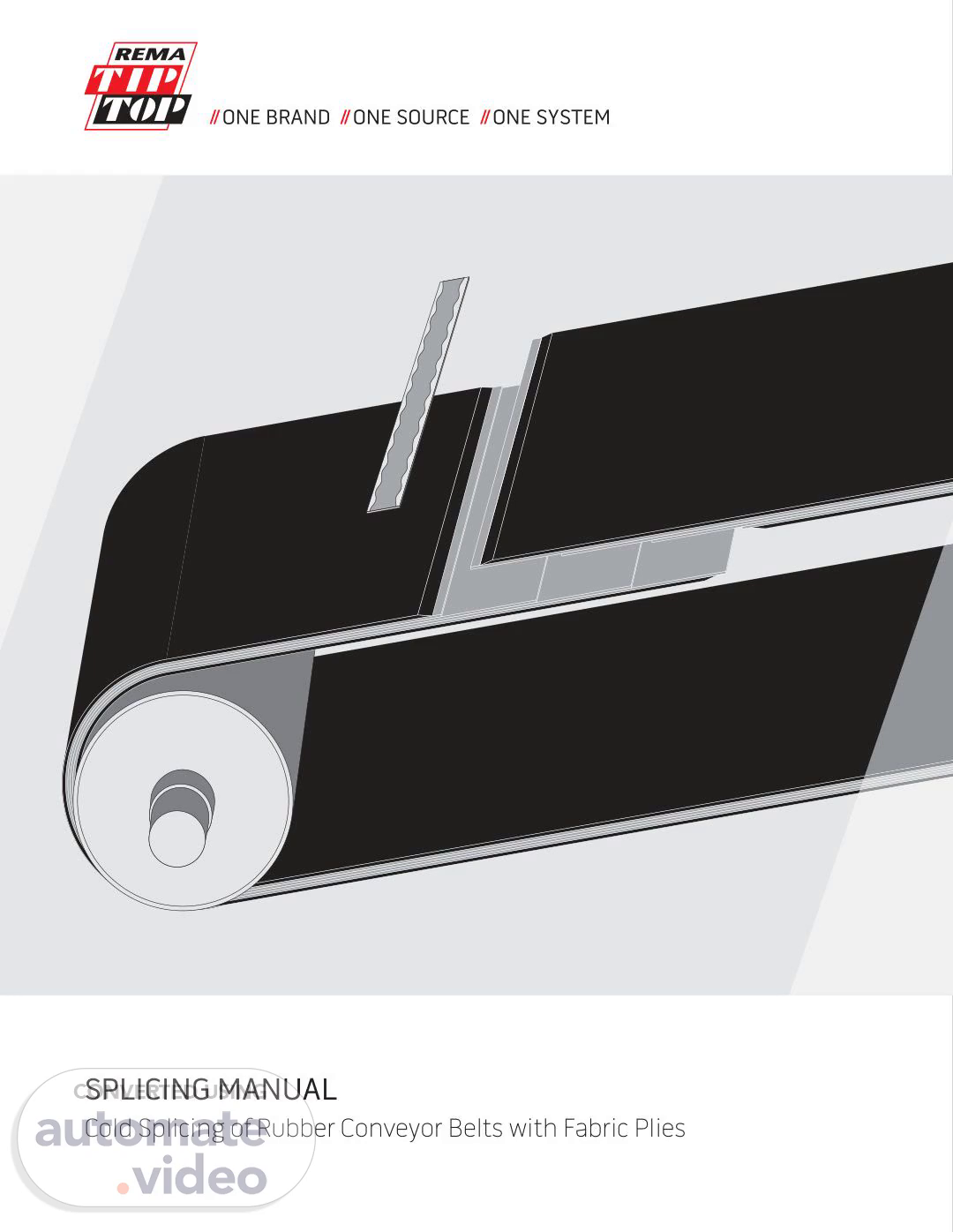
SPLICING MANUAL Cold Splicing of Rubber Conveyor Belts with Fabric Plies.
Scene 2 (7s)
2 Content General Recommendations Application Range of Cold Splices Contents Page General Recommendations 2 Storage of splicing products 2 Precautions 2 Application Range of Cold Splices 2 Standard and “V”-quality conveyor belts 2 Splicing methods 2 Place / site 2 Conditions for Cold Splicing 3 Working place 3 Conveyor belt 3 Ambient conditions 3 Tools and Equipment 3 Products for Cold Splicing of Standard and “V”-Quality Conveyor Belts 3 Systems and Dimensions of Cold Splices 4 Splicing methods 4 Selection of step direction 4 Splice runs against conveying direction 4 Splice runs in conveying direction 4 Selection of step length 5 Mono-ply belts – up to 1/500 5 Two-ply and multi-ply belts 6 Splicing Process 8 General preparation 8 Preparation of the lower part of the belt 9 Preparation of the upper part of the belt 12 Joining of the splice 13 Filling and covering the joint gap 15 Storage of splicing products Splicing products should be stored in a dry and dark place at a temperature between 59°F and 79°F (DIN 7716). Please observe expiry date on box! Precautions Observe safety instructions on the containers! Note: Our recommendations are the result of fi eld tests and long experience. In view of different materials and working conditions beyond our control it is generally recommended to make tests locally. A liability or responsibility can be extracted in no case from these recommendations. Standard and “V”-quality conveyor belts Cold endless splicing of mono- and multi-ply conveyor belts with textile carcass (DIN 22102) and covers made of the following polymers: – Natural rubber NR* – Styrene butadiene rubber SBR* – Isoprene rubber IR* – Butadiene rubber BR* – Chloroprene rubber CR* – or a mixture of above polymers, e.g. NR/SBR* In case of doubt consult belt manufacturer about rubber quality. For splicing of other belt types please contact your local REMA TIP TOP specialist. Sp licing methods – rectangular or – bias (0.3 x belt width) Place / Site – in a vulcanizing shop or – on site.
Scene 3 (1m 12s)
SPLICING MANUAL Cold Splicing of Rubber Conveyor Belts with Fabric Plies 3 Products for Cold Splicing of Standard and “V”-Quality Conveyor Belts Filler Rubber with CN Bonding Layer on Both Sides (TT440) U.S. Part # Product # Size 303 (1.5mm) 5285363 1/16" x 20" x 33' 305 (3mm) 5285899 1/8" x 29" x 33' 306 (3mm) 5285428 1/8" x 58" x 33' 309 (6mm) 5285916 1/4" x 29" x 33' 310 (6mm) 5285882 1/4" x 58" x 33' Belt Repair and Cover Strip U.S. Part # Product # Size CN66 (splice cover strip) 5316800 4" x 33' SC 2000 Black U.S. Part # Product # Size 101 000 041 SC2000B Pint / 1/2 kg 101 000 042 SC2000B 1KG Quart / 1 kg 101 000 043 SC2000BG Gallon / 5 kg 101 000 053 SC2000B-DRUM Drum / 290 kg UT-R 20 HARDENER (Non-Flammable) Use with SC 2000 Black Cement Only U.S. Part # Product # Size UTR20/20G 525 1030 20 g UTR20/40G 525 1046 40 g #13 Cleaning Solvent (Non-Flammable) Use with SC 2000 Black Cement Only U.S. Part # Product # Size 101 000 059 13-QT Quart / 32 fl . oz. 101 000 060 13-G Gallon / 1 US gal. 101 000 058 13-DRUM Drum / 54 U.S. gal. E-40 HARDENER (Flammable) Use with Standard Conveyor Belts and SC 4000 Black Cement Only U.S. Part # Product # Size E40/15G 525 1139 15 g E40/30G 525 1146 30 g R-50 CLEANING SOLVENT (Flammable) Use with SC 4000 Black Cement Only U.S. Part # Product # Size 101 000 061 R-50-QT Quart / 32 fl . oz. 101 000 062 R-50-GAL Gallon / 1 gal. 101 000 050 R-50-DRUM Drum / 54 US gal. SC 4000 Black U.S. Part # Product # Size 101 000 045 SC4000B-PINT Pint / 0.33 kg 101 000 046 SC4000-QT Quart / 660 g 101 000 047 SC4000-GAL Gallon / 3.3 kg 101 000 052 SC4000-DRUM Drum / 190 kg Conditions for Cold Splicing Working place In order to ensure quality and durability of a cold splice a clean working place and proper usage of the splicing products are essential. Conveyor belt Th e conveyor belt must be clean and dry. If necessary clean the belt as follows: – Scrape off water-soluble contamination (e.g. salt, fertilizer) and rinse with water. – Remove oil and grease with REMA TIP TOP Cleaning Fluid. Dry the belt with REMA TIP TOP Drying Hood or Air Dryer.* Ambient conditions Th e ambient temperature and the temperature of the splicing products should be between +50°F and +113°F. Humidity infl uences such as condensation water (below dew point) must be absolutely avoided. If necessary – erect a tent to protect working area from strong sunlight, rain and wind; – warm up splice area with a drying hood or a hot air dryer.* * Note: Electrical appliances must not be left unattended (risk of fi re!) or exposed to humidity. Tools and Equipment – Belt tensioners – Chain or cable winch – Screw clamps – Measuring tape – Metal ruler – Flat angle – Marking crayon (white) – Plumb line – 6” knife – Don Carlos knife – Off-set knife – Ply knife – Ply lifter – Whetstone – Scissors – Pincers – Grip tongs – Hand brush – Cement brush – Stitcher – Double acting roller – Cable drum – Safety goggles – Drying hood – Buffi ng motor (with fl exible shaft and wire brushes).
Scene 4 (2m 17s)
4 Systems and Dimensions of Cold Splices Splicing methods – Overlap splice (mono- and two-ply belts) – Step splice (multi-ply belts) A bias cut (0.3 x belt width) positively infl uences the durability of a splice Selection of step direction Splice runs against conveying direction Th is method is recommended because it is favorable even in case of aggressive scrapers. Splice runs in conveying direction Alternative method for slider bed conveyors. Bias cut 0.3 x B B B = Belt width Scraper.
Scene 5 (2m 37s)
SPLICING MANUAL Cold Splicing of Rubber Conveyor Belts with Fabric Plies 5 Systems and Dimensions of Cold Splices Selection of step length Mono-ply belts – up to 1/500 Overlap splice lv = ls ls = Step length lv = Splice length Carrying side Pulley side 2-3�8" 1-1�8" 1-1�8" 2-3�8" Rubber cover Fabric ply Joint gap Belt type Step length ls in inches Splice length lv in inches Number of steps 1/200 9-7⁄8 9-7⁄8 1 1/250 9-7⁄8 9-7⁄8 1/315 11-3⁄4 11-3⁄4 1/400 11-3⁄4 11-3⁄4 1/500 13-3⁄4 13-3⁄4.
Scene 6 (2m 57s)
6 Systems and Dimensions of Cold Splices * Th ese belt types can be spliced with both one step and / or two steps. Selection of step length Two-ply and multi-ply belts Belt type Step length ls in inches Splice length lv in inches Number of steps 2/220* 8 12 1 or 2 2/250* 10 14 2/300* 8 20 2/400* 15 19 2/500* 18 22 3/330 8 20 2 3/375 10 24 3/600 15 34 4/400 8 28 3 4/800 15 49 5/750 12 52 4 5/1000 15 64 5/1250 18 76 5/1500 20 84.
Scene 7 (3m 18s)
SPLICING MANUAL Cold Splicing of Rubber Conveyor Belts with Fabric Plies 7 Systems and Dimensions of Cold Splices In specific cases the splice can be made rectangular: la = 0 nst = Number of steps = Number of plies - 1 nst����s + la lz = la B lz lv ls ls ls la Belt length required for a functional splice lz = Step length ls = lv = Splice length Bias cut 0.3 x B la = Step splices lv = ls Conveyor belt with two plies; one step splice Conveyor belt with two plies; two step splice (overlapping) ls ls lv lv Conveyor belt with three plies; two step splice lv ls ls Conveyor belt with four plies; three step splice 4-3�4" Carrying side Pulley side Rubber cover Fabric ply Joint gap B = Belt width ls ls ls.
Scene 8 (3m 41s)
8 Splicing Process Overlap and step splice ls ls ls General preparation Provide tools, equipment and splicing products. If a new belt is installed place a working table / platform on head or tail of the conveyor or in the conveyor construction (remove carrying idlers if necessary) in such a way that the belt lies on it even and straight without tension. Th e working table / platform should be made of even and straight wooden boards, planks or beams..
Scene 9 (4m 1s)
SPLICING MANUAL Cold Splicing of Rubber Conveyor Belts with Fabric Plies 9 2. Fold back lower part and draw a line parallel to the bias cut on the pulley side, at 1-1⁄8" from the belt end. Also mark rubber edges which should be preserved. Cut belt cover along the line with a Don Carlos knife held at an angle of approx. 45°. Cut belt cover along the marked rubber edges with the Don Carlos knife held vertically without damaging the top ply. 3. Strip rubber cover with pincers. Cut rubber edges even with the upper fabric ply. Th e free belt ends (heads) should be secured with belt tensioners. Th e belt ends must be pulled together until the belt is tensioned. Furthermore, the belt ends must be exactly aligned and positioned so that they overlap minimum by splice length plus bias (lz). Th e belt should be fi xed / secured in this position. Preparation of the lower part of the belt 1. Fold back upper belt part and make a bias cut on the lower part. Splicing Process 0.3 x Width.
Scene 10 (4m 44s)
10 4. Bevel rubber cover 1-1⁄8" parallel to the removed strip using a 6" knife. Splicing Process 5. Fold back lower part again and mark splice length (lv acc. to chart), step length (ls) and rubber edges. Draw another line 1-1⁄8" parallel to the splice length line. Cut rubber cover along this line with a Don Carlos knife held at an angle of approx. 45°. Also cut rubber edges with the Don Carlos knife held vertically without damaging the fabric plies 6. Cut rubber cover in narrow strips (approx. 3⁄4" – 1-1⁄8" wide) and pull off with pincers or grip tongs. Cut rubber edges of the belt fl ush with off-set knife. ls lv ls 1-1�8" ls 7. Bevel belt cover 1-1⁄8" wide with a 6” knife..
Scene 11 (5m 17s)
SPLICING MANUAL Cold Splicing of Rubber Conveyor Belts with Fabric Plies 11 8. Cut upper fabric ply 1-1⁄8" from the rubber cover with a ply knife and pull off with pincers. 9. Mark the subsequent fabric plies according to the step length (ls), cut and pull off. Th e last fabric ply must be retained. Splicing Process 10. Cut the rubber edges of the belt fl ush with each fabric ply..
Scene 12 (5m 37s)
12 Splicing Process 2. Carry out bias cut on upper part. 3. Draw a line on the carrying side 1-1⁄8" from bias cut. Mark rubber edges also. Cut the rubber cover along the 1-1⁄8" line with a Don Carlos knife held at an angle of approx. 45°. Do not damage top fabric ply! Also cut the marked rubber edges with the Don Carlos knife held vertically. Pull off rubber cover with pincers and cut rubber edges fl ush. Bevel rubber cover 1-1⁄8" parallel to the removed strip using a 6” knife. 4. Proceed on the pulley side as instructed for the carrying side of the lower part of the belt (step down fabric plies, cut rubber edges fl ush, bevel rubber cover). 5. Control: Join both belt ends and check if the joints and the fabric steps are matching exactly to each other. Rectify if necessary. Moreover, it must be ensured that the edges of both belt ends are correctly aligned. ls ls ls Preparation of the upper part of the belt 1. Superimpose the belt ends ensuring correct alignment. Secure both parts to avoid dislocation (e.g. with clamps). Transfer the edge of the top fabric ply of the lower part to the upper part – for the bias cut. Exactly transfer fabric steps of lower part to upper part. Marking should be made with a marking crayon or by cutting small notches at both edges of the belt. ls ls ls.
Scene 13 (6m 34s)
SPLICING MANUAL Cold Splicing of Rubber Conveyor Belts with Fabric Plies 13 Joining of the splice 1. Carefully buff bevelled edges of the rubber covers and the surface of the rubber edges with a buffi ng tool (e.g. rotating wire brush). Buff intermediate rubber and buff even any high spots. When buffi ng avoid shiny spots and scorching of the rubber. Break edge of fabric steps without damaging the fabric ply (e.g. protect with a thin tin plate). Remove buffi ng dust with a clean, dry brush. Splicing Process 2. Th oroughly mix cement with hardener. Important: Th is mixture must be used within 2 hours (potlife). Observe working and safety instructions! Fabric plies with coarse surface texture: In such cases 3 coats of cement / hardener mixture have to be applied. Alternatively and in order to increase the initial bonding strength, it is recommended to use the CN Bonding Rubber 0.5 mm (528 5208) as follows: • Apply a coat of cement / hardener mixture to the whole splice area and the joint gaps of both belt ends and allow to dry completely (min. 30 minutes). • Th en apply another coat of cement / hardener mixture to the lower belt end and one coat to the exposed side of the CN bonding rubber and allow to dry until these coats are still slightly tacky (check with back of fi nger). • Apply the CN bonding rubber with the coated side onto the lower belt end and stitch on from the centre outwards without trapping air. Remove protective foil from the CN bonding rubber. • Apply another coat of cement / hardener mixture to the upper belt end and one coat to the CN bonding rubber and allow to dry until these coats are still slightly tacky (check with back of fi nger). • In case of overdrying apply another coat of cement / hardener mixture. 3. Coat the whole splicing area and the joint gaps of both belt ends with cement / hardener mixture (use a brush with short bristles). Allow fi rst coat to dry completely (min. 30 minutes). Th e second coat must be allowed to dry only until it is still slightly tacky (check with back of fi nger). In case of overdrying apply another coat. For fabric with coarse surface structure see below..
Scene 14 (7m 39s)
14 Splicing Process 4. Align and superimpose lower part and upper part of the belt without trapping air. Splice areas must match to each other exactly. Never overlap fabric ply edges. Stitch on or press on complete splice area from center outwards. Stich on the edges and joint gaps with a narrow stitcher (1⁄8"). 5. Th en stitch on the splice area using the double acting roller with its pressure screw tightened lightly at fi rst. Repeat this operation several times with the pressure screw fully tightened..
Scene 15 (8m 3s)
SPLICING MANUAL Cold Splicing of Rubber Conveyor Belts with Fabric Plies 15 Filling and covering the joint gaps 1. Coat once the joint gaps with cement / hardener mixture and allow to dry completely (min. 30 minutes). 2. If necessary fi ll any gaps in the joint area with CN fi ller rubber. Cut to size suitable pieces of fi ller rubber and coat joint gaps and fi ller rubber with cement / hardener mixture. Allow this coat to dry until it is still slightly tacky (check with back of fi nger). Apply fi ller rubber and stitch on. In case of thick rubber covers laminate fi ller rubber until max. 2 mm below belt surface to ensure that the cover strip (1.5 mm thick) is approx. 0.5 mm below belt surface. Splicing Process 3. Coat the joint gap with cement / hardener mixture. Remove protective foil on cover strip. Coat the bonding layer of the cover strip with cement / hardener mixture. Allow these coats to dry until they are still slightly tacky (check with back of fi nger). Apply cover strip without trapping air. First stitch on lightly with the wide stitcher and then fi rmly with the narrow stitcher from the centre outwards. 4. Repeat above operation for second splice gap..
Scene 16 (8m 53s)
07/2021 REMA TIP TOP/North America, Inc. 1500 Industrial Blvd. Madison, GA 30650 Phone: 800.334.REMA (7362) 706.752.4000 Fax: 706.752.4015 www.rematiptop.com REMA TIP TOP Product & Solutions ADHESIVES & SOLUTIONS Cements & Adhesives • SC 2000 Black / White • SC 4000 Black / White • BC 3004 Blue Cement • PC-4 Plastic Cement Solutions • PR 200 Metal Primer • #13 Cleaning Solvent • R50 Cleaning Solvent • TIP TOP Hand Cleaner • A&B Vulc Compound Splice Kits • Hot Splice Kits • MSHA Splice Kits • WK Press and Splice Material • Filler Rubber • CN Bonding Rubber CONVEYING SOLUTIONS Rollers & Pulleys • REMASLEEVE • REMAROLL • REMATRACK Repair Products • Repair Patches • Repair Strips • REMA GOO • RG 7000 • T-2 Repair System Belt Cleaners • REMACLEAN - T-Bar Scrapers • REMACLEAN - Green Combi • REMACLEAN - Grey Combi • REMACLEAN - Cleaning Brush Pulley Lagging • PERFORMANCE GRIP 70 • REMAGRIP • REMAGRIP Ceramic Lagging • UNIGRIP • UNILAG • T-REX Skirting • REMASKIRT • Combi-Skirt • T-REX • UNISKIRT Other • Conveyor Belting • REMACLEAT • Edge Wall • Impact Slider Bed Bars • REMAMILL • REMASCREEN TOOLS & REPAIR Other • REMAWRAP Pipe Repair • OTR Tire Patches Tools • Rubber Cut Saw • Extruder Gun • Vulcanizing Presses • Combi Stripper • Grooving Tool WEAR & CORROSION PROTECTION Wear Protection Lining • REMA Preformance Line • REMALINE • REMASTAR • UNILINE • REMATHAN • T-REX Heavy Wear Protection • REMALOX • REMALOX HD • KG Bars • ZP Profi le Bars • REMA WEAR Repair Corrosion Coatings & Linings • COROFLAKE • COROGARD • COROFLOOR • TOPLINE • RCC LININGS • COROFLEX Anticaking • REMAFLON • REMALEN • REMASLIDE Rubber Linings • CHEMOLINE • CHEMONIT Material Handling Hose • Fixed Flange • Split or Swivel Flange • Cut End Hose.