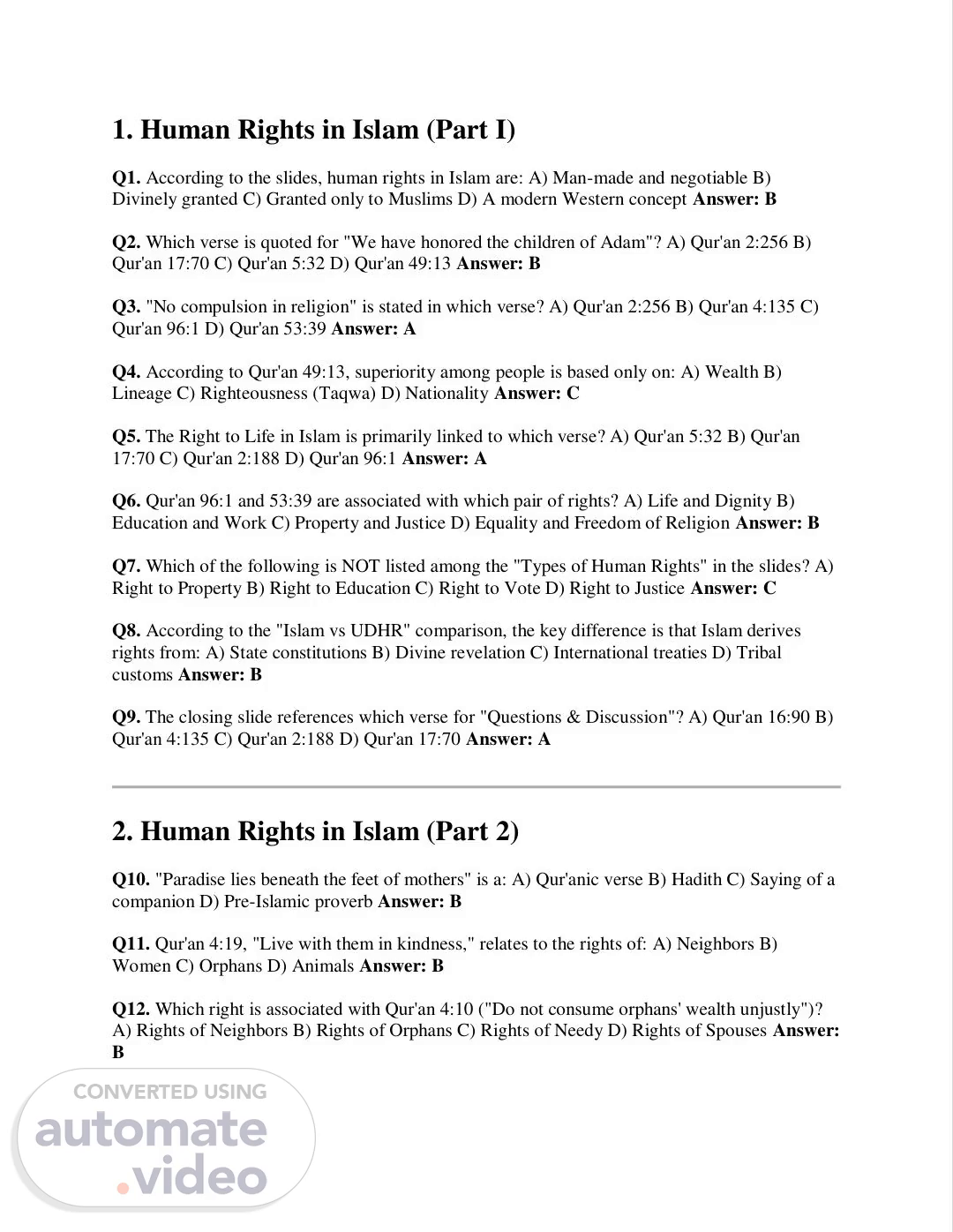
Scene 1 (0s)
1. Human Rights in Islam (Part I) Q1. According to the slides, human rights in Islam are: A) Man-made and negotiable B) Divinely granted C) Granted only to Muslims D) A modern Western concept Answer: B Q2. Which verse is quoted for "We have honored the children of Adam"? A) Qur'an 2:256 B) Qur'an 17:70 C) Qur'an 5:32 D) Qur'an 49:13 Answer: B Q3. "No compulsion in religion" is stated in which verse? A) Qur'an 2:256 B) Qur'an 4:135 C) Qur'an 96:1 D) Qur'an 53:39 Answer: A Q4. According to Qur'an 49:13, superiority among people is based only on: A) Wealth B) Lineage C) Righteousness (Taqwa) D) Nationality Answer: C Q5. The Right to Life in Islam is primarily linked to which verse? A) Qur'an 5:32 B) Qur'an 17:70 C) Qur'an 2:188 D) Qur'an 96:1 Answer: A Q6. Qur'an 96:1 and 53:39 are associated with which pair of rights? A) Life and Dignity B) Education and Work C) Property and Justice D) Equality and Freedom of Religion Answer: B Q7. Which of the following is NOT listed among the "Types of Human Rights" in the slides? A) Right to Property B) Right to Education C) Right to Vote D) Right to Justice Answer: C Q8. According to the "Islam vs UDHR" comparison, the key difference is that Islam derives rights from: A) State constitutions B) Divine revelation C) International treaties D) Tribal customs Answer: B Q9. The closing slide references which verse for "Questions & Discussion"? A) Qur'an 16:90 B) Qur'an 4:135 C) Qur'an 2:188 D) Qur'an 17:70 Answer: A 2. Human Rights in Islam (Part 2) Q10. "Paradise lies beneath the feet of mothers" is a: A) Qur'anic verse B) Hadith C) Saying of a companion D) Pre-Islamic proverb Answer: B Q11. Qur'an 4:19, "Live with them in kindness," relates to the rights of: A) Neighbors B) Women C) Orphans D) Animals Answer: B Q12. Which right is associated with Qur'an 4:10 ("Do not consume orphans' wealth unjustly")? A) Rights of Neighbors B) Rights of Orphans C) Rights of Needy D) Rights of Spouses Answer: B.
Scene 2 (1m 5s)
Q13. According to the slides, spouses are described in the Qur'an (30:21) as a source of: A) Wealth B) Tranquility C) Authority D) Competition Answer: B Q14. Which Hadith relates to the rights of non-Muslims? A) "Paradise lies beneath the feet of mothers" B) "A Muslim is the brother of another Muslim" C) "Whoever harms a protected non- Muslim, I will oppose him on the Day of Judgment" D) "Each of you is a shepherd and responsible for your flock" Answer: C Q15. Qur'an 6:38, describing animals as "communities like you," supports the right of: A) Animals B) Children C) Friends D) Enemies Answer: A Q16. Which right is supported by Qur'an 5:8, "Be just even with enemies"? A) Rights of Friends B) Rights of Enemies C) Rights of Relatives D) Rights of Non-Muslims Answer: B Q17. According to the slide on Rights of Children, parents must not be harmed because of: A) Their wealth B) The child (Qur'an 2:233) C) Their religion D) Their profession Answer: B Q18. "Believers are brothers" (Qur'an 49:10) is cited under which right? A) Rights of Friends B) Rights of Relatives C) Rights of Spouses D) Rights of Needy Answer: A 3. Lecture 4 — Ibadaat (Islamic Concept of Worship) Q19. The word "Ibadaat" is derived from the Arabic word "Abd," which means: A) Worship B) Slave/servant C) Prayer D) Sacrifice Answer: B Q20. According to Surah Adh-Dhariyat (51:56), Allah created jinn and mankind for the purpose of: A) Populating the earth B) Worshipping Him alone C) Building civilizations D) Testing each other Answer: B Q21. Which distinguishing feature of worship in Islam refers to removing intermediaries between man and Allah? A) All-embracing view B) Freedom from Intermediaries C) Comprehensive demands D) Theoretical comprehension Answer: B Q22. The Hadith "The whole earth has been rendered for me a mosque, pure and clean" illustrates that worship in Islam: A) Requires a mosque only B) Is not confined to specific places C) Is only valid in Makkah D) Requires a priest/intermediary Answer: B Q23. How many pillars of Islam are mentioned in the Hadith of Ibn Umar? A) Three B) Four C) Five D) Six Answer: C Q24. Which of the following is NOT one of the Five Pillars of Islam listed in the slides? A) Shahadat B) Salah C) Jihad D) Hajj Answer: C.
Scene 3 (2m 10s)
Q25. According to the slides, Salat is described as: A) Optional for able-bodied Muslims B) The distinguishing feature between a Muslim and a non-Muslim C) Only obligatory during Ramadan D) A once-in-a-lifetime duty Answer: B Q26. Fasting is described in the slides as a: A) Financial obligation B) Protecting shield against evil C) Pilgrimage ritual D) Testimony of faith Answer: B Q27. The word "Zakat" is derived from "zaka," meaning: A) To purify/to increase B) To fast C) To travel D) To testify Answer: A Q28. Hajj is described as requiring which combination of sacrifices? A) Only financial B) Only physical C) Physical, financial, and temporal D) Only spiritual Answer: C Q29. Who first built the Ka'abah, according to the slides? A) Hazrat Ibrahim (A.S) B) Hazrat Adam (A.S) C) Hazrat Ismail (A.S) D) Hazrat Muhammad (P.B.U.H) Answer: B Q30. Approximately how many years ago did Hazrat Ibrahim (A.S) and Ismail (A.S) rebuild the Ka'abah, per the slides? A) 1,500 years B) 2,500 years C) 4,500 years D) 6,000 years Answer: C 4. Lecture 5 — Life of the Holy Prophet in Makkah Q31. The Holy Prophet (P.B.U.H) was born on: A) 12 Rabi ul-Awwal (22 April 571 AD) B) 1 Muharram C) 27 Rajab D) 10 Dhul Hijjah Answer: A Q32. The Prophet's father, Abdullah, died: A) After the Prophet's birth B) Six months before his birth C) When the Prophet was six years old D) When the Prophet was eight years old Answer: B Q33. The Prophet's mother, Amina, passed away when he was: A) Six years old B) Eight years old C) Ten years old D) Twelve years old Answer: A Q34. Who suggested the name "Muhammad" for the Prophet? A) His mother B) His grandfather, Abdul Muttalib C) His uncle, Abu Talib D) Halima Sadia Answer: B Q35. Who took care of the Prophet after his grandfather passed away? A) Abu Talib B) Halima Sadia C) Khawla D) Suwaiba Answer: A Q36. How many sons did the Holy Prophet (P.B.U.H) have, according to the slides? A) Two B) Three C) Four D) Five Answer: B (Qasim, Abdullah, Ibrahim) Q37. Which daughter of the Prophet was married to Hazrat Ali (R.A)? A) Hazrat Zainab B) Hazrat Ruqayya C) Hazrat Umm-e-Kulsoom D) Hazrat Fatima Zahra Answer: D.
Scene 4 (3m 15s)
Q38. The title "Khatam-un-Nabiyyin" means: A) The first prophet B) The seal/last of the prophets C) The messenger of mercy D) The teacher of wisdom Answer: B Q39. The verse declaring the Prophet as the seal of the prophets is found in: A) Surah Al-Ahzab, verse 40 B) Surah Al-Baqarah, verse 256 C) Surah An-Nisa, verse 65 D) Surah Al-Imran, verse 164 Answer: A Q40. According to the slides, the chain of prophetic revelation started with: A) Hazrat Nooh (A.S) B) Hazrat Ibrahim (A.S) C) Hazrat Adam (A.S) D) Hazrat Musa (A.S) Answer: C 5. Lecture 6 — Life of the Holy Prophet in Madinah (Battles) Q41. Ghazwah-e-Badar was fought in: A) 1st Hijri B) 2nd Hijri C) 3rd Hijri D) 5th Hijri Answer: B Q42. In Ghazwah-e-Badar, the strength of the Muslim army was: A) 313 B) 700 C) 1,600 D) 3,000 Answer: A Q43. The disbelievers' commander-in-chief at Badar was: A) Abu Sufyan B) Abu Jahl C) Khalid Bin Waleed D) Ikedar Answer: B Q44. The Day of Badar is also called: A) Youm-ul-Furqan B) Youm-ul-Aqsa C) Youm-un-Nahr D) Youm-ul-Fitr Answer: A Q45. Ghazwah-e-Uhud was fought in: A) 2nd Hijri B) 3rd Hijri C) 5th Hijri D) 7th Hijri Answer: B Q46. The main reason for Ghazwah-e-Uhud was: A) Revenge for the defeat at Badar B) A dispute over trade routes C) A treaty violation D) Jewish conspiracy Answer: A Q47. In Ghazwah-e-Uhud, the temporary setback for Muslims was primarily caused by: A) Lack of soldiers B) Disobedience of the Prophet's instructions (archers leaving their post) C) Bad weather D) Betrayal by the Ansar Answer: B Q48. Ghazwah-e-Ahzab (Battle of the Trench) was fought in: A) 2nd Hijri B) 3rd Hijri C) 5th Hijri D) 9th Hijri Answer: C Q49. The trench strategy in Ghazwah-e-Ahzab was dug to defend which open side of Madinah? A) The southern side B) The Syrian side C) The eastern side D) The mountain side Answer: B Q50. Ghazwah-e-Khyber was fought in: A) 5th Hijri B) 7th Hijri C) 9th Hijri D) 10th Hijri Answer: B.
Scene 5 (4m 20s)
Q51. Khyber was known as the strongest shelter of: A) The Quraysh B) The Jews C) The Romans D) The hypocrites Answer: B Q52. Ghazwah-e-Tabuk was fought in: A) 5th Hijri B) 7th Hijri C) 9th Hijri D) 10th Hijri Answer: C Q53. In Ghazwah-e-Tabuk, who was appointed as deputy commander to look after Madinah? A) Hazrat Ali (R.A) B) Hazrat Usman (R.A) C) Hazrat Abu Bakr (R.A) D) Khalid Bin Waleed (R.A) Answer: A Q54. Who captured the Arab chief Ikedar with 400 soldiers during the Tabuk campaign? A) Hazrat Ali (R.A) B) Khalid Bin Waleed C) Zubair Bin Awam D) Miqdad Bin Aswad Answer: B 6. Lecture 7 — Character of the Holy Prophet (SAW) Q55. Before prophethood, the people of Makkah gave the Prophet the titles: A) Al-Ameen and Al-Mahdi B) As-Sadiq and Al-Ameen C) Al-Fatih and As-Sadiq D) Al-Kareem and Al-Ameen Answer: B Q56. Hazrat Khadija (R.A) proposed marriage to the Prophet mainly because of his: A) Wealth B) Honesty and trustworthiness C) Family status D) Poetry skills Answer: B Q57. The dispute over placing the Black Stone illustrates the Prophet's quality of: A) Simplicity B) Justice C) Humility D) Forgiveness Answer: B Q58. According to Hazrat Aisha (R.A), the Prophet never returned evil for evil, but always: A) Sought revenge quietly B) Forgave and pardoned C) Ignored the matter D) Sought worldly compensation Answer: B Q59. The Prophet's statement about the "sun in my right hand and the moon in my left hand" illustrates his: A) Simplicity B) Firmness and determination C) Justice D) Humility Answer: B Q60. Abu Sufyan, when questioned by the King of Rome, admitted that the Prophet: A) Was a wealthy trader B) Had never broken his promise C) Had many enemies D) Was unknown to the Quraysh Answer: B Q61. According to Surah An-Nahl (16:44), one of the Prophet's duties was to be the: A) Final decision maker only B) Explainer of the Book C) Ruler of Madinah D) Warrior Answer: B Q62. Surah An-Nisa (4:65) establishes the Prophet's role as: A) Explainer of the Book B) Final decision-maker in disputes C) Teacher of wisdom D) Universal messenger Answer: B.
Scene 6 (5m 25s)
Q63. According to the slides, unlike previous prophets, Prophet Muhammad's (P.B.U.H) prophethood was: A) Limited to Arabia B) Universal, for all mankind and jinn C) Restricted to a specific era D) Only for the Quraysh Answer: B 7. Lecture 8 (Part 1) — Duties of Muslims in the Holy Quran Q64. "Amr Bil Maroof Wa Nahi Anil Munkar" means: A) Enjoining good and forbidding evil B) Patience and gratitude C) Charity and fasting D) Belief and prayer Answer: A Q65. Qur'an 3:110 describes the followers of the Prophet as: A) The chosen tribe B) The best community raised for mankind C) The guardians of Makkah D) The inheritors of Jerusalem Answer: B Q66. According to Qur'an 49:10, believers are described as: A) Strangers B) Brothers C) Rivals D) Guardians Answer: B Q67. Regarding non-Muslim states that are not hostile to Islam, the Qur'an (60:8) instructs Muslims to: A) Avoid all contact B) Deal with them kindly and justly C) Impose taxes only D) Treat them as enemies Answer: B Q68. The treaty the Prophet signed with the Quraysh to maintain peace was called: A) Treaty of Badr B) Treaty of Hudaibiya C) Treaty of Khyber D) Treaty of Tabuk Answer: B Q69. "Kasb-e-Halal" refers to: A) Ritual purification B) Lawful, legal, and Riba-free earning C) Charitable donation D) Pilgrimage expenses Answer: B Q70. According to the slides, business and economics are referred to in the Qur'an as: A) "Fazlullah" (bounty/blessing) B) "Zulm" (injustice) C) "Fitna" (trial) D) "Riba" (interest) Answer: A Q71. Which of the following is discouraged in Islam according to the lecture on Kasb-e-Halal? A) Hard work B) Idleness, unemployment, and begging C) Trade and business D) Lawful profit Answer: B 8. Lecture 8 (Part 2) — Characteristics of Muslims / Character Building Q72. According to Hazrat Aisha (R.A), the Prophet's character was: A) A reflection of Arabian customs B) The Holy Quran itself C) Based on personal preference D) Shaped by his companions Answer: B.
Scene 7 (6m 30s)
Q73. Which of the following is NOT listed as a source of character building in the slides? A) Tauheed B) Prayer C) Trade D) Zakat Answer: C Q74. According to the Prophet's teaching, performing Hajj sincerely: A) Has no spiritual effect B) Removes all previous sins C) Only benefits the wealthy D) Is optional for character building Answer: B Q75. The Hadith "Everyone of you is a guardian and will be asked about his charge" emphasizes: A) Wealth accumulation B) Accountability and responsibility C) Military leadership D) Trade ethics Answer: B Q76. According to the slides, character is the result of: A) Wealth and status B) Mental attitude and how we spend our time C) Family lineage D) Educational qualifications Answer: B Q77. The three important principles for a successful Muslim society, per the slides, include enjoining good, forbidding evil, and: A) Accumulating wealth B) Striving for successful results C) Avoiding all non-Muslims D) Political dominance Answer: B 9. Lecture 9 — Sources of Religious and Legal Authority Q78. Which of the following is the primary and most fundamental source of Islamic law? A) Qiyas B) Ijma C) The Holy Quran D) Sunnah Answer: C Q79. "Sunnah" literally means: A) Consensus B) Procedure and behavior C) Analogy D) Command Answer: B Q80. "Ijma" is defined as: A) The literal text of the Quran B) Consensus of opinion of Muslim jurists C) A form of supplication D) The Prophet's personal habits Answer: B Q81. "Qiyas" involves: A) Memorizing the Quran B) Analogical reasoning comparing a new situation to an existing ruling C) A unanimous vote of scholars D) Direct revelation Answer: B Q82. The four sources of religious and legal authority listed in Lecture 9 are: A) Quran, Sunnah, Ijma, Qiyas B) Quran, Hadith, Zakat, Hajj C) Sunnah, Ijma, Tafsir, Fiqh D) Quran, Qiyas, Salah, Sawm Answer: A 10. Lecture 10 — Study of Selected Text (Surah Al-Fatiha & Surah Al-Ikhlas).
Scene 8 (7m 35s)
Q83. Surah Al-Fatiha is recited how many times in daily prayer (per verse count)? A) 5 verses, recited once B) 7 verses, recited repeatedly C) 10 verses, recited once D) 3 verses, recited repeatedly Answer: B Q84. "Fatiha" literally means: A) Closing B) Opening C) Mercy D) Guidance Answer: B Q85. Which of the following is NOT listed as a name of Surah Al-Fatiha? A) Umm-ul-Quran B) Sabba Al-Masani C) Surah Al-Kanz D) Surah Al-Falaq Answer: D Q86. "Maliki Yaumid-Din" refers to Allah as: A) The Most Merciful B) The Master of the Day of Judgment C) The Lord of the worlds D) The Guide to the straight path Answer: B Q87. According to the slides, the phrase "Ihdinas-Siratal-Mustaqim" is a request for: A) Forgiveness B) Guidance C) Sustenance D) Protection from enemies Answer: B Q88. In Surah Al-Fatiha, who are described as earning Allah's wrath? A) Christians B) Jews C) Polytheists D) Hypocrites Answer: B Q89. Who are described as "the misguided" in the final verse of Al-Fatiha, according to the slides? A) Jews B) Christians C) Idol worshippers D) Hypocrites Answer: B Q90. Surah Al-Ikhlas is described by the Prophet (P.B.U.H) as equal to: A) One-fourth of the Quran B) One-third of the Quran C) Half of the Quran D) The entire Quran Answer: B Q91. "Ikhlas" means: A) Mercy B) Purity and sincerity C) Guidance D) Justice Answer: B Q92. How many major points are drawn from Surah Al-Ikhlas in the slides? A) Two B) Three C) Four D) Five Answer: C Q93. "Lam yalid wa lam yulad" ("He begets not, nor was He begotten") emphasizes: A) Allah's mercy B) Allah having no partner or offspring C) Allah's guidance D) Allah's oneness in worship only Answer: B 11. Lecture 11 — Surah Al-Hujurat Q94. Surah Al-Hujurat was revealed in: A) Makkah B) Madinah C) Ta'if D) Yemen Answer: B Q95. According to the Tafsir notes, respecting the Holy Prophet (SAW) is described as: A) Optional B) A condition of faith C) Only for his companions D) A cultural custom Answer: B Q96. Surah Al-Hujurat instructs believers to investigate news brought by: A) Trusted scholars B) Wicked/corrupt people (Fasiq) C) Family members D) Foreign travelers Answer: B.
Scene 9 (8m 40s)
Q97. According to the Surah, human superiority is determined only by: A) Wealth B) Lineage C) Taqwa (God-consciousness) D) Nationality Answer: C Q98. Which of the following is explicitly prohibited in Surah Al-Hujurat, per the slides? A) Trading B) Mocking and calling names C) Traveling D) Marriage Answer: B Q99. According to the slides, all of mankind are descendants of: A) Hazrat Ibrahim (A.S) and Hazrat Hajira (R.A) B) Hazrat Adam (A.S) and Hazrat Hawwa (A.S) C) Hazrat Nooh (A.S) D) Hazrat Ismail (A.S) Answer: B Q100. The slides note a distinction between: A) A Muslim and an Arab B) A Believer and a Muslim C) A Sunni and a Shia D) A scholar and a layman Answer: B 12. Lecture 14 — Human Rights in Quran (Part II) Q101. According to Qur'an 5:32, killing one innocent person unjustly is equated to: A) A minor sin B) Killing all of mankind C) A forgivable act D) A civil offense only Answer: B Q102. The Right to Ownership is supported by verses instructing believers to: A) Give orphans their wealth and not exploit it B) Avoid all trade C) Give away all property D) Rent property only Answer: A Q103. Surah Al-Hujurat (49:11) forbids which behavior related to the Right to Honor? A) Trading unfairly B) Ridiculing others and using bad nicknames C) Refusing charity D) Breaking promises Answer: B Q104. The Right to Faith is supported by which principle? A) "There is no compulsion in religion" (2:256) B) "Fight until they believe" C) "Convert or pay tax" D) "Faith is inherited only" Answer: A Q105. Right to Equality (Qur'an 49:13) states that the most noble person in Allah's sight is: A) The wealthiest B) The most God-fearing (Taqwa) C) The most powerful D) The eldest Answer: B Q106. The Right to Merit is defined in the slides as: A) Rewarding based on family ties B) Giving the right/position to the deserving C) Distributing wealth equally regardless of effort D) Favoring the majority group Answer: B Q107. According to the Prophet (P.B.U.H), a person who severs the bond of kinship will: A) Be forgiven automatically B) Not enter Paradise C) Face only worldly punishment D) Be excused if wealthy Answer: B Q108. Non-Muslims living peacefully under Islamic rule were historically referred to as: A) Muhajireen B) Ansar C) Zimmies (protected people) D) Munafiqeen Answer: C.
Scene 10 (9m 46s)
Q109. Which caliph is specifically noted in the slides for treating non-Muslims kindly and justly regarding taxation? A) Hazrat Abu Bakr (R.A) B) Hazrat Umar (R.A) C) Hazrat Usman (R.A) D) Hazrat Ali (R.A) Answer: B Q110. According to the Hadith cited, a woman who prayed and fasted but harmed her neighbors with her tongue was said to: A) Still enter Paradise B) Go to Hell C) Be forgiven due to her worship D) Be given a warning only Answer: B Q111. The Prophet's comment "You killed it twice; sharpen your knife" relates to the rights of: A) Children B) Neighbors C) Animals D) Business partners Answer: C Q112. The friendship between the Prophet (P.B.U.H) and which companion is cited as the best example of friendship? A) Hazrat Umar (R.A) B) Hazrat Abu Bakr (R.A) C) Hazrat Ali (R.A) D) Hazrat Usman (R.A) Answer: B Q113. Regarding business partnerships, the Prophet (P.B.U.H) worked as a trade partner with: A) Hazrat Abu Bakr (R.A) B) Hazrat Khadija (R.A) C) Hazrat Umar (R.A) D) Abu Sufyan Answer: B.