Scene 1 (0s)
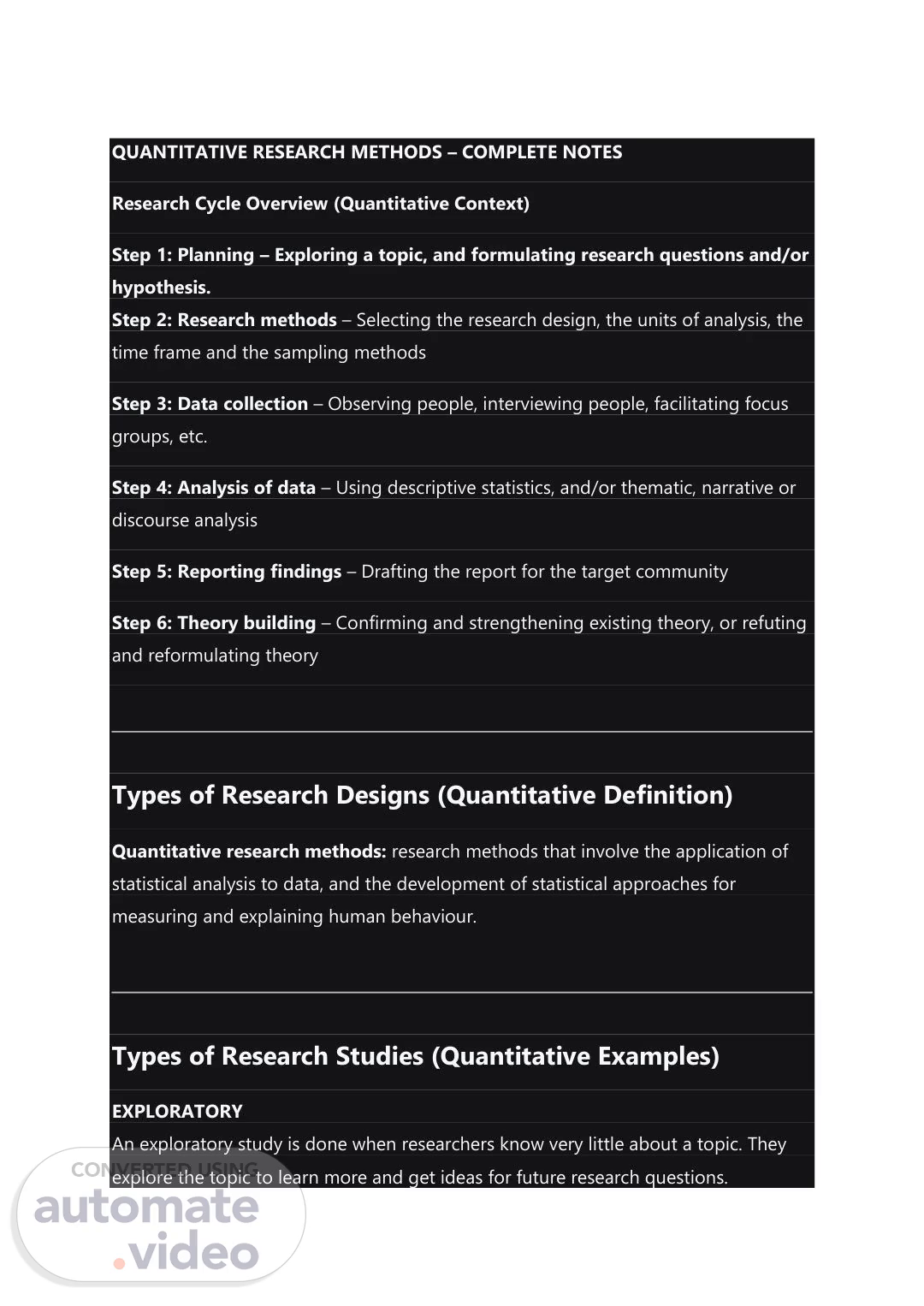
QUANTITATIVE RESEARCH METHODS – COMPLETE NOTES Research Cycle Overview (Quantitative Context) Step 1: Planning – Exploring a topic, and formulating research questions and/or hypothesis. Step 2: Research methods – Selecting the research design, the units of analysis, the time frame and the sampling methods Step 3: Data collection – Observing people, interviewing people, facilitating focus groups, etc. Step 4: Analysis of data – Using descriptive statistics, and/or thematic, narrative or discourse analysis Step 5: Reporting findings – Drafting the report for the target community Step 6: Theory building – Confirming and strengthening existing theory, or refuting and reformulating theory Types of Research Designs (Quantitative Definition) Quantitative research methods: research methods that involve the application of statistical analysis to data, and the development of statistical approaches for measuring and explaining human behaviour. Types of Research Studies (Quantitative Examples) EXPLORATORY An exploratory study is done when researchers know very little about a topic. They explore the topic to learn more and get ideas for future research questions..
Scene 2 (41s)
Example: If psychologists know little about how students use AI to study, they might interview students first to understand how they use it. This helps them develop questions for later research. (Note: Exploratory can use qualitative or quantitative methods, but is included here as per slide context.) DESCRIPTIVE A descriptive study is done when researchers want to describe a behaviour or phenomenon. Example: A researcher measures how many hours students study per week to describe their study habits. EXPLANATORY An explanatory study is done when researchers want to understand the relationship between two or more variables. Example: A researcher studies whether the number of hours students study affects their exam performance. Selecting Units of Analysis (Quantitative Example) QUANTITATIVE STUDY RESEARCH PROBLEM: WHAT ARE THE FACTORS THAT IMPACT MENTAL HEALTH AMONGST STUDENTS AT UKZN? Target population: UKZN STUDENTS Using Variables in Quantitative Research A variable is something that can change or take different values.
Scene 3 (1m 20s)
Categorical variables = variables that place people or things into distinct groups Continuous variables = variables measured along a range or continuum Independent variable (IV) = the variable that is expected to influence another variable Dependent variable (DV) = the variable that is measured to see whether it changes Causation = a change in one variable directly causes a change in another Correlation = two variables are related, but one does not necessarily cause the other Operationalisation = deciding exactly how a variable will be observed or measured Time Frame in Quantitative Research If all the data are collected at one point in time, the research design is for a cross- sectional study. If the data collected are over a period of time, e.g. every six months, the research design is for a longitudinal study. Sampling in Quantitative Research Sampling = selecting participants from a population for a study. KEY TERMS Representative Sample: A group that accurately reflects the population..
Scene 4 (1m 56s)
Probability Sampling: Every unit has a known, equal chance of selection (quantitative research). Non-Probability Sampling: Not all units have an equal chance of selection (quantitative and qualitative research). Quantitative Data Collection Methods Questionnaires Commonly use Likert-type scales Ideally suited for quantitative research – closed ended questions E.g. participants can either answer yes, no, or agree, or disagree This is ideal as it allows for answers to be coded e.g. yes=1, no=2 and agree=1 disagree=2 etc. They can be used in structured interviews or where there is little or no direct contact with the researcher Likert type scale example (as referenced in slides – typical format with statements and response options such as Strongly Agree, Agree, Neutral, Disagree, Strongly Disagree) Levels of Measurement (Quantitative) Nominal: The data can only be categorized into distinct categories without any inherent order. E.g. Male – 1; Female – 2; Young – 1; Middle Aged – 2; Old - 3.
Scene 5 (2m 36s)
Ordinal: The data can be categorized and ranked, but the distance between them cannot be measured. E.g. fail (0–40%) = 0; unsatisfactory (40–50%) = 1; satisfactory (50–60%) = 2; good (60–70%) = 3; excellent (70%+) = 4 Interval: The data can be categorized, ranked, and evenly spaced so that variables can be ordered, and the distance between them can be measured. E.g. the difference between an IQ score of 90 and 95 is the same as a difference between a score of 110 and 115. Most measures in the behavioural sciences are interval measures. Ratio: The data can be categorized, ranked, evenly spaced, and has a natural zero. E.g. age, height, weight, distance, number of children, number of books etc. Quantitative Data Analysis In quantitative data analysis you are expected to turn raw numbers into meaningful data through the application of rational and critical thinking. Quantitative data analysis may include the calculation of frequencies of variables and differences between variables. A quantitative approach is usually associated with finding evidence to either support or reject hypotheses you have formulated at the earlier stages of your research process. Data is entered into a computer database so that they may be subjected to statistical analysis. Descriptive Data Analysis A descriptive data analysis examines the frequency distribution of each variable..
Scene 6 (3m 29s)
This analysis gives the researcher an initial picture of how people scored on each variable and how their scores are related to each variable and how their scores are related to the scores of others. Measures of Central Tendency Mean, Median, Mode, Range Mean = average Median = middle value Mode = most common value Example: 2, 3, 3, 5, 7 Mean = 4 Median = 3 Mode = 3 Memory trick: Mean = average | Median = middle | Mode = most Errors in Quantitative Data Measurement errors in quantitative data refers to data that is inaccurate or wrong. If the errors influence all the data, they are called constant errors If errors only occur occasionally and/or due to particular conditions, they are called random errors Errors can creep in at any stage of the research process, which means the researcher should consider each step they have taken..
Scene 7 (4m 5s)
Bias in Quantitative Research Bias is any influence or deviation that might lead to false conclusions. It may arise from the interviewer, participant, analyst or researcher. Bias may occur when there are undetected influences on any stage of the research process which may influence the relationship between variables. Sources of Bias Funders bias (direct or indirect influence) Hindsight bias (the sense that the researcher knew it all along) Confirmation bias (tendency to interpret the data in a way that confirms the researcher's preconceived ideas) Interviewer bias: the interviewer influences answers. Participant bias: the participant gives inaccurate or dishonest answers. Analyst bias: data is coded, entered, or analysed incorrectly. Researcher bias: the researcher's own views influence the study. Objectivity in Quantitative Research Many researchers attempt to avoid bias by striving for objectivity (reliability, validity). Ethics (Relevant to All Research, Including Quantitative).
Scene 8 (4m 42s)
Five fundamental ethics principles: 1. Autonomy and respect for the dignity of persons 2. Non-maleficence (do no harm) 3. Beneficence (Benefits) 4. Justice 5. Fidelity Structure of Research Report (Quantitative Context) Standard structure typically includes: Title, Abstract, Introduction, Literature Review, Method (with subsections: Participants, Materials, Procedure, Design), Results, Discussion, Conclusion, References, Appendices. Theory Building in Quantitative Research Research helps psychologists test theories about behaviour. If findings support the theory, the theory becomes stronger and can help predict behaviour. If findings do not support the theory, the theory must be revised or improved. In both cases, new knowledge is created and our understanding of behaviour continues to grow. END OF QUANTITATIVE RESEARCH METHODS.
Scene 9 (5m 15s)
Here are all the qualitative research methods notes from your slides, presented in full wit QUALITATIVE RESEARCH METHODS – COMPLETE Research Cycle Overview (Qualitative Context) Step 1: Planning – Exploring the research topic, and formulating research questions and/or hypotheses Step 2: Research methods – Selecting the research design, the units of analysis, the time frame and the sampling methods Step 3: Data collection – Observing people, interviewing people, facilitating focus groups, etc. Step 4: Analysis of data – Using descriptive statistics, and/or thematic, narrative or discourse analysis Step 5: Reporting findings – Drafting the report for the target community Step 6: Theory building – Confirming and strengthening existing theory, or refuting and reformulating theory Types of Research Designs (Qualitative Definition) Qualitative research methods: research methods that obtain data in the form of descriptive narratives, in order to understand a phenomenon from the perspective of the research participant and gain an understanding of the meanings people give to their experiences.
Scene 10 (5m 56s)
Types of Research Studies (Qualitative Examples) EXPLORATORY An exploratory study is done when researchers know very little about a topic. They explore the topic to learn more and get ideas for future research questions. Example: If psychologists know little about how students use AI to study, they might interview students first to understand how they use it. This helps them develop questions for later research. DESCRIPTIVE A descriptive study is done when researchers want to describe a behaviour or phenomenon. Example: A researcher measures how many hours students study per week to describe their study habits. (Note: can be qualitative or quantitative) EXPLANATORY An explanatory study is done when researchers want to understand the relationship between two or more variables. Example: A researcher studies whether the number of hours students study affects their exam performance. (Note: more common in quantitative research, but qualitative research can also explore relationships and meanings) Selecting Units of Analysis (Qualitative Examples) QUALITATIVE STUDY 1 RESEARCH PROBLEM: WHAT CHALLENGES DO LOVE-SICK UKZN STUDENTS FACE IN KEEPING UP THEIR ACADEMIC PERFORMANCE AND WHAT COPING STRATEGIES DO THEY USE? Target population: LOVESICK UKZN STUDENTS.
Scene 11 (6m 41s)
QUALITATIVE STUDY 2 RESEARCH PROBLEM: HOW DO FEMALE UNDERGRADUATE STUDENTS AT UKZN EXPERIENCE COUNTER-NORMATIVE (OKUPHAMBANA NAMASIKO AJWAYELEKILE) ROMANTIC CHEMISTRY? Target population: FEMALE UNDERGRADUATE UKZN STUDENTS Sampling in Qualitative Research Sampling = selecting participants from a population for a study. KEY TERMS Non-Probability Sampling: Not all units have an equal chance of selection (quantitative and qualitative research). Qualitative Data Collection Methods Qualitative data collection methods: • Collects in-depth data • Uses open-ended methods • Follows less structured procedures • Relies on interactive interviews • Uses field notes, recordings, and photos • Often takes more time • Findings are usually not generalisable Interviews.
Scene 12 (7m 7s)
Structured interviews – interviewer follows a set list of questions – the participant does not have freedom to answer as they please (fixed answers) – (can be used in qualitative research but is more structured) Unstructured interviews (open ended interview) – the participant has freedom to answer; the researcher has less control of the answers. The researcher will have one general question and allow the participant to do more talking Semi-structured interviews – The researcher ensures that certain topics are covered but no fixed sequence or format of the questions. Qualitative Data Analysis Overview of Data Analysis Convert raw numbers → meaningful data (quantitative) Transcribe & analyse systematically; Identify themes, patterns, narratives (qualitative) Analysing Qualitative Data Information gathered via interviews and other qualitative data sources is usually transcribed Interviews and focus groups discussions are always audio-taped Researchers must then transcribe these sources of data into written format Audiotapes are transcribed word for word into electronic document Once the transcription is complete, the researcher should check it by reading through it while listening to the audio The analysis then involves going through the transcript in a systematic way so that conclusions may be reached about the issue under investigation.
Scene 13 (7m 51s)
Example of transcript (Referenced in slides – a written record of a recorded interview or conversation) Methods of Qualitative Analysis Thematic Analysis – A method used to systematically identify, organize patterns of meaning (themes) across data sets. Narrative analysis – approaches the transcript as if it were a story following some type of sequence. It uses narratives which should answer the 'and what happened' question. Discourse Analysis – places emphasis on the use and structure of language to reveal representations of the world or sets of meanings. The researcher tries to draw attention to dominant meanings of particular phenomena as well as how these meanings may be contradictory and ambivalent. Example of thematic analysis process (Referenced in slides – typically involves steps such as: familiarizing yourself with data, generating initial codes, searching for themes, reviewing themes, defining and naming themes, writing up) Bias in Qualitative Research Bias is any influence or deviation that might lead to false conclusions. It may arise from the interviewer, participant, analyst or researcher. Bias may occur when there are undetected influences on any stage of the research process which may influence the relationship between variables..
Scene 14 (8m 36s)
Sources of Bias Funders bias (direct or indirect influence) Hindsight bias (the sense that the researcher knew it all along) Confirmation bias (tendency to interpret the data in a way that confirms the researcher's preconceived ideas) Interviewer bias: the interviewer influences answers. Participant bias: the participant gives inaccurate or dishonest answers. Analyst bias: data is coded, entered, or analysed incorrectly. Researcher bias: the researcher's own views influence the study. Reflexivity in Qualitative Research In qualitative research, rather than objectivity, the researchers use reflexivity (in the process the researcher incorporates self-reflection on both part of the researcher and participants). Ethics (Relevant to All Research, Including Qualitative) Five fundamental ethics principles: 1. Autonomy and respect for the dignity of persons 2. Non-maleficence (do no harm) 3. Beneficence (Benefits) 4. Justice 5. Fidelity.
Scene 15 (9m 12s)
Structure of Research Report (Qualitative Context) Standard structure typically includes :Title, Abstract, Introduction, Literature Review, Method (with subsections: Participants, Materials/Instruments, Procedure, Design), Results/Findings (often organized by themes), Discussion, Conclusion, References, Appendices (e.g., interview questions, consent forms, transcript excerpts). Theory Building in Qualitative Research Research helps psychologists test theories about behaviour. If findings support the theory, the theory becomes stronger and can help predict behaviour. If findings do not support the theory, the theory must be revised or improved. In both cases, new knowledge is created and our understanding of behaviour continues to grow. END OF QUALITATIVE RESEARCH METHODS NOTES.