Scene 1 (0s)
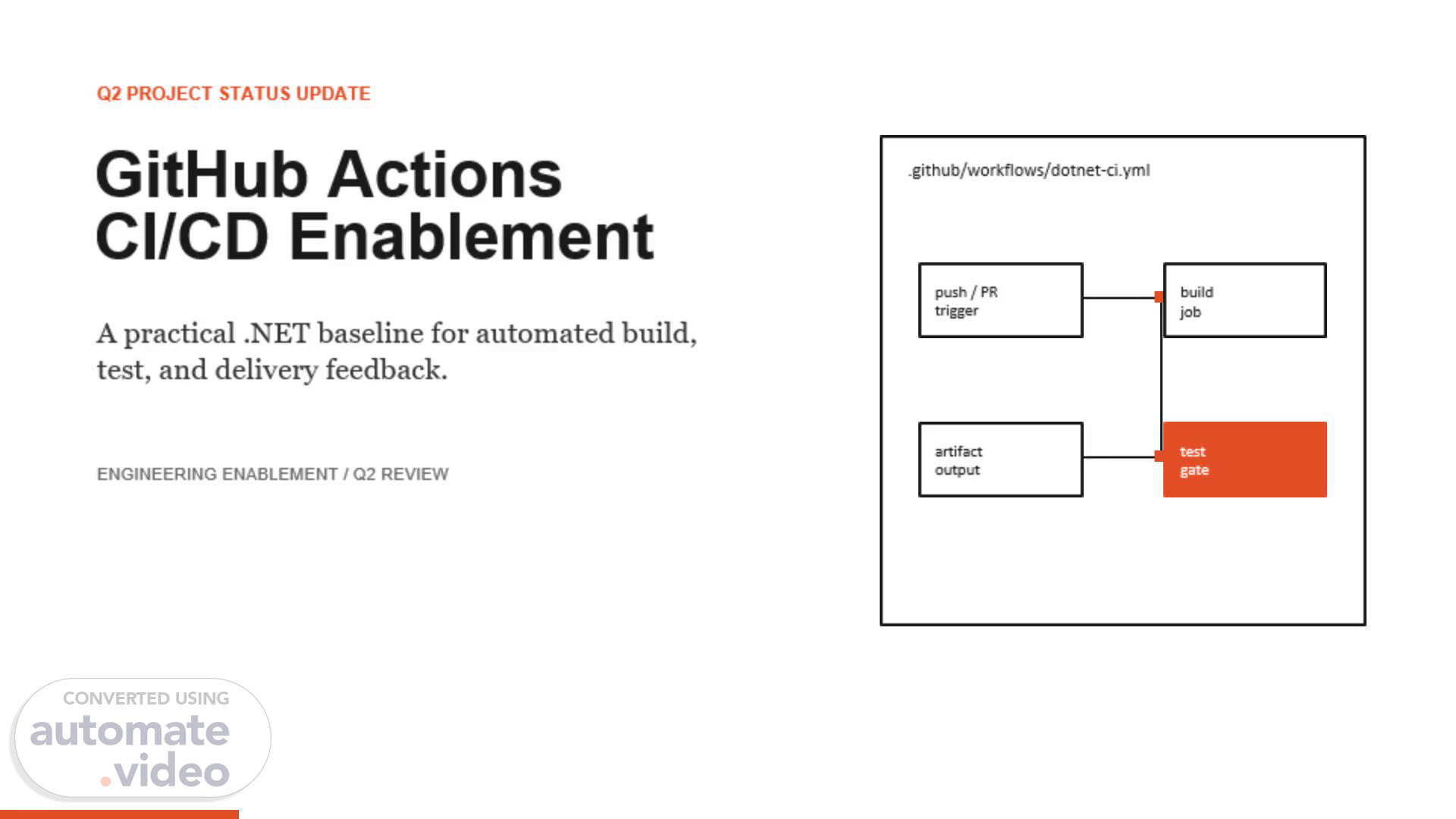
[Audio] Q2 PROJECT STATUS UPDATE GitHub Actions CI/CD Enablement .github/workflows/dotnet-ci.yml push / PR trigger build job A practical .NET baseline for automated build, test, and delivery feedback. artifact output test gate ENGINEERING ENABLEMENT / Q2 REVIEW.
Scene 2 (27s)
[Audio] 01 / EXECUTIVE READOUT The Q2 baseline is in place. A versioned, repeatable CI loop now connects repository changes to build, test, and artifact feedback. Establish a repeatable CI baseline for .NET repositories. OBJECTIVE SET Pushes and pull requests drive build, test, and artifact generation. Q2 OUTCOME DELIVERED Testing is gated by build completion through needs: build. OPERATING MODEL CONTROLLED Branch protection, matrix coverage, notifications, and security checks. NEXT FORWARD PATH The quarter delivered a complete automation loop rather than a one-off script. We now have a reusable pattern that gives developers fast feedback on every push or pull request. The most important control is the explicit dependency between build and test, which prevents invalid code from progressing through the pipeline..
Scene 3 (1m 26s)
[Audio] 02 / WHY THIS PROJECT The Q2 delivery goal was a dependable CI baseline. Automate the manual loop Replace hand-run build and test steps with workflow triggers. Standardize the toolchain Use .NET 8.0.x and the Release configuration consistently. Make results visible Not a one-off script—a versioned operating pattern that is easy to review, repeat, and extend. Surface status in pull requests, commits, logs, and summaries. Create a scalable foundation Leave a clear path to quality gates, security, and deployment. This work was intentionally scoped as a baseline to make the happy path consistent, observable, and easy to extend. Standardizing the SDK and build configuration directly reduces variation across local machines and runner environments. We set out to build a dependable pattern, and that is precisely what we delivered..
Scene 4 (2m 28s)
[Audio] 03 / OPERATIONAL FLOW EVENTS BECOME DELIVERY SIGNALS The Triggers The Process The Feedback EVENT SOURCE CONFIGURATION VISIBILITY Code pushes to the main branch. YAML definitions stored in .github/workflows/. Green/Red status attached directly to the commit or PR. COLLABORATION Pull requests targeting the main branch. ENVIRONMENT DIAGNOSTICS Execution on GitHub-hosted ubuntu-latest runners. Detailed step-by-step logs available in the Actions tab. A GitHub Actions workflow is a configurable automated process made up of jobs, steps, and reusable actions. Repository events serve as the entry point to turn raw code changes into visible quality signals. This connects build status directly to the change under review rather than relying on separate manual reports..
Scene 5 (3m 23s)
[Audio] 04 / THE BUILD JOB A controlled, repeatable environment. CHECKOUT SETUP .NET CACHE NUGET Clones the repository source code to the runner using actions/checkout@v4. Installs the specified .NET 8.0 SDK version to ensure toolchain consistency. Saves and reuses dependencies between runs to optimize build speed. RESTORE BUILD UPLOAD ARTIFACT Downloads project dependencies and prepares the environment for compilation. Compiles the code in Release configuration to verify syntax and logic. Persists the compiled output for testing or manual inspection. The execution sequence matters because the runner starts completely clean. The workflow checks out the repository and installs the required SDK before restoring dependencies and compiling. Uploading the build output preserves a useful handoff for later jobs or for human inspection after the run completes..
Scene 6 (4m 24s)
[Audio] 05 / PIPELINE CONTROLS Build success is the quality gate for automated testing. needs: build next steps... build test deploy PRIMARY JOB DEPENDENT JOB FUTURE SCOPE Scenario: Build Failure Scenario: Build Success If the build job fails, the test job is automatically skipped. This prevents wasting runner minutes on uncompilable code and provides an immediate "Red X" signal to the developer. Upon successful compilation, the test job triggers instantly. This ensures that only verified binaries are subjected to the test suite, maintaining the integrity of the delivery signal. Build completion is the core control gate that prevents broken code from wasting resources. If the build fails, testing stops immediately. And if it succeeds, tests run automatically on verified binaries. Building on our clean environment setup, this dependency enforces a reliable sequence. Moving forward, we rely on standardized components to keep this pipeline consistent..
Scene 7 (5m 34s)
[Audio] 06 / COMPONENT STATUS Reusable actions reduce setup effort and improve consistency. COMPONENT ROLE IN THE WORKFLOW Q2 STATUS Places repository code on the runner. Essential for all subsequent steps. actions/checkout@v4 IMPLEMENTED Installs the required .NET SDK version (8.0.x) to ensure toolchain consistency. actions/setup-dotnet@v4 IMPLEMENTED Reuses downloaded packages between runs to reduce build duration. NuGet cache IDENTIFIED Preserves compiled output after the run for inspection or deployment. upload-artifact IMPLEMENTED Standard actions keep our YAML focused on project intent rather than boilerplate setup. Checkout, toolchain setup, and artifact upload are fully in place today. But dependency caching is next up to optimize execution speed. Transitioning from these building blocks, let us look at how developers actually experience these pipeline signals..
Scene 8 (6m 40s)
[Audio] 07 / DEVELOPER EXPERIENCE OUTCOMES VISIBLE WHERE DEVELOPERS WORK PULL REQUEST PAGE COMMITS PAGE Automated merge-readiness checks provide immediate feedback to authors and reviewers before any code is merged. A persistent status icon is attached to every commit, creating a historical record of build and test health over time. ACTIONS TAB JOB SUMMARY Comprehensive, step-by-step execution logs allow for deep-dive diagnostics and rapid troubleshooting of failures. High-level insights including run duration, success status, and key outputs are available at a single glance. Automation only creates value when feedback lands directly in the developer workflow. We surface status checks on pull requests and commit histories so health is always transparent. Detailed logs live right in the Actions tab for fast troubleshooting. With visibility established across the team, we can now turn our attention to the next phase of maturity..
Scene 9 (7m 47s)
[Audio] 08 / Q3 ROADMAP HARDEN THE FOUNDATION AND SCALE ADOPTION QUALITY GATES MATRIX COVERAGE Enforce branch protection rules for main. Test across multiple .NET versions (6.0, 7.0, 8.0). — — Validate on Windows and macOS runners. Require ".NET CI" workflow to pass before merging. — — Expand integration test coverage. Implement automated code style linting. — — SECURITY OPERATIONS Integrate GitHub Secrets for sensitive data. Configure scheduled daily health runs. — — Enable static analysis (SAST) scanning. Enable manual workflow dispatch triggers. — — Automate dependency vulnerability checks. Add Slack/Email failure notifications. — — Q2 gave us a reliable baseline loop to build upon. Now we need to harden that foundation with branch protection, security scanning, and matrix coverage. Operations and notifications will follow to scale our maturity. Let us look at the recommended sequence for rolling out these improvements..
Scene 10 (8m 55s)
[Audio] 09 / IMPLEMENTATION STRATEGY RECOMMENDED ADOPTION SEQUENCE NOW NEXT THEN Enforce the Baseline Measure & Optimize Expand & Scale Apply the .NET CI workflow to all primary repositories. Track run duration and failure modes. Introduce matrix testing for multiple environments. • • • Implement NuGet caching to speed up builds. • Enable branch protection for the main branch. Automate security scanning and secrets management. • • Monitor pull request adoption rates. • Train teams on interpreting Actions feedback. Integrate automated deployment workflows. • • We can't scale everything at once, so we need a phased rollout. First we lock down the baseline on primary repositories and enforce branch protection. Next we measure our performance, track failure modes, and add caching. Then we expand into matrix testing, security scanning, and deployment. And that gives us a clear path from a working workflow to mature engineering operations..
Scene 11 (10m 5s)
[Audio] 10 / Q2 CONCLUSION THE CI LOOP IS IN PLACE AND READY TO SCALE → AUTOMATION AVAILABLE QUALITY GATE ENFORCED STANDARDIZED PATH VERSIONED LOGIC RICH DIAGNOSTICS READY FOR Q3 Every push or pull request now initiates a consistent, repeatable build-and-test sequence. The workflow is stored as code, making automation visible, reviewable, and versioned with the project. Persistent artifacts and detailed execution logs provide a solid foundation for rapid troubleshooting. The baseline is stable, allowing the team to focus on hardening, security, and broader adoption. We delivered a solid foundation this quarter. Every push and pull request now follows a standard build and test sequence. And because the logic lives in versioned code, it remains fully reviewable and transparent. Our next milestone moves us from optional automation to strict quality gate enforcement..
Scene 12 (11m 10s)
[Audio] CONCLUSION & NEXT STEPS DISCUSSION & NEXT DECISIONS PRIORITY ITEMS Q3 Ownership Confirm lead for branch protection and security integration. Adoption Priorities Identify the next high-impact repositories for CI enablement. Thank you for your time. The Q2 baseline is ready for enforcement and scaling. Open Questions Address technical constraints or resource requirements for scaling. Let's turn to our next steps and immediate decisions. We need to confirm ownership for branch protection and security scanning in Q3. We also need to pick the next batch of repositories for CI enablement. Let's open the floor for any questions or technical constraints you see ahead..