Scene 1 (0s)
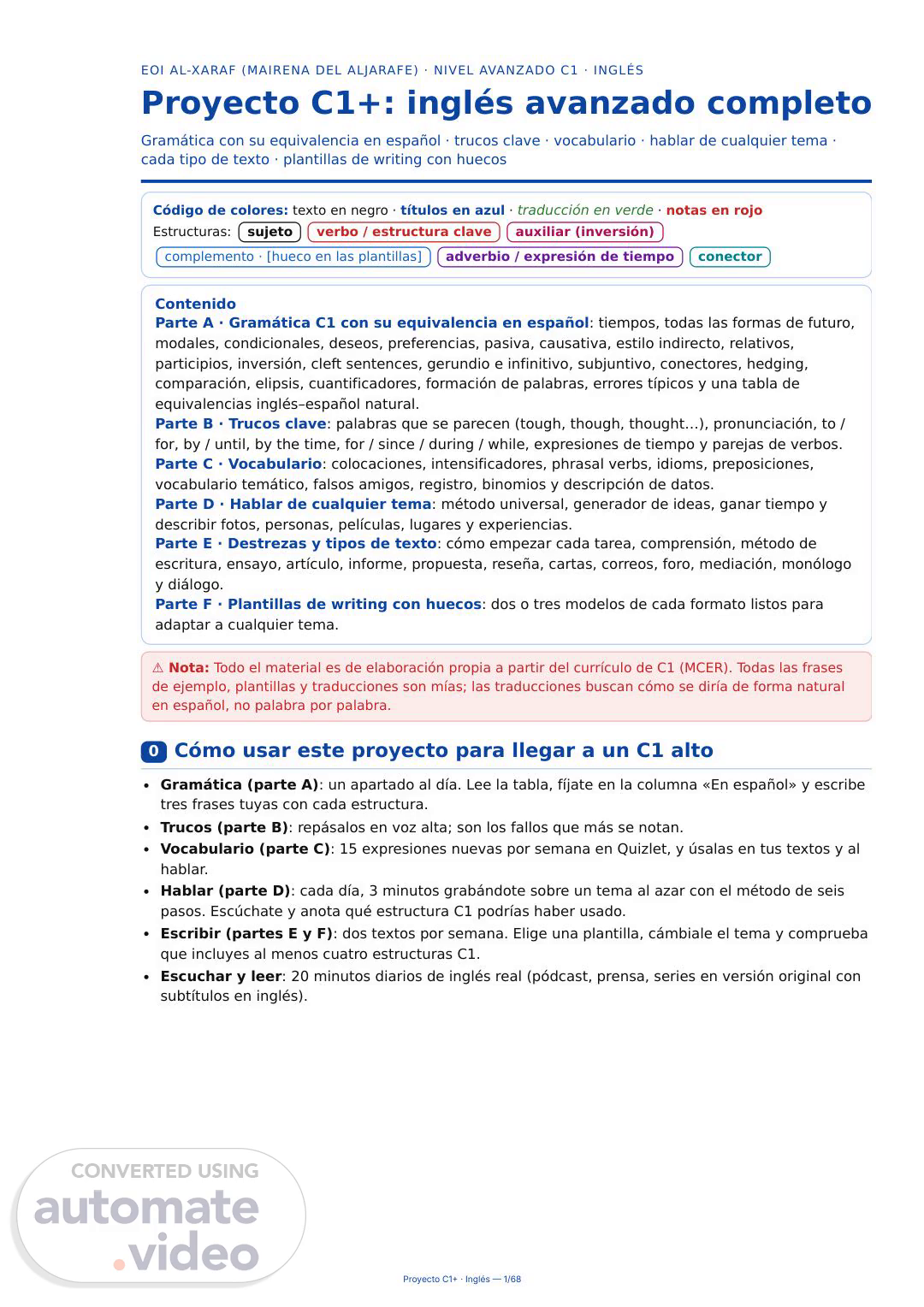
EOI AL-XARAF (MAIRENA DEL ALJARAFE) · NIVEL AVANZADO C1 · INGLÉS Proyecto C1+: inglés avanzado completo Gramática con su equivalencia en español · trucos clave · vocabulario · hablar de cualquier tema · cada tipo de texto · plantillas de writing con huecos Código de colores: texto en negro · títulos en azul · traducción en verde · notas en rojo Estructuras: sujeto verbo / estructura clave auxiliar (inversión) complemento · [hueco en las plantillas] adverbio / expresión de tiempo conector Contenido Parte A · Gramática C1 con su equivalencia en español: tiempos, todas las formas de futuro, modales, condicionales, deseos, preferencias, pasiva, causativa, estilo indirecto, relativos, participios, inversión, cleft sentences, gerundio e infinitivo, subjuntivo, conectores, hedging, comparación, elipsis, cuantificadores, formación de palabras, errores típicos y una tabla de equivalencias inglés–español natural. Parte B · Trucos clave: palabras que se parecen (tough, though, thought…), pronunciación, to / for, by / until, by the time, for / since / during / while, expresiones de tiempo y parejas de verbos. Parte C · Vocabulario: colocaciones, intensificadores, phrasal verbs, idioms, preposiciones, vocabulario temático, falsos amigos, registro, binomios y descripción de datos. Parte D · Hablar de cualquier tema: método universal, generador de ideas, ganar tiempo y describir fotos, personas, películas, lugares y experiencias. Parte E · Destrezas y tipos de texto: cómo empezar cada tarea, comprensión, método de escritura, ensayo, artículo, informe, propuesta, reseña, cartas, correos, foro, mediación, monólogo y diálogo. Parte F · Plantillas de writing con huecos: dos o tres modelos de cada formato listos para adaptar a cualquier tema. ⚠ Nota: Todo el material es de elaboración propia a partir del currículo de C1 (MCER). Todas las frases de ejemplo, plantillas y traducciones son mías; las traducciones buscan cómo se diría de forma natural en español, no palabra por palabra. 0 Cómo usar este proyecto para llegar a un C1 alto Gramática (parte A): un apartado al día. Lee la tabla, fíjate en la columna «En español» y escribe tres frases tuyas con cada estructura. Trucos (parte B): repásalos en voz alta; son los fallos que más se notan. Vocabulario (parte C): 15 expresiones nuevas por semana en Quizlet, y úsalas en tus textos y al hablar. Hablar (parte D): cada día, 3 minutos grabándote sobre un tema al azar con el método de seis pasos. Escúchate y anota qué estructura C1 podrías haber usado. Escribir (partes E y F): dos textos por semana. Elige una plantilla, cámbiale el tema y comprueba que incluyes al menos cuatro estructuras C1. Escuchar y leer: 20 minutos diarios de inglés real (pódcast, prensa, series en versión original con subtítulos en inglés). Proyecto C1 · Inglés 1/68.
Scene 2 (1m 5s)
Gramática C1 A1 Tiempos verbales: usos de nivel C1 y cómo se dicen en español A nivel C1 no basta con conocer los tiempos: hay que elegir el aspecto (simple, continuo, perfecto) según lo que quieres destacar. La columna «En español» te da la forma natural, no la traducción palabra por palabra. Tiempo Uso C1 En español Ejemplo Present perfect continuous acción que empezó en el pasado y sigue; resultado visible llevar + gerundio; hace … que I've been waiting here for an hour. Llevo una hora esperando aquí. Present perfect (+ for / since) estado que dura hasta ahora llevar + tiempo; desde hace I've been here for so long that I know everyone. Llevo aquí tanto tiempo que conozco a todo el mundo. Past perfect continuous duración hasta un momento del pasado llevaba + gerundio; hacía … que She had been working there for ten years when she resigned. Llevaba diez años trabajando allí cuando dimitió. Past perfect simple acción anterior a otra pasada había + participio By the time we arrived, the film had already started. Para cuando llegamos, la película ya había empezado. Past perfect + just acción recién terminada en el pasado acababa de + infinitivo I had just left when you called. Acababa de salir cuando llamaste. Present perfect + just acción recién terminada acabo de + infinitivo She's just finished the report. Acaba de terminar el informe. Pasiva en pasado perfecto con verbos de dos objetos (give, tell, offer) me habían dado / me dieron (activa con «me») I had been given a reply before the deadline. Me habían dado una respuesta antes del plazo. Past continuous marco de una narración; petición muy cortés estaba + gerundio; «quería saber si…» I was wondering if you could help me. Quería saber si podría ayudarme. Present continuous + always queja por algo repetido siempre está + gerundio He's always interrupting me! ¡Siempre me está interrumpiendo! PARTE A Todas las estructuras del nivel avanzado y cómo se dicen de verdad en español Proyecto C1 · Inglés 2/68.
Scene 3 (2m 4s)
[Audio] We will use this project to reach a high level of C1. We will study the grammar C1 with its equivalent in Spanish every day. We will review the key phrases and practice them out loud. We will learn 15 new expressions every week on Quizlet and use them in our texts and conversations. We will practice speaking every day for three minutes using the six-step method. We will listen and read 20 minutes a day of real English. We will write two texts per week, choosing a template, changing the topic, and checking that we include at least four C1 structures. We will make sure to review the grammar, key phrases, and vocabulary regularly. We will use the templates for writing with blanks to practice different types of texts. We will start each task with a clear method. We will practice comprehension. We will use the six-step method to generate ideas. We will practice speaking with a clear method. We will use the templates for writing with blanks to practice different types of texts. We will start each task with a clear method. We will practice comprehension. We will use the six-step method to generate ideas. We will practice speaking with a clear method. We will use the templates for writing with blanks to practice different types of texts. We will start each task with a clear method. We will practice comprehension. We will use the six-step method to generate ideas. We will practice speaking with a clear method. We will use the templates for writing with blanks to practice different types of texts. We will start each task with a clear method. We will practice comprehension. We will use the six-step method to generate ideas. We will practice speaking with a clear method. We will use the templates for writing with blanks to practice different types of texts. We will start each task with a clear method. We will practice comprehension. We will use the six-step method to generate ideas. We will practice speaking with a clear method. We will use the templates for writing with blanks to practice different types of texts. We will start each task with a clear method. We will practice comprehension. We will use the six-step method to generate ideas. We will practice speaking with a clear method. We will use the templates for writing with blanks to practice different types of texts. We will start each task with a clear method. We will practice comprehension. We will use the six-step method to generate ideas. We will practice speaking with a clear method. We will use the templates for writing with blanks to practice different types of texts. We will start each task with a clear method. We will practice comprehension. We will use the six-step method to generate ideas. We will practice speaking with a clear method. We will use the templates for writing with blanks to practice different types of texts. We will start each task with a clear method. We will practice comprehension. We will use the six-step method to generate ideas. We will practice speaking with a clear method. We will use the templates for writing with blanks to practice different types of texts. We will start each task with a clear method. We will practice comprehension. We will use the six-step method to generate ideas. We will practice speaking with a clear method. We will use the templates for writing with blanks to practice different types of texts. We will start each task with a clear method. We will practice comprehension. We will use the six-step method to.
Scene 4 (5m 45s)
[Audio] The structure "due to" is used to indicate something that is planned or scheduled to happen at a certain time. It is often used in formal or official contexts, such as calendars or schedules. It implies that something is expected to happen, but it's not necessarily a guarantee. In informal contexts, we might use the structure set to to convey a similar meaning, as in Prices are set to rise again. This structure is often used in news articles or reports. We will also look at the structure to which is used to indicate official plans or orders. For example, The president is to visit Spain next week. This structure implies that something is mandatory or obligatory. Finally, we will examine the structure scheduled or expected to which is used to indicate something that is programmed or anticipated to happen. For example, The work is expected to take two years. This structure implies that something is likely to happen, but it's not a guarantee. We will practice using these structures in sentences to convey the correct meaning and nuance..
Scene 5 (6m 56s)
[Audio] We're going to start with the first part of the project, which is to improve our grammar skills to an advanced level. We'll be studying the different structures and their equivalents in Spanish. We'll take a look at the table and identify the structures, and then we'll write three sentences using each one. We'll also review the common mistakes that native speakers make and practice our pronunciation. In the next part, we'll focus on learning new vocabulary, 15 expressions per week, and using them in our writing and speaking. We'll also practice speaking about any topic using a universal method and record ourselves to identify areas for improvement. In the following parts, we'll work on writing different types of texts, using templates with blanks, and practicing our listening and reading skills. We'll aim to write two texts per week, using at least four advanced structures. We'll also listen to and read English real content for 20 minutes every day. This project will help us achieve a high level of English proficiency, and we'll be able to express ourselves accurately and fluently. We'll make progress every day, and we'll see the results in our language skills. We'll be consistent and persistent in our efforts, and we'll reach our goal of becoming advanced level speakers. We'll enjoy the process and have fun while learning. We'll be motivated by the results we see in our progress, and we'll keep pushing ourselves to improve. We'll make mistakes, but we'll learn from them, and we'll become better speakers. We'll be proud of our achievements, and we'll feel confident in our language skills. We'll be able to communicate effectively in English, and we'll be able to express ourselves in different situations. We'll be able to write and speak clearly and accurately, and we'll be able to understand different accents and dialects. We'll be able to use our language skills in real-life situations, and we'll be able to participate in conversations with native speakers. We'll be able to read and understand different texts, and we'll be able to summarize them. We'll be able to listen to and understand different accents and dialects, and we'll be able to respond appropriately. We'll be able to use our language skills in different contexts, and we'll be able to adapt to different situations. We'll be able to express ourselves in a clear and concise manner, and we'll be able to use our language skills to achieve our goals. We'll be able to communicate effectively in English, and we'll be able to express ourselves in different situations. We'll be proud of our achievements, and we'll feel confident in our language skills. We'll be able to use our language skills in real-life situations, and we'll be able to participate in conversations with native speakers. We'll be able to read and understand different texts, and we'll be able to summarize them. We'll be able to listen to and understand different accents and dialects, and we'll be able to respond appropriately. We'll be able to use our language skills in different contexts, and we'll be able to adapt to different situations. We'll be able to express ourselves in a clear and concise manner, and we'll be able to use our language skills to achieve our goals. We'll be able to communicate effectively in English, and we'll be able to express ourselves in different situations. We'll be proud of our achievements, and we'll feel confident in our language skills. We'll be able to use our language skills in real-life situations, and we'll be able to participate in conversations with native speakers. We'll be able to read.
Scene 6 (10m 28s)
[Audio] As we continue our journey to achieve a high level of English proficiency, we need to focus on developing our grammar skills. In this project, we will explore the different aspects of grammar, including tenses, modal verbs, conditionals, and more. By mastering these structures, we will be able to express ourselves more accurately and confidently. We will explore the different aspects of vocabulary, including phrasal verbs, idioms, and more. By learning these words and phrases, we will be able to express ourselves more accurately and confidently. We will explore the different aspects of speaking, including how to start a conversation, how to describe people, places, and experiences, and more. By learning these skills, we will be able to communicate more effectively and confidently. We will explore the different aspects of writing, including how to start a text, how to write a report, how to write a proposal, and more. By learning these skills, we will be able to express ourselves more accurately and confidently in writing. We will explore the different aspects of listening and reading, including how to understand spoken language, how to read different types of texts, and more. By learning these skills, we will be able to comprehend and appreciate English language more effectively. Each of these structures has its own unique characteristics and uses. For example, the conditional tense is used to express hypothetical or uncertain situations, while the subjunctive mood is used to express doubt or uncertainty. The phrasal verb 'pick up' means to stop and talk to someone, while the idiom 'break a leg' means good luck. The structure 'describe a picture' is used to talk about a visual image, while the structure 'describe a person' is used to talk about a person's appearance or personality. The structure 'write a report' is used to write a formal document, while the structure 'write a proposal' is used to suggest a plan or idea. By the end of this project, we will have a solid understanding of the different structures and their uses, and we will be able to express ourselves more accurately and confidently in English. As we continue our journey to achieve a high level of English proficiency, we need to focus on developing our vocabulary skills. In this project, we will explore the different aspects of vocabulary, including phrasal verbs, idioms, and more. By learning these words and phrases, we will be able to express ourselves more accurately and confidently. We will explore the different aspects of speaking, including how to start a conversation, how to describe people, places, and experiences, and more. By learning these skills, we will be able to communicate more effectively and confidently. We will explore the different aspects of writing, including how to start a text, how to write a report, how to write a proposal, and more. By learning these skills, we will be able to express ourselves more accurately and confidently in writing. We will explore the different aspects of listening and reading, including how to understand spoken language, how to read different types of texts, and more. By learning these skills, we will be able to comprehend and appreciate English language more effectively. Each of these structures has its own unique characteristics and uses. For example, the phrasal verb 'pick up' means to stop and talk to someone, while the idiom 'break a leg' means good luck..
Scene 7 (14m 10s)
[Audio] We're going to focus on the structure of a wish. A wish is an expression of a desire or a feeling that something is not the way it should be. There are several ways to express a wish in English. One way is to use the verb wish followed by the subject and the verb would in the past simple or the present perfect. For example, I wish I had more time or I wish I could speak Japanese. Another way is to use the expression if only followed by the past simple or the past perfect. For example, If only I had studied harder or If only I had sent that email. We can also use the expression it's time followed by the past simple. For example, It's time we took action or It's time I apologized. Additionally, we can use the expression about time followed by the past simple. For example, It's about time we finished this project or It's about time I cleaned my room. Finally, we can use the expression wish followed by the subject and the verb could to express a desire for a capability that we don't have. For example, I wish I could swim or I wish I could speak French. Let's practice using these structures to express our wishes. We can start by writing three sentences each using the verb wish followed by the subject and the verb would, the expression if only followed by the past simple, the expression it's time followed by the past simple, and the expression about time followed by the past simple. We can also practice using the expression wish followed by the subject and the verb could to express a desire for a capability that we don't have. Let's make a wish come true! We can practice using the structures to express our wishes. We can start by writing three sentences each using the verb wish followed by the subject and the verb would, the expression if only followed by the past simple, the expression it's time followed by the past simple, and the expression about time followed by the past simple. We can also practice using the expression wish followed by the subject and the verb could to express a desire for a capability that we don't have. We can practice writing sentences using the verb wish followed by the subject and the verb would. For example, I wish I had more time or I wish I could speak Japanese. We can also practice writing sentences using the expression if only followed by the past simple. For example, If only I had studied harder or If only I had sent that email. Additionally, we can practice writing sentences using the expression it's time followed by the past simple. For example, It's time we took action or It's time I apologized. Furthermore, we can practice writing sentences using the expression about time followed by the past simple. For example, It's about time we finished this project or It's about time I cleaned my room. Finally, we can practice writing sentences using the expression wish followed by the subject.
Scene 8 (17m 13s)
[Audio] The task is to translate the given text into English. Translate each sentence individually. Here are the translations: 1. When learning new grammar structures, it's essential to practice using them in context. Translation: Learning new grammar structures requires practicing them in context. 2. We can start by identifying the structure and its equivalent in Spanish. Translation: Start by identifying the structure and its equivalent in Spanish. 3. For example, the structure 'prefer + to + infinitive' is equivalent to 'preferiría + infinitivo' in Spanish. Translation: The structure 'prefer + to + infinitive' is equivalent to 'preferiría + infinitivo' in Spanish. 4. To practice using this structure, we can create our own sentences using the verb 'prefer' followed by 'to + infinitive.' Translation: To practice using this structure, create your own sentences using the verb 'prefer' followed by 'to + infinitive.' 5. For instance, 'I prefer walking to driving' or 'I'd prefer to stay in tonight.' Translation: For example, 'I prefer walking to driving' or 'I'd prefer to stay in tonight.' 6. Remember to use the correct form of the verb 'prefer' according to the context. Translation: Use the correct form of the verb 'prefer' according to the context. 7. Now, let's move on to the next structure, 'would prefer + to + infinitive,' which is equivalent to 'preferiría + infinitivo' in Spanish. Translation: Move on to the next structure, 'would prefer + to + infinitive,' which is equivalent to 'preferiría + infinitivo' in Spanish. 8. This structure is used to express a preference with a sense of obligation or necessity. Translation: This structure expresses a preference with a sense of obligation or necessity. 9. For example, 'I'd prefer you to call me first' or 'I'd prefer it if you didn't smoke here.' Translation: For example, 'I'd prefer you to call me first' or 'I'd prefer it if you didn't smoke here.' 10. Practice using this structure by creating your own sentences. Translation: Practice using this structure by creating your own sentences. 11. Remember to use the correct form of the verb 'prefer' according to the context. Translation: Use the correct form of the verb 'prefer' according to the context. 12. Let's continue with the next structure, 'would rather + infinitive,' which is equivalent to 'prefiero, preferiría' in Spanish. Translation: Continue with the next structure, 'would rather + infinitive,' which is equivalent to 'prefiero, preferiría' in Spanish. 13. This structure is used to express a preference without using the verb 'prefer.' Translation: This structure expresses a preference without using the verb 'prefer.' 14. For example, 'I'd rather stay at home' or 'I'd rather walk than wait for the bus.' Translation: For example, 'I'd rather stay at home' or 'I'd rather walk than wait for the bus.' 15. Practice using this structure by creating your own sentences. Translation: Practice using this structure by creating your own sentences. 16. Remember to use the correct form of the verb 'prefer' according to the context. Translation: Use the correct form of the verb 'prefer' according to the context. 17. Let's look at the structure 'would rather not + infinitive,' which is equivalent to 'prefiero no' in Spanish. Translation: Look at the structure 'would rather not + infinitive,' which is equivalent to 'prefiero no' in Spanish. 18. This structure is used to express a negative preference. Translation: This structure expresses a negative preference. 19. For example, 'I'd rather not talk about it' or 'I'd rather not smoke.' Translation: For example, 'I'd rather not talk about it' or 'I'd rather not smoke.' 20. Practice using this structure by creating your own sentences. Translation: Practice using this structure by creating your own sentences. 21. Remember to use the correct form of the verb 'prefer' according to the context. Translation: Use the correct form of the verb 'prefer' according to the context. 22. I prefer walking to driving. Translation: I prefer walking.
Scene 9 (22m 13s)
[Audio] ## Step 1: Rewrite the given text in full sentences only. The passive voice is a key aspect of the C1 level, and it's essential to master it to communicate effectively in English. ## Step 2: Remove greetings from the rewritten text. We are going to explore the structure of the passive voice, specifically the advanced and impersonal forms. ## Step 3: Remove introduction sentences from the rewritten text. This is a key aspect of the C1 level, and it's essential to master it to communicate effectively in English. ## Step 4: Remove thanking sentences from the rewritten text. One of the key features of the passive voice is the use of the verb 'to be' in the present or past tense, followed by the past participle of the main verb. ## Step 5: Rewrite the remaining sentences in full sentences only. Notice how the subject of the sentence is the thing being affected, rather than the person or thing performing the action. ## Step 6: Continue rewriting the remaining sentences in full sentences only. The passive voice can be formed with an infinitive or gerund, as in 'I hate being told what to do.' ## Step 7: Rewrite the remaining sentences in full sentences only. The use of the passive voice with modals, such as'should have been' or 'is believed,' adds another layer of complexity. ## Step 8: Continue rewriting the remaining sentences in full sentences only. We can also use the passive voice with a subject and a verb, as in 'The fire is believed to have started in the kitchen.' ## Step 9: Rewrite the remaining sentences in full sentences only. Another important aspect of the passive voice is the use of the phrase 'there is said to be' or 'there are thought to be.' ## Step 10: Continue rewriting the remaining sentences in full sentences only. This is often used to express opinions or beliefs, as in 'There are thought to be over a million speakers.' ## Step 11: Rewrite the remaining sentences in full sentences only. The key to mastering the passive voice is to practice using it in different contexts and to be aware of the various forms it can take. ## Step 12: Continue rewriting the remaining sentences in full sentences only. With regular practice, you'll be able to use the passive voice with confidence and accuracy. The final answer is: The passive voice is a key aspect of the C1 level, and it's essential to master it to communicate effectively in English. The passive voice is used to describe an action that is being performed on someone or something, rather than by someone or something. One of the key features of the passive voice is the use of the verb 'to be' in the present or past tense, followed by the past participle of the main verb. Notice how the subject of the sentence is the thing being affected, rather than the person or thing performing the action. The passive voice can be formed with an infinitive or gerund, as in 'I hate being told what to do.' The use of the passive voice with modals, such as'should have been' or 'is believed,' adds another layer of complexity. We can also use the passive voice with a subject and a verb, as in 'The fire is believed to have started in the kitchen.' Another important aspect of the passive voice is the use of the phrase 'there is said to be' or 'there are thought to be.' This is often used to express opinions or beliefs, as in 'There are thought to be over a million speakers.' The key to mastering the passive voice is to practice using it in different contexts and to be aware.
Scene 10 (26m 25s)
[Audio] ## Step 1: Identify the main idea of the text The main idea of the text is to provide guidance on how to effectively use a project to improve language skills, specifically focusing on grammar, vocabulary, speaking, listening, and writing. ## Step 2: Break down the text into its components - Focus on one aspect of grammar per day. - Find equivalent structures in Spanish by looking at the table and writing three of your own sentences with each one. - Practice pronunciation by speaking aloud. - Learn 15 new expressions per week and use them in writing and speaking. - Practice speaking for three minutes a day on a random topic using the six-step method. - Listen to and read English language content for 20 minutes daily. - Improve writing skills by producing two texts per week, using a template and including at least four C1-level structures. - Review the table of equivalences between English and Spanish to learn new grammar structures. ## Step 3: Rewrite the text in full sentences only We should focus on one aspect of grammar per day when using this project to reach a high level of C1 proficiency. To achieve this, we can find the equivalent structures in Spanish by looking at the table and write three of our own sentences with each one. Practicing pronunciation is crucial, and we should do this by speaking aloud. Learning 15 new expressions per week is essential for effective communication, and we should use them in both our writing and speaking. To improve our speaking skills, we should practice speaking for three minutes a day on a random topic using the six-step method. Listening to and reading English language content for 20 minutes daily is also vital. Furthermore, we should produce two texts per week, using a template and including at least four C1-level structures. Additionally, reviewing the table of equivalences between English and Spanish will help us learn new grammar structures. ## Step 4: Combine the rewritten text into a single paragraph We should focus on one aspect of grammar per day when using this project to reach a high level of C1 proficiency. To achieve this, we can find the equivalent structures in Spanish by looking at the table and write three of our own sentences with each one. Practicing pronunciation is crucial, and we should do this by speaking aloud. Learning 15 new expressions per week is essential for effective communication, and we should use them in both our writing and speaking. To improve our speaking skills, we should practice speaking for three minutes a day on a random topic using the six-step method. Listening to and reading English language content for 20 minutes daily is also vital. Furthermore, we should produce two texts per week, using a template and including at least four C1-level structures. Additionally, reviewing the table of equivalences between English and Spanish will help us learn new grammar structures. The final answer is:.
Scene 11 (29m 42s)
[Audio] ## Step 1: Identify the type of relative clause Relative clauses are used to provide additional information about a noun in the main clause. ## Step 2: Determine the function of each type of relative clause Relative clauses introduced by whom and which provide more information about a person or a thing. Relative clauses introduced by of whom and whereby provide more information about a group of people or a situation. Relative clauses introduced by participles provide more information about an action or a state. ## Step 3: Provide examples for each type of relative clause For example, 'The person to whom I spoke was very helpful.' 'The company whose profits have doubled.' 'I have two brothers, both of whom live abroad.' 'They set up a system whereby staff can work from home.' 'The houses built after 2010 are more efficient.' 'She was the first woman to win the prize.' ## Step 4: Explain how to use participles to form compact and elegant sentences Participles can be used to form compact and elegant sentences, such as 'Feeling tired, she went to bed early.' 'Having finished the report, he left the office.' ## Step 5: Discuss the use of participles to form sentences with a negative connotation Participles can be used to form sentences with a negative connotation, such as 'Not knowing what to say, I kept quiet.' ## Step 6: Summarize the key points By the end of this section, you will be able to identify and use these structures in your writing and speaking..
Scene 12 (31m 26s)
[Audio] ## Step 1: Understand the concept of inversion Inversion is a grammatical structure used to give extra emphasis to a particular part of a sentence. ## Step 2: Identify the purpose of inversion The primary purpose of inversion is to highlight a specific element within a sentence, rather than emphasizing the entire sentence. ## Step 3: Analyze the usage of inversion Inversion is typically employed when an individual wishes to draw attention to a particular aspect of a sentence, such as a noun or verb. ## Step 4: Examine the effect of inversion on sentence meaning Inversion can significantly alter the tone and emphasis of a sentence, making it more impactful and persuasive. ## Step 5: Consider the importance of context Context plays a crucial role in determining when to employ inversion, as its effectiveness can vary depending on the situation and intended audience. ## Step 6: Evaluate the benefits of using inversion Using inversion can enhance clarity, precision, and overall communication by drawing attention to critical elements within a sentence. ## Step 7: Review common inversion patterns Some common inversion patterns include using phrases like "such [adjective]..." to emphasize a noun, and "not only... but also" to contrast ideas. ## Step 8: Assess the challenges of mastering inversion Mastering inversion requires practice and attention to detail, as its application can sometimes lead to ambiguity or confusion. ## Step 9: Develop strategies for effective inversion To effectively utilize inversion, writers and speakers should carefully consider their audience, context, and intended message. ## Step 10: Practice applying inversion in various contexts By practicing inversion in different scenarios, individuals can develop a deeper understanding of its nuances and applications. The final answer is: Inversion is a grammatical structure used to give extra emphasis to a particular part of a sentence. The primary purpose of inversion is to highlight a specific element within a sentence, rather than emphasizing the entire sentence. Inversion is typically employed when an individual wishes to draw attention to a particular aspect of a sentence, such as a noun or verb. Inversion can significantly alter the tone and emphasis of a sentence, making it more impactful and persuasive. Context plays a crucial role in determining when to employ inversion, as its effectiveness can vary depending on the situation and intended audience. Using inversion can enhance clarity, precision, and overall communication by drawing attention to critical elements within a sentence. Some common inversion patterns include using phrases like "such [adjective]..." to emphasize a noun, and "not only... but also" to contrast ideas. Mastering inversion requires practice and attention to detail, as its application can sometimes lead to ambiguity or confusion. To effectively utilize inversion, writers and speakers should carefully consider their audience, context, and intended message. By practicing inversion in different scenarios, individuals can develop a deeper understanding of its nuances and applications..
Scene 13 (35m 13s)
A14 Oraciones escindidas (cleft sentences) y otras formas de énfasis Estructura Ejemplo It is / was … that / who It was Maria who found the solution. Fue María quien encontró la solución. What … is / was … What I need is a long holiday. Lo que necesito son unas largas vacaciones. All … is / was … All I did was ask a question. Lo único que hice fue hacer una pregunta. The thing / reason / place … is The reason I called is that I need your advice. La razón por la que llamé es que necesito tu consejo. What happened was … What happened was that the train broke down. Lo que pasó fue que el tren se averió. do / does / did enfático I do understand your concerns. Comprendo perfectamente su preocupación. Fronting (anteposición) Strange as it may seem, I enjoyed the exam. Por extraño que parezca, disfruté del examen. the very, at all, whatsoever That's the very thing I wanted to avoid. Eso es justo lo que quería evitar. A15 Gerundio e infinitivo Verbos que cambian de significado Verbo + -ing + to + infinitivo remember / forget I remember locking the door. Recuerdo haber cerrado la puerta. Remember to lock the door. Acuérdate de cerrar la puerta. stop He stopped smoking. Dejó de fumar. He stopped to smoke. Se paró para fumar. try Try restarting the computer. Prueba a reiniciar el ordenador. I tried to open it, but I couldn't. Intenté abrirlo, pero no pude. regret I regret saying that. Me arrepiento de haber dicho eso. We regret to inform you that… Lamentamos comunicarle que… go on She went on talking. Siguió hablando. She went on to become a judge. Luego llegó a ser jueza. mean This means waiting longer. Esto supone esperar más. I meant to call you. Tenía intención de llamarte. Otras estructuras clave Preposición + -ing: I look forward to hearing from you; I'm used to working late; object to / be committed to / when it comes to + -ing. Infinitivo perfecto: She seems to have left (parece que se ha ido). Infinitivo continuo: He appears to be doing well. Gerundio perfecto: He denied having taken it. It's no use / There's no point + -ing: There's no point complaining. can't help + -ing: I couldn't help laughing (no pude evitar reírme). Proyecto C1 · Inglés 13/68.
Scene 14 (36m 19s)
A16 Subjuntivo y estructuras formales Estructura Ejemplo Subjuntivo tras verbos de petición The board demanded that he resign immediately. La junta exigió que dimitiera de inmediato. It is essential / vital / crucial that + infinitivo sin to It is essential that every student attend the meeting. Es fundamental que todos los alumnos asistan a la reunión. were (subjuntivo) If I were you, I'd apply. Yo que tú, lo solicitaría. as if / as though He talks as if he knew everything. Habla como si lo supiera todo. lest (muy formal) She spoke quietly lest she wake the baby. Habló bajito para no despertar al bebé. Fórmulas fijas Be that as it may, we must act. Sea como fuere, debemos actuar. ⚠ Nota: El subjuntivo no lleva -s ni cambia con el tiempo: They insisted that she be present. En inglés británico también es correcto con should: that she should be present. A17 Conectores y marcadores del discurso Son imprescindibles en la escritura y el monólogo. Varía: no repitas siempre but, because y so. Contraste y concesión Expresión Uso Ejemplo however / nevertheless / nonetheless sin embargo (inicio de oración, con coma) The plan is expensive. Nevertheless, it is worth trying. El plan es caro. Sin embargo, merece la pena intentarlo. although / even though aunque (+ oración) Even though it was raining, we went out. Aunque llovía, salimos. despite / in spite of a pesar de (+ sustantivo / -ing) Despite having little money, they travelled a lot. A pesar de tener poco dinero, viajaron mucho. despite the fact that a pesar de que (+ oración) Despite the fact that he was ill, he came. A pesar de que estaba enfermo, vino. whereas / while mientras que (contraste) I love cities, whereas my brother prefers the country. A mí me encantan las ciudades, mientras que mi hermano prefiere el campo. much as por mucho que Much as I admire him, I can't agree. Por mucho que lo admire, no puedo estar de acuerdo. albeit aunque, si bien (+ adjetivo / adverbio) It was a success, albeit a limited one. Fue un éxito, si bien limitado. notwithstanding no obstante, a pesar de (formal) Notwithstanding the risks, they went ahead. A pesar de los riesgos, siguieron adelante. adjetivo + as / though + sujeto + verbo por muy … que Tired as I was, I kept working. Por muy cansado que estuviera, seguí trabajando. however + adjetivo por muy … que However hard you try, you can't please everyone. Por mucho que te esfuerces, no puedes contentar a todos. Proyecto C1 · Inglés 14/68.
Scene 15 (37m 24s)
[Audio] By the end of this project, we will have mastered the C1 level in English and will be able to express ourselves confidently and accurately in writing and speaking. We will have developed a deep understanding of the language and will be able to use it in a variety of contexts, including academic, professional, and social situations. We will have also developed a range of skills, including writing, speaking, listening, and reading, and will be able to use these skills to communicate effectively with others. We will be able to use language to convey our ideas, opinions, and feelings, and will be able to understand and respond to the language of others. We will be able to use language to build relationships, negotiate, and persuade others, and will be able to use language to solve problems and make decisions. We will be able to use language to express ourselves creatively and imaginatively, and will be able to use language to tell stories and convey emotions. We will have developed a deep understanding of the language and will be able to use it in a variety of contexts, including academic, professional, and social situations. We will have also developed a range of skills, including writing, speaking, listening, and reading, and will be able to use these skills to communicate effectively with others. We will be able to use language to convey our ideas, opinions, and feelings, and will be able to understand and respond to the language of others. We will be able to use language to build relationships, negotiate, and persuade others, and will be able to use language to solve problems and make decisions. We will be able to use language to express ourselves creatively and imaginatively, and will be able to use language to tell stories and convey emotions. We will have developed a deep understanding of the language and will be able to use it in a variety of contexts, including academic, professional, and social situations. We will have also developed a range of skills, including writing, speaking, listening, and reading, and will be able to use these skills to communicate effectively with others. We will be able to use language to convey our ideas, opinions, and feelings, and will be able to understand and respond to the language of others. We will be able to use language to build relationships, negotiate, and persuade others, and will be able to use language to solve problems and make decisions. We will be able to use language to express ourselves creatively and imaginatively, and will be able to use language to tell stories and convey emotions. We will have developed a deep understanding of the language and will be able to use it in a variety of contexts, including academic, professional, and social situations. We will have also developed a range of skills, including writing, speaking, listening, and reading, and will be able to use these skills to communicate effectively with others. We will be able to use language to convey our ideas, opinions, and feelings, and will be able to understand and respond to the language of others. We will be able to use language to build relationships, negotiate, and persuade others, and will be able to use language to solve problems and make decisions. We will be able to use language to express ourselves creatively and imaginatively, and will be able to use language to tell stories and convey emotions. We will have developed a deep understanding of the language and will be able to use it in a variety of contexts, including academic, professional, and social.
Scene 16 (41m 11s)
[Audio] We can use phrases like 'it appears that', 'it seems that', or 'tend to'. Young people tend to rely on social media. We are not making a definitive statement; instead, we are suggesting a tendency. Another way to hedge is by using words like 'arguably', 'to some extent', or 'it could be argued that'. Tourism does more harm than good, it could be argued. We can also use comparative structures such as 'the more you practise, the more confident you become.' It's by far the best option. We can compare by using superlatives such as'she is every bit as talented as her sister.' It's not so much a problem as a challenge. Using hedging language, comparative structures, and elipsis allows us to express ourselves at the C1 level. We should practice using these structures in our writing and speaking. Practice makes perfect..
Scene 17 (42m 8s)
Recurso Ejemplo so / not tras think, hope, expect, afraid Will it rain? I hope not. ¿Lloverá? Espero que no. do so He promised to call, but he never did so. Prometió llamar, pero nunca lo hizo. one / ones I'd like the red one, please. Quiero el rojo, por favor. Auxiliar solo She said she would help, and she did. Dijo que ayudaría, y lo hizo. So / Neither + auxiliar + sujeto I loved the book. So did my sister. Me encantó el libro. A mi hermana también. to (sin repetir el verbo) I didn't want to go, but I had to. No quería ir, pero tuve que hacerlo. A21 Determinantes y cuantificadores Estructura Ejemplo few / a few · little / a little Few people know this, but a few experts do. Poca gente lo sabe, pero algunos expertos sí. quite a few / a great many Quite a few students failed. Suspendieron bastantes alumnos. each / every Each of the candidates was interviewed. Se entrevistó a cada uno de los candidatos. either / neither / both Neither option is ideal. Ninguna de las dos opciones es ideal. the former / the latter I prefer the latter. Prefiero el segundo / lo segundo. no / none of None of the proposals was accepted. No se aceptó ninguna de las propuestas. incontables (sin a / plural) She gave me some useful advice. Me dio algunos consejos útiles. ⚠ Nota: Incontables frecuentes en el examen: advice, information, news, research, evidence, equipment, furniture, luggage, accommodation, progress, knowledge, feedback. Para contarlos: a piece of advice. A22 Formación de palabras Tipo Afijos Ejemplos Prefijos negativos un-, in-, im-, il-, ir-, dis-, mis-, non- unreliable, inefficient, impractical, illegal, irrelevant, dishonest, misleading, non-existent Otros prefijos over-, under-, re-, co-, pre-, post-, counter-, mal-, out- overestimate, underpaid, rethink, co-author, pre-booked, post-war, counterproductive, malnutrition, outnumber Sustantivos -ment, -ness, -ity, -ance/-ence, - tion, -ship, -hood, -dom, -ism achievement, awareness, reliability, reluctance, assumption, leadership, childhood, freedom, consumerism Adjetivos -able/-ible, -ful, -less, -ous, -ive, -al, -ic, -ish sustainable, harmful, pointless, ambitious, persuasive, controversial, realistic, childish Verbos -ise/-ize, -en, -ify, en- prioritize, broaden, clarify, enable, enrich Adverbios -ly, -wise, -ward(s) increasingly, likewise, moneywise, afterwards ✔ Consejo: Truco: aprende familias completas. succeed → success → successful → successfully → unsuccessful; rely → reliable → reliability → unreliable → reliance. Proyecto C1 · Inglés 17/68.
Scene 18 (43m 13s)
A23 Errores típicos del hispanohablante (¡evítalos!) ✗ Incorrecto ✓ Correcto Explicación *I am agree I agree agree es un verbo *It depends of It depends on preposición *People is People are people es plural *The life is hard Life is hard sin artículo en sentido general *I have 30 years I am 30 (years old) edad con be *Discuss about Discuss something sin preposición *Explain me the problem Explain the problem to me objeto indirecto con to *Since three years For three years for + periodo *Make a question Ask a question colocación *Actually (= actualmente) Currently / nowadays falso amigo *Eventually (= eventualmente) Possibly / occasionally falso amigo: eventually = al final *Assist to a meeting Attend a meeting falso amigo *Sensible (= sensible) Sensitive sensible = sensato *Is important to It is important to el sujeto it es obligatorio *Very much people A lot of / many people cuantificador *I look forward to hear I look forward to hearing to es preposición A24 Equivalencias clave: cómo se dice de verdad en español Estas estructuras inglesas no se traducen palabra por palabra. Aprende el «par» inglés– español como una unidad: así entenderás mejor y, sobre todo, sabrás qué estructura usar cuando pienses en español. Proyecto C1 · Inglés 18/68.
Scene 19 (43m 49s)
Tiempo y duración Inglés Español natural Ejemplo I've been + -ing for… llevo + gerundio / hace … que I've been learning English for six years. Llevo seis años aprendiendo inglés. I'd been + -ing for… llevaba + gerundio / hacía … que We'd been driving for hours when the car broke down. Llevábamos horas conduciendo cuando se averió el coche. It's (been) ages since… hace siglos que no… It's been ages since I last saw her. Hace siglos que no la veo. have just + participio acabo de I've just heard the news. Acabo de enterarme de la noticia. had just + participio acababa de She had just gone to bed when the phone rang. Acababa de acostarse cuando sonó el teléfono. by the time + oración para cuando By the time you get here, I'll have finished. Para cuando llegues, ya habré terminado. by this time tomorrow mañana a estas horas By this time tomorrow, we'll be in London. Mañana a estas horas estaremos en Londres. the moment / as soon as en cuanto The moment I saw him, I knew. En cuanto lo vi, lo supe. once + oración una vez que Once you've finished, you can go. Una vez que hayas terminado, puedes irte. Énfasis y foco Inglés Español natural Ejemplo It was X who / that… fue X quien / el que… It was María who solved the problem. Fue María quien resolvió el problema. What I need is… lo que necesito es… What I need is a break. Lo que necesito es un descanso. All I want is… lo único que quiero es… All I want is some peace and quiet. Lo único que quiero es un poco de tranquilidad. do / did + verbo (enfático) sí que, de verdad I did tell you! ¡Sí que te lo dije! the very + sustantivo justo, precisamente, mismísimo That's the very reason I left. Esa es precisamente la razón por la que me fui. Pasiva y estructuras impersonales Inglés Español natural Ejemplo I was given / told / offered… me dieron / dijeron / ofrecieron I was offered a job in Madrid. Me ofrecieron un trabajo en Madrid. I had been given… me habían dado I had been given the wrong address. Me habían dado la dirección equivocada. It is said / believed that… se dice / se cree que It is believed that he lives abroad. Se cree que vive en el extranjero. He is said to be… dicen que es…, al parecer es… He is said to be a genius. Dicen que es un genio. Proyecto C1 · Inglés 19/68.
Scene 20 (44m 54s)
Deseo, consejo, concesión y otros Inglés Español natural Ejemplo I wish / If only… ojalá… I wish I were taller. Ojalá fuera más alto. You should have… tendrías que haber / deberías haber You should have told me. Tendrías que habérmelo dicho. You needn't have… no hacía falta que You needn't have bothered. No hacía falta que te molestaras. However much / hard… por mucho que However hard I try, I can't do it. Por mucho que lo intento, no me sale. Whatever / Whoever / Wherever… lo que sea que, quienquiera que, dondequiera que Whatever you decide, I'll support you. Decidas lo que decidas, te apoyaré. There's no point + -ing no merece la pena / no tiene sentido There's no point arguing. No tiene sentido discutir. can't help + -ing no poder evitar I couldn't help laughing. No pude evitar reírme. I can't afford to… no me puedo permitir I can't afford to lose this job. No me puedo permitir perder este trabajo. as if / as though como si + subjuntivo He acts as if he owned the place. Se comporta como si fuera el dueño. Proyecto C1 · Inglés 20/68.
Scene 21 (45m 36s)
Trucos clave B1 Palabras que se parecen: cómo suenan y qué significan La pronunciación va entre barras en alfabeto fonético (inglés británico). Repítelas en voz alta: /θ/ se pronuncia con la lengua entre los dientes, como la «z» de zapato en el español del centro y norte de España; /ð/ es una «d» suave, como la de nada. El grupo de tough, though, thought… Palabra Suena Significa Ejemplo tough /tʌf/ duro, difícil It's been a tough year. Ha sido un año duro. though /ðəʊ/ aunque; sin embargo (al final) It's expensive. It's worth it, though. Es caro. Aun así, merece la pena. although /ɔːlˈðəʊ/ aunque (al principio de la oración) Although it was late, we stayed. Aunque era tarde, nos quedamos. thought /θɔːt/ pensamiento; pensé (pasado de think) I thought you were coming. Creía que venías. through /θruː/ a través de; por; gracias a We drove through the night. Condujimos toda la noche. threw /θruː/ lanzó (pasado de throw); suena igual que through He threw the ball. Lanzó la pelota. thorough /ˈθʌrə/ minucioso, a fondo The police carried out a thorough search. La policía hizo un registro a fondo. throughout /θruː ˈaʊt/ durante todo; por todo It rained throughout the day. Llovió durante todo el día. trough /trɒf/ comedero; punto más bajo (economía) The economy is in a trough. La economía está en su punto más bajo. PARTE B Lo que más se confunde: pronunciación, preposiciones, expresiones de tiempo y verbos Proyecto C1 · Inglés 21/68.
Scene 22 (46m 36s)
Otras parejas traicioneras Palabra Suena Significa Ejemplo quite / quiet / quit /kwaɪt/ · / ˈkwaɪət/ · /kwɪt/ bastante · tranquilo · dejar It's been quite quiet here since I quit my job. Desde que dejé el trabajo, esto está bastante tranquilo. desert / dessert /ˈdezət/ · /dɪ ˈzɜːt/ desierto · postre We had ice cream for dessert. Tomamos helado de postre. advice / advise /ədˈvaɪs/ · /əd ˈvaɪz/ consejo (sustantivo) · aconsejar (verbo) I advise you to follow her advice. Te aconsejo que sigas su consejo. accept / except /əkˈsept/ · /ɪk ˈsept/ aceptar · excepto Everyone accepted except me. Todos aceptaron excepto yo. weather / whether /ˈweðə/ (suenan igual) tiempo atmosférico · si (dudas) I don't know whether the weather will improve. No sé si mejorará el tiempo. than / then /ðən/ · /ðen/ que (comparación) · entonces She's taller than me. Es más alta que yo. its / it's /ɪts/ (suenan igual) su (de una cosa) · it is / it has It's lost its value. Ha perdido su valor. whose / who's /huːz/ (suenan igual) cuyo / de quién · who is / who has Who's the man whose car is outside? ¿Quién es el hombre cuyo coche está fuera? live (verbo) / live (adjetivo) /lɪv/ · /laɪv/ vivir · en directo They live near the stadium and watch the matches live. Viven cerca del estadio y ven los partidos en directo. read (presente) / read (pasado) /riːd/ · /red/ leo · leí I read it yesterday. Lo leí ayer. lead (verbo) / lead (metal) /liːd/ · /led/ dirigir · plomo She will lead the team. Ella dirigirá el equipo. cloth / clothes /klɒθ/ · /kləʊðz/ tela, trapo · ropa I need new clothes. Necesito ropa nueva. bored / boring /bɔːd/ · / ˈbɔːrɪŋ/ aburrido (me aburro) · aburrido (que aburre) I was bored because the film was boring. Me aburría porque la película era aburrida. Proyecto C1 · Inglés 22/68.
Scene 23 (47m 41s)
B2 Pronunciación que delata el nivel Letras mudas Palabra Suena Significa knife · know · knee /naɪf/ · /nəʊ/ · /niː/ cuchillo · saber · rodilla (la k no suena) island /ˈaɪlənd/ isla (la s no suena) debt · doubt /det/ · /daʊt/ deuda · duda (la b no suena) receipt /rɪˈsiːt/ recibo (la p no suena) Wednesday /ˈwenzdeɪ/ miércoles (dos sílabas) comfortable /ˈkʌmftəbl/ cómodo (tres sílabas) vegetable /ˈvedʒtəbl/ verdura (tres sílabas) listen · castle /ˈlɪsn/ · /ˈkɑːsl/ escuchar · castillo (la t no suena) honest · hour /ˈɒnɪst/ · /ˈaʊə/ honrado · hora (la h no suena) salmon /ˈsæmən/ salmón (la l no suena) foreign /ˈfɒrən/ extranjero (la g no suena) muscle /ˈmʌsl/ músculo (la c no suena) El acento cambia la categoría Sustantivo Verbo Ejemplo REcord /ˈrekɔːd/ reCORD /rɪˈkɔːd/ They recorded a new record. Grabaron un disco nuevo. PREsent /ˈpreznt/ preSENT /prɪˈzent/ She presented him with a present. Le entregó un regalo. INcrease /ˈɪŋkriːs/ inCREASE /ɪnˈkriːs/ Prices will increase; it's a big increase. Los precios subirán; es una gran subida. OBject /ˈɒbdʒɪkt/ obJECT /əbˈdʒekt/ I object to that object being here. Me opongo a que ese objeto esté aquí. La terminación -ed Suena Cuándo Ejemplos /t/ tras sonido sordo: p, k, f, s, sh, ch worked /wɜːkt/, stopped, laughed, watched /d/ tras sonido sonoro o vocal played /pleɪd/, lived, called, cleaned /ɪd/ solo tras t o d: se añade una sílaba wanted /ˈwɒntɪd/, needed, decided ✔ Consejo: Truco: nunca pronuncies la e de -ed salvo tras t o d. Worked tiene una sílaba, no dos. Proyecto C1 · Inglés 23/68.
Scene 24 (48m 45s)
B3 Preposiciones y partículas que se confunden To o for Uso Regla Ejemplo Finalidad con verbo to + infinitivo (nunca *for + infinitivo) I came to see you. Vine a verte / para verte. Finalidad con sustantivo for + sustantivo I came for the meeting. Vine por la reunión / para la reunión. Función de un objeto for + -ing This knife is for cutting bread. Este cuchillo es para cortar pan. Destinatario for + persona This present is for you. Este regalo es para ti. Dirección to + lugar We're going to Madrid. Vamos a Madrid. Destino de una salida leave / head for The train for Madrid leaves at 9. El tren con destino a Madrid sale a las 9. By o until Uso Regla Ejemplo by plazo: como muy tarde; acción que ocurre una vez Send it by Friday. Envíalo para el viernes (como muy tarde). until / till situación que dura hasta ese momento I'll be at the office until 8. Estaré en la oficina hasta las 8. by then / by now para entonces / a estas alturas By now, they should be home. A estas alturas ya deberían estar en casa. not … until no … hasta I didn't realize until later. No me di cuenta hasta más tarde. For, since, during, while Uso Regla Ejemplo for + periodo (durante, desde hace) I've lived here for ten years. Vivo aquí desde hace diez años. since + punto de partida (desde) I've lived here since 2015. Vivo aquí desde 2015. during + sustantivo (durante) I fell asleep during the film. Me quedé dormido durante la película. while + oración (mientras) I fell asleep while I was watching TV. Me quedé dormido mientras veía la tele. Proyecto C1 · Inglés 24/68.
Scene 25 (49m 44s)
Expresiones de tiempo frecuentes Uso Regla Ejemplo in time / on time a tiempo (con margen) / puntual We arrived in time for dinner; the train was on time. Llegamos a tiempo para la cena; el tren llegó puntual. at the end / in the end al final de (momento) / al final, finalmente In the end, we stayed at the end of the street. Al final nos alojamos al final de la calle. ago / before hace (desde ahora) / antes, hacía (desde otro momento pasado) I met her two years ago; we had met once before. La conocí hace dos años; ya nos habíamos visto una vez antes. already / yet / still ya / todavía no, ya (preguntas) / todavía Have you finished yet? I'm still working. ¿Ya has terminado? Yo todavía estoy trabajando. in + periodo dentro de I'll be back in two weeks. Volveré dentro de dos semanas. within en un plazo de, antes de que pase You'll receive it within 48 hours. Lo recibirás en un plazo de 48 horas. the other day / a fortnight el otro día / quince días I saw him the other day. Lo vi el otro día. from now on a partir de ahora From now on, I'll be more careful. A partir de ahora tendré más cuidado. Proyecto C1 · Inglés 25/68.
Scene 26 (50m 32s)
B4 Parejas de verbos que se confunden Pareja Diferencia Ejemplo make / do make: crear, producir (a mistake, a decision, money, an effort) · do: tareas, actividades (homework, a job, research, a favour) I made a mistake while doing my homework. Cometí un error haciendo los deberes. say / tell say algo (to someone) · tell + persona + algo She told me the truth, but said nothing to him. Me dijo la verdad a mí, pero a él no le dijo nada. speak / talk speak: idiomas, más formal · talk: conversar We talked for hours; he speaks four languages. Hablamos durante horas; él habla cuatro idiomas. borrow / lend borrow: pedir prestado · lend: prestar Can I borrow your pen? / Can you lend me your pen? ¿Me prestas el boli? bring / take bring: traer (hacia aquí) · take: llevar (hacia allí) Bring me the book and take this letter to the post office. Tráeme el libro y lleva esta carta a correos. remember / remind remember: recordar (tú) · remind: recordar a otro Remind me to call her; I never remember. Recuérdame que la llame; nunca me acuerdo. rob / steal rob a una persona o un lugar · steal un objeto They robbed a bank and stole a million. Atracaron un banco y robaron un millón. win / earn / beat win un premio o partido · earn dinero trabajando · beat a un rival We beat them and won the cup. Les ganamos y ganamos la copa. look / see / watch look at: mirar · see: ver (percibir) · watch: mirar algo en movimiento I watched the match but didn't see the goal. Vi el partido, pero no vi el gol. hear / listen hear: oír · listen to: escuchar con atención I heard a noise, so I listened carefully. Oí un ruido, así que escuché con atención. journey / trip / travel journey: trayecto · trip: viaje (ida y vuelta) · travel: viajar (verbo) o los viajes en general The journey was long, but the trip was great. El trayecto fue largo, pero el viaje fue genial. fun / funny fun: divertido (lo pasas bien) · funny: gracioso (te hace reír) The party was fun and his jokes were funny. La fiesta fue divertida y sus chistes, graciosos. Proyecto C1 · Inglés 26/68.
Scene 27 (51m 37s)
Vocabulario C1 C1 Colocaciones verbo + sustantivo Una colocación es una combinación que «suena bien» a un nativo. Usarlas bien es uno de los rasgos más claros del nivel C1. Inglés Significado Ejemplo make a decision tomar una decisión We need to make a decision by Friday. Tenemos que tomar una decisión para el viernes. make an effort esforzarse She made a real effort to be polite. Se esforzó de verdad por ser educada. make progress avanzar, progresar You've made great progress this year. Has progresado muchísimo este año. make a point of procurar siempre, no dejar de I make a point of reading the news every day. Procuro no dejar de leer las noticias todos los días. make the most of aprovechar al máximo We should make the most of the good weather. Deberíamos aprovechar al máximo el buen tiempo. make allowances for tener en cuenta, ser indulgente con You must make allowances for his age. Tienes que tener en cuenta su edad. do research investigar She's doing research into climate change. Está investigando sobre el cambio climático. do sb a favour hacer un favor a alguien Could you do me a favour? ¿Podrías hacerme un favor? do harm / damage hacer daño, causar daños The storm did a lot of damage. La tormenta causó muchos daños. do your best hacer todo lo posible I'll do my best to help. Haré todo lo posible por ayudar. take into account tener en cuenta We must take into account the cost. Debemos tener en cuenta el coste. take for granted dar por sentado Don't take your health for granted. No des tu salud por sentada. take advantage of aprovechar(se de) I took advantage of the sales. Aproveché las rebajas. take steps / measures tomar medidas The government must take steps to reduce pollution. El gobierno debe tomar medidas para reducir la contaminación. take responsibility for asumir la responsabilidad de He refused to take responsibility for the mistake. Se negó a asumir la responsabilidad del error. take part in participar en Over 200 schools took part in the project. Más de 200 colegios participaron en el proyecto. have an impact on tener un impacto en Social media has a huge impact on young people. Las redes sociales tienen un enorme impacto en los jóvenes. have a go intentarlo Why don't you have a go? ¿Por qué no lo intentas? pay attention to prestar atención a Please pay attention to the instructions. Por favor, presten atención a las instrucciones. pay a compliment hacer un cumplido He paid me a compliment on my English. Me hizo un cumplido por mi inglés. PARTE C Colocaciones, phrasal verbs, idioms, preposiciones, temas y registro Proyecto C1 · Inglés 27/68.
Scene 28 (52m 42s)
catch sb's attention captar la atención de alguien The headline caught my attention. El titular me llamó la atención. raise awareness concienciar The campaign aims to raise awareness of mental health. La campaña pretende concienciar sobre la salud mental. meet a deadline cumplir un plazo We worked all night to meet the deadline. Trabajamos toda la noche para cumplir el plazo. reach an agreement llegar a un acuerdo Both sides finally reached an agreement. Las dos partes llegaron por fin a un acuerdo. draw a conclusion sacar una conclusión It's too early to draw any conclusions. Es demasiado pronto para sacar conclusiones. pose a threat suponer una amenaza Rising sea levels pose a serious threat to coastal towns. La subida del nivel del mar supone una grave amenaza para las localidades costeras. play a role in desempeñar un papel en Parents play a key role in education. Los padres desempeñan un papel clave en la educación. run a risk correr un riesgo You run the risk of losing everything. Corres el riesgo de perderlo todo. bear in mind tener presente Bear in mind that the shops close early. Ten presente que las tiendas cierran pronto. C2 Colocaciones adverbio + adjetivo (intensificadores) Inglés Significado Ejemplo bitterly disappointed profundamente decepcionado I was bitterly disappointed with the result. Me decepcionó profundamente el resultado. deeply moving profundamente conmovedor The film is deeply moving. La película es profundamente conmovedora. highly unlikely muy improbable It's highly unlikely that he'll come. Es muy improbable que venga. fully aware plenamente consciente I'm fully aware of the risks. Soy plenamente consciente de los riesgos. utterly ridiculous absolutamente ridículo The idea is utterly ridiculous. La idea es absolutamente ridícula. seriously ill gravemente enfermo Her father is seriously ill. Su padre está gravemente enfermo. painfully slow desesperadamente lento The internet is painfully slow today. Internet va desesperadamente lento hoy. widely regarded ampliamente considerado She is widely regarded as the best in her field. Se la considera la mejor de su campo. strongly recommend recomendar encarecidamente I strongly recommend booking in advance. Recomiendo encarecidamente reservar con antelación. deeply concerned muy preocupado We are deeply concerned about the situation. Estamos muy preocupados por la situación. entirely different completamente distinto That's an entirely different matter. Eso es un asunto completamente distinto. heavily dependent muy dependiente The region is heavily dependent on tourism. La región depende mucho del turismo. perfectly reasonable totalmente razonable It's a perfectly reasonable request. Es una petición totalmente razonable. Proyecto C1 · Inglés 28/68.
Scene 29 (53m 47s)
blissfully unaware totalmente ajeno (sin saberlo) He was blissfully unaware of the danger. Era totalmente ajeno al peligro. fiercely independent ferozmente independiente My grandmother is fiercely independent. Mi abuela es ferozmente independiente. ⚠ Nota: Con adjetivos extremos (exhausted, furious, fascinating) se usan absolutely, utterly, totally, no very: absolutely exhausted, no *very exhausted. C3 Phrasal verbs imprescindibles para el C1 ⚠ Nota: En registro formal (ensayos, cartas formales, informes) conviene sustituir muchos phrasal verbs por un verbo latino equivalente: find out → discover, put off → postpone. En el oral y en textos informales, en cambio, los phrasal verbs dan naturalidad. Trabajo, estudios y planes Inglés Significado Ejemplo carry out llevar a cabo The team carried out a detailed survey. El equipo llevó a cabo una encuesta detallada. come up with idear, proponer She came up with a brilliant idea. Se le ocurrió una idea brillante. put forward proponer (formal) He put forward a new proposal. Presentó una nueva propuesta. draw up redactar, elaborar They drew up a contract. Redactaron un contrato. set up crear, montar She set up her own business. Montó su propia empresa. take on contratar; asumir I've taken on too much work. He asumido demasiado trabajo. put off aplazar Don't put off until tomorrow what you can do today. No dejes para mañana lo que puedas hacer hoy. call off cancelar The match was called off because of the rain. Suspendieron el partido por la lluvia. look into investigar, estudiar The police are looking into the matter. La policía está investigando el asunto. follow up hacer un seguimiento I'll follow up with an email. Haré un seguimiento por correo. fall behind quedarse atrás, retrasarse He fell behind with his studies. Se retrasó en los estudios. catch up on ponerse al día con I need to catch up on my reading. Tengo que ponerme al día con las lecturas. brush up on repasar, refrescar I must brush up on my French. Tengo que repasar mi francés. hand in entregar Please hand in your essays on Monday. Entregad las redacciones el lunes, por favor. get through superar, aprobar; acabar I finally got through the exam. Por fin aprobé el examen. Proyecto C1 · Inglés 29/68.
Scene 30 (54m 52s)
Relaciones y comunicación Inglés Significado Ejemplo get on with llevarse bien con I get on with my colleagues. Me llevo bien con mis compañeros. fall out with pelearse con She fell out with her best friend. Se peleó con su mejor amiga. look up to admirar I have always looked up to my grandfather. Siempre he admirado a mi abuelo. look down on menospreciar Don't look down on people with less money. No menosprecies a la gente con menos dinero. let down decepcionar, fallar I won't let you down. No te fallaré. stand up for defender You must stand up for your rights. Debes defender tus derechos. bring up sacar (un tema); criar She brought up an interesting point. Planteó una cuestión interesante. put across transmitir, hacer entender He put across his ideas very clearly. Transmitió sus ideas con mucha claridad. point out señalar I'd like to point out that the data is incomplete. Me gustaría señalar que los datos están incompletos. talk sb into convencer a alguien de She talked me into joining the gym. Me convenció para apuntarme al gimnasio. come across dar una impresión; encontrar por casualidad He comes across as arrogant. Da la impresión de ser arrogante. make up inventar; reconciliarse They argued but soon made up. Discutieron, pero enseguida se reconciliaron. Problemas y soluciones Inglés Significado Ejemplo deal with ocuparse de, afrontar The council must deal with the problem. El ayuntamiento debe ocuparse del problema. cope with hacer frente a, sobrellevar She copes with stress very well. Sobrelleva muy bien el estrés. sort out solucionar, arreglar We need to sort out this mess. Tenemos que arreglar este lío. work out resolver; calcular; salir bien I can't work out the answer. No consigo resolverlo. figure out entender, averiguar I can't figure out how this works. No consigo entender cómo funciona esto. come up against toparse con We came up against serious opposition. Nos topamos con una fuerte oposición. get round sortear, eludir There's a way to get round the problem. Hay una forma de sortear el problema. face up to afrontar, aceptar You must face up to reality. Debes afrontar la realidad. put up with aguantar, soportar I can't put up with this noise any longer. No aguanto más este ruido. break down averiarse; venirse abajo The car broke down on the motorway. El coche se averió en la autopista. run out of quedarse sin We've run out of milk. Nos hemos quedado sin leche. Proyecto C1 · Inglés 30/68.
Scene 31 (55m 57s)
back up respaldar, apoyar The evidence backs up her claim. Las pruebas respaldan su afirmación. rule out descartar The police have ruled out suicide. La policía ha descartado el suicidio. Cambio, aumento y disminución Inglés Significado Ejemplo bring about provocar, ocasionar Technology has brought about huge changes. La tecnología ha provocado enormes cambios. phase out eliminar gradualmente Petrol cars will be phased out by 2035. Los coches de gasolina se irán eliminando hasta 2035. cut down on reducir (el consumo de) I'm trying to cut down on sugar. Intento reducir el azúcar. step up intensificar The police have stepped up security. La policía ha intensificado la seguridad. scale back reducir, recortar The company scaled back its plans. La empresa recortó sus planes. die out extinguirse, desaparecer Many traditions are dying out. Muchas tradiciones están desapareciendo. take off despegar; tener éxito Her career took off after the film. Su carrera despegó tras la película. turn out resultar It turned out to be true. Resultó ser verdad. end up acabar (en / haciendo) We ended up staying at home. Acabamos quedándonos en casa. give up dejar (un hábito); rendirse He gave up smoking last year. Dejó de fumar el año pasado. keep up with mantenerse al día con, seguir el ritmo It's hard to keep up with technology. Es difícil mantenerse al día con la tecnología. Otros muy frecuentes Inglés Significado Ejemplo account for explicar; suponer (un porcentaje) Tourism accounts for 12% of GDP. El turismo supone el 12 % del PIB. stem from derivarse de Many problems stem from poverty. Muchos problemas se derivan de la pobreza. boil down to reducirse a It all boils down to money. Todo se reduce al dinero. live up to estar a la altura de The hotel didn't live up to our expectations. El hotel no estuvo a la altura de nuestras expectativas. look forward to tener ganas de I look forward to hearing from you. Quedo a la espera de su respuesta. get across hacer entender It's hard to get across such a complex idea. Es difícil transmitir una idea tan compleja. go along with estar de acuerdo con, aceptar I'll go along with your decision. Aceptaré tu decisión. set off salir (de viaje); provocar We set off at dawn. Salimos al amanecer. turn down rechazar She turned down the offer. Rechazó la oferta. Proyecto C1 · Inglés 31/68.
Scene 32 (57m 3s)
C4 Idioms (expresiones idiomáticas) ⚠ Nota: Úsalos sobre todo en el oral y en textos informales. En un ensayo formal, uno o dos como máximo y bien integrados. Opinión, acuerdo y decisiones Inglés Significado Ejemplo sit on the fence no mojarse Stop sitting on the fence and tell us what you think. Deja de nadar entre dos aguas y dinos qué opinas. see eye to eye estar de acuerdo We don't always see eye to eye. No siempre estamos de acuerdo. the bottom line lo esencial, en definitiva The bottom line is that we can't afford it. En definitiva, no nos lo podemos permitir. food for thought algo en lo que pensar Her talk gave us food for thought. Su charla nos dio que pensar. a double-edged sword un arma de doble filo Social media is a double-edged sword. Las redes sociales son un arma de doble filo. the tip of the iceberg la punta del iceberg These cases are just the tip of the iceberg. Estos casos son solo la punta del iceberg. a grey area una zona gris The law is a grey area here. La ley es una zona gris en este punto. go back to the drawing board volver a empezar desde cero The plan failed, so we went back to the drawing board. El plan fracasó, así que volvimos a empezar desde cero. play devil's advocate hacer de abogado del diablo Let me play devil's advocate for a moment. Déjame hacer de abogado del diablo un momento. Dificultad, esfuerzo y éxito Inglés Significado Ejemplo a piece of cake pan comido The test was a piece of cake. El examen fue pan comido. a steep learning curve una curva de aprendizaje empinada The new job involves a steep learning curve. El nuevo trabajo exige aprender mucho y rápido. go the extra mile esforzarse al máximo Good teachers go the extra mile for their students. Los buenos profesores se desviven por sus alumnos. pull your weight arrimar el hombro Everyone must pull their weight. Todo el mundo debe arrimar el hombro. cut corners hacer chapuzas, ahorrar a costa de la calidad The builders cut corners to save money. Los constructores escatimaron para ahorrar. in the long run a la larga It will pay off in the long run. A la larga merecerá la pena. hit the nail on the head dar en el clavo You've hit the nail on the head. Has dado en el clavo. learn the ropes aprender cómo funciona algo It took me a month to learn the ropes. Tardé un mes en aprender cómo funcionaba todo. against all odds contra todo pronóstico They won against all odds. Ganaron contra todo pronóstico. call it a day dar por terminada la jornada Let's call it a day. Dejémoslo por hoy. Proyecto C1 · Inglés 32/68.
Scene 33 (58m 8s)
Problemas, emociones y relaciones Inglés Significado Ejemplo be at a loss no saber qué hacer o decir I was at a loss for words. Me quedé sin palabras. get cold feet echarse atrás (por miedo) He got cold feet before the wedding. Se echó atrás antes de la boda. in hot water en apuros She's in hot water with her boss. Está en apuros con su jefe. over the moon encantado, loco de alegría I was over the moon with my results. Estaba loco de alegría con mis notas. let off steam desahogarse Exercise helps me let off steam. El ejercicio me ayuda a desahogarme. the last straw la gota que colma el vaso That was the last straw. Esa fue la gota que colmó el vaso. get on sb's nerves sacar de quicio His attitude really gets on my nerves. Su actitud me saca de quicio. break the ice romper el hielo A joke can help break the ice. Un chiste puede ayudar a romper el hielo. be on the same wavelength estar en la misma onda We're on the same wavelength. Estamos en la misma onda. keep sb in the dark tener a alguien en la ignorancia They kept us in the dark about the changes. No nos contaron nada de los cambios. a blessing in disguise no hay mal que por bien no venga Losing that job was a blessing in disguise. Perder ese trabajo fue una suerte, aunque entonces no lo pareciera. Dinero, tiempo y otros Inglés Significado Ejemplo cost an arm and a leg costar un ojo de la cara That car cost an arm and a leg. Ese coche costó un ojo de la cara. make ends meet llegar a fin de mes Many families struggle to make ends meet. Muchas familias tienen dificultades para llegar a fin de mes. in the nick of time justo a tiempo We arrived in the nick of time. Llegamos justo a tiempo. once in a blue moon muy de vez en cuando I only eat out once in a blue moon. Solo como fuera muy de vez en cuando. by the skin of your teeth por los pelos I passed by the skin of my teeth. Aprobé por los pelos. a drop in the ocean una gota en el océano The donation is a drop in the ocean. La donación es una gota en el océano. the elephant in the room el tema que todos evitan Nobody mentioned the elephant in the room. Nadie mencionó el tema que todos evitaban. jump on the bandwagon subirse al carro Many brands have jumped on the bandwagon. Muchas marcas se han subido al carro. rule of thumb regla general, regla práctica As a rule of thumb, save 10% of your income. Como norma general, ahorra el 10 % de tus ingresos. up in the air en el aire, sin decidir Our plans are still up in the air. Nuestros planes siguen en el aire. Proyecto C1 · Inglés 33/68.
Scene 34 (59m 13s)
C5 Preposiciones dependientes Adjetivo + preposición Inglés Significado Ejemplo aware of consciente de Are you aware of the risks? ¿Eres consciente de los riesgos? capable of capaz de She is capable of great things. Es capaz de grandes cosas. responsible for responsable de Who is responsible for this decision? ¿Quién es responsable de esta decisión? keen on entusiasmado con, aficionado a I'm not very keen on horror films. No me entusiasman las películas de terror. fond of aficionado a, encariñado con She's very fond of her students. Les tiene mucho cariño a sus alumnos. familiar with familiarizado con Are you familiar with this software? ¿Conoces este programa? reluctant to reacio a He was reluctant to admit his mistake. Era reacio a admitir su error. prone to propenso a This area is prone to flooding. Esta zona es propensa a las inundaciones. committed to comprometido con We are committed to reducing emissions. Estamos comprometidos con la reducción de emisiones. concerned about preocupado por Parents are concerned about screen time. A los padres les preocupa el tiempo de pantalla. Verbo + preposición Inglés Significado Ejemplo rely on depender de, confiar en You can rely on me. Puedes contar conmigo. consist of consistir en, constar de The exam consists of four parts. El examen consta de cuatro partes. contribute to contribuir a Pollution contributes to climate change. La contaminación contribuye al cambio climático. result in dar lugar a The change resulted in chaos. El cambio dio lugar al caos. result from derivarse de The delay resulted from a technical fault. El retraso se debió a un fallo técnico. object to oponerse a Residents object to the new airport. Los vecinos se oponen al nuevo aeropuerto. succeed in conseguir, lograr She succeeded in passing the exam. Consiguió aprobar el examen. benefit from beneficiarse de Everyone will benefit from the changes. Todos se beneficiarán de los cambios. apply for solicitar (un puesto) I'm going to apply for the job. Voy a solicitar el puesto. Proyecto C1 · Inglés 34/68.
Scene 35 (1h 0m 18s)
Sustantivo + preposición Inglés Significado Ejemplo an increase in un aumento de There's been an increase in crime. Ha habido un aumento de la delincuencia. a solution to una solución a There is no easy solution to this. No hay una solución fácil para esto. the reason for la razón de What was the reason for the delay? ¿Cuál fue el motivo del retraso? an effect on un efecto en Stress has an effect on your health. El estrés afecta a tu salud. access to acceso a Everyone should have access to education. Todo el mundo debería tener acceso a la educación. a demand for una demanda de There's a growing demand for green energy. Hay una demanda creciente de energía verde. C6 Vocabulario temático para los temas típicos del examen ✔ Consejo: Los temas más habituales en el C1 son: medio ambiente, tecnología, trabajo, educación, salud, sociedad, medios de comunicación, viajes y consumo. En el PDF de vocabulario de Language Practice (unidades 1–20) tienes mucho más léxico de cada tema. Medio ambiente Inglés Significado Ejemplo carbon footprint huella de carbono We all need to reduce our carbon footprint. Todos tenemos que reducir nuestra huella de carbono. renewable energy energía renovable The country is investing in renewable energy. El país está invirtiendo en energía renovable. sustainable sostenible We need a more sustainable lifestyle. Necesitamos un estilo de vida más sostenible. greenhouse gases gases de efecto invernadero Cars emit greenhouse gases. Los coches emiten gases de efecto invernadero. biodiversity biodiversidad Deforestation threatens biodiversity. La deforestación amenaza la biodiversidad. single-use plastics plásticos de un solo uso The EU has banned some single-use plastics. La UE ha prohibido algunos plásticos de un solo uso. Tecnología y medios Inglés Significado Ejemplo cutting-edge de vanguardia The lab uses cutting-edge technology. El laboratorio usa tecnología de vanguardia. artificial intelligence inteligencia artificial Artificial intelligence is transforming many jobs. La inteligencia artificial está transformando muchos trabajos. screen time tiempo de pantalla Children should limit their screen time. Los niños deberían limitar su tiempo de pantalla. fake news noticias falsas Fake news spreads faster than the truth. Las noticias falsas se difunden más rápido que la verdad. data privacy privacidad de los datos Users are worried about data privacy. A los usuarios les preocupa la privacidad de sus datos. go viral hacerse viral Her video went viral overnight. Su vídeo se hizo viral de la noche a la mañana. Proyecto C1 · Inglés 35/68.
Scene 36 (1h 1m 23s)
Trabajo y economía Inglés Significado Ejemplo work-life balance conciliación entre trabajo y vida personal Remote work can improve work-life balance. El teletrabajo puede mejorar la conciliación. remote work teletrabajo Remote work became common after 2020. El teletrabajo se generalizó a partir de 2020. job security estabilidad laboral Young people lack job security. Los jóvenes carecen de estabilidad laboral. burnout agotamiento laboral, síndrome de estar quemado Long hours can lead to burnout. Las jornadas largas pueden provocar agotamiento. cost of living coste de la vida The cost of living has risen sharply. El coste de la vida ha subido mucho. the gig economy la economía de trabajos esporádicos Many riders work in the gig economy. Muchos repartidores trabajan en la economía de los trabajos esporádicos. Educación y salud Inglés Significado Ejemplo lifelong learning aprendizaje permanente Lifelong learning is essential nowadays. El aprendizaje permanente es esencial hoy en día. critical thinking pensamiento crítico Schools should teach critical thinking. Los colegios deberían enseñar pensamiento crítico. school dropout abandono escolar Spain has one of the highest school dropout rates in the EU. España tiene una de las tasas de abandono escolar más altas de la UE. sedentary lifestyle vida sedentaria A sedentary lifestyle increases health risks. La vida sedentaria aumenta los riesgos para la salud. mental health salud mental Mental health is finally being taken seriously. Por fin se toma en serio la salud mental. well-being bienestar Exercise improves our well-being. El ejercicio mejora nuestro bienestar. Sociedad, viajes y consumo Inglés Significado Ejemplo mass tourism turismo masivo Mass tourism is changing city centres. El turismo masivo está cambiando los centros urbanos. gentrification gentrificación Gentrification is pushing locals out. La gentrificación está expulsando a los vecinos. ageing population envejecimiento de la población Spain has an ageing population. España tiene una población envejecida. inequality desigualdad The crisis led to growing inequality. La crisis provocó un aumento de la desigualdad. consumerism consumismo Consumerism encourages us to buy things we don't need. El consumismo nos anima a comprar cosas que no necesitamos. peer pressure presión de grupo Teenagers often give in to peer pressure. Los adolescentes a menudo ceden a la presión de grupo. Proyecto C1 · Inglés 36/68.
Scene 37 (1h 2m 28s)
C7 Palabras que se confunden y falsos amigos Palabra Significa No confundir con actually en realidad actualmente = currently / nowadays eventually al final, finalmente eventualmente = possibly / occasionally assist ayudar asistir = attend sensible sensato sensible = sensitive sympathetic comprensivo simpático = friendly, nice embarrassed avergonzado embarazada = pregnant library biblioteca librería = bookshop career trayectoria profesional carrera universitaria = degree realize darse cuenta realizar = carry out pretend fingir pretender = intend, aim argument discusión, pelea; argumento argumento de una película = plot success éxito suceso = event, incident lay / lie poner algo (lay, laid) / tumbarse (lie, lay, lain) lie (lied) = mentir rise / raise subir (sin objeto) / levantar, subir algo Prices rose / They raised prices affect / effect afectar (verbo) / efecto (sustantivo) It affects us / It has an effect on us economic / economical económico (de la economía) / barato, que ahorra economic crisis / an economical car historic / historical histórico (importante) / del pasado a historic victory / historical documents beside / besides al lado de / además besides = moreover lose / loose perder / suelto, flojo loose clothes principal / principle principal; director de colegio / principio a matter of principle C8 Registro: informal frente a formal En las cartas formales, informes y ensayos, sustituye el vocabulario coloquial por su equivalente formal. En correos a amigos y foros, haz lo contrario. Informal Formal Significado get obtain / receive conseguir / recibir find out discover / ascertain averiguar put off postpone aplazar ask for request pedir buy purchase comprar need require necesitar help assist ayudar start / begin commence empezar end terminate / conclude terminar enough sufficient suficiente give provide dar, proporcionar show demonstrate mostrar, demostrar tell inform informar think about consider considerar Proyecto C1 · Inglés 37/68.
Scene 38 (1h 3m 11s)
Informal Formal Significado go up increase / rise subir, aumentar go down decrease / decline bajar, disminuir lots of a considerable number of / a great deal of mucho(s) about approximately / regarding aproximadamente / respecto a but however pero / sin embargo so therefore / consequently así que / por tanto also furthermore / moreover también / además sorry I apologize for… lo siento / pido disculpas Thanks! I am grateful for… gracias Can you…? I would be grateful if you could… ¿Podría…? Write soon! I look forward to hearing from you. Quedo a la espera de su respuesta. ⚠ Nota: En registro formal: sin contracciones (I am, no I'm), sin exclamaciones, sin abreviaturas (e.g., etc. con moderación) y con más pasivas e impersonales. C9 Binomios y expresiones fijas Inglés Significado Ejemplo pros and cons ventajas e inconvenientes Let's weigh up the pros and cons. Sopesemos los pros y los contras. by and large en general By and large, the project was a success. En general, el proyecto fue un éxito. sooner or later tarde o temprano He'll find out sooner or later. Se enterará tarde o temprano. first and foremost ante todo First and foremost, we must ensure safety. Ante todo, debemos garantizar la seguridad. trial and error ensayo y error I learnt to cook by trial and error. Aprendí a cocinar a base de prueba y error. ups and downs altibajos Every relationship has its ups and downs. Toda relación tiene sus altibajos. safe and sound sano y salvo They arrived home safe and sound. Llegaron a casa sanos y salvos. peace and quiet paz y tranquilidad I need some peace and quiet. Necesito un poco de paz y tranquilidad. on and off de vez en cuando, a ratos It rained on and off all day. Llovió a ratos todo el día. sick and tired harto I'm sick and tired of waiting. Estoy harto de esperar. Proyecto C1 · Inglés 38/68.
Scene 39 (1h 4m 13s)
C10 Más phrasal verbs de nivel C1 Inglés Significado Ejemplo bring forward adelantar (una fecha) The meeting has been brought forward to Monday. La reunión se ha adelantado al lunes. call for exigir, requerir The situation calls for immediate action. La situación exige medidas inmediatas. come down to reducirse a, depender de It all comes down to money. Todo depende del dinero. crack down on tomar medidas duras contra The police are cracking down on speeding. La policía está actuando con dureza contra el exceso de velocidad. do away with suprimir, eliminar They want to do away with exams. Quieren suprimir los exámenes. draw on recurrir a, basarse en She drew on her own experience. Recurrió a su propia experiencia. fall through fracasar, venirse abajo The deal fell through at the last minute. El acuerdo se vino abajo en el último momento. get by arreglárselas I can get by in Italian. Me defiendo en italiano. give in ceder, rendirse The government refused to give in to pressure. El gobierno se negó a ceder a la presión. hold back contener, frenar Fear of failure can hold back even talented people. El miedo al fracaso puede frenar incluso a personas con talento. lay off despedir (por falta de trabajo) The factory laid off 200 workers. La fábrica despidió a 200 trabajadores. look back on recordar (el pasado) I look back on those years with affection. Recuerdo aquellos años con cariño. make up for compensar Nothing can make up for lost time. Nada puede compensar el tiempo perdido. opt out of optar por no participar You can opt out of the scheme. Puedes optar por no participar en el programa. pass up dejar pasar (una oportunidad) Don't pass up this opportunity. No dejes pasar esta oportunidad. pick up on captar, notar She picked up on my nervousness. Notó mi nerviosismo. play down restar importancia The minister played down the risks. El ministro restó importancia a los riesgos. pull through recuperarse, salir adelante The doctors expect him to pull through. Los médicos esperan que salga adelante. run into encontrarse con (problemas, alguien) We ran into some difficulties. Nos encontramos con algunas dificultades. see through calar (a alguien), no dejarse engañar I saw through his excuses. No me creí sus excusas. settle down establecerse, sentar la cabeza They want to settle down and have children. Quieren establecerse y tener hijos. single out señalar, destacar a alguien She was singled out for praise. La destacaron con elogios. take up empezar (una afición); ocupar I've taken up yoga. He empezado a hacer yoga. tie in with encajar, coincidir con His story doesn't tie in with the evidence. Su versión no encaja con las pruebas. Proyecto C1 · Inglés 39/68.
Scene 40 (1h 5m 18s)
touch on mencionar brevemente The report only touches on the issue. El informe solo menciona el tema de pasada. weigh up sopesar You should weigh up the pros and cons. Deberías sopesar los pros y los contras. wipe out arrasar, eliminar The disease wiped out the population. La enfermedad aniquiló a la población. write off dar por perdido, descartar Don't write off the team yet. No des por perdido al equipo todavía. C11 Más idioms útiles Inglés Significado Ejemplo a can of worms un asunto delicado, la caja de Pandora The inquiry opened a can of worms. La investigación destapó la caja de Pandora. a vicious circle un círculo vicioso Poverty can become a vicious circle. La pobreza puede convertirse en un círculo vicioso. behind the scenes entre bastidores A lot of work goes on behind the scenes. Hay mucho trabajo entre bastidores. by word of mouth de boca en boca The restaurant became popular by word of mouth. El restaurante se hizo popular por el boca a boca. hit the headlines saltar a los titulares The scandal hit the headlines last week. El escándalo saltó a los titulares la semana pasada. in a nutshell en pocas palabras In a nutshell, we need more money. En pocas palabras, necesitamos más dinero. keep an open mind mantener una mente abierta You should try to keep an open mind. Deberías intentar mantener la mente abierta. not my cup of tea no es lo mío Opera is not my cup of tea. La ópera no es lo mío. on the spur of the moment de forma impulsiva, sin pensarlo We decided to go on the spur of the moment. Decidimos ir sin pensarlo. out of the blue de repente, inesperadamente He called me out of the blue. Me llamó de repente. take sth with a pinch of salt no creerse algo del todo I'd take his advice with a pinch of salt. Yo no me creería del todo sus consejos. the best of both worlds lo mejor de los dos mundos Hybrid work offers the best of both worlds. El trabajo híbrido ofrece lo mejor de los dos mundos. to cut a long story short en resumen, para no alargarme To cut a long story short, we missed the flight. Para no alargarme, perdimos el vuelo. turn a blind eye hacer la vista gorda The authorities turned a blind eye to the problem. Las autoridades hicieron la vista gorda ante el problema. when it comes to en lo que se refiere a When it comes to cooking, he's an expert. En lo que se refiere a cocinar, es un experto. Proyecto C1 · Inglés 40/68.
Scene 41 (1h 6m 23s)
C12 Describir datos y tendencias (gráficos e infografías) ✔ Consejo: Imprescindible para la mediación con gráficos e infografías y para los informes. Inglés Significado Ejemplo rise sharply subir bruscamente Prices have risen sharply since 2020. Los precios han subido bruscamente desde 2020. increase steadily aumentar de forma constante Sales increased steadily over the year. Las ventas aumentaron de forma constante a lo largo del año. peak at alcanzar un máximo de Unemployment peaked at 26% in 2013. El paro alcanzó un máximo del 26 % en 2013. plummet caer en picado Profits plummeted during the crisis. Los beneficios cayeron en picado durante la crisis. decline gradually descender gradualmente The birth rate has declined gradually. La natalidad ha descendido gradualmente. level off estabilizarse Prices levelled off in the summer. Los precios se estabilizaron en verano. fluctuate fluctuar The figures fluctuated throughout the decade. Las cifras fluctuaron durante toda la década. roughly / approximately aproximadamente Roughly half of respondents agreed. Aproximadamente la mitad de los encuestados estaba de acuerdo. a significant minority una minoría importante A significant minority disagreed. Una minoría importante no estaba de acuerdo. twice as many el doble de Twice as many women as men took part. Participaron el doble de mujeres que de hombres. compared with en comparación con Spending fell by 10% compared with last year. El gasto bajó un 10 % en comparación con el año pasado. ⚠ Nota: rise (rose, risen) no lleva objeto: Prices rose. raise sí: They raised prices. Para porcentajes: rose by 5% (cuánto) / rose to 30% (hasta dónde). Proyecto C1 · Inglés 41/68.
Scene 42 (1h 7m 20s)
Hablar de cualquier tema D1 Hablar de cualquier tema: el método Con un esquema fijo puedes hablar dos, tres o cinco minutos de cualquier tema sin quedarte en blanco. Paso Qué haces Frase para hacerlo 1. Encuadra Presenta el tema y por qué importa. This is an issue that affects all of us, directly or indirectly. Es un tema que nos afecta a todos, directa o indirectamente. 2. Opina Da tu postura pronto. Personally, I tend to think that the advantages outweigh the drawbacks. Personalmente, tiendo a pensar que las ventajas superan a los inconvenientes. 3. Razona Dos o tres razones, cada una con un ejemplo. For one thing, it saves time. For another, it's cheaper. Por un lado, ahorra tiempo. Por otro, es más barato. 4. Ejemplifica Una experiencia personal o un caso real. I'll give you an example from my own life. Os pondré un ejemplo de mi propia vida. 5. Matiza Reconoce la otra cara. That said, I'd admit there are some risks. Dicho esto, reconozco que hay algunos riesgos. 6. Cierra Resume y mira al futuro. All in all, I'm convinced that this trend is here to stay. En definitiva, estoy convencido de que esta tendencia ha llegado para quedarse. Generador de ideas para cualquier tema Si no se te ocurre qué decir, recorre estos enfoques: personal (mi experiencia) · social (familia, amigos, jóvenes y mayores) · económico (coste, empleo) · medioambiental · tecnológico · educativo · pasado / presente / futuro · España frente a otros países. Ganar tiempo con naturalidad Expresión Uso Ejemplo That's a tricky one. pregunta difícil That's a tricky one; let me think for a second. Es difícil; déjame pensar un segundo. It's not something I've given much thought to, but… tema desconocido It's not something I've given much thought to, but I'd say… No es algo en lo que haya pensado mucho, pero diría que… How shall I put it? buscar palabras How shall I put it? It's complicated. ¿Cómo lo diría? Es complicado. What I'm trying to say is… reformular What I'm trying to say is that both sides have a point. Lo que intento decir es que las dos partes tienen razón en parte. Off the top of my head… respuesta espontánea Off the top of my head, I'd say about a third. Así a bote pronto, diría que un tercio. PARTE D Método, ideas y descripciones de fotos, personas, películas y lugares Proyecto C1 · Inglés 42/68.
Scene 43 (1h 8m 25s)
D2 Describir una foto Paso Frases 1. Visión general The photo shows a busy market in what looks like a Mediterranean town. La foto muestra un mercado concurrido en lo que parece un pueblo mediterráneo. 2. Situar In the foreground there is an elderly woman; in the background you can see the sea. En primer plano hay una señora mayor; al fondo se ve el mar. 3. Especular She must be a local, because she seems to know everyone. Debe de ser del pueblo, porque parece que conoce a todo el mundo. 4. Interpretar el ambiente The atmosphere seems relaxed, as if nobody were in a hurry. El ambiente parece tranquilo, como si nadie tuviera prisa. 5. Relacionar contigo It reminds me of the markets I used to visit as a child. Me recuerda a los mercados que visitaba de niño. Expresión Uso Ejemplo at the top / bottom, on the left / right situar On the right, a man is reading a newspaper. A la derecha, un hombre está leyendo el periódico. It looks as if / as though… impresión It looks as if it's about to rain. Parece que está a punto de llover. might / could / may be + -ing especular They might be waiting for someone. Puede que estén esperando a alguien. can't be / must be deducción It can't be winter; everyone's wearing T-shirts. No puede ser invierno; todo el mundo va en camiseta. judging by… basar la deducción Judging by their clothes, they're tourists. A juzgar por su ropa, son turistas. D3 Describir a una persona Aspecto físico Inglés Significado Ejemplo in her early / mid / late thirties de treinta y pocos / unos treinta y cinco / cerca de los cuarenta She's probably in her early thirties. Tendrá treinta y pocos. slim / well-built / stocky delgado / fuerte, corpulento / robusto y bajo He's tall and well-built. Es alto y corpulento. shoulder-length / cropped hair pelo por los hombros / muy corto She has shoulder-length wavy hair. Tiene el pelo ondulado por los hombros. freckles / wrinkles pecas / arrugas He has a face full of freckles. Tiene la cara llena de pecas. casually / smartly dressed vestido de manera informal / elegante He was smartly dressed for the interview. Iba muy bien vestido para la entrevista. Carácter y comportamiento Inglés Significado Ejemplo easy-going tranquilo, de trato fácil My brother is very easy-going. Mi hermano es muy tranquilo. outgoing extrovertido, sociable She's outgoing and makes friends easily. Es sociable y hace amigos con facilidad. level-headed sensato, equilibrado We need someone level-headed in charge. Necesitamos a alguien sensato al mando. Proyecto C1 · Inglés 43/68.
Scene 44 (1h 9m 30s)
self-centred egocéntrico He can be rather self-centred. A veces es bastante egocéntrico. down-to-earth sencillo, con los pies en la tierra Despite her fame, she's very down-to-earth. A pesar de su fama, es muy sencilla. stubborn terco, cabezota My father is as stubborn as a mule. Mi padre es más terco que una mula. Modelo breve My grandmother was a small, wiry woman in her late seventies, with sharp blue eyes that missed nothing. Mi abuela era una mujer menuda y fibrosa, de casi ochenta años, con unos ojos azules penetrantes a los que no se les escapaba nada. Although she could be rather stubborn, she was the most generous person I have ever known. Aunque podía ser bastante cabezota, era la persona más generosa que he conocido nunca. What I admire most about her is the way she faced every problem with a smile. Lo que más admiro de ella es cómo afrontaba cada problema con una sonrisa. ⚠ Nota: Para describir carácter suaviza lo negativo: he can be a bit…, she tends to be…, he isn't exactly… (no es precisamente…). D4 Hablar de una película, una serie o un libro Inglés Significado Ejemplo be set in estar ambientada en The series is set in Victorian London. La serie está ambientada en el Londres victoriano. plot argumento, trama The plot was so complex that I got lost. La trama era tan complicada que me perdí. starring protagonizada por It's a thriller starring Cate Blanchett. Es un thriller protagonizado por Cate Blanchett. gripping apasionante, que engancha The first episode is absolutely gripping. El primer episodio engancha muchísimo. predictable previsible The ending was rather predictable. El final era bastante previsible. thought- provoking que hace reflexionar It's a thought-provoking documentary. Es un documental que hace reflexionar. be based on estar basada en The film is based on a true story. La película está basada en una historia real. spoiler destripe, spóiler I won't give you any spoilers. No te voy a destripar nada. Estructura para hablar de ella The film I'd like to talk about is «Parasite», a South Korean thriller directed by Bong Joon-ho. La película de la que me gustaría hablar es «Parásitos», un thriller surcoreano dirigido por Bong Joon-ho. It tells the story of a poor family who gradually infiltrate the household of a wealthy one. Cuenta la historia de una familia pobre que se va infiltrando poco a poco en la casa de una familia rica. What struck me most was the way it mixes comedy and tragedy. Lo que más me impresionó fue cómo mezcla la comedia y la tragedia. I'd highly recommend it to anyone who enjoys films that make you think. Se la recomendaría de verdad a cualquiera que disfrute con películas que te hacen pensar. ⚠ Nota: El argumento se cuenta en presente: The story follows a young woman who moves to Paris… Proyecto C1 · Inglés 44/68.
Scene 45 (1h 10m 35s)
D5 Hablar de un lugar y de una experiencia Un lugar Expresión Uso Ejemplo It is located / situated… situar The village is situated at the foot of the mountains. El pueblo está situado al pie de las montañas. It is renowned for… fama The city is renowned for its architecture. La ciudad es famosa por su arquitectura. What makes it special is… destacar What makes it special is the light at sunset. Lo que lo hace especial es la luz al atardecer. It is well worth a visit. recomendar It is well worth a visit, especially in spring. Merece mucho la pena visitarlo, sobre todo en primavera. Una experiencia (narración) Expresión Uso Ejemplo It all started when… empezar It all started when I missed my flight to Rome. Todo empezó cuando perdí el vuelo a Roma. Little did I know that… suspense (inversión) Little did I know that it would change my life. Poco me imaginaba que me cambiaría la vida. To my surprise / relief… reacción To my relief, someone had found my wallet. Para mi alivio, alguien había encontrado mi cartera. Looking back, … reflexión Looking back, it was the best thing that could have happened. Mirándolo ahora, fue lo mejor que podía haber pasado. Proyecto C1 · Inglés 45/68.
Scene 46 (1h 11m 21s)
Destrezas y tipos de texto E1 Guía rápida: cómo empezar cada prueba Para cada tarea: qué hacer en los primeros minutos y dos frases con las que puedes arrancar. El resto de frases útiles está en los apartados siguientes. Ensayo de opinión (formal) Contexto del tema → tu postura clara en la primera o segunda frase. Para empezar In recent years, the debate over remote work has intensified considerably. En los últimos años, el debate sobre el teletrabajo se ha intensificado considerablemente. It is often argued that technology isolates us; I, however, firmly believe the opposite. A menudo se sostiene que la tecnología nos aísla; yo, sin embargo, creo firmemente lo contrario. Ensayo a favor y en contra (formal) Presenta el tema y anuncia que vas a analizar las dos posturas; tu opinión, solo al final. Para empezar Few issues divide public opinion as sharply as mass tourism. Pocos temas dividen tanto a la opinión pública como el turismo masivo. This essay will examine both the advantages and the drawbacks of a four-day week. Este ensayo analizará tanto las ventajas como los inconvenientes de la semana laboral de cuatro días. Artículo (semiformal) Título llamativo → pregunta retórica o dato sorprendente que enganche al lector. Para empezar Have you ever wondered how much time you spend on your phone each day? ¿Te has preguntado alguna vez cuánto tiempo pasas cada día con el móvil? Believe it or not, most of us spend more time online than asleep. Aunque parezca mentira, la mayoría pasamos más tiempo conectados que durmiendo. Informe (formal) Encabezado (To / From / Subject) → apartado «Introduction» con el objetivo del informe. Para empezar The aim of this report is to assess the facilities offered by the school. El objetivo de este informe es evaluar las instalaciones que ofrece la escuela. This report is based on a survey carried out among 150 students. Este informe se basa en una encuesta realizada a 150 alumnos. Propuesta (formal) Objetivo de la propuesta → situación actual → qué propones. Para empezar The purpose of this proposal is to suggest ways of improving the library. El propósito de esta propuesta es sugerir formas de mejorar la biblioteca. I am writing to put forward a plan to reduce waste in our office. Le escribo para presentar un plan de reducción de residuos en nuestra oficina. PARTE E Cómo empezar y hacer cada tarea, con sus estructuras en formal e informal Proyecto C1 · Inglés 46/68.
Scene 47 (1h 12m 26s)
Reseña (semiformal) Qué reseñas y contexto → primera impresión. Para empezar If you are looking for a thriller that keeps you guessing, this is the book for you. Si buscas un thriller que te mantenga en vilo, este es tu libro. Set in 1950s Seville, the film tells the story of two rival families. Ambientada en la Sevilla de los años cincuenta, la película cuenta la historia de dos familias rivales. Carta o correo formal Saludo formal → motivo de la carta en la primera frase. Para empezar I am writing to complain about the service I received on 3 May. Le escribo para quejarme del servicio que recibí el 3 de mayo. I am writing in response to your advertisement for a part-time assistant. Le escribo en respuesta a su anuncio de auxiliar a tiempo parcial. Correo informal (coproducción) Saludo cercano → reacciona al correo que has recibido → di para qué escribes. Para empezar Thanks so much for your email; it was great to hear from you! ¡Muchísimas gracias por tu correo; qué alegría tener noticias tuyas! You'll never guess what happened to me last weekend! ¡No te vas a creer lo que me pasó el fin de semana pasado! Entrada de foro Responde a la pregunta o al usuario anterior → tu postura. Para empezar I've been following this thread with interest and I'd like to add my point of view. He estado siguiendo este hilo con interés y me gustaría dar mi punto de vista. I couldn't agree more with the previous post. Estoy totalmente de acuerdo con la publicación anterior. Mediación escrita Saluda al destinatario → explica de dónde sale la información y para qué le sirve. Para empezar I've just read an article that I think you'll find really useful. Acabo de leer un artículo que creo que te va a resultar muy útil. As you asked, here is a summary of the main points of the leaflet. Como me pediste, aquí tienes un resumen de los puntos principales del folleto. Monólogo Presenta el tema → anuncia cómo vas a organizar lo que vas a decir. Para empezar I'd like to talk about something that affects all of us: stress at work. Me gustaría hablar de algo que nos afecta a todos: el estrés en el trabajo. First, I'll look at the causes, and then I'll suggest some solutions. Primero analizaré las causas y después propondré algunas soluciones. Proyecto C1 · Inglés 47/68.
Scene 48 (1h 13m 31s)
Diálogo Abre la conversación e invita a tu pareja a participar desde el principio. Para empezar Shall we start with the first option? What do you think? ¿Empezamos por la primera opción? ¿Qué te parece? I'd like to hear your view first: which idea do you prefer? Me gustaría oír primero tu opinión: ¿qué idea prefieres? Mediación oral Di de qué fuente hablas → ve directamente a lo que necesita saber tu interlocutor. Para empezar I've had a look at this leaflet, and there are a few things you should know. He echado un vistazo a este folleto y hay algunas cosas que deberías saber. Basically, the graph shows that prices have doubled in ten years. Básicamente, el gráfico muestra que los precios se han duplicado en diez años. ✔ Consejo: Antes de escribir la primera frase, subraya en el enunciado: tipo de texto, destinatario, registro y todos los puntos que tienes que tratar. E2 Comprensión de textos escritos: estrategias Lee primero el título, las preguntas y las opciones; subraya palabras clave. Skimming: lectura rápida para la idea general de cada párrafo. Scanning: busca el dato concreto. Las respuestas casi nunca repiten las palabras del texto: busca sinónimos y paráfrasis (rise → increase, not uncommon → frequent). En opción múltiple, desconfía de la opción que copia palabras literales: suele ser una trampa. En huecos de frases o párrafos, fíjate en los conectores, pronombres y referencias (this, such, however, the latter) antes y después del hueco. Verdadero/falso: si el texto no lo dice, no lo des por cierto. Busca las palabras que matizan: some, most, rarely, allegedly. Controla el tiempo: reparte los minutos entre las tareas. Si te atascas, pasa a la siguiente y vuelve después. No dejes nada en blanco: una respuesta razonada siempre es mejor que un hueco vacío. E3 Comprensión de textos orales: estrategias Aprovecha el tiempo previo a la audición para leer las preguntas y predecir el tipo de respuesta (número, nombre, opinión, causa…). En la primera escucha, responde lo que puedas; en la segunda, confirma y completa. Atención a los giros: but, actually, having said that, on second thoughts, the thing is. Lo que sigue suele ser la respuesta. Distingue hechos de opiniones y quién dice qué cuando hay varios hablantes. En los huecos, escribe la palabra exacta que oyes y revisa ortografía y concordancia. Escucha mucho inglés real: pódcasts (BBC 6 Minute English, The Guardian Science Weekly), noticias, entrevistas y TED Talks, con acentos distintos. Proyecto C1 · Inglés 48/68.
Scene 49 (1h 14m 36s)
E4 Producción escrita: método general Paso Qué hacer 1. Analiza (5 min) Identifica tipo de texto, destinatario, registro, objetivo y todos los puntos que debes tratar. Subráyalos. 2. Planifica (5–10 min) Esquema con un párrafo por idea. Anota 3–4 estructuras C1 y colocaciones que vas a usar. 3. Escribe (40 min aprox.) Párrafos claros, una idea principal por párrafo, conectores variados. 4. Revisa (10 min) Número de palabras, concordancias, tiempos, preposiciones, ortografía, puntuación y registro. Estructuras C1 que debes intentar incluir Una inversión: Not only does… but… / Rarely do we… Una cleft sentence: What concerns me most is… Una pasiva impersonal: It is widely believed that… Una condicional mixta o invertida: Were the government to…, Had we… Una oración de participio: Having considered…, Faced with… Hedging: arguably, to some extent, it could be argued that Colocaciones y vocabulario preciso del tema; conectores formales variados. ⚠ Nota: No fuerces las estructuras: si quedan artificiales, restan. Es mejor un texto natural con cuatro o cinco estructuras de nivel que una lista de fórmulas memorizadas. E5 Ensayo de opinión (formal) Párrafo Contenido Introducción Presenta el tema (contexto, dato o pregunta) y deja clara tu postura. Desarrollo 1 Primer argumento + explicación + ejemplo. Desarrollo 2 Segundo argumento + explicación + ejemplo. Desarrollo 3 (opcional) Contraargumento y refutación: Admittedly…, However… Conclusión Resume y reafirma tu opinión; puedes añadir una recomendación. Expresión Uso Ejemplo It is often claimed that… introducir el tema It is often claimed that technology isolates us. A menudo se afirma que la tecnología nos aísla. In my view / I firmly believe that… dar tu opinión I firmly believe that education should be free. Creo firmemente que la educación debería ser gratuita. There is no doubt that… opinión firme There is no doubt that the climate is changing. No cabe duda de que el clima está cambiando. A case in point is… dar un ejemplo A case in point is the rise of online shopping. Un claro ejemplo es el auge de las compras por internet. Admittedly, … / It must be acknowledged that… conceder un punto Admittedly, the plan has some drawbacks. Hay que reconocer que el plan tiene algunos inconvenientes. Opponents argue that…; however, … refutar Opponents argue that it is too costly; however, the long-term savings are clear. Los detractores sostienen que es demasiado caro; sin embargo, el ahorro a largo plazo es evidente. All things considered, … concluir All things considered, the benefits far outweigh the risks. Teniéndolo todo en cuenta, las ventajas superan con creces a los riesgos. Proyecto C1 · Inglés 49/68.
Scene 50 (1h 15m 41s)
Modelo de introducción In recent years, remote work has gone from being a privilege to becoming the norm for millions of employees. En los últimos años, el teletrabajo ha pasado de ser un privilegio a convertirse en la norma para millones de empleados. While some argue that it damages teamwork, I firmly believe that, if managed well, it benefits both workers and companies. Aunque algunos sostienen que perjudica el trabajo en equipo, creo firmemente que, bien gestionado, beneficia tanto a los trabajadores como a las empresas. E6 Ensayo a favor y en contra (for and against) Presenta las dos caras de forma equilibrada y da tu opinión solo en la conclusión. Expresión Uso Ejemplo On the one hand, … On the other hand, … presentar las dos caras On the one hand, tourism creates jobs. On the other hand, it pushes up rents. Por un lado, el turismo crea empleo. Por otro, encarece los alquileres. One major advantage is that… ventaja One major advantage is that it reduces costs. Una gran ventaja es que reduce costes. A further benefit is… otra ventaja A further benefit is greater flexibility. Otra ventaja es una mayor flexibilidad. The main drawback is that… inconveniente The main drawback is that it can be isolating. El principal inconveniente es que puede aislar. Critics point out that… postura contraria Critics point out that the data is unreliable. Los críticos señalan que los datos no son fiables. Weighing up both sides, … conclusión equilibrada Weighing up both sides, I would say that a balance is needed. Sopesando ambas posturas, diría que hace falta un equilibrio. E7 Artículo (semiformal) Título atractivo; puede ser una pregunta o un juego de palabras. Primer párrafo que enganche: pregunta retórica, dato sorprendente, anécdota. Tono más personal y directo: se puede hablar al lector (you), usar alguna contracción, preguntas retóricas y algún idiom. Final que deje huella: reflexión, consejo o pregunta abierta. Expresión Uso Ejemplo Have you ever wondered…? enganchar al lector Have you ever wondered why we sleep less than our grandparents? ¿Te has preguntado alguna vez por qué dormimos menos que nuestros abuelos? Believe it or not, … dato sorprendente Believe it or not, the average teenager spends seven hours a day online. Aunque parezca mentira, el adolescente medio pasa siete horas al día conectado. Picture the scene: … anécdota Picture the scene: it's 8 a.m. and the trains are packed. Imagina la escena: son las 8 de la mañana y los trenes van abarrotados. Proyecto C1 · Inglés 50/68.