Scene 1 (0s)
PROJECT SAM SMART MULTI-FUNCTION AGRICULTURAL ROBOT ALL INDIA COMPETITION • PROJECT PRESENTATION 4 CORE FARMING OPERATIONS SMART SENSOR-BASED CONTROL 50 W SOLAR POWER ₹12,789 EST. PROTOTYPE COST SMART FARMING • BETTER FUTURE Blueprint • Components • Working • Cost • Operations.
Scene 2 (50s)
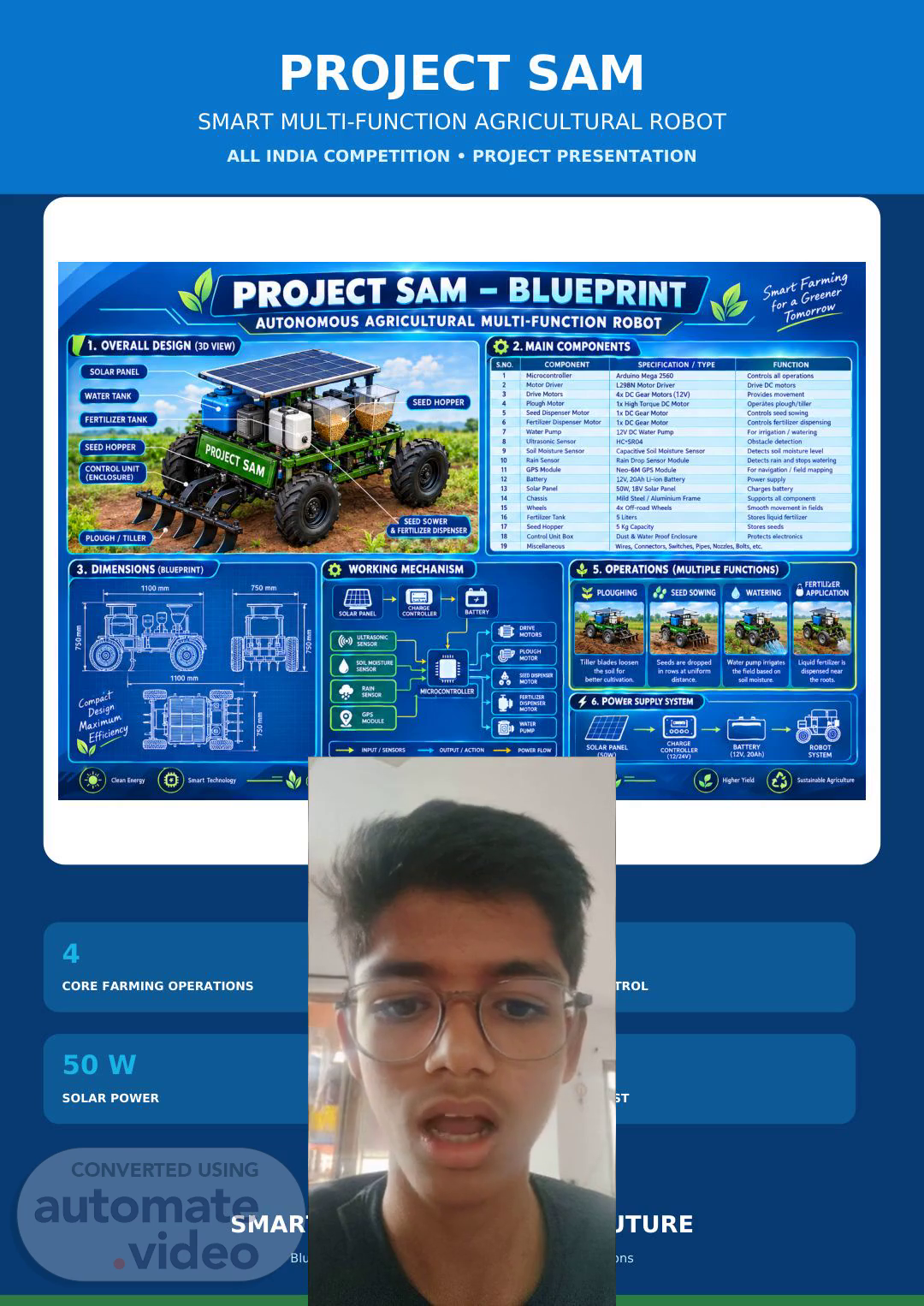
[Audio] The smart multi-function agricultural robot, Project SAM, aims to address the numerous challenges faced by farmers in performing their daily tasks. The robot's primary function is to automate various agricultural processes such as ploughing, sowing seeds, watering crops, and applying fertilizers. The robot's design incorporates advanced technologies including sensors, motors, a microcontroller, GPS, and solar power. The use of these technologies enables the robot to efficiently carry out tasks with minimal human intervention, allowing farmers to save time and reduce manual labor. The robot also provides farmers with the ability to control water supply based on soil moisture levels, enabling them to optimize crop growth and yield. Furthermore, the robot allows for the combination of multiple farming operations within a single platform, thereby increasing efficiency and reducing costs. The ultimate goal of Project SAM is to make farming more accessible, intelligent, and sustainable through the utilization of technology. By utilizing technology, farmers can expect to improve their productivity and quality of life, leading to a better future for themselves and their families..
Scene 3 (2m 12s)
[Audio] The project aims to create a robotic system that can automate farming tasks efficiently and effectively. The system consists of several key components including a reference hardware design, overall 3D robot design, and specific hardware elements such as the water pump, soil-moisture sensor, GPS module, and Arduino Uno DC geared motor. These components work together to enable the robot to perform various farming tasks efficiently and effectively. The water pump allows the robot to distribute water throughout its systems, while the soil-moisture sensor helps to optimize watering schedules based on soil conditions. The GPS module supports navigation and movement planning, ensuring the robot moves safely and efficiently across the farm. The Arduino Uno DC geared motor serves as the main microcontroller, controlling the robot's movements and automating tasks through its integration with sensors and motors. By combining these components, the project creates a comprehensive and integrated farming solution..
Scene 4 (3m 21s)
[Audio] "Project SAM utilizes a combination of solar power, GPS, and sensors to manage its operations. The solar panel converts sunlight into electrical energy, which is then regulated by a charge controller and stored in the battery. This stored power is used to drive the robot's systems, including the motors, seed dispenser, and pump. The Arduino control unit processes data from the GPS, moisture sensing, and obstacle sensing modules to determine the optimal actions to take. The robot's systems work together in a coordinated manner to achieve multiple farming functions in a single platform." The system uses solar power to generate electricity. The solar panel converts sunlight into electrical energy. This energy is then regulated by a charge controller. The energy is stored in a battery for later use. The stored power is used to drive various components such as motors, pumps, and dispensers. The Arduino control unit processes data from different sensors. The sensors include GPS, moisture sensors, and obstacle detectors. The control unit determines the optimal actions based on this data. The robot's systems work together to perform multiple farming tasks. The system can be controlled remotely using a smartphone app. The app allows users to monitor the robot's progress and adjust settings as needed. The system is designed to optimize crop growth and reduce water usage. It is an innovative solution for farmers looking to improve their efficiency and productivity. The system consists of several interconnected components that work together seamlessly. The components include a solar panel, batteries, motors, pumps, and dispensers. The system is highly efficient and can be scaled up or down depending on the user's needs. The system can be integrated with other technologies such as drones and satellite imaging. The system provides real-time monitoring and control of the robot's operations. The system can be customized to meet the specific needs of individual farmers. The system offers a range of benefits including increased efficiency, reduced costs, and improved crop yields. The system has been tested and proven to be effective in various environments. The system is designed to be easy to use and maintain. The system requires minimal maintenance and upkeep. The system is suitable for small-scale farms and large commercial operations. The system can be used for a variety of agricultural applications. The system is a valuable resource for farmers seeking to improve their productivity and efficiency..
Scene 5 (6m 13s)
[Audio] The indicative costs for the prototype of the smart multi-function agricultural robot, also known as Project SAM, are provided here. These costs are based on the component quantities and unit prices listed. The total estimated cost is ₹12,789. This is a preliminary estimate and actual costs may vary depending on factors such as supplier selection, material quality, and specifications. The breakdown of costs includes components such as Arduino boards, motors, sensors, batteries, and solar panels, as well as structural elements like metal frames and off-road wheels. The detailed list of components and their respective costs allows for a clear understanding of the expenses involved in developing this project..
Scene 6 (7m 7s)
[Audio] The advanced robotic system of Project SAM enables multiple functions to be performed simultaneously, thereby enhancing overall farm productivity. The system comprises three primary functions: ploughing, seeding, and watering. Ploughing involves the use of a front plough/tiller to loosen the soil, while seeding utilizes a seed hopper and dispenser to release seeds at controlled intervals. Watering is facilitated by a fertilizer hopper and dispenser that releases a measured amount of fertilizer near the crop rows. Additionally, the system incorporates a moisture sensor to determine when irrigation is required, and a pump to send water through tubing and nozzles. Furthermore, navigation is enabled via GPS and obstacle sensing, allowing the robot to follow a planned route. Overall, Project SAM represents a significant advancement in smart farming, offering improved efficiency and reduced environmental impact. By integrating multiple functions into a single platform, Project SAM provides an affordable solution for farmers, utilizing sensor-based control and solar power. This approach not only enhances farm productivity but also contributes to a better future for farmers..