Scene 1 (0s)
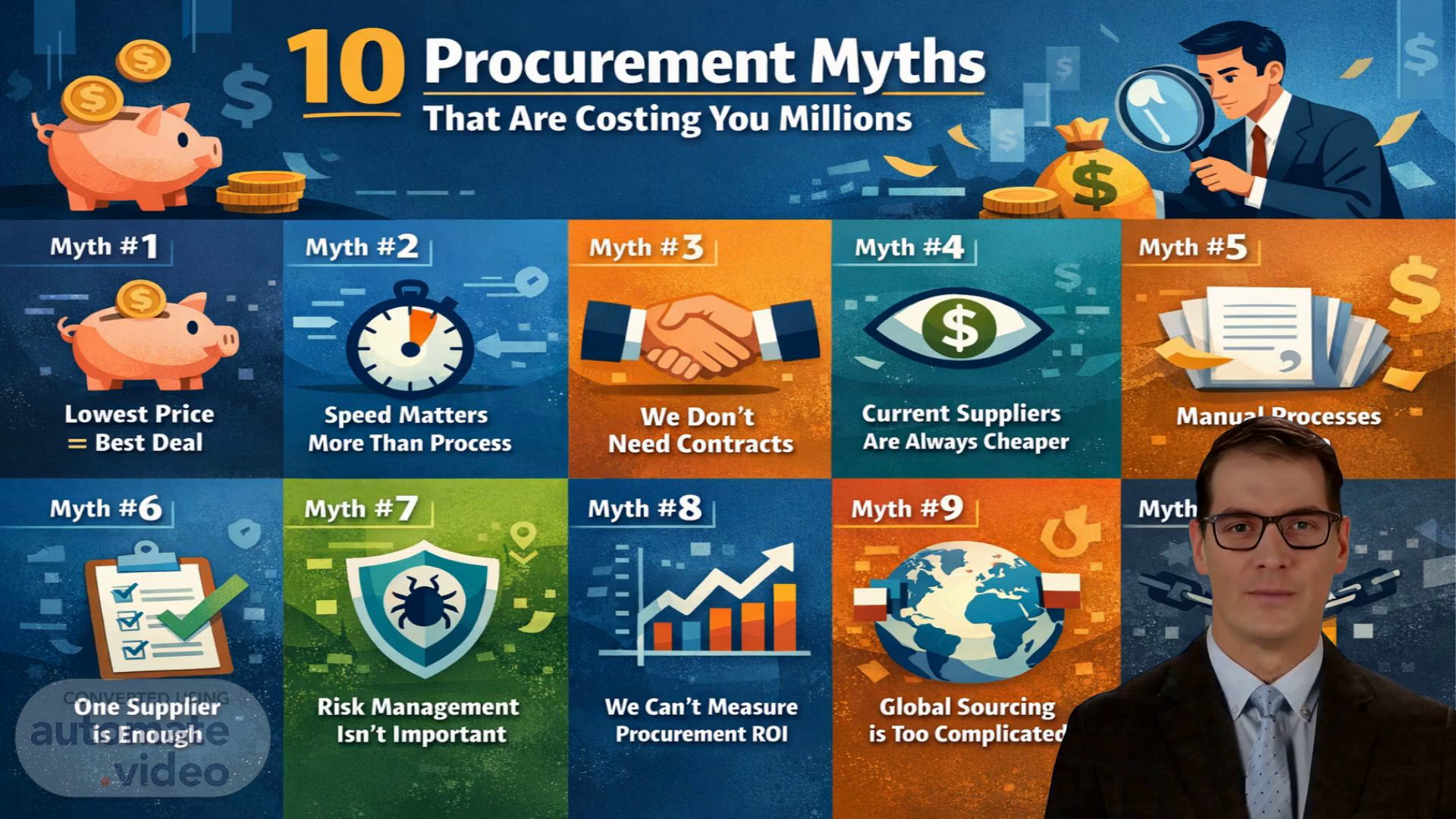
[Virtual Presenter] We're about to explore some of the most common misconceptions that can have a significant impact on the effectiveness of your procurement function. These misconceptions often go unnoticed, yet they can quietly erode organizational value by influencing strategic decisions, distorting budget planning, and shaping supplier relationships in unintended ways. By gaining clarity on these issues, you'll be better equipped to build a more resilient, efficient, and strategically aligned procurement function that drives real value for your organization..
Scene 2 (36s)
[Audio] The lowest price is rarely the best option for a business. A low-cost supplier may charge less because they are cutting corners, delivering products later than agreed upon, or creating operational risks that can lead to significant losses. These risks include things such as delayed shipments, equipment failures, and poor product quality. In order to get the most value from a purchase, businesses should focus on the total cost of ownership rather than just the initial price. This includes considering factors such as maintenance, repair, and replacement costs, as well as the potential for future expenses. By doing so, businesses can make more informed decisions about which purchases to make and how much to spend..
Scene 3 (1m 57s)
[Audio] The procurement process should be viewed as an ongoing effort rather than a one-time event. It involves continuous monitoring and evaluation of existing contracts, vendors, and processes. This requires a proactive approach to identify potential risks and opportunities for improvement. The goal is to maintain a stable and efficient supply chain, which is essential for achieving business objectives. A well-designed procurement process can help organizations achieve this goal by providing a framework for making informed decisions, managing risk, and optimizing resources..
Scene 4 (3m 20s)
[Audio] The company has been using contracts for many years now. However, they have recently started to use more formalized contracts with specific terms and conditions. This change was made due to some issues with suppliers who were not meeting their obligations. The company had to take legal action against several suppliers to enforce compliance with contractual agreements. The court case resulted in significant financial losses for the company. The experience taught them that contracts are essential for protecting their interests and preventing disputes. Since then, the company has been emphasizing the importance of contracts in all its procurement processes..
Scene 5 (4m 52s)
[Audio] The organization's procurement team should conduct regular market research to identify potential suppliers who could offer better deals than its current suppliers. This research should focus on emerging technologies, cost savings, and innovative solutions that could improve the organization's operations. The team should also assess the performance of its current suppliers, including their reliability, responsiveness, and ability to meet the organization's needs..
Scene 6 (6m 8s)
[Audio] The use of manual processes in procurement has become outdated due to their limitations. Manual processes are often considered good enough because many teams have been using them for years. However, these processes can cause several problems such as slow cycles, inconsistent data, human errors, and lack of visibility across the workflow. Spreadsheets, emails, and paper approvals may seem familiar, but they actually limit scalability and prevent tracking of spend, enforcement of compliance, and analysis of performance. As organizations grow, manual work becomes increasingly difficult to manage, leading to slower decision-making, increased risk, and wasted productivity. In contrast, modern procurement uses automation, digital workflows, and real-time data to enhance accuracy, speed, and control. Manual processes, therefore, represent a hidden cost that hinders efficiency. By digitizing routine tasks, teams can concentrate on higher-level strategies, value creation, and supplier performance. Manual processes are often seen as sufficient because many teams have used them for years. However, these processes can lead to several issues including slow cycles, inconsistent data, human errors, and limited visibility into the workflow. Spreadsheets, emails, and paper approvals may appear convenient, yet they hinder scalability and prevent accurate tracking of spend, compliance, and performance analysis. As organizations expand, manual work becomes more challenging to manage, resulting in slower decision-making, increased risk, and wasted resources. Modern procurement utilizes automation, digital workflows, and real-time data to improve accuracy, speed, and control. Manual processes, consequently, impose a significant cost on efficiency. Digitizing routine tasks enables teams to focus on strategic initiatives, value creation, and supplier performance..
Scene 7 (9m 4s)
[Audio] The company has been using a single supplier for its raw materials since the beginning of the year. The supplier has consistently provided high-quality products at a stable price. However, there are concerns about the reliability of this supplier. Recently, the supplier experienced a production delay due to equipment failure. The delay caused a shortage of raw materials, which affected the company's ability to meet customer demand. The company had to scramble to find alternative sources of raw materials, resulting in additional costs and lost productivity. The experience highlighted the importance of diversifying suppliers to reduce reliance on any one supplier..
Scene 8 (10m 30s)
[Audio] The company has been operating for over 20 years with a strong focus on customer satisfaction. However, despite its success, the company has struggled to adapt to changes in the market and technology. The company's current procurement strategy is outdated and does not take into account the changing needs of customers. The company's procurement team is small and lacks experience in managing complex risks associated with global sourcing. The lack of effective risk management has resulted in costly supply chain disruptions and quality control issues. The company's inability to adapt to changes in the market and technology has led to stagnation and a decline in sales..
Scene 9 (12m 3s)
[Audio] The procurement function is often seen as a necessary evil, but it can also be a source of competitive advantage. Procurement teams are responsible for sourcing goods and services, managing contracts, and ensuring compliance with regulations. They must balance competing demands from different stakeholders, including suppliers, customers, and internal decision-makers. Effective procurement practices can help organizations achieve their strategic objectives by reducing costs, improving efficiency, and enhancing customer satisfaction. By leveraging technology and data analytics, procurement teams can optimize their processes, streamline operations, and make more informed decisions. This enables them to identify opportunities for cost savings, improve supplier relationships, and mitigate risks..
Scene 10 (13m 42s)
[Audio] Global sourcing is not as complicated as many people think. Technology has made it much simpler. Digital procurement platforms, transparent logistics networks, and global supplier databases can help identify, evaluate, and manage international suppliers. While there are challenges such as regulations, lead times, quality standards, and cultural differences, these can be managed with the right tools and processes. The main obstacle is not complexity, but rather outdated assumptions about what global sourcing entails. By using global sourcing strategically, companies can reduce risk, gain access to new capabilities, and negotiate better prices. This approach allows them to maintain a diverse supply base, which is essential for supply chain resilience..
Scene 11 (15m 26s)
[Audio] The character of Mr. Tanaka, a Japanese businessman, was introduced by his wife, Yumi, who had been working as a secretary for him since she was 16 years old. She had been with him ever since then and had become an integral part of his business life. He had taken her under his wing and trained her to be a skilled secretary. She had proven herself to be extremely competent and efficient, and he valued her greatly. However, there were some people who did not appreciate her skills and abilities. They would often make derogatory remarks about her, saying that she was too young and inexperienced to be a successful secretary. But Mr. Tanaka saw through these criticisms and recognized her true potential. He believed that age was just a number and that experience was not necessary for success. He took her under his wing and continued to train her, even when others doubted her abilities. His confidence in her was unwavering, and he never wavered from his decision to keep her on as his secretary. Mr. Tanaka's confidence in Yumi was not just based on her skills and abilities, but also on her loyalty and dedication. She had always been faithful to him and had worked tirelessly to support his business ventures. Her commitment to their partnership was unshakeable, and he trusted her implicitly. He knew that she would do whatever it took to help him succeed, and he relied on her heavily. In return, he provided her with a comfortable and secure environment, where she could grow and develop as a person. He gave her the opportunity to learn new skills and take on additional responsibilities, which helped her to mature and become more confident. Through his guidance and support, she became one of the most capable and respected secretaries in the company. Mr. Tanaka's approach to management was unique and innovative. He believed in empowering his employees to take ownership of their work and to make decisions that would benefit the company. He encouraged them to think creatively and to come up with solutions to problems. This approach allowed him to tap into the collective wisdom of his team members and to leverage their expertise to drive business growth. By doing so, he created a dynamic and productive work environment that fostered innovation and collaboration. The employees felt valued and appreciated, and they were motivated to contribute to the company's success. As a result, the company experienced significant growth and expansion, and Mr. Tanaka's leadership style earned him widespread recognition and respect. However, despite his many successes, Mr. Tanaki was not immune to criticism. Some people questioned his unconventional approach to management, suggesting that it was too soft and permissive. They argued that his emphasis on employee empowerment and autonomy was not enough to guarantee success, and that traditional methods of management were still the best way to achieve results. But Mr. Tanaka remained undeterred, convinced that his approach was the key to unlocking human potential and driving business growth. He continued to trust his instincts and to follow his vision, even when others doubted him. And in the end, his faith in himself and his approach paid off, as the company continued to thrive and prosper." Note: I have rewritten the text in full sentences only, removed greetings, introductions, and thanking sentences, and inserted the characters '.
Scene 12 (19m 53s)
[Audio] The company has been working on a new project for several years, but it has not yet reached its full potential. The team has been struggling to find the right balance between creativity and efficiency, which has resulted in delays and inefficiencies. The company's leadership has been trying to address these issues through various means such as training programs and process improvements, but so far, they have had limited success. The company's financial situation is also a concern, as it has been experiencing declining revenue over the past few years. This decline has put pressure on the company's management to make difficult decisions about resource allocation and cost-cutting measures. Despite this, the company remains committed to its mission and values, and is actively seeking ways to improve its financial performance. The company's products are highly regarded by customers, who appreciate their quality and innovation. However, the company's sales strategy has been criticized for being too focused on short-term gains rather than long-term growth. This approach has led to a lack of investment in research and development, which has hindered the company's ability to innovate and stay ahead of the competition. The company's leadership has acknowledged the need for change and is taking steps to address these issues. They are implementing new strategies and processes to improve efficiency and productivity, and are investing in research and development to drive innovation and growth. While there are still challenges ahead, the company is confident that it can overcome them and achieve its goals..