Scene 1 (0s)
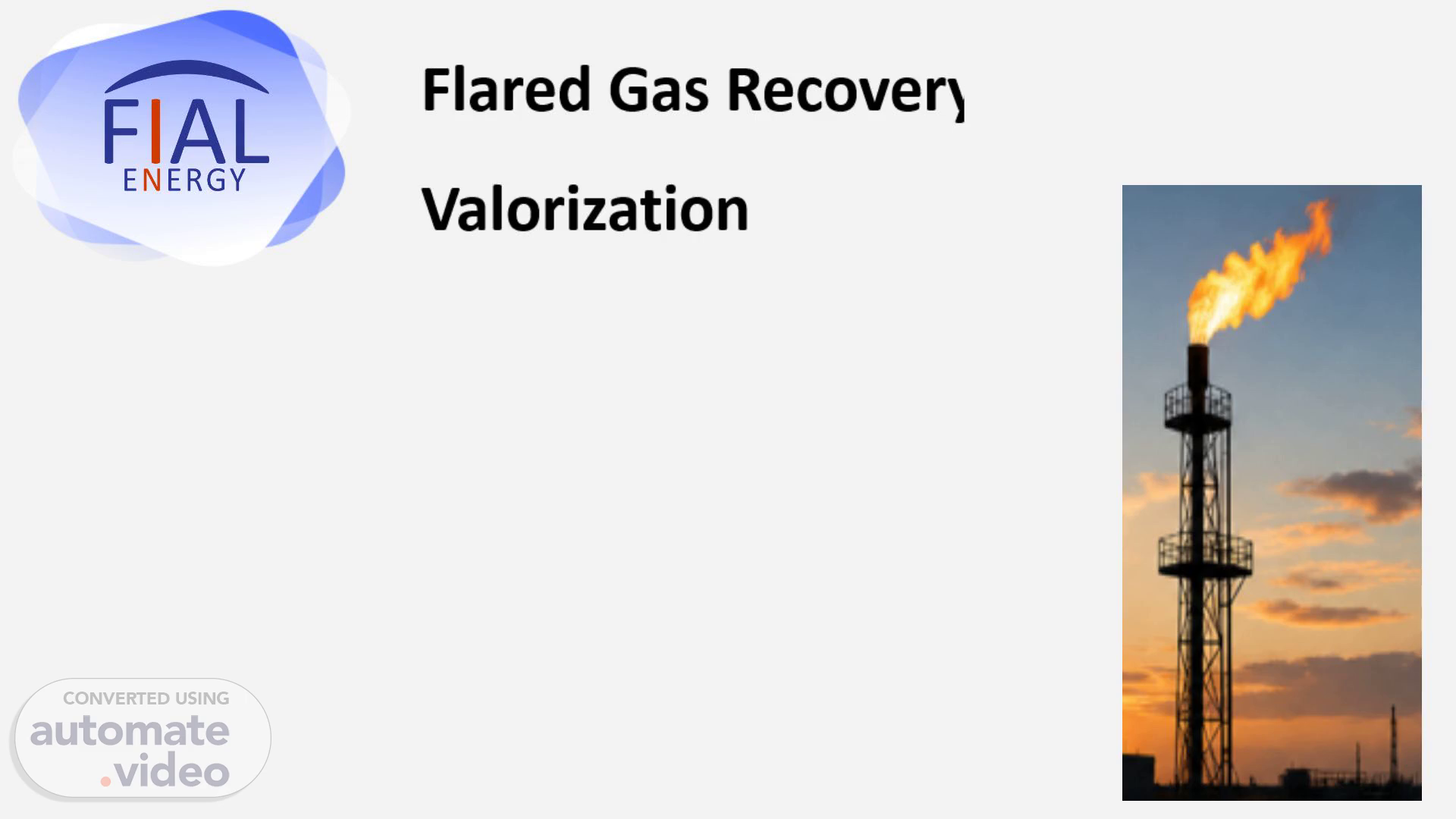
Flared Gas Recovery and Valorization. June 2026. Integration of Flare Gas Recovery for LNG and LPG Production.
Scene 2 (12s)
1.. 2.. 3.. 4.. 5.. 6.. Introduction & Context. Aims, Objectives & Technologies.
Scene 3 (28s)
Introduction & Context.. Libya's Gas Flaring Challenge.
Scene 4 (1m 25s)
Libya's Gas Potential and Future Outlook.. Growing gas production creates new opportunities for flare gas recovery and monetization.
Scene 5 (2m 15s)
LIBYA'S GAS POTENTIAL AND FUTURE OUTLOOK Growing gas production creates new opportunities for flare gas recovery and monetization Growing natural gas production, combined with NOC's gas-to-power strategy, creates a strategic opportunity to recover associated gas, reduce flaring, generate additional value through LNG and LPG production, and support a cleaner, more efficient, and reliable domestic energy supply. Gas production growth will be driven by the development of the A and E offshore fields, alongside the expansion of existing gas assets. Libya's Largest Opportunity for Gas Conversion Technologies o NOC strategy is expected to replace fuel oil in power generation, improve efficiency, and reduce emissions. O Sales gas is forecast to increase from 1,566 MMscf/d in 2026 to over 2,100 MMscf/d by 2033 (—35% growth). Increase gas utilization O Higher gas production will increase the availability of associated gas, reinforcing the need for efficient flare gas recovery and monetization solutions. Maximize associated gas recovery FUTURE GAS PRODUCTION This growing gas production presents a significant opportunity to maximize the recovery and utilization of associated gas, minimizing flaring while creating additional value through gas monetization..
Scene 6 (2m 54s)
[image] Flaring Gas • Causes pollution and penalties • Wastes valuable resources.
Scene 7 (3m 2s)
[Audio] Libya has recently joined the World Bank’s Global Gas Flaring Reduction Partnership (G-G-F-R-), reaffirming its commitment to eliminate routine gas flaring by 2030. This initiative represents a major step toward reducing associated gas losses from oil production activities, improving operational efficiency, and enhancing environmental performance across the energy sector..
Scene 8 (4m 1s)
[Audio] Libya has recently joined the World Bank’s Global Gas Flaring Reduction Partnership (G-G-F-R-), reaffirming its commitment to eliminate routine gas flaring by 2030. This initiative represents a major step toward reducing associated gas losses from oil production activities, improving operational efficiency, and enhancing environmental performance across the energy sector..
Scene 9 (4m 27s)
Selecting the optimal flare gas recovery solution requires an assessment of gas characteristics, site conditions, infrastructure availability, and project economics. Key evaluation criteria include:.
Scene 10 (5m 20s)
[Audio] The final selection of the flare gas recovery technology and process configuration will be established during the feasibility study based on the recovered flare gas composition, associated gas flow rate, operating pressure, available utilities and infrastructure, product specifications, and the overall techno economic evaluation of the project..
Scene 11 (5m 46s)
Top Gas Flaring Reduction Projects in Libya.. Current Initiatives and Future Opportunities.
Scene 12 (6m 45s)
[Audio] The final selection of the flare gas recovery technology and process configuration will be established during the feasibility study based on the recovered flare gas composition, associated gas flow rate, operating pressure, available utilities and infrastructure, product specifications, and the overall techno economic evaluation of the project..
Scene 13 (7m 18s)
Modular and scalable technologies Suitable for remote and isolated flare locations.
Scene 14 (7m 45s)
LNG Production from Recovered Flare Gas.. Flare Gas Pretreatment for LNG Production.
Scene 15 (8m 27s)
[Audio] The dried gas is routed to a Natural Gas Liquid (N-G-L--) recovery unit, which is designed to remove and recover the C2þ or C3þ hydrocarbons and produce a lean gas for liquefaction. Removal of the N-G-L components would eliminate the need for a scrubber column in the liquefaction plant, which typically is used to remove aromatics and heavy hydrocarbons to avoid waxing in the main exchanger. The N-G-L recovery unit can be designed for ethane recovery to produce an ethane product that can be fed to an ethylene cracker in a petrochemical complex. The N-G-L components, the C3 to C5þ liquids, are valuable marketable products. The N-G-L com ponents are fractionated into individual products for sales. Propane and butane are exported as separate products, or a combined propane butane mix product. C5þ and heavier components can be exported for gasoline blending. If mercaptans were present in the feed gas, they would show up in the C5þ liquids, which must be treated to meet the liquid’s sulfur specification. Nitrogen removal by cryogenic separation process is the proven nitrogen removal process for L-N-G production. For L-N-G--, feed gas quality and pretreatment are critical determinants of plant performance and final product purity M-D-E-A (methyldiethanolamine) solvent absorption for acid gas removal. This mature technology efficiently removes C-O-2 and H-2-S from feed gas with excellent chemical selectivity and strong economic efficiency, making it well suited to large scale industrial application. Molecular sieve adsorption dehydration, using high efficiency molecular sieves to achieve deep dehydration to sub ppm water content levels required for cryogenic liquefaction without risk of ice or hydrate formation in the cold box..
Scene 16 (10m 29s)
[Audio] The dried gas is routed to a Natural Gas Liquid (N-G-L--) recovery unit, which is designed to remove and recover the C2þ or C3þ hydrocarbons and produce a lean gas for liquefaction. Removal of the N-G-L components would eliminate the need for a scrubber column in the liquefaction plant, which typically is used to remove aromatics and heavy hydrocarbons to avoid waxing in the main exchanger. The N-G-L recovery unit can be designed for ethane recovery to produce an ethane product that can be fed to an ethylene cracker in a petrochemical complex. The N-G-L components, the C3 to C5þ liquids, are valuable marketable products. The N-G-L com ponents are fractionated into individual products for sales. Propane and butane are exported as separate products, or a combined propane butane mix product. C5þ and heavier components can be exported for gasoline blending. If mercaptans were present in the feed gas, they would show up in the C5þ liquids, which must be treated to meet the liquid’s sulfur specification. Nitrogen removal by cryogenic separation process is the proven nitrogen removal process for L-N-G production. For L-N-G--, feed gas quality and pretreatment are critical determinants of plant performance and final product purity M-D-E-A (methyldiethanolamine) solvent absorption for acid gas removal. This mature technology efficiently removes C-O-2 and H-2-S from feed gas with excellent chemical selectivity and strong economic efficiency, making it well suited to large scale industrial application. Molecular sieve adsorption dehydration, using high efficiency molecular sieves to achieve deep dehydration to sub ppm water content levels required for cryogenic liquefaction without risk of ice or hydrate formation in the cold box..
Scene 17 (12m 37s)
[Audio] Produces L-N-G as the primary commercial product. Recovers valuable L-P-G--, ethane, condensate, sulfur, and fuel gas. Maximizes the utilization of the recovered flare gas. Creates multiple revenue streams through diversified products. Supplies internal facilities or commercial markets..
Scene 18 (13m 48s)
[Audio] Liquefied Petroleum Gas (L-P-G--) recovered from associated gas represents the dominant source of global L-P-G supply, accounting for an estimated 60% of total world L-P-G output, with the remaining share derived as a by product of refinery operations. Associated gas derived L-P-G is compositionally simpler, consisting primarily of propane (C3H8) and butane (C4H10), whereas refinery sourced L-P-G is a more complex mixture that also contains propylene and butylene isomers. L-P-G serves as both an energy fuel and a petrochemical feedstock, with end uses spanning residential and commercial cooking and heating, engine and transport fuel, industrial process heating, and chemical/petrochemical feedstock applications. The global L-P-G Recovery From Associated Gas market is estimated at approximately $90–100 billion in 2026, and is projected to expand at a compound annual growth rate (C-A-G-R-) of approximately 4.3%–5.3% through 2031. Growth is underpinned by sustained natural gas and associated gas production growth in major hydrocarbon basins, continued L-P-G demand in residential, transport and industrial end uses across emerging Asia Pacific economies, and ongoing investment in gas processing and N-G-L recovery infrastructure by national and international oil companies.
Scene 19 (15m 36s)
[Audio] Further, S-M-R is concluded to be the most suitable process for small scale movable L-N-G plants because it exhibits the highest exergy efficiency, the lowest product cost considering makeup facilities, and the widest operation range. In future work, the safety and environmental issues of the refrigerant will be further investigated as these were excluded in this study..
Scene 20 (16m 34s)
Economic Benefits of Flare Gas Recovery for LNG and LPG Production..