Scene 1 (0s)
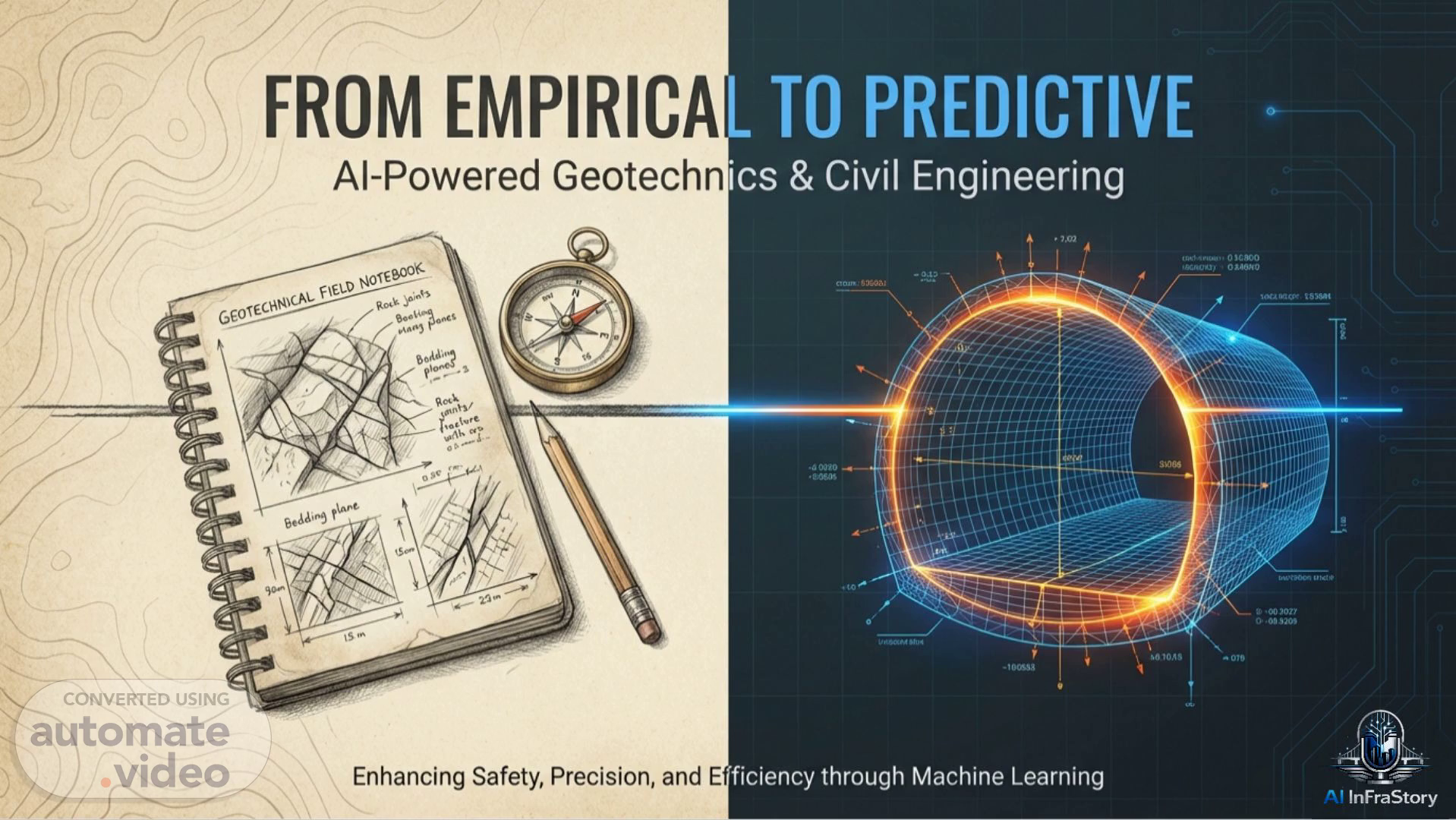
FROM EMPIRICA I I A1-Powered Geotechn ics & Civil Engineering O'C900 • 7.02 & øf///å'///'//l—;; 011680 •00202* .09 Enhancing Safety, Precision, and E ficiency through Machine Learning NotebookLM.
Scene 2 (12s)
THE SHIFT Empirical Chart THE DEEP DIVE Traditional Fracture Mapping THE HORIZON Digital Twin Infrastructure.
Scene 3 (20s)
THE A1 TOOLKIT IN CIVIL ENGINEERING aaa aaa aaa Traditional ML SVM + soil classification Hybrid Models ANN settlement prediction Deep Learning CNN + crack detection Optimization GA --5 resource allocation.
Scene 4 (29s)
THE LIMITATIONS OF EMPIRICAL METHODS Borehole Face 2D Observation 1 D Observation The 'Black Box' of Nature: Critical joints often missed by limited observation. Traditional systems (RQD, RMR, Q-System) rely on subjective judgment and limited 1 D/2D views, failing to capture anisotropic reality..
Scene 5 (43s)
TIMELINE OF CLASSIFICATION 11946' Terzaghi's Rock Load Theory The Origin '1960s-70s' RQD, RMR, Q-System The Foundation '1990s' GSI, BO Refinement ooaa ooo ooo '2000s' Fuzzy Logic & Basic ML Digitization '2020s' Deep Learning & Hybrid Ensembles CNNs, XUNet, Real-time IoT The A1 Era.
Scene 6 (54s)
AUTOMATING ROCK QUALITY DESIGNATION (RQD) The Old Way L = 18 cm L : 22 cm L = 30 cm L < 10 cm. Not Counted L < 10 cm, Not Counted Manual Logging (Subject to Human Error) The A1 way Fracture Detected: 98% Confidence. Automated Image Processing (CNNs & Deep Ensemble Learning) Length of core pieces > 10 cm length RQD = x 100 Total length of core run 18+22+30 RQD = x 100 100 Shift from manual counting to Computer Vision. F. Algorithms: CNNs extract spatial patterns; XUNet & IRUNet reduce bias. Benefit: Removes subjective error and accelerates logging..
Scene 7 (1m 16s)
FIELD DATA A1 MODEL RMR PREDICTION 0000 ooaa Q9 DESIGN DECISION REAL EXAMPLE: TUNNEL PROJECT STABILITY PREDICTION (1000 A1 models anticipate rock mass conditions ahead of excavation, enabling optimized support installation and reduced risks. PREDICTION VS. ACTUAL RMR 100 80 60 40 20 100 Predicted RMR Actual RMR 200 300 400 soo Tunnel Chainage (m) Graph demonstrates high accuracy of A1 model in predicting Rock Mass Rating compared to actual field observations..
Scene 8 (1m 32s)
GEOLOGICAL STRENGTH INDEX FOR JOINTED ROCKS From the lithology, conditions of the dic •r 6 the average value of eci9e.Ouotii • re realistic ote that th k plonar s n unfavo ct to the e ate the roa ts strength of • one to detegiA'dllen,ae water is u in the fair to vemppoy_5 dltions. Wåter INTACT OR rock speci stlu rock disconti BLOCKY isturbe of cubical ntersectin formed by 4 Of mole JOInt sots LOCKY/OISTURBED/SEAMY Folded with angular blocks ormed by many intersecting iscontinuity sets. Penistence Z O 3 Q) -c 3 o O f beddin lanes or schis'.osi ISINTEGRATED • Poorly inter- ocked. heavily broken rock mass •th mixture of angular and rounded rock pleces Lack of blockiness due to close spacing N/A of the weak schistosity or shear planes N/A.
Scene 9 (1m 59s)
SPECIALIZED STANDARDS: CANADIAN GEOTECHNICS ML Performance Comparison (Accuracy %) 100 60 40 Hydropower Tunnel (e.g., Northern QC) Transportation Tunnel (e.g., Vancouver, BC) Mining Project (e.g., Northern ON) 80 20 ANN Linear Regression Random Forest SVM Algorithm Context: Applying ML to complex Canadian geological conditions, from permafrost to deep rock. Innovation: Focus on optimizing for cold-climate challenges and data sparsity in remote locations. Why?: Algorithms like Random Forest and SVM show robustness in handling high variability and limited datasets..
Scene 10 (2m 20s)
THE ALGORITHM LEADERBOARD SVM & ANN (The Heavyweights) Versatility Image Data Geological Precision Popularity High Mediu Speed Accuracy Random Forest (The Rising Star) • Heavyweights: SVM & ANN are most widely used for non-linear modeling. • Rising Stars: Random Forest minimizes overfitting. • Optimizers: Genetic Algorithms (GA) & PSO are the "secret sauce" for tuning parameters. NotebookLM.
Scene 11 (2m 33s)
BEYOND GEOTECHNICS: A1 ACROSS THE INDUSTRY Embankment settlement prediction Infrastructure monitoring.
Scene 12 (2m 41s)
THE DIGITAL TWIN & BIM INTEGRATION • Sties • æoos 293 . SON'S • Wind • Vior8tm • oeta • The Synergy: A1 + IoT + BIM Real-time Asset Management. • Predictive Maintenance: Sensors feed data to Deep Belief Networks (DBNs) to predict failure before it occurs..
Scene 13 (2m 54s)
CRITICAL IMPLEMENTATION CHALLENGES Field Site SITE A: SOFT SOIL SITE B: FRACTURED ROCK Data Scarcity High-quality geotechnical data is rare and expensive. Limited boreholes mean sparse data points for training. Generalizability Models trained on one geology may fail in another. Retraining is often required. Black Box SAFE? HPC SERVER The 'Black Box' Deep Learning lacks interpretability. Engineers need to know WHY a tunnel is deemed safe. Computational Cost High-end DL requires massive resources, limiting on-site use with standard hardware..
Scene 14 (3m 13s)
THE ROADMAP: FUTURE TRENDS Transfer Learning Using pre-trained models on small, project-specific datasets. Eentralized Data Banks ShÜed XAI Explainable A1: Making the "Black Box" transparent for safety compliance. PINNs Physics-informed Neural Networks: Combining data with physical laws of geology..
Scene 15 (3m 25s)
A NEW ERA OF PRECISION A1 is not replacing the engineer; it is equipping them with a new lens to see the invisible. The fusion of Metaheuristics, Deep Learning, and Mechanics ushers in unprecedented safety. Invest in data standardization and hybrid modeling to unlock the potential..