Scene 1 (0s)
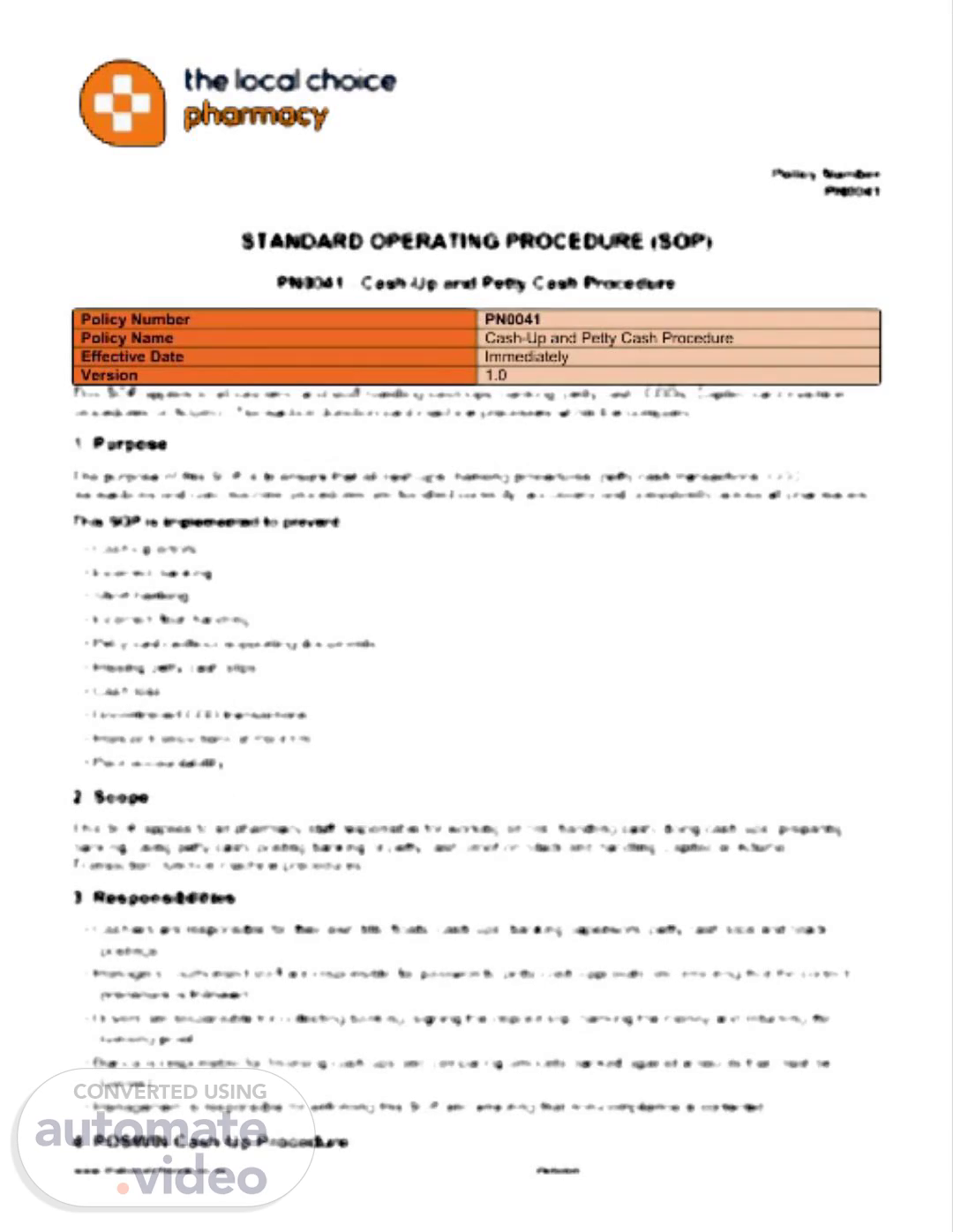
www.thelocalchoice.co.za Version Policy Number PN0041 STANDARD OPERATING PROCEDURE (SOP) PN0041 - Cash-Up and Petty Cash Procedure Policy Number PN0041 Policy Name Cash-Up and Petty Cash Procedure Effective Date Immediately Version 1.0 This SOP applies to all cashiers, and staff handling cash-ups, banking, petty cash, CODs, Capitec card machine procedures or Adumo / Transaction Junction card machine processes within the company. 1. Purpose The purpose of this SOP is to ensure that all cash-ups, banking procedures, petty cash transactions, COD transactions and card machine procedures are handled correctly, accurately and consistently across all pharmacies. This SOP is implemented to prevent: • Cash-up errors • Incorrect banking • Short banking • Incorrect float handling • Petty cash without supporting documents • Missing petty cash slips • Cash loss • Uncontrolled COD transactions • Manual transactions at front tills • Poor accountability 2. Scope This SOP applies to all pharmacy staff responsible for working on tills, handling cash, doing cash-ups, preparing banking, using petty cash, posting banking or petty cash proof on Slack and handling Capitec or Adumo / Transaction Junction machine procedures. 3. Responsibilities • Cashiers are responsible for their own tills, floats, cash-ups, banking paperwork, petty cash slips and Slack postings. • Managers / authorised staff are responsible for passwords, petty cash approvals and ensuring that the correct procedure is followed. • Drivers are responsible for collecting banking, signing the deposit slip, banking the money and returning the banking proof. • Bianca is responsible for finalising cash-ups and comparing amounts banked against amounts that must be banked. • Management is responsible for enforcing this SOP and ensuring that non-compliance is corrected. 4. POSWIN Cash-Up Procedure.
Scene 2 (1m 46s)
[Audio] The manager has already set up the POSWIN system and has given you permission to start the cash-up process. The manager has also informed you that there is no float to be recorded. Therefore, you can skip this step. You do not need to open the POSWIN system as the manager has already done so. You do not need to enter the manager's password because the manager has already done so. You do not need to calculate today's cash-up because the manager has already done so. You do not need to save the analysis and incident report number because the manager has already done so. You do not need to record the amount of the float because there is no float to be recorded. You do not need to open an Excel spreadsheet on your cash register and enter the amount of the float because there is no float to be recorded. You do not need to print out the Excel sheet because you do not need to bank anything. You do not need to bring the Excel sheet to the bank because you do not need to bank anything. You do not need to fill in the deposit slip accurately because you do not need to bank anything. You do not need to post the bank slip onto the Slack channel because you do not need to bank anything. You do not need to wait for Bianca to finalize the cash-ups because you do not need to bank anything. You do not need to fill in the bank sheets to compare the total amount that needs to be banked with the actual amount banked because you do not need to bank anything. You do not need to note any discrepancies because you do not need to bank anything..
Scene 3 (3m 16s)
[Audio] The standard operating procedure for handling cash-ups, banking, petty cash, and card machine transactions in our company's pharmacies has been established. This procedure is essential in preventing errors, loss, and lack of accountability among our cashiers and staff. The procedure includes several steps which must be followed carefully. When filling out the deposit slips, please remember to write today's date and the total amount of money being banked. This should only include notes, no coins. Also, please ensure that all R10 and R20 notes are exchanged for larger notes. The driver who collects the money to be banked must write down their name and signature, indicating that they have taken responsibility for the cash. The same goes for the cashier who worked on the till and cashed up the money. They must also write their name and sign the slip. Another staff member must then count the money and check that everything balances. They must also write their name and sign the slip. This is an important step in maintaining accountability. I want to draw your attention to the disclaimer underneath each deposit slip. It states that the pharmacy will not be held liable for any lost or short-banked money. It is the responsibility of both the cashier and driver to take full accountability for the money. Please note that coins cannot be banked and must be kept safely in your till or bankbook until there is enough to make notes that can be banked. Once the deposit slips are filled out, please put the cash into a money bag and staple the paper onto the bag. This bag will be collected by the driver, who will then take it to the bank. All details on the deposit must be filled in and signed for. It is the responsibility of the cashier to inform the driver when the money is ready to be collected. Once the driver returns, please take clear pictures of the banking slips and post them on our Slack channel immediately. This will ensure that we have a record of the deposits. In case the ATM does not take all the notes, please post a photo of the bank slip on the channel and bank it on your next run. Lastly, please remember to post the bank slip on our banking channel on Slack for verification. Keep your bank deposit book with you at all times..
Scene 4 (5m 38s)
[Audio] The cash handling procedures in our pharmacy are very important. Proper handling of cash is crucial to prevent errors, loss, and lack of accountability among cashiers and staff. To achieve this, we have established certain guidelines which must be followed. Firstly, cashiers must do their cash-ups before going on lunch. This is important because no other staff member can work at your till if you have not cashed up. It ensures that all transactions are accurately recorded and prevents unauthorized access to the till. Moving on, it is mandatory for all tills at the front of the pharmacy to have passwords on them. This is to ensure that no manual transactions are done and all sales are properly recorded in our system. Once the bank slip is posted onto our Slack channel, the cash-ups will be performed by a designated staff member. For all our pharmacies, Bianca will be responsible for this task. She will also fill in the bank sheets to compare the total amount that needs to be banked with the amount you have banked. Any discrepancies, whether shortages or overages, must be noted on the sheet. Please remember, you are responsible for your own till. Any short amounts banked or discrepancies on your sheet will be deducted from your salary. This is to encourage accountability and accuracy in handling cash. Now, let's talk about card transactions. Your till should not open when a card transaction is done. If it does, inform the above-mentioned staff to contact Propharm for repairs. We want to ensure that our card machine is functioning properly at all times. Also, please note that you are not allowed to type in the product description when making a sale. You should only type in the product code or scan the product. If you are able to type in the description, please report it to the designated staff to contact Propharm. If there are any issues with the product code, please go to the stock controller for corrections. In case the system requests a manager's code, you should ask the pharmacist to scan their barcode at your till. This is to ensure proper authorization for any high-value transactions. Another important reminder is that no tills should have keys in them. We want to prevent any accidental or unauthorized access to the tills. Also, cashiers are not allowed to use their cellphones while on duty. Please use the pharmacy's WhatsApp or Slack phone for taking and posting pictures on Slack. If there are no customers, one cashier should always stay at the till while the others can assist on the floor. This helps to ensure that the tills are always attended and prevents any potential mistakes or discrepancies. Lastly, cashiers should not know if they are over or short on their cash-ups. If there are any significant discrepancies, you will be notified on Slack. This is to prevent any bias or manipulation of the cash-up process. I hope these guidelines are clear and will be followed by everyone. Remember, proper handling of cash is essential for the success and integrity of our pharmacies..
Scene 5 (8m 47s)
[Audio] The petty cash system is designed to provide a convenient way to manage small expenses that are not covered by regular accounts. The petty cash fund is typically managed by a designated person who is responsible for making withdrawals and managing the account. The manager may also use the petty cash fund to cover their own expenses. The petty cash system allows for flexibility in terms of how expenses are recorded and accounted for. It provides a simple and efficient way to handle small expenses that do not require formal accounting procedures. The petty cash system can be used for various purposes such as paying employees, covering office supplies, and other miscellaneous expenses. The petty cash system is widely used in many organizations and businesses. Many companies have adopted this system to streamline their financial operations and improve efficiency. The petty cash system has been shown to reduce costs and increase productivity. It is often used in conjunction with other financial systems to ensure accurate and timely payment of expenses. The petty cash system is flexible and adaptable to different business needs. It can be easily implemented and integrated into existing financial systems. The petty cash system is a valuable tool for managing small expenses and improving financial efficiency..
Scene 6 (10m 11s)
[Audio] To initiate a petty cash transaction using POSWIN, follow these steps: 1. Open the POSWIN application. 2. Click on the Transactions menu. 3. Select the Petty Cash option. 4. Choose the Withdrawal button to remove funds from your account. 5. Enter your password to access the system. 6. Provide the required ASS code for security purposes. 7. Fill in a valid reason for the withdrawal, such as a purchase or payment. Note that the reason should not be 'GENERAL'. 8. Save and exit the system after completing the transaction. 9. To complete the return process, go to the Allocation section of the POSWIN application. 10. Enter your password again to access the system. 11. Select the petty cash transaction for which you withdrew the money. 12. If there is any remaining change, click on the Return Change button. 13. Put the returned cash back into the drawer. 14. Allocate the expense to the correct department, such as Stationery, Cleaning, Petrol, Incentives, Staff Teas, etc. 15. Always follow these steps when conducting a petty cash transaction using POSWIN..
Scene 7 (11m 43s)
[Audio] "All petty cash slips for a specific till should be stapled together and included with your cash-up paperwork after completing the cash-up process. This ensures that all petty cash transactions are properly recorded and makes it easier to balance the funds. It is important to keep all relevant documents, such as the withdrawal slip, return change slip, allocation slip, and original invoice/slip, together when conducting a petty cash transaction to maintain accuracy and prevent mistakes. If a petty cash allocation needs to be reversed, specific steps must be followed, including accessing the POSWIN system, selecting the appropriate menu options, and confirming the cancellation. By adhering to these procedures, petty cash transactions can be managed accurately and efficiently..
Scene 8 (12m 31s)
[Audio] To return a specific amount, click on it and select Return Change. Enter the amount and return the cash to the drawer. Finally, allocate the petty cash to the appropriate department. When using the Capitec card machine, follow these steps: Go to POSWIN, then Transactions, Invoicing, and Cashier Code. Scan the customer's loyalty card. If they do not have one, ask if you can create one for them. Scan the products and then press F2 followed by Cash Sale and Yes. Choose Manual Credit Card and provide the following information at the bottom: CVV NUMBER: 000, CARD NUMBER: 000, EXPIRY DATE: MM:00, YY:00, and www.thelocalchoice.co.za. Note that in some cases, the CVV number may not be 000 depending on the card used. It is advisable to use the Capitec card machine whenever possible..
Scene 9 (13m 36s)
[Audio] During this session, we will discuss the correct procedures for cash-ups, banking, petty cash, and card machine transactions as outlined in our Standard Operating Procedure. This topic is important as it promotes accountability and prevents errors and loss among our cashiers and staff within the company's pharmacies. A critical step, highlighted on slide number 9, is to put all Capitec slips in the till until cashing up. This is crucial to avoid any slips from being lost or misplaced. Moving on to slide number 10, we will cover how to record card machine transactions on the Excel sheet. When cashing up, remember to enter the card number and amount on the right side of the sheet where the float and cash are recorded. For example, if you have 3 slips, it should be recorded as follows: 369 R125.30 / 441 R92.50 / 511 R564.20. This ensures accurate tracking and record-keeping. Slide number 9 also emphasizes the importance of version control, which helps us keep track of any changes or updates made to the SOP. The current version is 1.0, compiled by B. Denton on 22/05/2026 and approved by management. Before concluding, I would like to draw your attention to the acknowledgement section on slide number 10. It is crucial that every employee confirm they have read, understood, and received training on this SOP and are aware of the consequences of non-compliance. Please sign and date this section to indicate your understanding and agreement. In summary, thank you for your participation in this training session. This SOP is a vital tool in ensuring the accurate handling of cash-ups, banking, petty cash, and card machine transactions in our pharmacies. Let's continue to follow these procedures to maintain accountability and prevent any errors or loss. Thank you..