Scene 1 (0s)
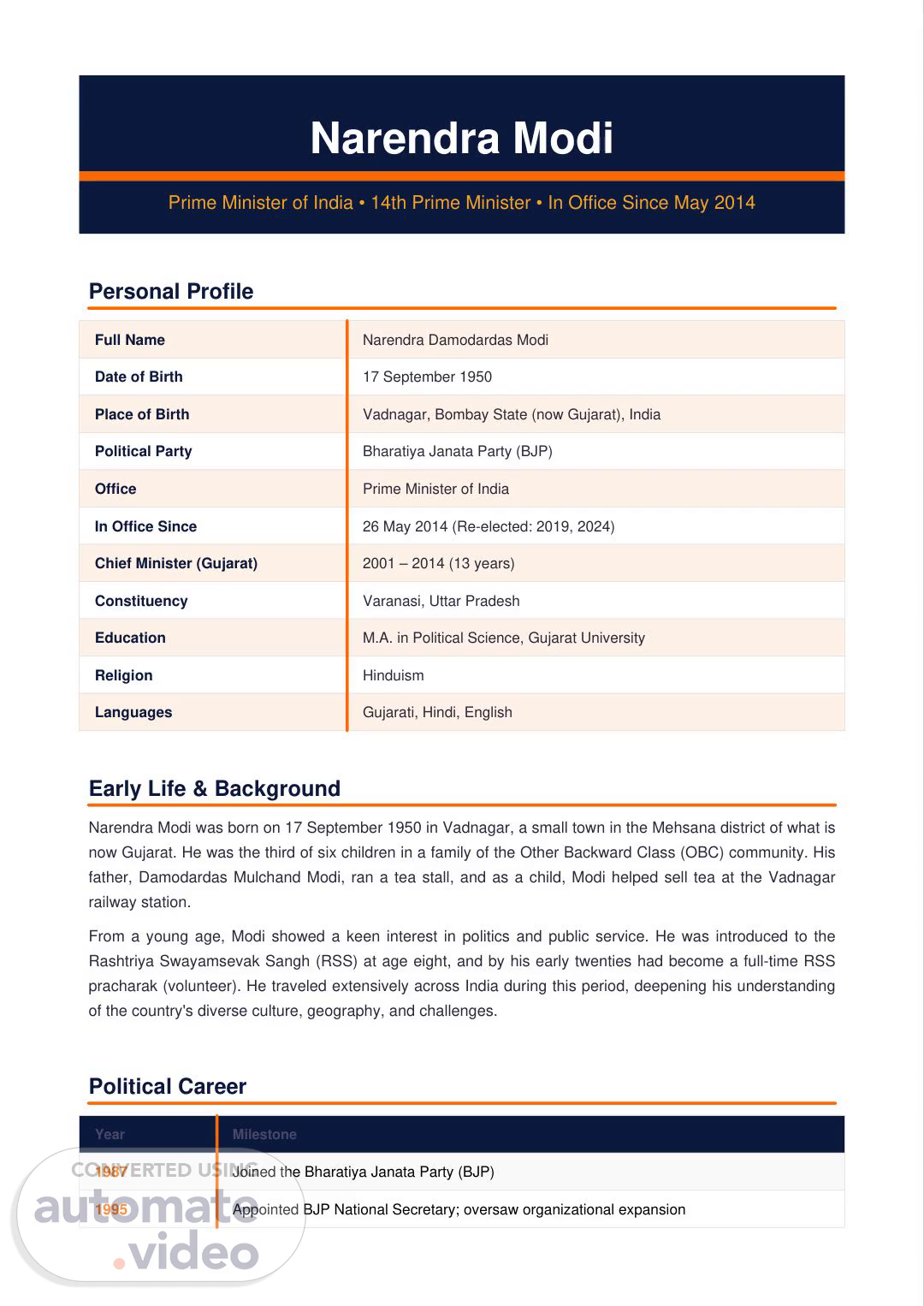
Narendra Modi Prime Minister of India • 14th Prime Minister • In Office Since May 2014 Personal Profile Full Name Narendra Damodardas Modi Date of Birth 17 September 1950 Place of Birth Vadnagar, Bombay State (now Gujarat), India Political Party Bharatiya Janata Party (BJP) Office Prime Minister of India In Office Since 26 May 2014 (Re-elected: 2019, 2024) Chief Minister (Gujarat) 2001 – 2014 (13 years) Constituency Varanasi, Uttar Pradesh Education M.A. in Political Science, Gujarat University Religion Hinduism Languages Gujarati, Hindi, English Early Life & Background Narendra Modi was born on 17 September 1950 in Vadnagar, a small town in the Mehsana district of what is now Gujarat. He was the third of six children in a family of the Other Backward Class (OBC) community. His father, Damodardas Mulchand Modi, ran a tea stall, and as a child, Modi helped sell tea at the Vadnagar railway station. From a young age, Modi showed a keen interest in politics and public service. He was introduced to the Rashtriya Swayamsevak Sangh (RSS) at age eight, and by his early twenties had become a full-time RSS pracharak (volunteer). He traveled extensively across India during this period, deepening his understanding of the country's diverse culture, geography, and challenges. Political Career Year Milestone 1987 Joined the Bharatiya Janata Party (BJP) 1995 Appointed BJP National Secretary; oversaw organizational expansion.
Scene 2 (46s)
2001 Appointed Chief Minister of Gujarat following party leadership change 2002 Re-elected as Chief Minister of Gujarat after state elections 2007 Won third consecutive term as Chief Minister of Gujarat 2012 Won fourth consecutive term as Chief Minister of Gujarat 2014 Led BJP to landslide victory; became 14th Prime Minister of India 2019 Re-elected as Prime Minister with an even larger parliamentary majority 2024 Sworn in for a historic third consecutive term as Prime Minister Key Policies & Initiatives Make in India (2014) A flagship initiative to transform India into a global manufacturing hub, targeting 25% contribution of manufacturing to GDP and creating millions of jobs. Digital India (2015) A campaign to ensure government services are made available to citizens electronically. It led to the proliferation of UPI payments, Aadhaar-based identification, and over 900 million internet users. Swachh Bharat Mission (2014) A nationwide cleanliness campaign that constructed over 110 million toilets across India, significantly improving rural sanitation and public health. Jan Dhan Yojana (2014) A financial inclusion program that opened over 500 million bank accounts for the unbanked population, enabling direct benefit transfers and reducing corruption. GST Implementation (2017) Led the historic rollout of the Goods and Services Tax, unifying India's complex indirect tax structure into a single national market. PM Gati Shakti (2021) A I111 trillion national infrastructure master plan integrating highways, railways, ports, airports, and logistics to reduce costs and boost competitiveness. Production-Linked Incentive (2020) Offered $26 billion in incentives across 14 sectors to boost domestic manufacturing in electronics, pharmaceuticals, automobiles, and more. Atmanirbhar Bharat (2020) A self-reliance initiative launched during COVID-19, aiming to reduce import dependence and build domestic supply chains across critical sectors. Economic Achievements Under Modi.
Scene 3 (1m 45s)
GDP Growth India averaged ~7% GDP growth, becoming the world's 5th largest economy at $3.9 trillion. FDI Inflows Foreign Direct Investment surged to record highs, exceeding $83 billion in FY21-22. Unicorn Startups India's startup ecosystem grew to 100+ unicorns, ranked 3rd globally. Renewable Energy India's renewable energy capacity crossed 200 GW, targeting 500 GW by 2030. Poverty Reduction Over 250 million people lifted out of multidimensional poverty (2014–2023). Space Milestones India's Chandrayaan-3 achieved the first-ever lunar south pole landing in 2023. International Standing & Foreign Policy Modi has significantly elevated India's global standing through an active and assertive foreign policy. His 'Neighbourhood First' policy prioritizes relations with South Asian nations, while his 'Act East' policy has deepened ties with Southeast Asian countries. He has cultivated strong personal relationships with leaders across the world, including the United States, Japan, France, and Gulf nations. Under his leadership, India hosted the G20 Summit in 2023, positioning the country as a key voice for the Global South. Modi has also been a strong advocate for a reformed United Nations Security Council with a permanent seat for India. He received the UAE's highest civilian honor, the Order of Zayed, and has been awarded similar honors by Russia, Afghanistan, Palestine, and the Maldives. "Good governance with good intentions is the hallmark of our government. Implementation with integrity is our core passion." Awards & Recognitions 2014 Order of Abdulaziz Al Saud — Saudi Arabia 2016 Order of St. Andrew — Russia (highest state award) 2016 Order of Zayed — UAE (highest civilian honor) 2018 Seoul Peace Prize — South Korea 2019 Order of the Distinguished Rule of Nishan Izzuddin — Maldives 2021 Legion of Honour — France (Grand Cross) 2023 Order of the Nile — Egypt 2023 Companion of the Order of Fiji — Fiji Sources: Prime Minister's Office of India (pmindia.gov.in) • Ministry of External Affairs • World Bank • IMF • Press Information Bureau.