Scene 1 (0s)
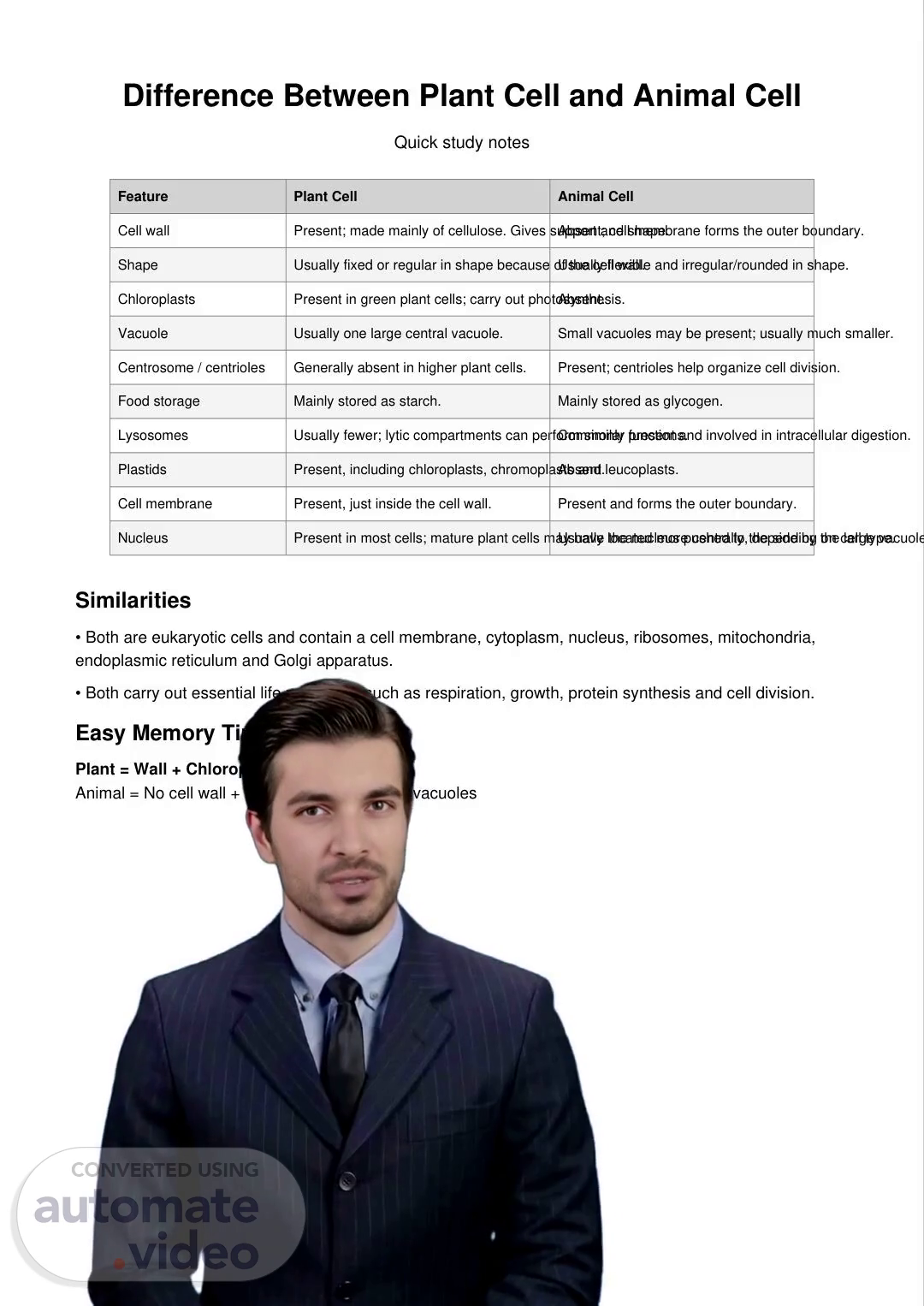
[Virtual Presenter] As a teacher, it is important for us to understand the key differences between plant cells and animal cells. Knowledge of these differences will not only help us in our studies, but also in our daily lives. Let's start our quick study notes on the first slide. The first major difference between plant cells and animal cells is the presence of a cell wall. In plant cells, the cell wall is made mainly of cellulose and gives support and shape to the cell. On the other hand, animal cells do not have a cell wall. Instead, the cell membrane forms the outer boundary. Another difference is the shape of the cells. Due to the presence of a cell wall, plant cells are usually fixed or regular in shape. In contrast, animal cells are usually flexible and irregular or rounded in shape. Moving on to the organelles, plant cells have specialized structures called chloroplasts, which are responsible for carrying out photosynthesis. However, animal cells do not have chloroplasts. Next, let's look at the vacuoles. Plant cells have one large central vacuole, while animal cells have smaller vacuoles. This is because plant cells mainly store food as starch, while animal cells store food as glycogen. Unlike animal cells, plant cells lack centrosomes and centrioles, which are involved in cell division. Another distinct feature is the presence of plastids in plant cells, including chloroplasts, chromoplasts, and leucoplasts. These are responsible for various functions such as photosynthesis and pigmentation. Lastly, both plant and animal cells have a cell membrane, which forms the outer boundary of the cell. They also contain similar organelles such as the nucleus, cytoplasm, ribosomes, mitochondria, endoplasmic reticulum, and Golgi apparatus. To make it easier to remember, here's a quick tip: Plants have walls, chloroplasts, and large vacuoles, while animals do not. Remember, both plant and animal cells are eukaryotic cells and carry out essential life processes such as respiration, growth, protein synthesis, and cell division. Understanding these differences will help us in our studies and in our daily lives. This concludes our quick study notes, thank you for watching..