Scene 1 (0s)
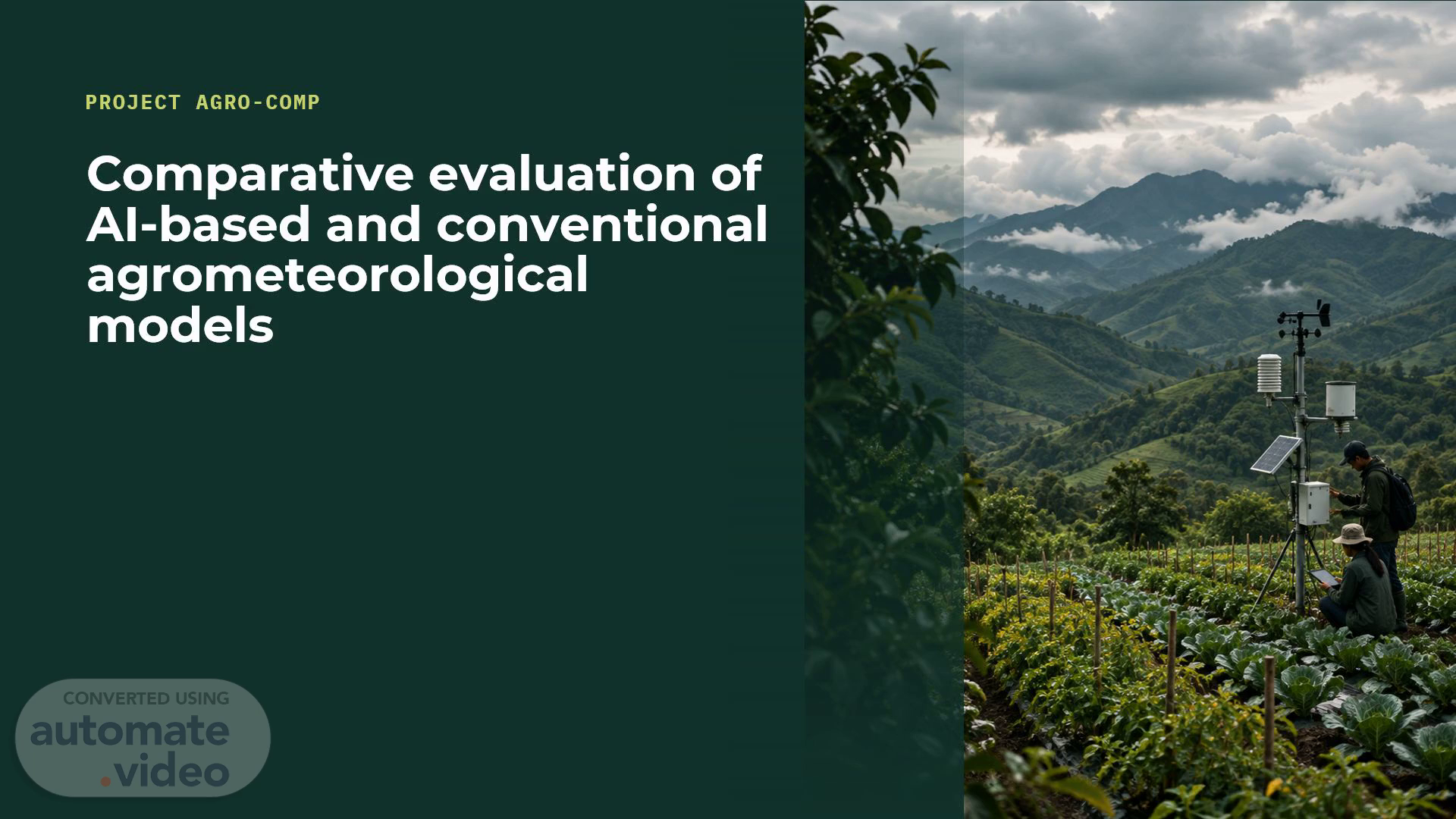
PROJECT AGRO-COMP. Comparative evaluation of AI-based and conventional agrometeorological models.
Scene 2 (13s)
[Audio] 1 · Research problem & significance High-value crop production in Northern Philippines faces challenges from variable agrometeorological conditions. Although localized weather data are available from the NVSU–PAGASA Agrometeorological Station and NVCCC's AWS network, their use in crop-specific decision-making remains limited. This study aims to integrate localized agrometeorological data with AI-based models to develop and evaluate a decision support platform for high-value crops, promoting informed farm management, resource efficiency, and climate resilience in Northern Philippines..
Scene 3 (59s)
Three questions define the inquiry. 01 What weather challenges and information needs do high-value crop farmers have?.
Scene 4 (1m 14s)
[Audio] The main objective of Project AGRO-COMP is to comparatively evaluate AI-based and conventional agrometeorological models for climate-smart management of selected high-value crops in Northern Philippines. To achieve this, the study has four specific objectives. First, to develop and prepare the datasets. We will compile, assess, and integrate historical and real-time agrometeorological observations from existing weather monitoring stations, together with available crop-specific information. This will establish the data foundation for model development and evaluation. Second, to develop and optimize agrometeorological models. We will apply AI-based approaches, such as Random Forest and XGBoost, alongside conventional statistical and agronomic models to predict a selected crop-management requirement. Third, to compare and validate model performance. This is the core scientific component of the study. We will evaluate the models using appropriate statistical performance indicators and independent validation to determine whether AI provides measurable advantages over conventional approaches. Importantly, we do not assume that AI will necessarily perform better. Fourth, to generate and demonstrate decision support outputs. Based on the validated models, we aim to develop a prototype that translates agrometeorological information into practical, location-specific crop-management recommendations. Overall, the study is designed not merely to develop an AI-based platform, but to generate scientific evidence on the predictive value of localized weather data and the comparative effectiveness of different modeling approaches. We expect these findings to contribute to agrometeorological research and support the future development of evidence-based, climate-smart agricultural technologies..
Scene 5 (3m 21s)
[Audio] NEEDS – Why is this project necessary? High-value crop production is highly influenced by changing weather conditions, particularly rainfall, temperature, humidity, and solar radiation. In Nueva Vizcaya, we already have an existing network of agrometeorological monitoring stations that provides valuable localized weather observations. However, the extent to which these data can support accurate, crop-specific management decisions remains to be scientifically established. This creates an important research need: to determine how localized agrometeorological information can be effectively translated into reliable and actionable recommendations for climate-smart agriculture. SOLUTION – What does the project propose? To address this, Project AGRO-COMP proposes to develop and comparatively evaluate AI-based and conventional agrometeorological models using historical and real-time weather observations together with available crop-specific data. The study will assess which modeling approaches provide the most accurate and reliable predictions for selected agricultural management decisions. Based on the validated findings, we also aim to demonstrate a prototype decision support system that can translate scientific results into practical crop-management information. DIFFERENTIATION – What makes this project different? What distinguishes Project AGRO-COMP is its emphasis on scientific comparison rather than simply developing another AI-based agricultural application. We will evaluate AI-based models against conventional statistical and agronomic approaches using consistent performance indicators and independent validation. We will also investigate how localized microclimatic conditions influence model performance. Most importantly, we are not assuming that AI is superior. Our objective is to establish scientific evidence on when, where, and to what extent AI offers additional predictive value over conventional methods. BENEFITS – What are the expected contributions? The primary expected benefit is the generation of scientific knowledge on the relationship between localized agrometeorological information and crop-management requirements. The project is expected to provide comparative evidence on model performance, a validated methodological framework, and research outputs that can support future climate-smart agricultural technologies. In the longer term, these findings may help farmers, agricultural extension personnel, and local government units make better-informed decisions on crop management and climate-related risks. However, improvements in productivity and resource-use efficiency will require further field validation. CLOSING STATEMENT Ultimately, Project AGRO-COMP aims to maximize the scientific value of our existing agrometeorological monitoring infrastructure by transforming weather observations into validated knowledge that can support climate-smart agricultural decision-making in Northern Philippines..
Scene 6 (6m 40s)
[Audio] This slide presents the proposed research workflow of Project AGRO-COMP, which follows a systematic process from data collection to model validation and the development of climate-smart agricultural recommendations. First is data collection and preparation. We will utilize historical and real-time agrometeorological observations from the NVSU–PAGASA Agrometeorological Station and the existing Automatic Weather Station network of the Nueva Vizcaya Climate Change Center. These data will be complemented by available crop-specific information. We will assess data completeness, accuracy, and suitability before proceeding with model development. Second is data processing and analysis. We will examine the relationships between agrometeorological variables, such as rainfall, temperature, relative humidity, and solar radiation, and the selected crop-management requirement. This will help identify relevant predictors and establish the basis for model development. Third is comparative model development. We will develop AI-based models, such as Random Forest and XGBoost, alongside conventional statistical and agronomic models. All models will be evaluated using comparable datasets and consistent performance indicators to ensure a fair scientific comparison. Fourth is model validation and evaluation. This is the most important scientific component of the project. We will assess prediction accuracy, reliability, and model performance using independent validation data. We will also examine how differences in microclimatic conditions influence model performance across selected locations. Fifth is the development of decision support outputs. Based on the validated models, we will demonstrate how agrometeorological information can be translated into practical, location-specific recommendations for high-value crop management. A prototype decision support platform may be developed to demonstrate the application of the research findings. Finally, we will conduct pilot evaluation and refinement. The resulting recommendations and prototype will be assessed for technical reliability, usability, and relevance to farmers and agricultural extension personnel. Feedback will guide further improvements. Overall, the workflow is designed to ensure that each stage is supported by scientific evaluation. Rather than assuming that AI will outperform conventional methods, Project AGRO-COMP will determine which modeling approach is most appropriate for the available data and selected agricultural decision. Through this process, we aim to generate validated scientific evidence that can serve as a foundation for future climate-smart agricultural decision support systems in Northern Philippines..
Scene 7 (9m 33s)
PROJECT AGRO-COMP | 24-MONTH RESEARCH WORK PLAN. Comparative AI and conventional agrometeorological modeling • Proposed schedule.
Scene 8 (10m 10s)
A green and white card with mountains and hills Description automatically generated.