Scene 1 (0s)
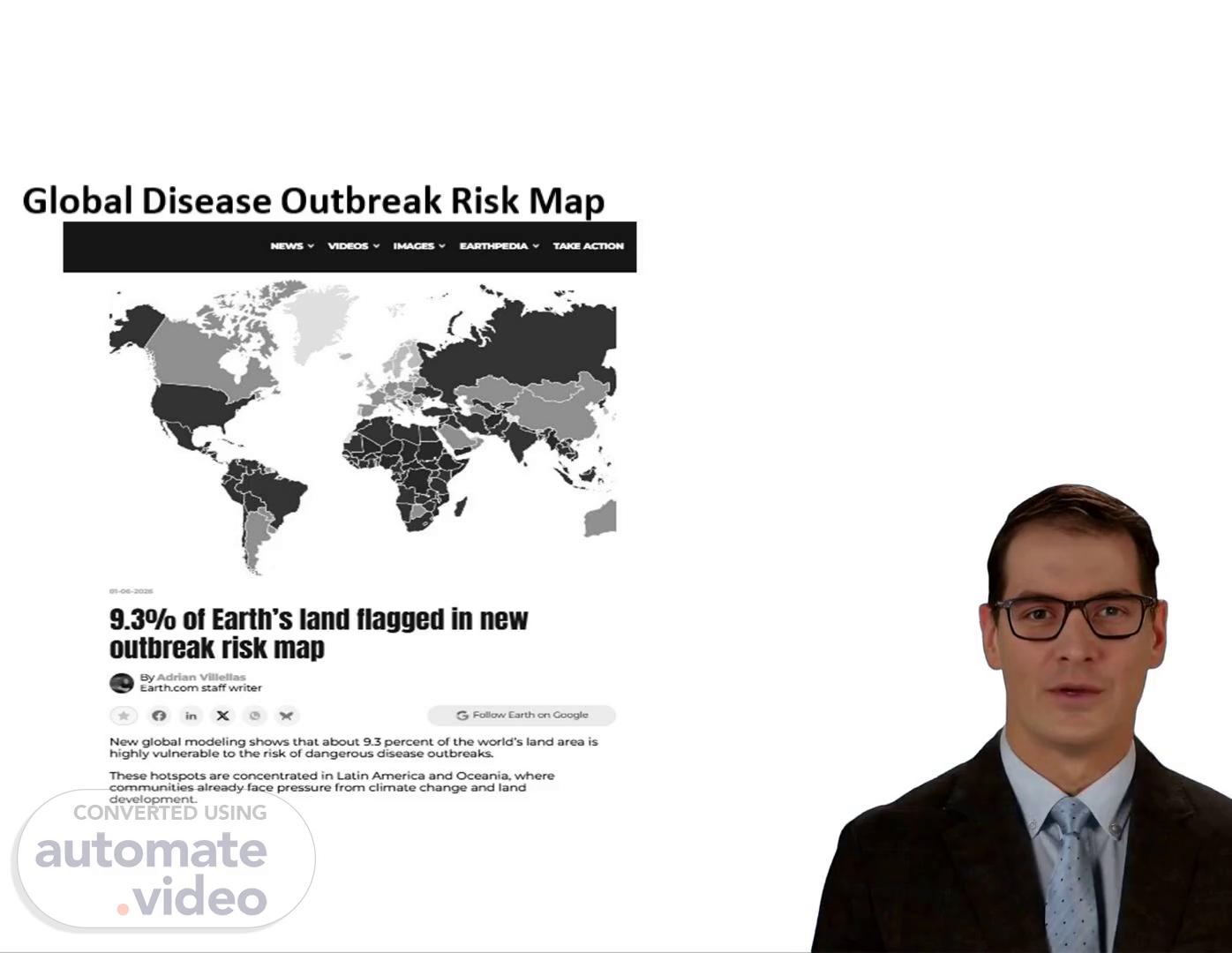
[Virtual Presenter] The global disease outbreak risk map is an innovative tool designed to identify areas around the world that are at high risk of experiencing a major disease outbreak. The map uses advanced data analysis techniques to pinpoint locations where the conditions are ripe for an outbreak to occur. These locations include areas with high population densities, poor sanitation, inadequate healthcare systems, and other environmental factors that can facilitate the spread of disease. The map also takes into account the presence of certain diseases such as influenza, tuberculosis, and malaria, which are known to cause significant morbidity and mortality worldwide. By analyzing these factors, the map provides a comprehensive picture of the global landscape of disease outbreak risk. Regions identified as being at high risk include sub-Saharan Africa, parts of Asia, and Latin America. These regions face unique challenges due to their geographical location, cultural practices, and socioeconomic factors. For example, sub-Saharan Africa has limited access to modern healthcare facilities, while parts of Asia have large populations living in close proximity to each other, creating ideal breeding grounds for infectious diseases. Latin America has experienced significant economic growth, but its rural areas often lack basic infrastructure, making them more susceptible to disease outbreaks. The map highlights the importance of addressing these underlying issues in order to mitigate the risk of disease outbreaks..
Scene 2 (1m 39s)
[Audio] The region of South America is home to a significant portion of the world's most vulnerable populations. Approximately 30% of the continent's land area is classified as high or very high risk for disease outbreaks. The majority of these regions are found in the Amazon rainforest, which spans across nine countries including Brazil, Peru, Ecuador, Colombia, Bolivia, Venezuela, Guyana, Suriname, and French Guiana. Many of these countries have limited healthcare resources and infrastructure, making them more susceptible to disease outbreaks..
Scene 3 (2m 15s)
[Audio] The European Commission's Joint Research Centre (JRC) has provided significant support to develop effective disease outbreak risk mapping tools. The JRC brings together experts from various fields, including veterinary epidemiology. A key figure in our research team is Angela Fanelli, who has extensive experience in veterinary epidemiology. She has played a crucial role in shaping our approach to disease outbreak risk mapping. Her work focuses on understanding the complex relationships between animals, their environments, and human populations. We use machine learning models to analyze large datasets, including satellite imagery, climate patterns, and historical outbreak data. This comprehensive approach allows us to identify areas of high risk for disease outbreaks and inform strategies for mitigating these risks. By combining multiple sources of information, we can provide a more accurate picture of disease outbreak risk, ultimately supporting efforts to protect public health..
Scene 4 (3m 19s)
[Audio] The World Health Organization (WHO) has identified several key characteristics of zoonotic diseases. Firstly, they are caused by pathogens that originate from animal sources. Secondly, these diseases can be transmitted between different species, including humans. Thirdly, the transmission of zoonotic diseases often involves the spillover of pathogens from one species to another. This can occur through direct contact, such as biting or scratching, or indirectly through vectors like mosquitoes or ticks. The risk of transmission is further increased by human activities such as deforestation, urbanization, and the wildlife trade. These activities can lead to the overlap of habitats and increase the likelihood of disease transmission. Furthermore, the increasing globalization of trade and travel has created new opportunities for the spread of zoonotic diseases. As a result, it is essential to develop effective strategies for preventing and controlling zoonotic diseases..