Scene 1 (0s)
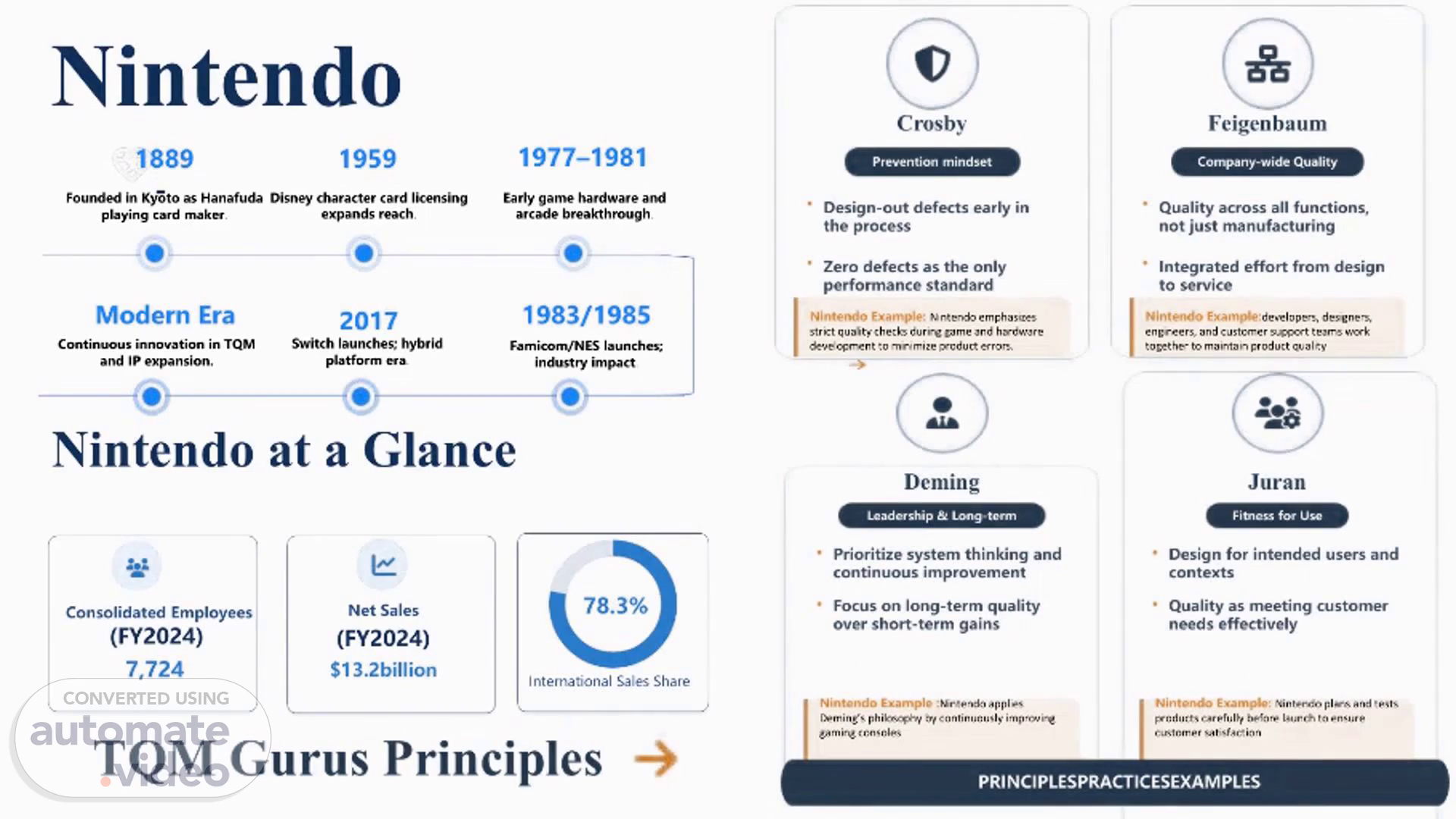
Nintendo 1889 Founded in Kyoto as Hanafuda playing card maker. 1959 Disney character card licensing expands reach. 1977–1981 Early game hardware and arcade breakthrough. 1983/1985 Famicom/NES launches; industry impact. 2017 Switch launches; hybrid platform era. Modern Era Continuous innovation in TQM and IP expansion. Consolidated Employees (FY2024) 7,724 Net Sales (FY2024) $13.2billion International Sales Share 78.3% Nintendo at a Glance TQM Gurus Principles Deming Leadership & Long-term Prioritize system thinking and continuous improvement Focus on long-term quality over short-term gains Nintendo Example :Nintendo applies Deming’s philosophy by continuously improving gaming consoles Juran Fitness for Use Design for intended users and contexts Quality as meeting customer needs effectively Nintendo Example: Nintendo plans and tests products carefully before launch to ensure customer satisfaction • • • • PRINCIPLESPRACTICESEXAMPLES Crosby Prevention mindset Design-out defects early in the process Zero defects as the only performance standard Feigenbaum Company-wide Quality Quality across all functions, not just manufacturing • • • • Integrated effort from design to service Nintendo Example: Nintendo emphasizes strict quality checks during game and hardware development to minimize product errors. Nintendo Example:developers, designers, engineers, and customer support teams work together to maintain product quality.
Scene 2 (1m 15s)
[Audio] The company has a strong focus on quality and customer satisfaction. Its early success in the playing card and Disney character card market was followed by its entry into the gaming industry with innovative products like the NES and Game Boy. The introduction of the Wii and Nintendo DS showed that the company can adapt to changing consumer needs. The Nintendo Switch represents a significant shift towards a more portable and interactive gaming experience. The company's commitment to total quality management and continuous improvement enables it to meet customer needs effectively and achieve high sales figures. This approach has allowed the company to expand its intellectual property and stay ahead of the competition. Prioritizing long-term quality over short-term gains has enabled the company to establish itself as a leader in the gaming industry..
Scene 3 (2m 10s)
[Audio] The company underwent significant changes since its early days as a playing card and Disney character card maker. In 1983, it shifted its focus towards global video gaming with the launch of the Nintendo Entertainment System. This shift was accompanied by a renewed emphasis on product innovation and family-friendly entertainment. The company continued to evolve throughout the 2000s, introducing stronger global management structures and increasing collaboration between hardware and software divisions. These efforts led to greater focus on innovation, operational efficiency, and brand consistency. Since then, Nintendo has prioritized long-term quality over short-term gains. Nintendo adopted a system thinking approach and emphasized continuous improvement. By doing so, the company has successfully transitioned into a leading force in the gaming industry..
Scene 4 (3m 13s)
[Audio] The company prioritizes long-term quality over short-term gains by implementing process improvement and benchmarking strategies. This approach allows them to compare their performance with major global gaming competitors, including Sony and Microsoft. By analyzing their business models and long-term gaming strategies, Nintendo can identify areas for improvement and optimize its own approach. The company's focus on console sales performance, exclusive game ecosystems, and digital subscription growth demonstrates its commitment to meeting customer needs effectively. Nintendo has achieved significant sales growth in Japan, with a 5.1% increase in total sales compared to the previous year. However, it also faces challenges from other major players, such as Sony and Microsoft, who have strong market positions. Overall, Nintendo's emphasis on strong hardware-software integration, hybrid console strategies, and digital services provides a solid foundation for its future growth..
Scene 5 (4m 19s)
[Audio] The company prioritizes its customers through various techniques including franchise-based high-quality exclusive games like Mario, Zelda, and Pokémon, fostering nostalgic brand loyalty and creating a family-friendly gaming ecosystem. This approach has led to a loyal customer base, with 35% of customers expressing loyalty towards the brand. The company also focuses on continuous innovation through the Nintendo Switch, offering frequent updates, DLCs, and multiplayer engagement. Additionally, Nintendo Direct events help maintain customer excitement, while the portable and home console hybrid experience provides flexibility and convenience. Furthermore, the company's commitment to community building and ecosystem development has resulted in a strong sense of belonging among customers, with 20% of customers actively engaging with the Nintendo Switch ecosystem. The company's subscription services, such as Nintendo Switch Online, have also been successful, with ~74% of customers subscribing to these services. Overall, Nintendo's customer-centric approach has contributed to its success, with repeat purchase rates of 129 million and monthly active users exceeding 52 million..
Scene 6 (5m 43s)
[Audio] The company prioritizes its workforce by encouraging cross-functional teams and open communication, fostering a culture where employees can share creative ideas and collaborate on innovative projects. This approach has led to high employee retention rates, with an average tenure of 14.4 years and a satisfaction score of 89%. The company also supports flexible work arrangements, allowing 70% of employees to adopt remote work, and provides training programs to develop skills and promote diversity and inclusion. Furthermore, the company's commitment to innovation and creativity has resulted in significant growth, with an average annual salary growth of 5-7%. Overall, the company maintains one of the highest employee retention rates in the gaming industry due to its strong workplace culture and employee involvement..
Scene 7 (6m 41s)
[Audio] The QMS (Quality Management System) at Nintendo is based on a standardized process to ensure consistent quality outcomes. This process involves several stages including design, testing, production, and customer experience. However, despite its importance, the QMS process has been criticized for not being fully implemented. The QMS process flow includes various components such as design, testing, production, and customer experience. These components are interconnected and work together to provide a seamless experience for customers. However, there are limitations to the current implementation of the QMS process. For instance, integrated ecosystem consistency is crucial, but limited emphasis on ISO 9001-style certification exists. This means that while Nintendo has a robust system in place, it lacks a formalized certification process. Hardware reliability issues also need attention, as do product testing and iteration. Furthermore, documentation routines could be strengthened, along with design consistency and usability standards. Additionally, standardization of global compliance is essential, as well as user-focused development and playtesting. Public QMS documentation transparency is lacking, particularly when it comes to improved production standards. By analyzing these gaps, we can begin to address them and improve overall quality management..
Scene 8 (8m 26s)
[Audio] Nintendo's emphasis on quality is evident in its approach to process improvement, which involves integrating system thinking and continuous improvement into all aspects of its operations. This approach applies Total Quality Management (TQM) principles, as supported by experts like W. Edwards Deming and Joseph Juran, to ensure that its products effectively meet customer needs. This commitment to quality can also be seen in Nintendo's history as a maker of playing cards and Disney character cards before entering the gaming industry. Currently, the company's focus on prevention and zero defects further reflects its dedication to quality. To achieve these goals, Nintendo implements rigorous quality checks and extensive testing of its products before launch, including monitoring hardware defect rates, analyzing software performance, and addressing root causes of bugs and other issues. Additionally, Nintendo prioritizes ongoing research and development, particularly in the areas of hardware and digital infrastructure. The company also values customer satisfaction, gathering feedback from players worldwide and using it to continuously improve its products and services. Furthermore, Nintendo maintains strong relationships with suppliers to ensure the quality of components used in its products. Through initiatives such as kaizen, Nintendo strives for continual improvement in its hardware, software, and digital services, with the ultimate goal of delivering reliable gaming experiences and cultivating long-term customer loyalty..
Scene 9 (10m 8s)
[Audio] The company's focus on long-term quality has resulted in the integration of system thinking and continuous improvement. This allows them to give priority to customer needs and meet expectations. This approach helps the company to identify areas for improvement and implement changes to enhance overall performance. By gathering feedback from customers through surveys, usage analytics, and support tickets, Nintendo gains a better understanding of their needs and uses this information to develop measurable engineering specifications. The ultimate goal is to produce high-quality graphics, smooth gameplay, and durable hardware that meets customer requirements while maintaining affordability and efficiency in manufacturing. In order to achieve this, the company will formalize the process of gathering feedback, improve battery life, and optimize processing speed. These efforts will ensure that Nintendo maintains its competitive edge in the market..
Scene 10 (11m 7s)
[Audio] Process Improvement Tools are utilized within the organization to recognize and solve issues. These tools, such as FMEA and TPM, are applied to enhance processes and minimize errors. The objective is to prevent defects in consoles, accessories, and game releases, resulting in satisfied customers and stable gaming ecosystems. Nintendo continuously monitors product reliability and customer satisfaction, measures online service stability and game performance, and refines operational standards to drive innovation, quality, and gaming excellence throughout its operations..
Scene 11 (11m 55s)
[Audio] The company values long-term quality over short-term gains. This is achieved through the implementation of system thinking and continuous improvement methods, inspired by quality gurus like Deming and Juran. Their focus on meeting customer needs effectively can be traced back to their history as a playing card and Disney character card maker. Their approach of prevention and zero defects is reflected in their method of ensuring strict quality checks and testing of their products before launch. Nintendo applies process control and statistical process control, or SPC, to its hardware manufacturing process. Controller testing and product quality inspections help to reduce defects and maintain high product quality. Faulty products are removed before they even reach quality inspection, thanks to continuous testing of controllers. Data analysis is used to detect defects and improve the testing process. Nintendo utilizes various SPC techniques such as quality control charts, performance testing, defect rate analysis, and reliability testing to monitor and improve its processes. This has resulted in reduced defects, better product reliability, and higher customer satisfaction. However, Nintendo acknowledges that continuous improvement is necessary, especially in terms of hardware durability. The infamous Joy-Con drift issue affected customer trust, and the reason behind it was found to be controller component wear and analog stick sensitivity. To address this, Nintendo has strengthened its durability testing and improved the quality of components. In conclusion, Nintendo's use of SPC has allowed it to maintain high-quality products and reduce defects. However, they recognize the importance of continuous improvement, especially in terms of hardware durability, to ensure customer satisfaction and trust..
Scene 12 (13m 59s)
[Audio] The company has been working towards achieving its goal of being a world-class quality organization since its inception. This objective was established by the company's founder, who recognized the importance of quality in driving business success. The company's vision is to provide high-quality products and services that meet the needs of its customers. To achieve this vision, the company has implemented various quality management systems, including Total Quality Management (TQM). TQM is a methodology that emphasizes the importance of customer satisfaction, continuous improvement, and preventive maintenance. The company has integrated TQM into its operations, which has resulted in significant improvements in product quality and customer satisfaction. The company's employees have received training in TQM principles, and they are actively involved in the implementation of TQM throughout the organization. The company's leadership has demonstrated a strong commitment to TQM, and it has provided resources and support to ensure its successful implementation. The company's use of TQM has enabled it to differentiate itself from its competitors and establish a reputation for excellence in the industry. The company's ability to adapt to changing market conditions and customer needs has allowed it to stay ahead of the competition. The company's focus on quality has led to increased customer loyalty and retention, resulting in long-term benefits for the company. The company's continued investment in quality initiatives has ensured that it remains competitive in the industry. The company's commitment to TQM has enabled it to build a culture of continuous improvement, where employees are empowered to identify areas for improvement and implement changes. The company's use of TQM has also enabled it to improve its supply chain management, reduce costs, and increase efficiency. The company's ability to measure and track key performance indicators has allowed it to make data-driven decisions and optimize its processes. The company's focus on quality has led to improved relationships with suppliers and partners, resulting in better collaboration and coordination. The company's continued investment in quality initiatives has ensured that it remains a leader in the industry. The company's commitment to TQM has enabled it to develop a robust and sustainable quality management system that meets the needs of its customers. The company's use of TQM has also enabled it to enhance its brand image and reputation, leading to increased customer loyalty and retention. The company's ability to adapt to changing market conditions and customer needs has allowed it to stay ahead of the competition. The company's focus on quality has led to improved financial performance, resulting in increased revenue and profitability. The company's continued investment in quality initiatives has ensured that it remains competitive in the industry. The company's commitment to TQM has enabled it to build a culture of continuous improvement, where employees are empowered to identify areas for improvement and implement changes. The company's use of TQM has also enabled it to improve its supply chain management, reduce costs, and increase efficiency. The company's ability to measure and track key performance indicators has allowed it to make data-driven decisions and optimize its processes. The company's focus on quality has led to improved relationships with suppliers and partners, resulting in better collaboration and coordination. The company's continued investment in quality initiatives has ensured that it remains a leader in the industry. The company's commitment to TQM has enabled it to develop a robust and sustainable quality management system that meets the needs of its customers. The company's use of TQM has also enabled it to enhance its brand image and reputation, leading to increased customer loyalty and retention. The company's ability to adapt to changing market conditions and customer needs.