Scene 1 (0s)
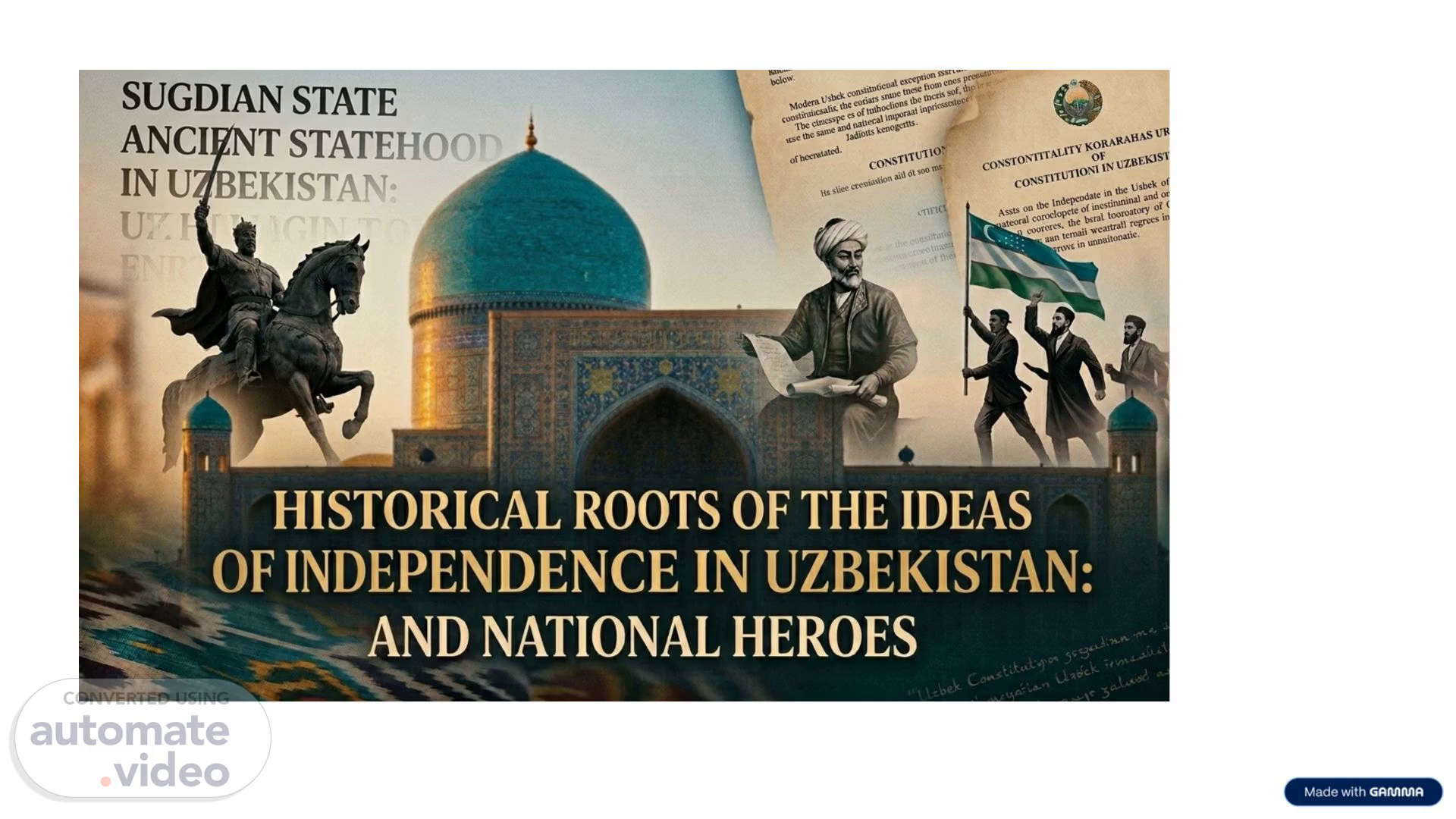
SUGDIAN STATE ANCI T STATEHOOD INU EKISTAN• encs nattecal CSe satne I Ot soo ws suee CONSTITUTION 1 IN in the Usbek ot Indepcodate • turunal ant: Assts on ibe of inesti roeloptee too—cs ateoral co in HISTORICAL ROOTS OF THE IDEAS OF INDEPENDENCE IN UZBEKISTAN: AND NATIONAL HEROES.
Scene 2 (11s)
Independence is not only political freedom. Beyond politics, independence is the preservation of national identity and cultural heritage. Uzbekistan's statehood spans 3,000 years, from ancient Sogdia to the Timurid Empire. Brave leaders like Jaloliddin Manguberdi and enlightened Jadid scholars fought against oppression, sacrificing their lives to ensure the Uzbek people could finally reclaim their destiny..
Scene 3 (30s)
Statehood is the foundation of a nation's existence. It represents a defined sovereign territory where a people live under their own government authority. This authority is exercised through a robust system of laws and institutions, such as a constitution and legal framework, ensuring order and justice. Beyond administrative structures, statehood is fueled by a shared national identity, granting the people political, economic, and cultural autonomy to shape their own future.
Scene 4 (51s)
Ancient states like Sogdiana, Bactria, and Khorezm were thriving hubs of the Silk Road. Beyond military might and bold resistance against conquerors like Alexander the Great, they excelled in advanced irrigation, vibrant Zoroastrian culture, and grand monumental architecture that defined Central Asia.
Scene 5 (1m 7s)
Achaemenid Period: Seeds of Freedom. During the 6th century BCE, Central Asia was absorbed into the vast Persian Empire, marking a significant shift in regional power dynamics. Despite this foreign rule, the spirit of independence began to awaken..
Scene 6 (1m 39s)
Courage in the Face of Empire. During periods of foreign rule, local heroes often emerged, embodying the spirit of resistance and patriotism. Their stories, passed down through generations, became beacons of hope and inspiration for future independence movements..
Scene 7 (2m 4s)
Spitamen: The Enduring Spirit of Resistance. Spitamen, a brave Sogdian warlord, personified the fierce determination of Central Asian peoples to resist foreign domination, challenging even the might of Alexander the Great..
Scene 8 (2m 42s)
Arab Conquest Period: Enduring Identity. The 7th and 8th centuries marked a transformative era for Central Asia, as the Arab conquests brought profound changes while also igniting a deep-seated desire to preserve local cultures and traditions..
Scene 9 (3m 23s)
Khorezmshahs: A Resurgent Empire. Following periods of foreign influence, the Khorezmshah dynasty emerged in Central Asia, not only reasserting regional autonomy but also ushering in a golden age of cultural and economic flourishing..
Scene 10 (3m 59s)
Jalal ad-Din Mingburnu: Unyielding Defender. Jalal ad-Din Mingburnu, the last Khorezmshah, became a legendary figure for his valiant and unyielding resistance against the formidable Mongol hordes..
Scene 11 (4m 32s)
The Mongol Invasion: A Test of Resilience. In the 13th century, Central Asia faced an unprecedented cataclysm with the Mongol invasion, which brought widespread destruction. Yet, amidst the devastation, the region's foundational traditions and national spirit remarkably endured..
Scene 12 (5m 5s)
The Timurid Empire: Rebuilding Central Asian Power.
Scene 13 (5m 28s)
Timurid Renaissance: A New Golden Age. Under the Timurid Empire, Central Asia experienced a magnificent cultural and scientific rebirth, where statehood actively fostered groundbreaking advancements in astronomy, literature, and architecture..
Scene 14 (6m 9s)
Shaybanid and Ashtarkhanid Periods. The Bukhara, Khiva, and Kokand Khanates maintained long-term independence. These powerful states possessed their own armies, unique coinage, and administrative systems..
Scene 15 (6m 28s)
Russian Empire Conquest. 19th Century Occupation.