Scene 1 (0s)
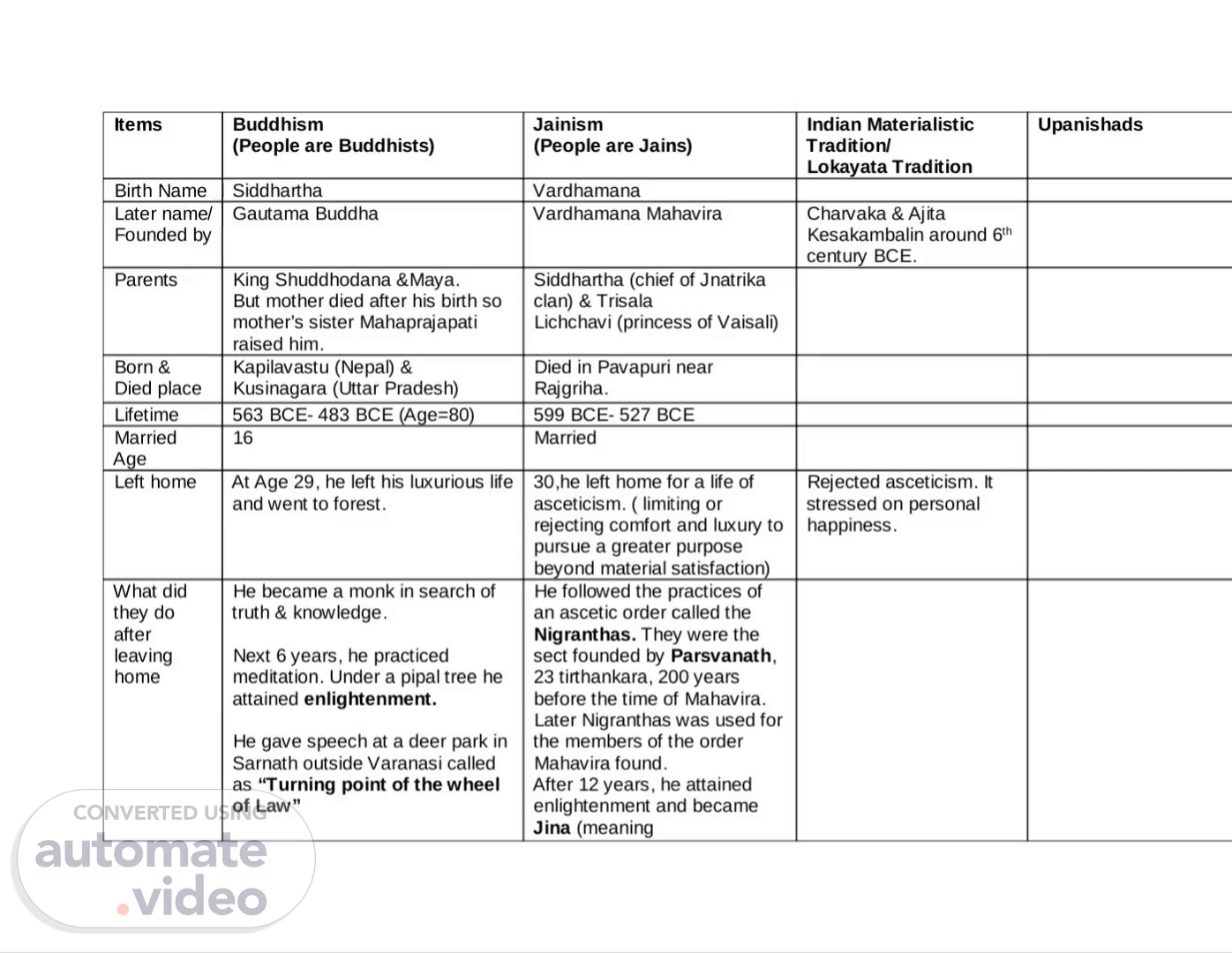
[Virtual Presenter] Upanishads Items Buddhism (People are Buddhists) Jainism (People are Jains) Indian Materialistic Tradition/ Lokayata Tradition Birth Name Siddhartha Vardhamana Later name/ Founded by Gautama Buddha Vardhamana Mahavira Charvaka & Ajita Kesakambalin around 6th century BCE. Siddhartha (chief of Jnatrika clan) & Trisala Lichchavi (princess of Vaisali) Parents King Shuddhodana &Maya. But mother died after his birth so mother’s sister Mahaprajapati raised him. Born & Died place Kapilavastu (Nepal) & Kusinagara (Uttar Pradesh) Died in Pavapuri near Rajgriha. Lifetime 563 BCE- 483 BCE (Age=80) 599 BCE- 527 BCE 16 Married Married Age Left home At Age 29, he left his luxurious life and went to forest. Rejected asceticism. It stressed on personal happiness. 30,he left home for a life of asceticism. ( limiting or rejecting comfort and luxury to pursue a greater purpose beyond material satisfaction) He became a monk in search of truth & knowledge. What did they do after leaving home Next 6 years, he practiced meditation. Under a pipal tree he attained enlightenment. He gave speech at a deer park in Sarnath outside Varanasi called as “Turning point of the wheel of Law” He followed the practices of an ascetic order called the Nigranthas. They were the sect founded by Parsvanath, 23 tirthankara, 200 years before the time of Mahavira. Later Nigranthas was used for the members of the order Mahavira found. After 12 years, he attained enlightenment and became Jina (meaning.
Scene 2 (2m 13s)
[Audio] Conquerer/great hero). He spent 45 years travelling and preaching. Spent his time preaching Jainism. Teachings Emphasized in attainment of Nirvana (liberation from the cycle of birth & death). Emphasized importance of the people, the "lok" instead of any higher power or God. Upanishad- means a session to sit at the feet a master who imparts Doctrines. Oldest religion in world. Enlightened person or great teacher leads them on to path of Dharma. This teacher is called TriThankara. 24 Trithankara are there. 1st was Rishabhadeva 24th was Mahavira and last. There are 108 Upanishads. Identity of soul of individual (atman & universe (Brahman) i repeated throughout the Upanishad literature. Strict vegetarians Believed in equality of humans, Rebirth, Preached nonviolence or ahimsa, Karma, Enlightenment. Believed in middle path and rejected both extreme luxury & extreme asceticism. Preached in Pali language known by common people. Only things that you can see, touch or experience are real. Live for pleasure and happiness in present moment because thye did not believe in any consequences after death. Encouraged people to enjoy life and seek pleasure without worrying about religious rules and consequences. Didn't believe in rebirth. 3 Jewels/ Triratnas are 1.Right Knowledge 2.Right Action 3. Right faith 8 Fold Path. The principles are 1.Right Knowledge 2.Right Action 3. Right Thinking 4. Right observation 5.Right Speech 6. Right Living 7. Right Effort 8. Right Meditation New ideas focused on potential of human beings and the material things that we around us, it came to be known as Indian materialistic Tradition. Emphasized that knowledge of the atman (seeking unity with the universal soul) or self i important. Promoted social stability integration. Theory of Karma is also part of Upanishad philosophy. (meaning in one present birth, a person has to bear the consequences of the actions performed by hi or her in the previous birth. This is the broader 4 Noble truth: 1.suffering is an integral part of our lives. 2. Suffering is caused by our 5 Promises/Panchmahavratas: 1.Noninjury to living things 2. Truth.
Scene 3 (4m 54s)
[Audio] concept of Dharma. 3. Non-Stealing 4. Non-ownership of property 5.Chastity desires. 3. suffering ends when our desires end. 4. Freedom from suffering is possible by following 8-fold path. They are practical and believed in Salvation by knowledge or realization instead of faith / work. Buddha teachings are compiled in 3 Books/Tripitakas: 1.Vinaya Pitaka 2. Abhidhamma pitaka 3.Sutta Pitaka. Jatakas are story related to Buddha and written in Pali language. Criticized rituals. Against Against Vedic sacrifices leading to killing of animals. Buddhas was against Sanskrit language as it was spoken by upper caste Brahmanas, and religious teaching are conducted in Sanskrit but common people spoke Pali & Prakrit and cannot understand. Brahmins dominated the society as the highest caste. Some Kshatriya spoke the principles of Upanishads and created an atmosphere to reform the priest dominated Ve religion. Disapproved caste system which divided society on basis of birth. Opposed God, rituals, sacrifices & ceremonial work ship. Outside India like Nepal. Spread across Spread by followers and monks. Spread outside India like China, Japan, Myanmar, Tibet & SriLanka. Split 2 Sects Mahayana After the death of Mahavira, Jains split to 2 sects..
Scene 4 (6m 32s)
[Audio] Hinayana. Digambaras (don't cover body) Svetambaras (wore white cloth).