Scene 1 (0s)
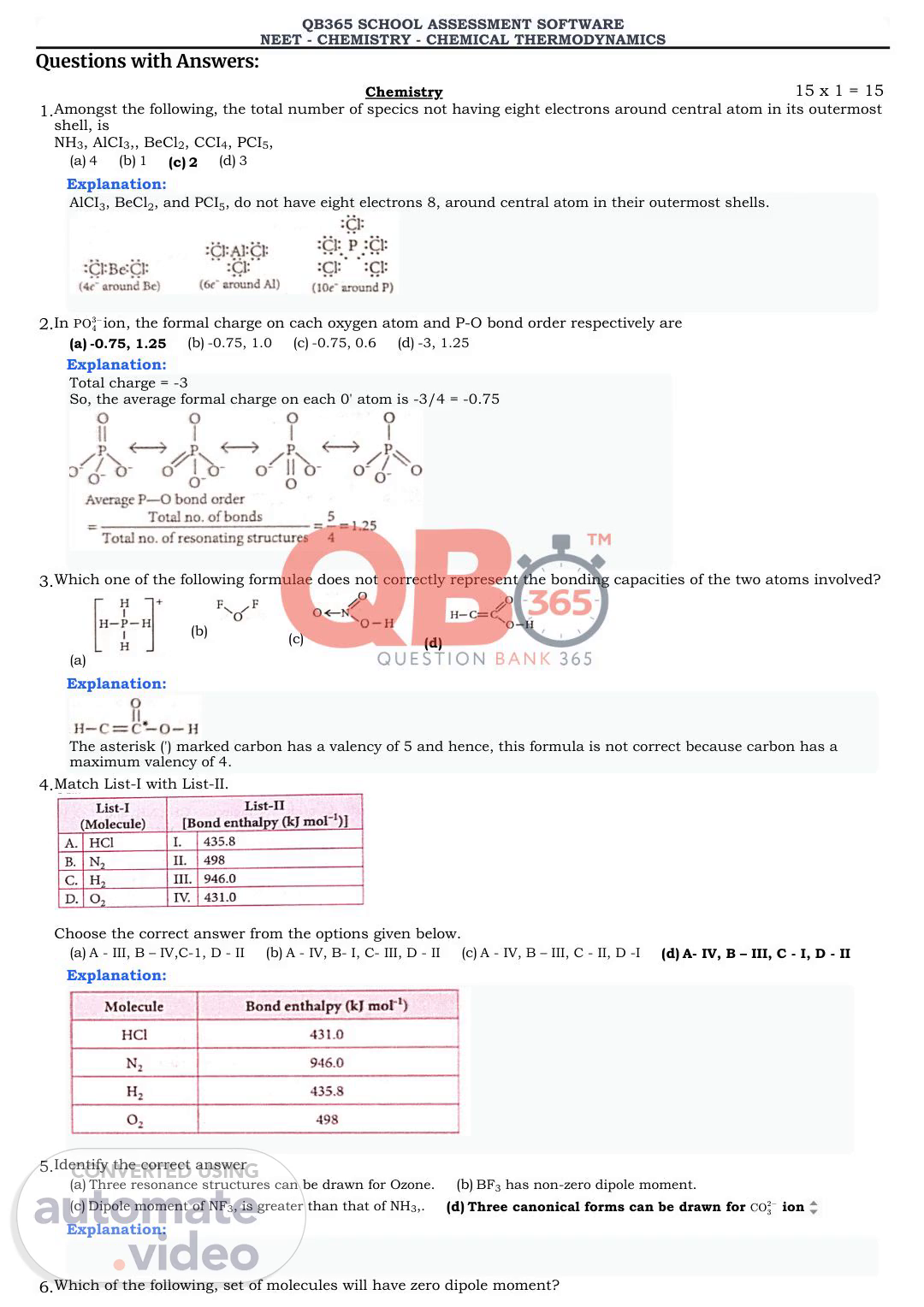
QB365 SCHOOL ASSESSMENT SOFTWARE NEET - CHEMISTRY - CHEMICAL THERMODYNAMICS Questions with Answers: Chemistry 15 x 1 = 15 1.Amongst the following, the total number of specics not having eight electrons around central atom in its outermost shell, is NH , AlCI ,, BeCl , CCI , PCI , (a) 4 (b) 1 (c) 2 (d) 3 Explanation: AlCI , BeCl , and PCI , do not have eight electrons 8, around central atom in their outermost shells. 3 3 2 4 5 3 2 5 2.In ion, the formal charge on cach oxygen atom and P-O bond order respectively are (a) -0.75, 1.25 (b) -0.75, 1.0 (c) -0.75, 0.6 (d) -3, 1.25 Explanation: Total charge = -3 So, the average formal charge on each 0' atom is -3/4 = -0.75 PO3− 4 3.Which one of the following formulae does not correctly represent the bonding capacities of the two atoms involved? (a) (b) (c) (d) Explanation: The asterisk (') marked carbon has a valency of 5 and hence, this formula is not correct because carbon has a maximum valency of 4. 4.Match List-I with List-II. Choose the correct answer from the options given below. (a) A - III, B – IV,C-1, D - II (b) A - IV, B- I, C- III, D - II (c) A - IV, B – III, C - II, D -I (d) A- IV, B – III, C - I, D - II Explanation: 5.Identify the correct answer (a) Three resonance structures can be drawn for Ozone. (b) BF has non-zero dipole moment. (c) Dipole moment of NF , is greater than that of NH ,. (d) Three canonical forms can be drawn for ion Explanation: 3 3 3 CO2− 3 6.Which of the following, set of molecules will have zero dipole moment?.
Scene 2 (1m 5s)
(a) Ammonia, beryllium difluoride, water, 1,4-dichlorobenzene (b) Boron trifluoride, hydrogen fluoride, carbon dioxide, 1, 3-dichlorobenzene (c) Nitrogen trifluoride, berylliunm difluoride, water,1,3-dichlorobenzene (d) Boron trifluoride, beryllium difluoride, carbon dioxide, 1, 4-dichlorobenzene Explanation: 7.The species, having bond angles of 120° is (a) CIF (b) NCI (c) BCI (d) PH Explanation: BCI ,-Trigonal planar, sp -hybridised, 120° angle 3 3 3 3 3 2 8.The correct order of increasing bond length of C- H, C-O,C-C and C=C is (a) C- H<C=C<C-O <C-C (b) C- C< C=C<C-O <C- H (c) C- O<C-H<C-C<C=C (d) C- H«C-O<C-C<C=C Explanation: C-H<C=C<C-O<C-C 9.Which of the following structures is the most preferred and hence of lowest energy for SO ,? (a) (b) (c) (d) Explanation: has maximum number of covalent bonds involving pπ – dπ bonding also 3 10.The correct order of C - O bond length among CO, is (a) (b) (c) (d) Explanation: More single bond character in resonance hybrid, more is the bond length. Hence, the increasing bond length is CO2− 3 , CO2 CO < CO2− 3 < CO2 CO2− 3 < CO2 < CO CO < CO2 < CO2− 3 CO2 < CO2− 3 < CO CO ⇒: C ≡ O :⟷: + C = O : CO 2 ⇒: O = C = O :⟷: O +≡ C − O¨− :⟷: O¨ − C ≡ O +: CO < CO 2 < CO 3 2− 11.The correct order in which the O - O bond length increases in the following is (a) (b) (c) (d) Explanation: Bond lengths of O-O in O , is 1.21 A, in H O is 1.48 A and in O is 1.28 Å. Therefore, correct order of the O-O bond length is H O > O >O O2 < H2O2 < O3 O3 < H2O2 < O2 H2O2 < O2 < O3 O2 < O3 < H2O2 2 2 2 3 2 2 3 2 12.H O is dipolar whereas BeF is not. It is because (a) the electronegativity of F is greater than that of O (b) H O involves hydrogen bonding whereas BeF is a discrete molecule (c) H O is linear and BeF is angular (d) H O is angular and BeF is linear Explanation: The overall value of the dipole moment of a polar molecule depends on its geometry and shape, i.e., vectorial addition of dipole moment of the constituent bonds. Water has angular structure with bond angle 104.5°, it has 2 2 2 2 2 2 2 2.
Scene 3 (2m 10s)
dipole moment. However BeF , is a linear molecule thus, dipole moment summation of all the bonds present in the molecule cancel each other. 2 13.Match List-I with List-II. Choose the correct answer from the options given below: (a) (A)- (iv). (B) - (III), (C) - (II),(D) - (I) (b) (A) - (iv), (B) - (III), (C) - (I), (D) - (II) (c) (A)- (II), (B)- (III), (C) - (iv), (D) - (I) (d) (A) - (III), (B)- (I), (C) - (iv), (D) - (II) Explanation: PCl : Trigonal bipyramidal SF :Octahedral BrF :Square pyramidal BF : Trigonal planar 5 6 5 3 14.In which of the following molecules all the bonds are not equal? (a) NF (b) CIF (c) BF (d) AlF Explanation: The Cl - F (Cl - F ) bond length is equal to 1.60 while each of the two axial Cl F (CI - F ) bond length is equal to 1.70 . 3 3 3 3 eq a 15.Identify the correct orders against the property mentioned. H O> NH , > CHCI - Dipole moment XeF > XeO , > XeF, - Number of lone pairs on central atom O-H>C-H> N–0- Bond length N > O > H - Bond enthalpy Choose the correct answer from the options given below: (a) A, C only (b) B, C only (c) A, D only (d) B, D only Explanation: A. H2O> NH , > CHCI ,: Order of dipole moment B. XeF, > XeF,> XeO : Decreasing number of lone pairs of electrons on central atom C. N-O>C- H>O- H:Order of bond length D.N >O > H :Order of bond enthalpy 2 3 3 4 3 2 2 2 2 3 3 2 2 2.