Scene 1 (0s)
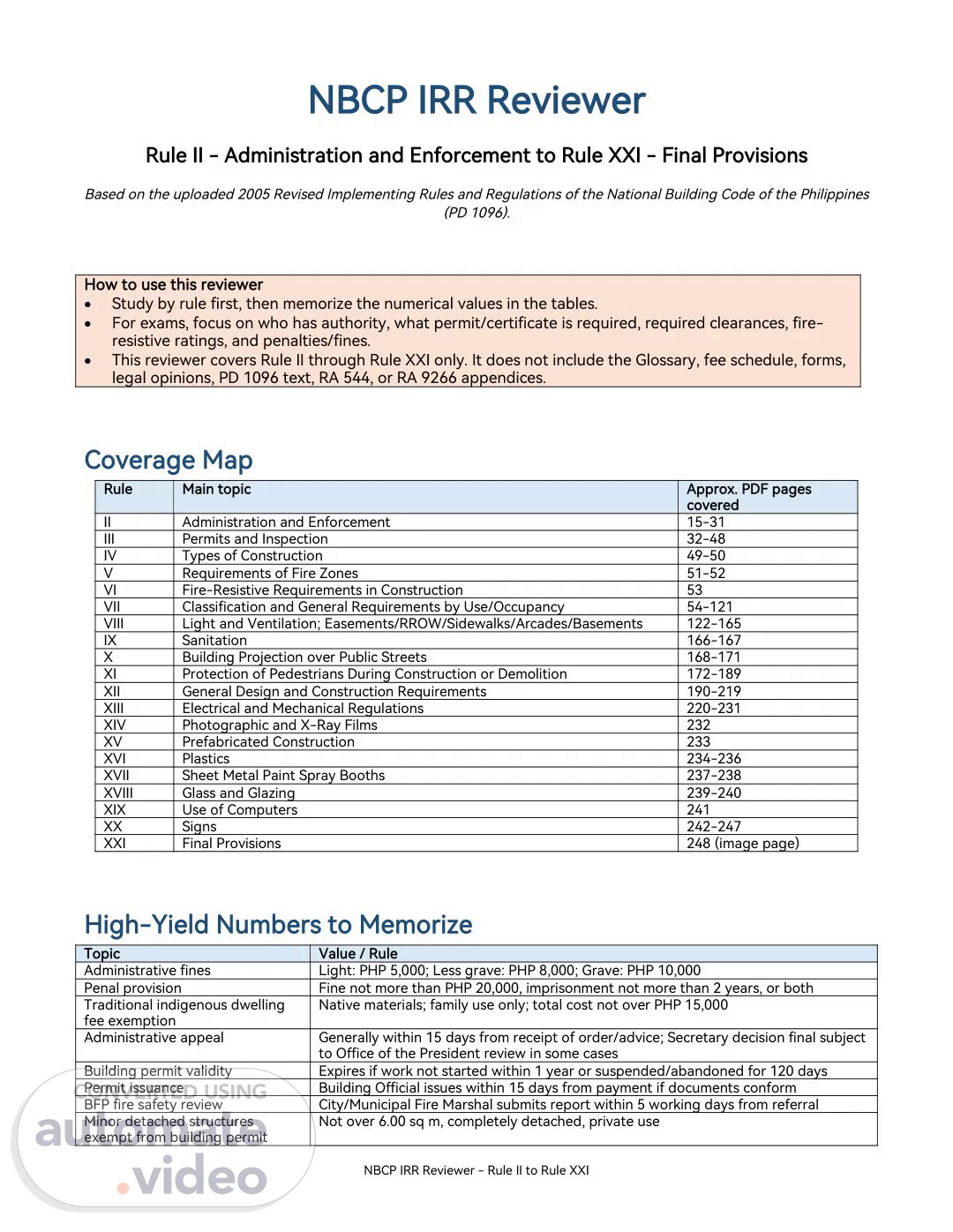
NBCP IRR Reviewer - Rule II to Rule XXI NBCP IRR Reviewer Rule II - Administration and Enforcement to Rule XXI - Final Provisions Based on the uploaded 2005 Revised Implementing Rules and Regulations of the National Building Code of the Philippines (PD 1096). How to use this reviewer Study by rule first, then memorize the numerical values in the tables. For exams, focus on who has authority, what permit/certificate is required, required clearances, fire- resistive ratings, and penalties/fines. This reviewer covers Rule II through Rule XXI only. It does not include the Glossary, fee schedule, forms, legal opinions, PD 1096 text, RA 544, or RA 9266 appendices. Coverage Map Rule Main topic Approx. PDF pages covered II Administration and Enforcement 15-31 III Permits and Inspection 32-48 IV Types of Construction 49-50 V Requirements of Fire Zones 51-52 VI Fire-Resistive Requirements in Construction 53 VII Classification and General Requirements by Use/Occupancy 54-121 VIII Light and Ventilation; Easements/RROW/Sidewalks/Arcades/Basements 122-165 IX Sanitation 166-167 X Building Projection over Public Streets 168-171 XI Protection of Pedestrians During Construction or Demolition 172-189 XII General Design and Construction Requirements 190-219 XIII Electrical and Mechanical Regulations 220-231 XIV Photographic and X-Ray Films 232 XV Prefabricated Construction 233 XVI Plastics 234-236 XVII Sheet Metal Paint Spray Booths 237-238 XVIII Glass and Glazing 239-240 XIX Use of Computers 241 XX Signs 242-247 XXI Final Provisions 248 (image page) High-Yield Numbers to Memorize Topic Value / Rule Administrative fines Light: PHP 5,000; Less grave: PHP 8,000; Grave: PHP 10,000 Penal provision Fine not more than PHP 20,000, imprisonment not more than 2 years, or both Traditional indigenous dwelling fee exemption Native materials; family use only; total cost not over PHP 15,000 Administrative appeal Generally within 15 days from receipt of order/advice; Secretary decision final subject to Office of the President review in some cases Building permit validity Expires if work not started within 1 year or suspended/abandoned for 120 days Permit issuance Building Official issues within 15 days from payment if documents conform BFP fire safety review City/Municipal Fire Marshal submits report within 5 working days from referral Minor detached structures exempt from building permit Not over 6.00 sq m, completely detached, private use.
Scene 2 (14s)
NBCP IRR Reviewer - Rule II to Rule XXI Open terrace/patio exempt from building permit Not over 20.00 sq m, resting directly on ground, private use Garden masonry wall exempt from building permit Not over 1.20 m high Group A dwelling lot occupancy Not more than 90% of corner lot; 80% of inside lot Group A dwelling property-line distance At least 2.00 m from property line subject to easements Habitable room size Minimum 6.00 sq m, least dimension 2.00 m Kitchen size Minimum 3.00 sq m, least dimension 1.50 m Bath/toilet size Minimum 1.20 sq m, least dimension 900 mm Ceiling heights Artificial ventilation: 2.40 m; first storey of multi-storey: 2.70 m; natural ventilation: 2.70 m; mezzanine clear height: 1.80 m above and below Window opening At least 10% of room floor area, not less than 1.00 sq m; toilets/baths/laundry: at least 1/20 floor area, not less than 240 sq mm Waterway easement Urban: 3 m per side; agricultural: 20 m per side; forest: 40 m per side Balcony projection clearance Underside clearance at least 3.00 m above street/sidewalk grade Temporary walkway during construction At least 1.20 m; if no sidewalk, at least 600 mm; none allowed where RROW is 5.00 m or less Construction fence At least 2.40 m high above curb line Exit travel distance 45.00 m without sprinkler; 60.00 m with complete automatic fire-extinguishing system Required exit door At least 900 mm wide and 2.00 m high; clear width at least 700 mm when open Stairs Width: 1.10 m if occupant load >50; 900 mm if <=50; 750 mm private stair if load <10; riser max 200 mm; run min 250 mm Handrails 800-900 mm above tread nosing; intermediate handrail for each 3.00 m of stair width Smokeproof enclosure Required as one exit in buildings 5 storeys or more; two-hour enclosure Service drop clearances Roof: 2.50 m generally; ground/platform: 3.00 m; street crossing: 5.50 m Escalator Inclination max 30 degrees; balustrade width 560 mm to 1.20 m; speed max 38 m/min Boiler room No part of boiler closer than 1.00 m from wall; at least 2 exits; outside boiler distance 3.00 m if main building not fire-resistive Plastic flame-spread rating 225 or less; smoke density not greater than untreated wood under similar test conditions Paint spray booth No. 18 U.S. gauge steel; area max 150 sq m or 10% of basic area Glass/jalousie louver Glass not thinner than 5.6 mm and not longer than 1.20 m Projecting signs Max projection: 1.20 m over non-arcaded sidewalk; 0.60 m over arcade; 0.30 m if no sidewalk; clearance: 3.00 m without arcade, 5.00 m with arcade RULE II - Administration and Enforcement Core idea: The Code is administered and enforced through the DPWH Secretary, with the National Building Code Development Office (NBCDO) as technical staff and the Building Official as the field enforcement officer. Section Reviewer notes 201 Administration and enforcement of the Code/IRR, including administrative penalties, are vested in the Secretary. 202 NBCDO assists the Secretary, resolves technical/legal problems forwarded to the Secretary, conducts seminars/workshops on PD 1096/IRR/BP 344, and performs other assigned tasks. 203 Secretary formulates policies and standards, issues memorandum circulars/guidelines, exercises appellate jurisdiction, approves referral codes, prescribes fees, and appoints Building Officials. 204 Secretary may secure professional/technical/scientific services, testing laboratories, consultants, experts, and advisers. 205 Building Official carries out Code provisions in the field and enforces orders/decisions. 206 Building Official must be Filipino, of good moral character, registered architect/civil engineer, member in good standing of accredited professional organization for at least 5 years, with at least 5 years diversified experience, and must have completed PD 1096/IRR seminar-workshop. 207 Duties include enforcing the Code/IRR; processing permits/certificates; requiring amendatory permits for design changes; annual inspections; action on permits, stoppage, dangerous declarations, fines; quarterly reports; and other duties. 208-210 Fees are prescribed by the Secretary. Records and accounting of collections must be maintained. Public buildings and qualifying traditional indigenous family dwellings are exempt from building permit fees. Collections are divided into local/national shares as prescribed. 211 Rules, standards, and criteria take effect after publication once a week for 3 consecutive weeks in a.
Scene 3 (28s)
NBCP IRR Reviewer - Rule II to Rule XXI newspaper of general circulation. 212 Administrative fines and surcharges apply to unauthorized construction, work without permits, changes in approved plans, non-compliance with orders, occupancy without certificate, and similar violations. 213 Criminal penalty upon conviction: fine not over PHP 20,000, imprisonment not over 2 years, or both. 214-215 Dangerous/ruinous buildings include structures unsafe, without safe egress, fire hazardous, hazardous to health/welfare, dilapidated, abandoned, or pollution-causing. Building Official may order repair, vacation, or demolition. 216 Code/IRR remedies are additional to other remedies available under existing laws. Administrative fine classification Light violations: PHP 5,000 - e.g., failure to post certificate/permit sign; failure to provide safety measures. Less grave violations: PHP 8,000 - e.g., non-compliance with work stoppage for alteration/addition/conversion/repair without permit; use/occupancy without proper certificate. Grave violations: PHP 10,000 - e.g., unauthorized plan changes, change to less fire-resistive construction, non-compliance with demolition/abatement order, construction/demolition without permit, change of use without certificate, open excavations abandoned for more than 120 days. Surcharges under Rule II Work without permit: 100% surcharge of building fees. If work began while permit is pending: excavation for foundation = 10%; construction of foundation = 25%; superstructure up to 2.00 m above grade = 50%; superstructure above 2.00 m = 100% of building permit fees. Failure to pay annual inspection fee within 30 days from prescribed date = 25% surcharge. Due process and abatement procedure Protest/complaint: respondent must submit written explanation/answer within not less than 5 days from notice. Hearing notice must be served at least 5 days before hearing. If imminent danger is suspected, inspection team reports within 10 days. Building Official decides within 15 days after investigation; order becomes final/executory after 15 days unless appealed. Owner of dangerous/ruinous building gets at least 15 days to vacate, repair, renovate, demolish, or remove; re-inspection report may be completed within 30 days; if owner fails to comply, OBO may act and charge expenses to owner. RULE III - Permits and Inspection Core idea: A person, corporation, or government agency cannot build, alter, repair, convert, use, occupy, move, demolish, or add to a building/structure without the required permit/certificate from the Building Official. Permit / Certificate Purpose / reviewer note Building Permit Main authorization to proceed with construction, alteration, repair, conversion, moving, demolition, addition, etc. Ancillary Permits Submitted with building permit application and signed/sealed by respective professionals. Includes architectural, civil/structural, electrical, mechanical, sanitary, plumbing, and electronics permits. Accessory Permits For special parts/functions or activities before/during permit processing: excavation, fencing, sidewalk construction, scaffolding, signs, demolition, swimming pools, vaults, towers, tanks, stages, etc. Certificate of Occupancy Required before actual use or occupancy. Application includes certificate of completion, construction logbook, as-built plans/specifications, and inspection sheet. Certificate of Change of Use/Occupancy Required when occupancy/use classification changes..
Scene 4 (42s)
NBCP IRR Reviewer - Rule II to Rule XXI Building permit not required for selected minor works Limit / condition Small detached sheds, outhouses, greenhouses, children’s playhouses, aviaries, poultry houses, etc. Not over 6.00 sq m total area; completely detached; private use only Open terraces or patios resting on ground Not over 20.00 sq m; private use only Window grilles Minor construction exemption Garden pools for water plants/aquarium fish Not over 500 mm deep; private use only Garden masonry walls other than party walls Not over 1.20 m high Non-structural repairs Examples: roofing sheets/tiles, gutters, downspouts, ceilings/sidings, non-load-bearing partitions, doors/windows, flooring, perimeter fence repair, plumbing fixtures in single-detached dwellings/duplexes Application requirements you should remember If applicant is registered owner: certified true copy of OCT/TCT, tax declaration, and current real property tax receipt. If applicant is not registered owner: include notarized contract of lease or deed of absolute sale, plus ownership documents. Submit five (5) sets of survey plans, design plans, specifications, and documents prepared, signed, and sealed by proper professionals. Architectural documents include vicinity/location map, site development plan, perspective, floor plans, at least 4 elevations, at least 2 sections, reflected ceiling plan, details, schedules, etc. BFP/Fire Marshal reviews one set and submits recommendations within 5 working days; failure to act is treated as conformity with Fire Code requirements. Permit issuance, validity, and appeal If application conforms, Building Official issues permit within 15 days from payment of required fees. Ground preparation/excavation permit may be issued while building permit is being processed. Excavation more than 50.00 cu m and more than 2.00 m deep requires cash bond of PHP 50,000 for the first 50 cu m and PHP 300 for each excess cu m; excavation must not exceed 100 cu m or 3.00 m deep before building permit is issued and must not be left open for more than 120 days. Building permit expires if work is not commenced within 1 year after issuance, or if suspended/abandoned for 120 days after commencement. Non-issuance/suspension/revocation grounds include errors in plans, inaccurate data, and non- compliance with Code/IRR; appeal to Secretary within 15 days. Inspection and occupancy Owner must engage a duly licensed architect or civil engineer for full-time inspection/supervision. A construction logbook must be kept at the jobsite at all times and submitted upon completion. The Certificate of Occupancy is issued only after inspection/verification, required fees, and documentation. Partial Certificate of Occupancy may be issued for independent portions if safe. RULE IV - Types of Construction Type Construction character Type I Wood construction; structural elements may be any materials permitted by the Code. Type II Wood construction with protective fire-resistant materials; one-hour fire-resistive throughout, with limited fire-retardant treated wood in permanent non-bearing partitions. Type III Masonry and wood construction; one-hour fire-resistive throughout; exterior walls incombustible fire- resistive construction. Type IV Steel, iron, concrete, or masonry construction; walls, ceilings, and permanent partitions are incombustible fire-resistive construction; limited treated wood allowed for non-bearing partitions. Type V Four-hour fire-resistive throughout; structural elements of steel, iron, concrete, or masonry..
Scene 5 (56s)
NBCP IRR Reviewer - Rule II to Rule XXI Rule IV exam focus A building cannot change construction type if the change would make it exceed allowable limits for the new type. Type I is the least fire-resistive; Type V is the most fire-resistive in this rule sequence. Always connect type of construction with fire zone and occupancy limitations. RULE V - Requirements of Fire Zones Fire zone concept Meaning Fire zone Area where only certain building types are permitted based on use/occupancy, construction type, and fire resistance. Building in more than one zone If more than 1/3 of total floor area lies in the more restrictive zone, the building is considered in that more restrictive zone. Moved building Must comply with the requirements of the fire zone into/within which it is moved; also applies to pre-engineered/prefabricated buildings. Temporary building May be allowed by special permit for limited period and must be removed after expiry; fire protective/preventive measures must be adequate. Existing nonconforming building Generally cannot be enlarged/altered/remodeled/repaired/moved unless exceptions apply; repairs/changes in 12 months generally limited to 20% of value, and must not increase fire hazard. Zone General meaning Non-Fire Restricted Zone Usually rural/countryside, sparse construction; buildings may be indigenous/light construction, up to Types I and II. Fire Restrictive Zone Suburban-type areas requiring fire-resistivity; exterior walls at least 2-hour fire-resistive; generally Types II, III, IV. Highly Fire Restrictive Zone Requires highly fire-resistive/non-combustible construction assemblies of about 3- to 4- hour fire-resistive materials; only Types IV and V. RULE VI - Fire-Resistive Requirements in Construction Core definitions Fire-resistive rating = degree to which material withstands fire based on accepted testing methods. Fire-resistive time period rating = length of time material withstands burning, such as 1 hour, 2 hours, or 4 hours. Materials and assemblies must conform to prescribed fire-resistive standards and regulations. RULE VII - Classification and General Requirements by Use or Occupancy Core idea: Buildings are classified by use/occupancy because occupancy determines allowable construction type, height, floor area, location, exits, light, ventilation, sanitation, fire protection, and hazards. Group Main use / mnemonic A Residential dwellings: single-family dwellings, small non-leasing residential uses, small schools/clinics/related uses under specified limits. B Residential buildings, hotels, apartments: multiple dwelling units, boarding/lodging houses, hotels, apartments, row houses, etc., accommodating more than 10 persons. C Education and recreation: schools/day-care and similar instruction or recreation uses not classified under Group H/I or other specified categories. D Institutional: hospitals, sanitaria, jails, prisons, reformatories, nursing homes, nurseries, and similar care/restraint occupancies..
Scene 6 (1m 11s)
NBCP IRR Reviewer - Rule II to Rule XXI E Business and mercantile: service stations, garages, stores, offices, dining below specified loads, police/fire stations, certain factories/shops. F Industrial: ice plants, power/pumping plants, cold storage, factories/workshops using incombustible and non- explosive materials. G Storage and hazardous: storage/handling of hazardous, highly flammable, combustible materials; paint shops; repair garages; aircraft repair hangars. H Assembly other than Group I: assembly uses with occupant load thresholds below Group I, with or without stage. I Assembly with occupant load 1000 or more and with a stage. J Accessory: agricultural structures, private garages/carports, fences over 1.80 m, tanks, swimming pools, towers, stages/platforms, courts, tombs, vaults, etc. Change in use and mixed occupancy Change in use/occupancy is not allowed unless the building complies with requirements for the new division/group. Existing building may change to another use if approved by the Building Official and the proposed use is less hazardous in life/fire risk than the existing use. Mixed occupancy: the whole building generally follows the most restrictive occupancy requirements. Exceptions: one-storey buildings may have each portion follow its own occupancy; minor accessory use not exceeding 10% of floor area/basic area may let the major use control classification. Occupancy separations may be 1-hour, 2-hour, 3-hour, or 4-hour fire-resistive. Four-hour separation has no openings. Location, area, height, and Group A dwelling essentials No building may be constructed unless it adjoins or has direct access to a public space, yard, or street on at least one side. For exterior wall openings where protection is required, opening area in any storey must not exceed 50% of the wall area in that storey. Allowable floor area and maximum height depend on occupancy group, construction type, fire zone, frontage, open spaces, setbacks, parking/loading, and zoning. Group A dwelling: lot occupancy not more than 90% of a corner lot and 80% of an inside lot; at least 2.00 m from property line subject to easements. Group A dwelling: at least one sanitary toilet; footings at least 250 mm thick and 600 mm below ground; first-floor live load at least 200 kg/sq m and second floor at least 150 kg/sq m; roof wind load at least 120 kg/sq m; stairs at least 750 mm clear width, 200 mm rise, 200 mm minimum run; at least one entrance and another exit. Cemeteries and memorial parks guide Rule VII includes guidelines on building bulk, development controls, and accessory structures within cemeteries and memorial parks. For review, remember that cemetery/memorial structures are regulated by building bulk, height, setbacks, access, and accessory-use controls, not merely by lot ownership. RULE VIII - Light and Ventilation Core idea: Buildings must have enough natural/artificial light, ventilation, open space, courts, yards, windows, and setbacks so that rooms are habitable and public easements/RROW remain usable. Section What to remember 801 Every building must be designed, constructed, and equipped to provide adequate light and ventilation. Buildings must face an approved street, public alley, or approved private street. 802-803 Site occupancy is measured at ground level, excluding courts/yards/light wells. PSO, ISA, USA, MACA, and TOSL regulate how much of the lot may be built or paved. 804 Courts must meet minimum dimensions. Courts/yards/light wells are measured clear of projections,.
Scene 7 (1m 25s)
NBCP IRR Reviewer - Rule II to Rule XXI except limited items such as roof leaders/copings/sills/fire escapes not exceeding 1.20 m. 805 Ceiling heights: 2.40 m for habitable rooms with artificial ventilation; 2.70 m for natural ventilation; first storey in multi-storey 2.70 m; mezzanine 1.80 m clear above and below. 806 Room minimums: habitable 6.00 sq m/2.00 m least dimension; kitchen 3.00 sq m/1.50 m; bath/toilet 1.20 sq m/900 mm. 807 Minimum air space: school rooms 3 cu m with 1 sq m floor area per person; workshops/factories/offices 12 cu m per person; habitable rooms 14 cu m per person. 808 Window openings: 10% of room floor area, at least 1.00 sq m; toilet/bath/laundry 1/20 floor area, at least 240 sq mm; windows open to court/yard/street/alley/open watercourse. 809-811 Vent shafts, skylights, and artificial ventilation are allowed but must meet minimum areas/dimensions and air change requirements. Easements, RROW, sidewalks, arcades, and basements Easements outside private property limits are public domain and cannot be used for private residential/commercial/industrial gain, long-term parking, or uses inconsistent with public recreation and access. Waterway easements: urban areas = 3.00 m per side; agricultural areas = 20.00 m per side; forest areas = 40.00 m per side. RROW/carriageway should be free of structures that block view corridors/sight lines; only allowed public, transportation, utility, and properly permitted limited uses may be placed within RROW. Sidewalks are for pedestrians. Minimum sidewalk width is generally 1.20 m for RROW of 9.00 m or more; planting strips have minimum widths such as 200 mm for grass/shrubs and 300 mm for trees per side of RROW. Arcades and covered pedestrian routes must not be treated as private extensions of building owners; they are for pedestrian protection and public access. Basements and lots are controlled by open-space, fire, access, parking/loading, drainage, ventilation, and public safety requirements. RULE IX - Sanitation Section Reviewer note 901 Buildings must comply with sanitation requirements and related health regulations. 902 Water supply systems must be potable, adequate, and protected from contamination. 903 Wastewater disposal systems must be properly designed and connected/treated according to sanitation/plumbing rules. 904 Storm drainage systems must safely collect and dispose of stormwater without creating public nuisance or damage. 905 Pest and vermin control must be provided, especially where health risks exist. 906 Noise pollution must be controlled where mechanical/equipment/building use may create public nuisance. 907 Pipe materials must conform to Code and applicable plumbing/sanitary standards. RULE X - Building Projection over Public Streets General rule No part of a building/structure or appendage may project beyond the building line except as specifically allowed. Projection is measured horizontally from the property line to the outermost point. Item Allowed / required value Footings along national roads/public highway May project not more than 300 mm beyond property line if at least 2.40 m below grade and not obstructing utilities. Foundations into public sidewalk May encroach not over 500 mm if top is at least 600 mm below established grade and utilities are not obstructed..
Scene 8 (1m 39s)
NBCP IRR Reviewer - Rule II to Rule XXI Balcony projection by street width >3 to <6 m: 0.60 m; 6 to <10 m: 0.90 m; 10 to <11 m: 1.00 m; 11 to <12 m: 1.10 m; 12 to <13 m: 1.30 m; 13 to <14 m: 1.40 m; 14 m or over: 1.50 m. Balcony underside clearance At least 3.00 m above street/sidewalk grade. Arcades Minimum clear height 3.00 m above sidewalk grade; driveway crossings at same level as arcade. Canopies/marquees Horizontal clearance from curb at least 300 mm; vertical clearance at least 3.00 m; incombustible or at least 2-hour fire-resistive; with drainage. Movable awnings/hoods Horizontal clearance from curb at least 300 mm; vertical clearance at least 2.40 m; must not block required exit when folded. Doors/windows If less than 2.40 m above pavement/ground, cannot project beyond property line when opened, except fire exit doors. Corner buildings/chaflans Corner building/solid fence on street/alley less than 3.60 m wide must be truncated; chaflan length not less than 4.00 m; no chaflan needed if building is arcaded. RULE XI - Protection of Pedestrians During Construction or Demolition Requirement Value / rule Use of street/sidewalk during work Only as allowed by permit and this Rule; pedestrians must be protected when work is adjacent to public way. Stored materials Must not obstruct hydrants, alarms, utility boxes, manholes, drainage, vehicular/pedestrian flow; materials generally not piled higher than 1.80 m; if over 1.20 m, sides/ends taper back. Mixing mortar/concrete Not allowed on public streets. Temporary walkway At least 1.20 m if sidewalk fenced/closed; if no sidewalk, at least 600 mm; no temporary walkway where RROW is 5.00 m or less. Walkway live load 650 kg/sq m uniform live load. Protective railings At least 1.00 m high where required. Construction/demolition fence Encloses site; approved material; at least 2.40 m above curb; doors kept closed except actual use. Canopy Clear height 2.40 m above walkway; if used for storage/work, railings at least 1.00 m and toe boards at least 300 mm; load at least 4800 Pa or intended load, whichever is bigger. Canopy lighting Underside lighted at night with at least 100-watt bulb every 6.00 m and at changes of grade/elevation. Net/screen If horizontal distance between building face and sidewalk outer edge is less than 1/2 building height, net/screen required in addition to fence and canopy. Medium/high-rise safety For buildings 6 storeys and higher, protective/safety devices must be completely installed. Warning signs/lights Conspicuous signs around site; illuminated at night; maintained even when operations are not in progress. Demolition focus Demolition must be conducted so that public safety, utilities, and adjacent properties are protected. Devices such as fences, canopies, walkways, dust screens, catch platforms, warning lights, and netting must be maintained until hazards are removed. The Building Official can require safety measures and coordinate enforcement when public welfare is at risk. RULE XII - General Design and Construction Requirements Core idea: This is the practical safety-design rule. It regulates excavation, foundations, vertical openings, floors, roofs, exits, stairs, skylights, balconies, roof structures, chimneys, fire-extinguishing systems, stages, projection rooms, and wall-board/plaster installation..
Scene 9 (1m 53s)
NBCP IRR Reviewer - Rule II to Rule XXI Section Reviewer note 1201 All buildings/structures must be designed and constructed safely and in accordance with Code and referral codes. 1202 Excavations, foundations, retaining walls must protect workers, public, adjacent property, and utilities; shoring/underpinning/drainage may be required. 1203 Veneer must be properly anchored/supported and must meet fire and weather requirements. 1204 Vertical openings must be enclosed/protected to prevent spread of fire/smoke. 1205 Floor construction must support loads and meet fire-resistive requirements. 1206 Roof construction/covering includes attic access, area separation, draft stops, ventilation, drains/overflow/scuppers, concealed piping, and flashing. 1207 Stairs, exits, occupant loads: determines number/width/arrangement of exits, exit doors, corridors, stairways, ramps, smokeproof enclosures, passageways, and signs. 1208-1209 Skylights, bays, porches, balconies must be constructed and located safely. 1210 Penthouses/roof structures are limited by use, height, construction, and fire-resistance. 1211 Chimneys, fireplaces, barbecues must be constructed to prevent fire hazards and ensure proper draft/clearance. 1212 Fire-extinguishing systems are required by occupancy/hazard and must follow approved standards. 1213-1214 Stages/platforms and motion picture projection rooms require special fire safety and construction rules. 1215 Lathing, plastering, and wall-board installation must comply with material and installation requirements. Exit / stair rule Value Minimum number of exits Every building or usable portion must have at least 1 exit. Floors above first storey If occupant load is more than 10, at least 2 exits. Mezzanine If used other than storage and greater than 185 sq m or more than 18 m in any dimension, at least 2 stairways to adjacent floor. Occupant load 500-999 At least 3 exits. Occupant load 1000 or more At least 4 exits. Exit width formula Total width of exits in meters must be at least occupant load divided by 165. Distance between 2 exits At least 1/5 of perimeter of area served, measured straight line between exits. Travel distance to exit 45 m without sprinkler; 60 m with complete automatic fire-extinguishing system. Exit door swing Must swing in direction of exit travel when serving hazardous areas or occupant load 50 or more. Exit door size Doorway must allow door at least 900 mm wide and 2.00 m high; clear exitway at least 700 mm when open. Exit door leaf No leaf over 1.20 m wide. Stair width Occupant load >50: at least 1.10 m; load <=50: 900 mm; private stair load <10: 750 mm. Stair rise/run Riser max 200 mm; tread run min 250 mm; variation max 5 mm in a flight. Landing Dimension in direction of travel equal to stair width; need not exceed 1.20 m for straight run. Distance between landings Max 3.60 m vertical distance. Handrail height 800 mm to 900 mm above nosing; stairway >3.00 m width needs intermediate handrail for each 3.00 m. Stair to roof In buildings 4 or more storeys, one stairway extends to roof unless roof slope greater than 1 in 3. Smokeproof enclosure In buildings 5 storeys or more, one required exit must be smokeproof enclosure; enclosure walls generally 2-hour fire-resistive. RULE XIII - Electrical and Mechanical Regulations Electrical regulations Electrical systems, equipment, and installations must conform to Philippine Electrical Code Parts 1 and 2 as adopted under RA 7920. Attachment plans for power lines/cables/transformers/electrical equipment on or in buildings must be approved by a Professional Electrical Engineer and submitted to the Building Official. Where buildings exceed 15.00 m in height, overhead lines should, where practicable, allow a clear zone of at least 1.80 m horizontal adjacent to the building or beginning not over 2.45 m from the building for.
Scene 10 (2m 8s)
NBCP IRR Reviewer - Rule II to Rule XXI firefighting ladder use. Conductors over 300 V to ground must not run along/near building surfaces unless guarded or inaccessible. Service drop clearances: generally 2.50 m over roofs, 3.00 m from ground/platform/projection, 1.00 m horizontal from windows/doors/porches/fire escapes, and 5.50 m over street crossing. Mechanical regulations Mechanical systems/equipment/installations must conform to the Philippine Mechanical Code under RA 8495 as amended. Moving/dangerous parts of prime movers, machines, and power transmission equipment must be guarded, shielded, fenced, or enclosed. Cranes require safe access, warning devices, and clear rated-load markings; temporary crane operation without warning device needs a flagman. Hoists require marked controls, rated-load marking, stops, and automatic braking when power is cut off. Mechanical item High-yield requirement Elevators Required in private/public buildings for public use accessible to disabled persons under BP 344. Hoistways enclosed; pits must allow at least 600 mm clearance when car rests on compressed buffers. Elevator grouping When 4 or more elevators serve the same portion, locate in at least 2 hoistways; no more than 4 elevators in one hoistway. Elevator ropes Minimum hoisting ropes: 3 for traction elevators, 2 for drum type; minimum diameter 30 mm. Residential elevator service Apartments/condominiums 5 storeys or more: at least 1 passenger elevator on 24-hour constant service. Escalators Inclination max 30 degrees; width between balustrades 560 mm to 1.20 m; rated speed max 38 m/min. Boilers inside buildings Boiler room reinforced concrete/masonry, no other use, no part of boiler closer than 1.00 m from wall, at least 2 exits. Boilers outside non-fire-resistive main building At least 3.00 m from outside wall; boiler house fire-resistive. Smokestacks Withstand 175 kph wind load; rise at least 5.00 m above eaves of any building within 50.00 m radius. Boiler certificate of operation After inspection/test, certificate issued for period not exceeding 1 year. Air conditioning comfort range Effective temperature 20-24 C, relative humidity 50-60%, air movement 4.60- 7.60 m/min within living zone. RULE XIV - Photographic and X-Ray Films Rule XIV focus Automatic fire-extinguishing systems are required for film storage rooms when unexposed films in safety shipping containers exceed 14.00 cu m; shelving storage not in containers exceeds 1.40 cu m; or storage outside accepted safety containers is involved. Film negatives in handling/storage must be in heavy Manila envelopes, max 12 films per envelope; expanding envelopes prohibited. Not more than 110 kg may be stored in any single cabinet; if film storage exceeds 450 kg, use vented storage vaults or detached/roof vaults; vault doors must be 4-hour fire-resistive. Only incandescent electric light with guards/globes is allowed; portable extension-cord lights prohibited; NO SMOKING signs required; films must be at least 600 mm from heat sources. Some film classes are exempt, such as amateur roll/film pack under 1.40 cu m, safety film, dental X-ray film, film manufacturing storage incidental thereto, and films in standard motion picture booths..
Scene 11 (2m 22s)
NBCP IRR Reviewer - Rule II to Rule XXI RULE XV - Prefabricated Construction Rule XV focus Prefabricated assemblies are governed by approval, testing, and evidence of structural/fire performance before use. Important reviewer principle: factory-made or pre-engineered parts are still subject to Code performance, permit, inspection, and fire-safety requirements. RULE XVI - Plastics Section Reviewer note 1601 Approved plastics must have flame-spread rating 225 or less and smoke density not greater than untreated wood under similar conditions; combustion products must not be more toxic than untreated wood. 1602 Plastic materials must have adequate strength/durability for design loads; fastenings must resist design loads and stresses. 1603 Plastic-glazed openings must allow escape; travel distance to such openings should not exceed 45 m without automatic fire suppression or 60 m with it; openings minimum 600 mm square; spacing between plastic-glazed openings generally at least 2.00 m. 1604 Plastic skylights may be used in specified types/occupancies; no skylight within 3.00 m of property line except Group A; skylights separated 2.50 m laterally and 3.00 m along roof slope; individual skylight max 10 sq m; aggregate plastics in skylights/monitors/sawtooth max 20% of floor area; curb 100 mm if roof slope less than 1 in 3 unless screened. 1605 Plastic panels in monitors/sawtooth roofs: individual glazing max 15 sq m; aggregate with skylights max 20% floor area; separated by incombustible/roofing material at least 1.50 m; lower edge at least 150 mm above adjoining roof. 1606 Plastic ceiling light diffusers over 10% of any 10 sq m room area must be approved; installation must not detach at 80 C for 15 minutes, subject to exceptions. 1607-1609 Approved plastics may be used in partitions where fire-resistive/incombustible construction is not required; exterior veneer limited by height/area/separation; plastics may be used in awnings/canopies and greenhouses subject to restrictions. RULE XVII - Sheet Metal Paint Spray Booths Topic Requirement Construction Spray booths steel not less than No. 18 U.S. gauge; designed per Code; smooth interior surfaces; exhaust air must pass freely. Area Not over 150 sq m nor 10% of basic area permitted for the major use of the building. Floor If combustible, cover with non-combustible, non-sparking material for safe residue removal. Fire protection Open front over 1.00 sq m without doors must have fire curtain/metal deflector at least 100 mm deep; booth separated from other operations by at least 91 cm or as required by Fire Marshal. Lighting Illumination through hammered wire or heat-treated glass panels; panels isolate spray area from light unit area. Ventilation Mechanical exhaust directly outdoors; airflow at least 30.00 lineal m/min through any part of spray area; exhaust fan blades non-ferrous; motor not in booth/duct; duct discharge at least 2.00 m from combustible construction and 8.00 m from exterior wall openings. RULE XVIII - Glass and Glazing Rule XVIII focus Applies to exterior glass/glazing in all occupancies except Groups A, B, and J not over 3 storeys; applies to interior/exterior glass in all occupancies subject to human impact. Each glass light must bear manufacturer label indicating type and thickness; special glass must have.
Scene 12 (2m 36s)
NBCP IRR Reviewer - Rule II to Rule XXI permanent identification. Fixed glass panels at same floor level must be made obvious by bars, 450 mm opaque bulkhead, distinctive glass, fixed planters, or equivalent arrangement. Glass panels more than 600 mm wide and 180 mm or more high adjacent to wall openings must be safety glass unless protected by opaque bulkhead at least 450 mm high. Area limitation table: 8 mm glass up to 1.10 m x 1.10 m; 10 mm up to 2.25 m x 2.25 m; 12 mm up to 3.00 m x 3.00 m; 15 mm for over 3.00 m dimensions. Jalousie/louvered window glass must be at least 5.6 mm thick and not longer than 1.20 m; exposed edges smooth. Shower/bathtub enclosures: wire-reinforced glass at least 5.6 mm, fully tempered at least 4.8 mm, or laminated safety glass at least 6.4 mm. RULE XIX - The Use of Computers Rule XIX focus Computer use for any part of building design is permitted if programs are documented. Documentation includes reference to accessible publications or statement of theoretical background/algorithms, plus software name, version number, developer company, and address. Computer-generated output sheets must be submitted as part of design computations; first sheet must be signed and sealed by the designer. Output must be accompanied by certification identifying documented programs used; input data must be clearly distinguished from computed results. RULE XX - Signs Topic Requirement General Signs must not confuse/obstruct official traffic signs/signals/devices; foreign- language signs need English or local dialect translation; adjacent signboards follow a common baseline as determined by Building Official; installation must be harmonious/aesthetic. Maintenance Signs and supports/braces/guys/anchors must be kept in repair and preserved; display neatly painted and secured. Design/construction Signs must resist forces according to the National Structural Code for Buildings; building-mounted sign loads transmitted through structural frame without overstress. Supports/anchorages All supports/anchorages on private property and per Code; signs only where zoning allows. Roof signs No roof signs on wooden structures or structures with wooden roof framing; metallic parts exposed to lightning must be grounded; obstruction/warning lights when applicable. Ground signs Must be within property line; cannot occupy RROW/street/sidewalk/arcade; public/government signs on sidewalks must not obstruct pedestrians or distract motorists. Projecting signs Non-arcaded RROW: project max 1.20 m over sidewalk; arcaded: max 0.60 m from arcade wall line; no sidewalk: max 0.30 m. Clearance: at least 3.00 m without arcade, 5.00 m over arcaded RROW. Electric/neon signs Between signboards on one building: at least 4.00 m clear distance; adjacent buildings: at least 2.00 m from common boundary; signboards cannot obstruct windows/emergency exits and cannot be closer than 1.00 m from electric/telephone posts and wires. Wall signs Outdoor display signs against building front may extend max 300 mm from wall; lowest portion at least 3.00 m above sidewalk; wall signs/display windows within 3.00 m above sidewalk must be flush or recessed. Materials Structural steel generally ASTM A36; secondary members and hot-rolled members have thickness requirements; combustible materials restricted especially in highly restrictive Fire Zones. Projections/clearances No sign may interfere with fire escape, exit, standpipe, light, or ventilation. Signs.
Scene 13 (2m 50s)
NBCP IRR Reviewer - Rule II to Rule XXI within 1.50 m of exterior wall openings must be incombustible or approved plastics. Alley projection: none below 3.00 m; max 300 mm if 3.00-4.50 m high; max 1.00 m if over 4.50 m high. Lighting Signs must be illuminated only by electrical means in accordance with the Philippine Electrical Code. RULE XXI - Final Provisions Section Reviewer note 2101 Separability Clause If any provision of the IRR or its application to any person/circumstance is declared unconstitutional or invalid by a competent court, the remaining provisions continue in full force and effect. 2102 Repealing and Amending Clause Administrative orders, rules, regulations, memoranda, circulars, and issuances inconsistent with the IRR are repealed or modified accordingly. 2103 Effectivity IRR takes effect 15 days after publication once a week for 3 consecutive weeks in a newspaper of general circulation. Complete Section Checklist: Rule II to Rule XXI Rule Sections Checklist Rule II 201-216 Responsibility; NBCDO; Secretary powers; professional assistance; Building Officials; qualifications/duties; fees; exemptions; use of income; IRR; administrative fines; penal provisions; dangerous/ruinous buildings; abatement; remedies. Rule III 301-309 Building permits; application; processing; issuance; validity; non- issuance/suspension/revocation; appeal; inspection/supervision; certificate of occupancy. Rule IV 401-403 Types of construction; changes in type; requirements by type. Rule V 501-507 Fire zones; mixed zones; moved buildings; temporary buildings; street center lines; existing building restrictions; designation of fire zones. Rule VI 601-604 Fire-resistive rating, time period rating, standards, regulations. Rule VII 701-709 Occupancy classification; change in use; mixed occupancy; location; allowable floor areas; area increases; maximum height; Group A dwelling requirements; other occupancies; cemetery/memorial park controls. Rule VIII 801-811 Light/ventilation; site occupancy; PSO; courts; ceiling heights; room sizes; air space; windows; vent shafts; skylights; artificial ventilation; easements/RROW/sidewalks/arcades/basements. Rule IX 901-907 Sanitation; water supply; wastewater; storm drainage; pest control; noise; pipes. Rule X 1001-1008 Projection; alleys/streets; balconies; arcades; marquees; awnings; doors/windows; chaflans. Rule XI 1101-1108 Pedestrian protection during construction/demolition; storage; mixing mortar; utilities; walkways; protective devices; maintenance/removal; demolition. Rule XII 1201-1215 Design/construction; excavation/foundations; veneer; vertical openings; floors; roofs; stairs/exits/occupant loads; skylights; balconies; penthouses; chimneys; fire extinguishing; stages; projection rooms; wall boards. Rule XIII 1301-1302 Electrical regulations and mechanical regulations. Rule XIV 1401-1403 Film storage/handling; exempt films; fire-extinguishing systems. Rule XV 1501 Prefabricated assembly. Rule XVI 1601-1609 Approved plastics; installation; openings; skylights; monitors/sawtooth; light diffusers; partitions; veneer; awnings/canopies. Rule XVII 1701-1704 Paint spray booth; fire protection; light; ventilation. Rule XVIII 1801-1805 Glass/glazing; area limitation; glazing; louvered windows; impact. Rule XIX 1901-1903 Computer use; program documentation; computer-generated computations. Rule XX 2001-2006 Signs; maintenance; design/construction; supports; clearances; lighting. Rule XXI 2101-2103 Separability; repealing/amending; effectivity. Practice Questions 1. Who is primarily vested with administration/enforcement of the Code and IRR?.
Scene 14 (3m 5s)
NBCP IRR Reviewer - Rule II to Rule XXI Answer: The DPWH Secretary. 2. Who acts as technical staff of the Secretary? Answer: The National Building Code Development Office (NBCDO). 3. What are the minimum qualifications of a Building Official? Answer: Filipino, good moral character, registered architect or civil engineer, member in good standing of accredited professional organization for at least 5 years, at least 5 years diversified professional experience in building design/construction, and completed PD 1096/IRR seminar-workshop. 4. What are the three administrative fine levels? Answer: Light = PHP 5,000; Less grave = PHP 8,000; Grave = PHP 10,000. 5. What happens to a building permit if work is not started within one year? Answer: It expires and becomes null and void. 6. What if construction is suspended or abandoned for 120 days? Answer: The building permit expires and becomes null and void. 7. List the seven ancillary permits. Answer: Architectural, civil/structural, electrical, mechanical, sanitary, plumbing, electronics. 8. What is Type V construction? Answer: Four-hour fire-resistive throughout; structural elements of steel, iron, concrete, or masonry. 9. How many occupancy groups are listed in Rule VII? Answer: 10 groups: A to J, subdivided into 25 divisions. 10. What is the general rule for mixed occupancy? Answer: The whole building follows the most restrictive requirements among the occupancies, subject to exceptions. 11. What are the minimum room areas for a habitable room, kitchen, and bath/toilet? Answer: Habitable room 6 sq m; kitchen 3 sq m; bath/toilet 1.20 sq m. 12. What waterway easement is required in urban, agricultural, and forest areas? Answer: Urban 3 m per side, agricultural 20 m per side, forest 40 m per side. 13. What is the minimum vertical clearance for movable awnings? Answer: 2.40 m. 14. What is the minimum height of construction/demolition site fences? Answer: 2.40 m above curb line. 15. What is the required travel distance to exits with and without a complete automatic fire-extinguishing system?.
Scene 15 (3m 19s)
NBCP IRR Reviewer - Rule II to Rule XXI Answer: 45 m without system; 60 m with complete automatic fire-extinguishing system. 16. When must exit doors swing in direction of exit travel? Answer: When serving hazardous areas or occupant load of 50 or more. 17. What is required for one exit in buildings five storeys or more? Answer: One required exit must be a smokeproof enclosure. 18. What service-drop clearance is required when crossing a street? Answer: At least 5.50 m from the crown of the street or sidewalk. 19. What is the maximum escalator inclination? Answer: 30 degrees from horizontal. 20. What is the max area of a paint spray booth? Answer: 150 sq m or 10% of the basic area permitted for the major use, whichever governs. 21. What is the general flame-spread requirement for approved plastics? Answer: 225 or less. 22. What is the clearance below projecting signs over non-arcaded sidewalks and arcaded RROW? Answer: 3.00 m without arcade; 5.00 m over arcaded RROW. 23. When does Rule XXI say the IRR becomes effective? Answer: 15 days after publication once a week for 3 consecutive weeks in a newspaper of general circulation..