Scene 1 (0s)
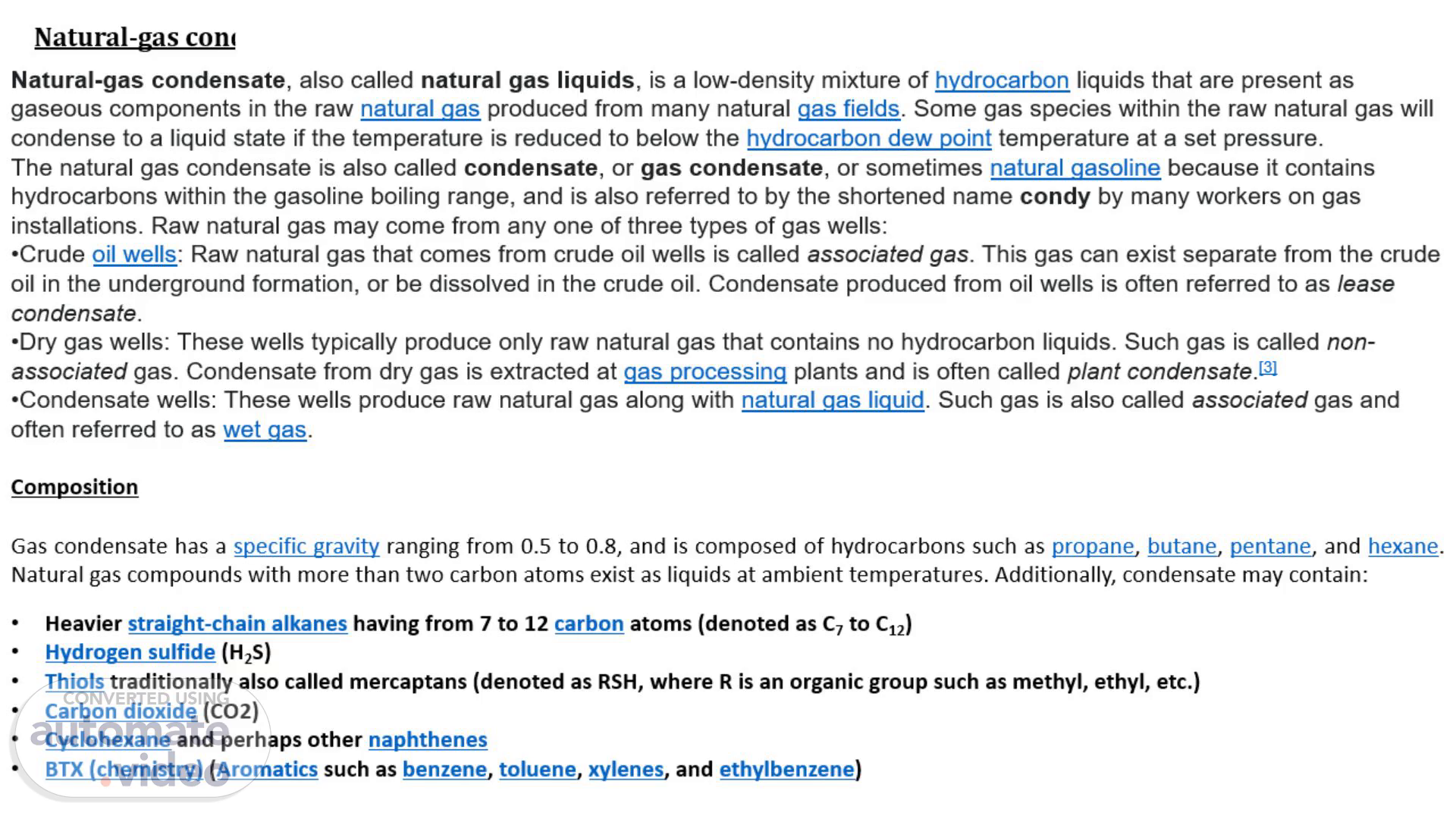
Natural-gas condensate. Natural-gas condensate, also called natural gas liquids, is a low-density mixture of hydrocarbon liquids that are present as gaseous components in the raw natural gas produced from many natural gas fields. Some gas species within the raw natural gas will condense to a liquid state if the temperature is reduced to below the hydrocarbon dew point temperature at a set pressure. The natural gas condensate is also called condensate, or gas condensate, or sometimes natural gasoline because it contains hydrocarbons within the gasoline boiling range, and is also referred to by the shortened name condy by many workers on gas installations. Raw natural gas may come from any one of three types of gas wells: Crude oil wells: Raw natural gas that comes from crude oil wells is called associated gas. This gas can exist separate from the crude oil in the underground formation, or be dissolved in the crude oil. Condensate produced from oil wells is often referred to as lease condensate. Dry gas wells: These wells typically produce only raw natural gas that contains no hydrocarbon liquids. Such gas is called non-associated gas. Condensate from dry gas is extracted at gas processing plants and is often called plant condensate.[3] Condensate wells: These wells produce raw natural gas along with natural gas liquid. Such gas is also called associated gas and often referred to as wet gas. Composition Gas condensate has a specific gravity ranging from 0.5 to 0.8, and is composed of hydrocarbons such as propane, butane, pentane, and hexane. Natural gas compounds with more than two carbon atoms exist as liquids at ambient temperatures. Additionally, condensate may contain: Heavier straight-chain alkanes having from 7 to 12 carbon atoms (denoted as C7 to C12) Hydrogen sulfide (H2S) Thiols traditionally also called mercaptans (denoted as RSH, where R is an organic group such as methyl, ethyl, etc.) Carbon dioxide (CO2) Cyclohexane and perhaps other naphthenes BTX (chemistry) (Aromatics such as benzene, toluene, xylenes, and ethylbenzene).
Scene 2 (1m 5s)
Separating the condensate from the raw natural gas.
Scene 3 (2m 12s)
Condensate Condensate. Schematic flow diagram of the separation of condensate from raw natural gas.
Scene 4 (2m 20s)
Dangers Like all fossil fuels, condensate contains toxicants which are harmful to the environment, animals and humans. It is generally more flammable and explosive than normal crude oil. Operating in areas where condensate has escaped is dangerous for crew due to the danger of explosions, oxygen displacement and the threat of asphyxiating and anaesthetizing, which can occur within a few human breaths.
Scene 5 (3m 15s)
Natural-gas processing. Natural-gas processing is a range of industrial processes designed to purify raw natural gas by removing impurities, contaminants and higher molecular mass hydrocarbons to produce what is known as pipeline quality dry natural gas. Natural-gas processing begins at the well head. The composition of the raw natural gas extracted from producing wells depends on the type, depth, and location of the underground deposit and the geology of the area. Oil and natural gas are often found together in the same reservoir. The natural gas produced from oil wells is generally classified as associated-dissolved gas meaning that the gas had been associated with or dissolved in crude oil. Natural gas production not associated with crude oil is classified as “non-associated.” In 2009, 89 percent of U.S. wellhead production of natural gas was non-associated. Natural-gas processing plants purify raw natural gas by removing contaminants such as solids, water, carbon dioxide (CO2), hydrogen sulfide (H2S), mercury and higher molecular mass hydrocarbons. Some of the substances which contaminate natural gas have economic value and are further processed or sold. An operational natural gas plant delivers pipeline-quality dry natural gas that can be used as fuel by residential, commercial and industrial consumers, or as a feedstock for chemical synthesis. Types of raw-natural-gas wells Raw natural gas comes primarily from any one of three types of wells: crude oil wells, gas wells, and condensate wells. Natural gas that comes from crude oil wells is typically called associated gas. This gas can have existed as a gas cap above the crude oil in the underground reservoir or could have been dissolved in the crude oil, coming out of solution as the pressure is reduced during production. Natural gas that comes from gas wells and condensate wells, in which there is little or no crude oil, is called non-associated gas. Gas wells typically produce only raw natural gas, while condensate wells produce raw natural gas along with other low molecular weight hydrocarbons. Those that are liquid at ambient conditions (i.e., pentane and heavier) are called natural-gas condensate (sometimes also called natural gasoline or simply condensate). Natural gas is called sweet gas when relatively free of hydrogen sulfide; gas that does contain hydrogen sulfide is called sour gas. Natural gas, or any other gas mixture, containing significant quantities of hydrogen sulfide, carbon dioxide or similar acidic gases, is called acid gas. Raw natural gas can also come from methane deposits in the pores of coal seams, often existing underground in a more concentrated state of adsorption onto the surface of the coal itself. Such gas is referred to as coalbed gas or coalbed methane (coal seam gas in Australia). Coalbed gas has become an important source of energy in recent decades..
Scene 6 (4m 21s)
Contaminants in raw natural gas Raw natural gas typically consists primarily of methane (CH4) and ethane (C2H6), the shortest and lightest hydrocarbon molecules. It often also contains varying amounts of: Heavier gaseous hydrocarbons: propane (C3H8), normal butane (n-C4H10), isobutane (i-C4H10) and pentanes. All of these are collectively referred to as Natural Gas Liquids or NGL and can be processed into finished by-products. Liquid hydrocarbons (also referred to as casinghead gasoline or natural gasoline) and/or crude oil. Acid gases: carbon dioxide (CO2), hydrogen sulfide (H2S) and mercaptans such as methanethiol (CH3SH) and ethanethiol (C2H5SH). Other gases: nitrogen (N2) and helium (He). Water: water vapor and liquid water. Also dissolved salts and dissolved gases (acids). Mercury: very small amounts of mercury primarily in elemental form, but chlorides and other species are possibly present.[3] Naturally occurring radioactive material (NORM): natural gas may contain radon, and the produced water may contain dissolved traces of radium, which can accumulate within piping and processing equipment. This can render piping and equipment radioactive over time..
Scene 7 (5m 0s)
The raw natural gas must be purified to meet the quality standards specified by the major pipeline transmission and distribution companies. Those quality standards vary from pipeline to pipeline and are usually a function of a pipeline system's design and the markets that it serves. In general, the standards specify that the natural gas: Be within a specific range of heating value (caloric value). For example, in the United States, it should be about 1035 ± 5% BTU per cubic foot of gas at 1 atmosphere and 60°F (41 MJ ± 5% per cubic metre of gas at 1 atmosphere and 15.6°C). In the United Kingdom the gross calorific value must be in the range 37.0 – 44.5 MJ/m3 for entry into the National Transmission System (NTS). Be delivered at or above a specified hydrocarbon dew point temperature (below which some of the hydrocarbons in the gas might condense at pipeline pressure forming liquid slugs that could damage the pipeline.) Hydrocarbon dew-point adjustment reduces the concentration of heavy hydrocarbons so no condensation occurs during the ensuing transport in the pipelines. In the UK the hydrocarbon dew point is defined as <-2 °C for entry into the NTS.[4] Be free of particulate solids and liquid water to prevent erosion, corrosion or other damage to the pipeline. Be dehydrated of water vapor sufficiently to prevent the formation of methane hydrates within the gas processing plant or subsequently within the sales gas transmission pipeline. A typical water content specification in the U.S. is that gas must contain no more than seven pounds of water per million standard cubic feet of gas.[5][6] In the UK this is defined as <-10 °C @ 85barg for entry into the NTS. Contain no more than trace amounts of components such as hydrogen sulfide, carbon dioxide, mercaptans, and nitrogen. The most common specification for hydrogen sulfide content is 0.25 grain H2S per 100 cubic feet of gas, or approximately 4 ppm. Specifications for CO2 typically limit the content to no more than two or three percent. In the UK hydrogen sulfide is specified ≤5 mg/m3 and total sulfur as ≤50 mg/m3, carbon dioxide as ≤2.0% (molar), and nitrogen as ≤5.0% (molar) for entry into the NTS. Maintain mercury at less than detectable limits (approximately 0.001 ppb by volume) primarily to avoid damaging equipment in the gas processing plant or the pipeline transmission system from mercury amalgamation and embrittlement of aluminum and other metals..
Scene 8 (6m 5s)
Description of a natural-gas processing plant. NatGasProcessing.svg.
Scene 9 (6m 31s)
There are a variety of ways in which to configure the various unit processes used in the treatment of raw natural gas. The block flow diagram below is a generalized, typical configuration for the processing of raw natural gas from non-associated gas wells. It shows how raw natural gas is processed into sales gas piped to the end user markets.[9][10][11][12][13] It also shows how processing of the raw natural gas yields these byproducts: Natural-gas condensate Sulfur Ethane Natural gas liquids (NGL): propane, butanes and C5+ (which is the commonly used term for pentanes plus higher molecular weight hydrocarbons)[14][15][16] Raw natural gas is commonly collected from a group of adjacent wells and is first processed in a separator vessel(s) at that collection point for removal of free liquid water and natural gas condensate. The condensate is usually then transported to an oil refinery and the water is treated and disposed of as wastewater. The raw gas is then piped to a gas processing plant where the initial purification is usually the removal of acid gases (hydrogen sulfide and carbon dioxide). There are several processes available for that purpose as shown in the flow diagram, but amine treating is the process that was historically used. However, due to a range of performance and environmental constraints of the amine process, a newer technology based on the use of polymeric membranes to separate the carbon dioxide and hydrogen sulfide from the natural gas stream has gained increasing acceptance. Membranes are attractive since no reagents are consumed.[17] The acid gases, if present, are removed by membrane or amine treating can then be routed into a sulfur recovery unit which converts the hydrogen sulfide in the acid gas into either elemental sulfur or sulfuric acid. Of the processes available for these conversions, the Claus process is by far the most well known for recovering elemental sulfur, whereas the conventional Contact process and the WSA (Wet sulfuric acid process) are the most used technologies for recovering sulfuric acid. Smaller quantities of acid gas may be disposed of by flaring..
Scene 10 (7m 36s)
The residual gas from the Claus process is commonly called tail gas and that gas is then processed in a tail gas treating unit (TGTU) to recover and recycle residual sulfur-containing compounds back into the Claus unit. Again, as shown in the flow diagram, there are a number of processes available for treating the Claus unit tail gas and for that purpose a WSA process is also very suitable since it can work autothermally on tail gases. The next step in the gas processing plant is to remove water vapor from the gas using either the regenerable absorption in liquid triethylene glycol (TEG), commonly referred to as glycol dehydration, deliquescent chloride desiccants, and or a Pressure Swing Adsorption (PSA) unit which is regenerable adsorption using a solid adsorbent. Other newer processes like membranes may also be considered. Mercury is then removed by using adsorption processes (as shown in the flow diagram) such as activated carbon or regenerable molecular sieves. Although not common, nitrogen is sometimes removed and rejected using one of the three processes indicated on the flow diagram: Cryogenic process (Nitrogen Rejection Unit), using low temperature distillation. This process can be modified to also recover helium, if desired (see also industrial gas). Absorption process, using lean oil or a special solvent as the absorbent. Adsorption process, using activated carbon or molecular sieves as the adsorbent. This process may have limited applicability because it is said to incur the loss of butanes and heavier hydrocarbons..
Scene 11 (8m 30s)
The next step is to recover the natural gas liquids (NGL) for which most large, modern gas processing plants use another cryogenic low temperature distillation process involving expansion of the gas through a turbo-expander followed by distillation in a demethanizing fractionating column. Some gas processing plants use lean oil absorption process[20] rather than the cryogenic turbo-expander process. The recovered NGL stream is sometimes processed through a fractionation train consisting of three distillation towers in series: a deethanizer, a depropanizer and a debutanizer. The overhead product from the deethanizer is ethane and the bottoms are fed to the depropanizer. The overhead product from the depropanizer is propane and the bottoms are fed to the debutanizer. The overhead product from the debutanizer is a mixture of normal and iso-butane, and the bottoms product is a C5+ mixture. The recovered streams of propane, butanes and C5+ may be "sweetened" in a Merox process unit to convert undesirable mercaptans into disulfides and, along with the recovered ethane, are the final NGL by-products from the gas processing plant. Currently, most cryogenic plants do not include fractionation for economic reasons, and the NGL stream is instead transported as a mixed product to standalone fractionation complexes located near refineries or chemical plants that use the components for feedstock. In case laying pipeline is not possible for geographical reason,or the distance between source and consumer exceed 3000 km, natural gas is then transported by ship as LNG (liquefied natural gas) and again converted into its gaseous state in the vicinity of the consumer. The residue gas from the NGL recovery section is the final, purified sales gas which is pipelined to the end-user markets. Rules and agreements are made between buyer and seller regarding the quality of the gas. These usually specify the maximum allowable concentration of CO2, H2S and H2O as well as requiring the gas to be commercially free from objectionable odours and materials, and dust or other solid or liquid matter, waxes, gums and gum forming constituents, which might damage or adversely affect operation of the buyers equipment. When an upset occurs on the treatment plant buyers can usually refuse to accept the gas, lower the flow rate or re-negotiate the price..
Scene 12 (9m 35s)
Helium recovery If the gas has significant helium content, the helium may be recovered by fractional distillation. Natural gas may contain as much as 7% helium, and is the commercial source of the noble gas. For instance, the Hugoton Gas Field in Kansas and Oklahoma in the United States contains concentrations of helium from 0.3% to 1.9%, which is separated out as a valuable byproduct. Consumption Natural gas consumption patterns, across nations, vary based on access. Countries with large reserves tend to handle the raw-material natural gas more generously, while countries with scarce or lacking resources tend to be more economical. Despite the considerable findings, the predicted availability of the natural-gas reserves has hardly changed. Applications of natural gas Fuel for industrial heating and desiccation process Fuel for the operation of public and industrial power stations Household fuel for cooking, heating and providing hot water Fuel for environmentally friendly compressed or liquid natural gas vehicles Raw material for chemical synthesis Raw material for large-scale fuel production using gas-to-liquid (GTL) process (e.g. to produce sulphur-and aromatic-free diesel with low-emission combustion).
Scene 13 (10m 20s)
List of countries by annual natural gas consumption.