Scene 1 (0s)
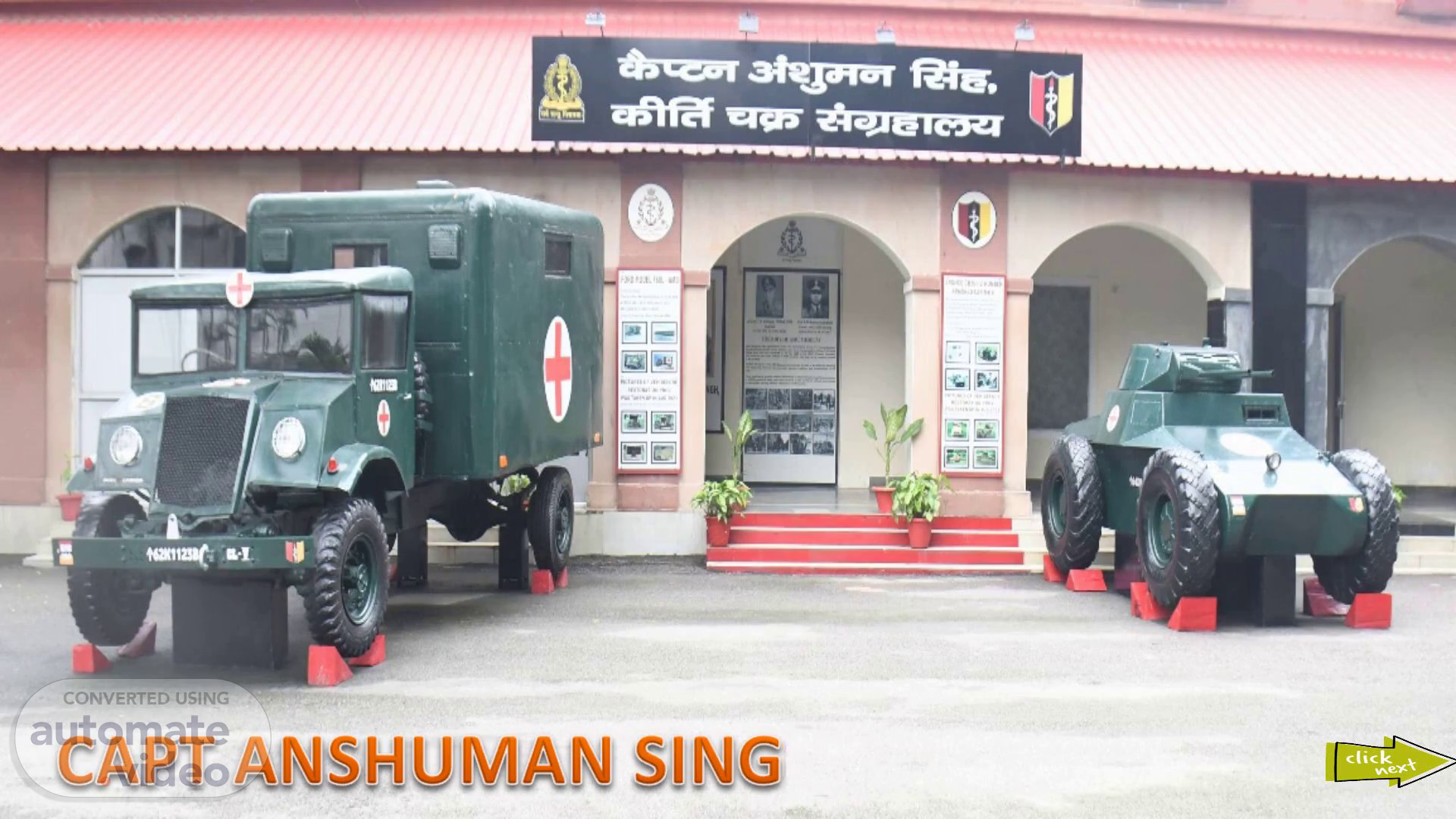
CAPT ANSHUMAN SINGH, KC MUSEUM. Capt Anshuman Singh, Kc Museum.
Scene 2 (6s)
[Audio] Intro Amc History Humanitarian Assistance Amc In Operations.
Scene 3 (14s)
Amc In Operations Amc In Operations. AMC IN OPERATIONS.
Scene 4 (22s)
[Audio] Jammu & Kashmir Operations (1947-48) B Section of 3 Light Field Ambulance had been flown to Jammu and Kashmir on 28 October 1947 along with the first Indian troops. The remaining sections had been positioned at Jhansi and reached Delhi only on November. They were flown up the following day with essential equipment but no transport. They set up a main dressing station at Srinagar and sent out sections to Khannabal, Handwara, Sunawara and Bandipur.60 Para Field Ambulance had arrived at Dehra Dun from Quetta and immediately went to the Uri sector. This ambulance worked under repeated mortar fire until the underground Cariappa Hospital could be built and equipped. This hospital was constructed by felling all the trees on a hillside to support the roof, while the wards and the operation theatre were dug into the hill. 92 General Hospital was on its way back from Japan under orders to disband. These orders were cancelled and even, before the unit reached Srinagar, men and stores were positioned there so that the hospital could function in the state military hospital and neighboring barracks.26 General Hospital, an improvised hospital was raised at Jammu. on the upper storey of the newly built civil hospital, 31 Casualty Clearing Stations were opened with some men and stores and functioned until it was replaced by the 148 General Hospital, the first military hospital in Jammu..
Scene 5 (2m 1s)
JAMMU & KASHMIR OPERATIONS (1947-48).
Scene 6 (2m 12s)
JAMMU & KASHMIR OPERATIONS (1947-48).
Scene 7 (2m 27s)
[Audio] Indo China 1962 There was only one Field Ambulance in Ladakh with detachments located in several forward areas. Many of the posts were located at heights beyond 16000 feet, o ne Mobile Dressing Station (M-D-S--) and two Advance Dressing Station (A-D-S--) were air lifted when the operations began bringing with them supplies of oxygen cylinders, transfusion fluids and ancillary stores.24. Field Ambulance was moved forward to Lumpu, while one company advanced to Namka Chu to provide medical cover to 9 Punjab. The Field Ambulance established its headquarters at Lumpu with one company deployed as an A-D-S along the line of communication to Tawang. A second A-D-S was sent to Tsangdhar on 06 october. Later, a Mobile Surgical Unit was attached to the Field Ambulance at Lumpu. Stretcher bearers carried casualties from Namka Chu to Tsangdhar, with each stretcher requiring 08 bearers who had to be found from the units themselves because the brigade had no stretcher bearers of its own. The mountain paths were so steep that it required a great effort for a single man to scramble up and down and it was almost impossible to keep a stretcher level or even continuously held up..
Scene 8 (3m 52s)
[Audio] Indo China War 1962. INDO CHINA WAR 1962.
Scene 9 (4m 8s)
INDO CHINA WAR 1962.
Scene 10 (4m 20s)
[Audio] Indo Pak War (1965) The Chinese aggression of 1962 forced a major reappraisal of military administration and the state of readiness of the Army, As a result in 1963 the field medical units of the Army were reorganized and the Army was better prepared to meet the Pakistani attack 03 years later. General Hospitals were set up at Srinagar, Rajouri and Udhampur (with one of its section positioned at Jammu) along with one Para Mobile Surgical unit and a Medical Battalion at Dhar Road and a Staging Section at Banihal. Medical stores were stocked up at a Base Depot and a Sub Depot in Srinagar. Many battle areas were situated at such high altitudes that casualties could only be evacuated by stretcher which often took marry hours before they could be moved to an A-D-S by road..
Scene 11 (5m 17s)
INDO PAK WAR (1965).
Scene 12 (5m 29s)
[Audio] Op Cactus Lily (bangladesh1971) Throughout the summer of 1971 storm clouds had been gathering over the Indian subcontinent. The bed strength of the existing military hospitals in West Bengal, Assam and Tripura was augmented to meet the projected requirements and 02 Corps Field Hospitals, 02 Staging Sections and 01 General Hospital were raised. The bed strength in military hospitals throughout the country was raised to 34342, with the addition of 9240 beds. 02 Forward Neurosurgical Centres (one each at Jalandhar and Guwahati) and 03 Forward Thoracic Surgery Centres (one each at Jalandhar, Guwahati and Kolkata) were opened to bring highly specialized treatment within easy reach of the expected battle areas. In all, 04 Corps Field Hospitals, 02 Staging Sections, 20 Ambulance Trains and 12 Ward Coaches were raised. The medical deployment in the Eastern Theatre included the 02 newly raised Corps Field Hospitals, one located at Krishan Nagar and the other, with the addition of 02 sections of a General Hospital, at Raiganj. The newly raised General Hospital was divided into og sections, which were located respectively at Silchar with 100 beds (raised later to 200), Dharampur with 200 beds (raised later to 300), and Taliamura with 400 beds (raised later to 500)..
Scene 13 (7m 12s)
Op Cactus Lily (bangladesh1971). OP CACTUS LILY (BANGLADESH,1971).
Scene 14 (7m 18s)
[Audio] Op Pawan (1987) The Indo Sri Lanka accord was signed in Sri Lanka on 29 July 19 This was to be upheld by an Indian Peace Keeping Force (I-P-K-F-). The f phase envisioned the supervision of the surrender of arms by the various militant groups. Soon thereafter 24 AN-125 and AN-32 seconds flew into Pa carrying two Indian Army battalions constituting the I-P-K-F-. On 30 July 1987 GOC-in C Southern Command flew into Ja to discuss arrangements with the Sri Lankan forces and by August Infantry Division along with 354 Field Amb, 454 Field Amb and 100 Field Amb had landed in northern Sri Lanka. Later were augmented by 304 Field Ambulance, 404 Field Ambulance and 457 Field Ambulance..
Scene 15 (8m 25s)
OP PAWAN (1987).
Scene 16 (8m 40s)
[Audio] Op Vijay (1999) OP vijay is one of the most recent examples of high altitude warfare in mountain terrain, which posed significant logistical problems for the combating sides. The terrain the Kargil and surrounding regions of the Line of Control (LoC) is inhospitable in the of times. The battle terrain of o P vijay is dominated by high altitude peaks and ridge. The military outposts on the ridges were generally around 5000 mtr (16000 ft) h with a few as high as 5485 metres (18000 ft). The terrain is extremely rugged with few tracks leading from the main roads towards the LoC. By 30 June 1999 Indian forces were prepared for a major high altitude offer against Pakistani posts along the border. The previous 06 weeks India had move infantry divisions, 05 independent brigades and 44 battalions of paramilitary troop Kashmir. Because of the nature of the terrain, division and corps operations could ne mounted; the scale of most fighting was at the regimental or battalion level. In effec divisions of the Indian Army were deployed in the conflict zone.
Scene 17 (10m 2s)
Op Vijay (1999). OP VIJAY (1999).
Scene 18 (10m 11s)
Amc Abroad Amc In Un Missions Foreign Deployments.
Scene 19 (10m 18s)
[Audio] Indo China (1954) Under the 'Geneva Agreement for Peace in Indo China', India accepted the proposed International Commission for Supervision and Control (I-C-S-C-) in Vietnam, Laos and Cambodia.The I-C-S-C team was formed from the Army Medical Corps for supervision and control. The Headquarters were established at Hanoi to provide medical care. A 20 bed hospital was established at Hanoi with 1001 Rooms at Saigon (later Ho Chi Minh City), Vientiane and Phnom Penh. Another hospital was opened at Saigon in late 1955 when Headquarters of the M International Commission was shifted there..
Scene 20 (11m 7s)
[Audio] L-A-O-S (1964) In 1964, a bloody civil war broke out in Laos and United Nations had to intervene in view of the deteriorating condition. 11 medical officers and 37 paramedical personnel of A-M-C were sent to Laos for medical assistance to refugees during Civil War in Laos. In July 1966, a 30 bed hospital named 'Laos India Friendship Hospital' was opened at Semoung, Vientiane. The Prime Minister of Laos, Prince Sauvanna Phauma visiting the 'Laos India Friendship Hospital' at Vientiane..
Scene 21 (11m 46s)
[Audio] Congo (1960) In the year 1960, President Patric Lumomba's assassination had thrown the Con into a fever of resentment. They wanted an immediate evacuation of Belgian colonist their territory. This created a situation which demanded the intervention of the L Nations to establish peace in Congo. In September 1960, an Indian Peace Keeping M under United Nations was sent to Congo. The medical team of the Army Medical performed commendably under the adverse circumstances..
Scene 22 (12m 22s)
[Audio] Second Time In Congo. SECOND TIME IN CONGO.
Scene 23 (12m 38s)
[Audio] UNDOF (1974 Till date). UNDOF (1974 Till date).
Scene 24 (12m 47s)
[Audio] unifil lebanon (1978 Till date). UNIFIL LEBANON (1978 Till date).
Scene 25 (13m 5s)
[Audio] Untac (combodia 1992 93). UNTAC (COMBODIA 1992- 93).
Scene 26 (13m 12s)
[Audio] Uno Som (somalia1992 95). UNO SOM (SOMALIA1992- 95).
Scene 27 (13m 19s)
[Audio] Un Mission Ethiopia & Eritrea (2000-08). UN MISSION ETHIOPIA & ERITREA (2000-08).
Scene 28 (13m 26s)
[Audio] Un Mission Sudan(2006-10). UN MISSION SUDAN(2006-10).
Scene 29 (13m 34s)
[Audio] Un Mission South Sudan (july 2011-till Date.
Scene 30 (13m 42s)
[Audio] Un Mission Abroad Korea ( Neutral Nations 1950-54 Indo China (international) 1954 Gaza (egypt) (unef) 1956-67 Congo 1960-63 Laos 1964 Golan Heights (undof) 1974 Till Date Lebanon (unifil) 1978 Till Date Cambodia (untac) 1991-93 Somalia (unso M) 1993-95.
Scene 31 (14m 25s)
[Audio] Rawanda (unamir) 1993-94 Mozambique (unomoz) 1993-95 Angola (unavem) 1956-97 Sierra Leone (unamsil) 1999-05 Democratic Republic Of Congo (monuc) 1999 Till Date Sudan (unmis) 2005-10 Ethiopa – Eritrea (unmee) 2000-08 Southern Sudan (unmiss) 2011 Till Date.
Scene 32 (15m 6s)
[Audio] Imtrat Bhutan. IMTRAT BHUTAN. sue. toea.E.
Scene 33 (15m 13s)
[Audio] Iatt Botswana. IATT BOTSWANA.
Scene 34 (15m 20s)
[image] go back signs Sticker by deladeso. [image] go back signs Sticker by deladeso.
Scene 35 (15m 27s)
[Audio] Humanitarian Assistance. HUMANITARIAN ASSISTANCE.
Scene 36 (15m 36s)
[Audio] Jammu & Kashmir. JAMMU & KASHMIR.
Scene 37 (15m 58s)
JAMMU & KASHMIR.
Scene 38 (16m 7s)
[Audio] Uttarkashi Earthquake (1991). UTTARKASHI EARTHQUAKE (1991).
Scene 39 (16m 17s)
[Audio] Bhuj Earthquake (2001). BHUJ EARTHQUAKE (2001).
Scene 40 (16m 26s)
[Audio] Op Kosi Prahar Bihar Floods 2008. OP KOSI PRAHAR BIHAR FLOODS 2008.
Scene 41 (16m 34s)
[Audio] Sikkim Earthquake (2011). SIKKIM EARTHQUAKE (2011).
Scene 42 (16m 40s)
[Audio] Bam Earth Quake (iran 2003). BAM EARTH QUAKE (IRAN 2003).
Scene 43 (16m 47s)
[Audio] Tsunami Relief Operations ( Sri Lanka2004).
Scene 44 (16m 57s)
[Audio] Cyclone Nargis (myanmar, 2008) A medical team of 422 Field Hospital was deployed under OP sahayata I at Pyapon and Bogale, the worst Cyclone nargis hit areas in the Irrawady Delta of Myanmar in May 2008.
Scene 45 (17m 18s)
[Audio] 60 Parachute Fd Hospital 60 Parachute Fd Hospital 60 Parachute Field Hospital (S-I-X-T-Y) is the only Airborne Medical Unit of the Indian Army. The unit was raised on 10 August 1942 became a part of the 50 (Independent) Parachute Brigade in 1954. Served with distinction in several theatres and was one of the first units of the Indian Army to have embarked on a UN Peacekeeping mission in Korea in 1950..
Scene 46 (17m 53s)
[Audio] Korea (1950-54). KOREA (1950-54).
Scene 47 (18m 27s)
[Audio] Korea (1950 54). KOREA (1950- 54).
Scene 48 (18m 45s)
[Audio] Korea (1950 54) Decorations & Awards Mvc 02 Vrc 08 Sm 01 Vsm 02 Mention –in -dispatches 25 Coas Commendation 10 5 Coas Commendation 04 G O C –in c Commendation 09.
Scene 49 (19m 9s)
[Audio] Longest Hospital Train Journey In The World.
Scene 50 (19m 20s)
[Audio] Korean War (60 Para) The Korean war was an armed conflict on the Korean Peninsula between North and South Korea and their allies. North Korea was supported by the People's Republic of Ch ina and Soviet Union and South Korea was supported by the UN. It was the 1st time the UN intervened in a military conflict. The 60 Indian Para Field Ambulance sailed on 08 Nov 1950 with a strength of 17 Officers, 10 Junior Commissioned Officers and 304 other ranks arriving in Pusav on 20 November. On 01 December 1950, they found themselves in Pyongyang, where the, military conflict was active, after a brief rest at Taegu. On 4 December, they were ordered to withdraw from Pyongyang area to Seoul. Despite they challenging situation, the men of sixty refused to leave without their equipment and stores. Determined to carry out their mission, they travelled at night to avoid detection, hiding under tunnels and bridges during the day. Along the way they discovered a railway engine and a few bogies, filling the engine with water using buckets from a nearby river, earning them the nickname "THE bucket BRIGADE". After gathering coal to fuel the engine, they drove the train until it was destroyed on 5 December. Nevertheless, they reached Seoul on 6 December with their equipment, stores, and vehicles intact, continuing their medical services there. By the end of January 1951, the 60th received orders for a second withdrawal, this time alongside the 27th British Brigade under 9 Corps. During Operation killer, the brigade encountered a well fortified enemy position, achieving success despite facing significant challenges in evacuating casualties across a frozen river..