

Page 1 (0s)
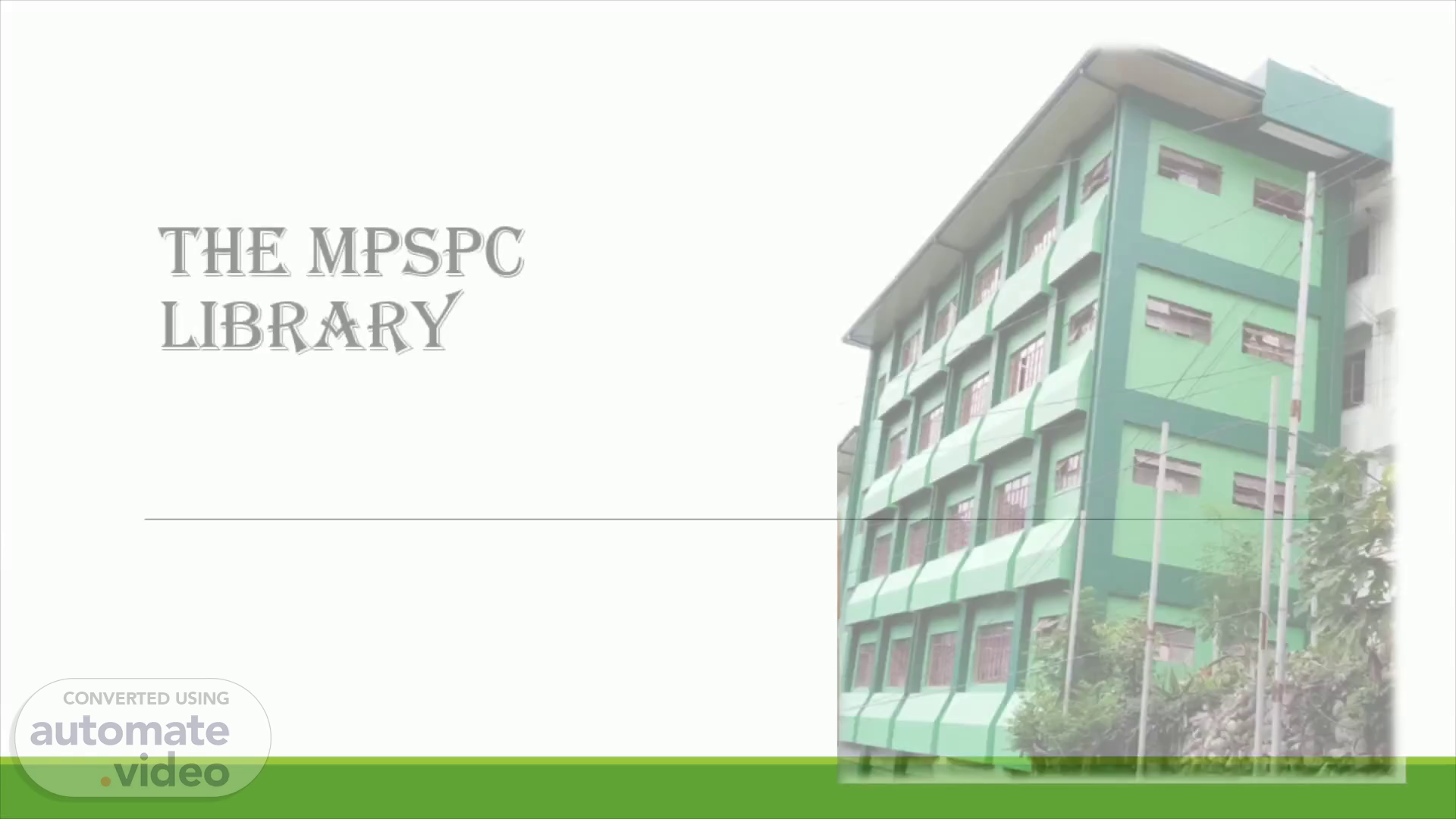
[Audio] Good Day everyone and welcome to the Mountain Province State Polytechnic College, Bontoc Campus Library.
Page 2 (10s)
[Audio] Before we go to the different section of the library, let us first discuss what a library is, A library can be considered a store – house of knowledge. In dictionaries the word "library" has been defined as a building or room containing a collection of books. It is also a place for study and research..
Page 3 (33s)
[Audio] Let's go to the different sections of the library..
Page 4 (40s)
[Audio] Found at the first floor of the library building are the book collections on criminology, information technology, nursing and general collection..
Page 5 (50s)
[Audio] Found at the second floor of the library building are the book collections on public administration, political science, teacher education, business courses, thesis and dissertations..
Page 6 (1m 4s)
[Audio] Found at the third floor of the library building are the collections on hospitality management, tourism management, filipiniana special collections on IPED and cordillera materials, and fiction..
Page 7 (1m 18s)
[Audio] Found at the fourth floor of the SSDO building is the Periodicals section..
Page 8 (1m 25s)
[Audio] Found at the fourth floor of the library building is the e-library and the office of the director for libraries..
Page 9 (1m 34s)
[Audio] We now go to the different types of reference sources..
Page 10 (1m 52s)
[Audio] References sources, Provide answers to specific questions such as brief facts, statistics, and technical instructions; provide background information; or direct you to additional information..
Page 11 (2m 9s)
[Audio] The first type of reference source is the encyclopedia, it is A reference material that contains information on all subjects, or limited to a specific field or subject, arranged in systematic order (usually alphabetical) and a good basis for the beginning stages of research. This can either be online or in book form..
Page 12 (2m 32s)
[Audio] Next type of reference source is the dictionary. Standard dictionaries give an alphabetical list of words and their definitions, but there are several useful variations also classified as dictionaries. This can either be online or in book form..
Page 13 (2m 51s)
[Audio] Atlases contain an organized group of pictorial or illustrated political, cultural, physical, road, and/or thematic maps. Atlases may be organized around a specific subject, theme, or geographic area. This can either be online or in book form..
Page 14 (3m 13s)
[Audio] Almanacs are not usually used for extensive research , but are good for looking up specific facts, statistics, tables and lists about people, places, events, countries, organizations, zip codes, and popular culture such as sports and entertainment. Generally, almanacs cover a broad period of time, while Yearbooks, which contain similar information, only cover a given year. This can either be online or in book form..
Page 15 (3m 46s)
[Audio] Thesauri contain synonyms and antonyms (opposites) but usually don't define the words. This can either be online or in book form..
Page 16 (3m 59s)
[Audio] Let as go to the arrangement of books in the library..
Page 17 (4m 6s)
[Audio] The MPSPC library uses the Dewey Decimal Classification. This was developed by Melville Dewey, The DDC helps libraries arrange the books in the library so that library users can find them easily..
Page 18 (4m 23s)
[Audio] The Dewey Decimal Classification is made up of ten main classes, this are 000-099 for computer science, information and general works, 100-199 for philosophy and psychology, 200-299 for religion, 300-399 for social sciences, 400-499 for languages, 500-599 for natural sciences and mathematics, 600-699 for technology, 700-799 for the arts and recreation, 800-899 for literature and 900-999 for history and geography..
Page 19 (5m 5s)
[Audio] A call number is like an address: it tells us where the book is located in the library. Call numbers appear on the spines of books and journals, for thin books it is found in front..
Page 20 (5m 24s)
[Audio] In 000-099, you find books on computer science, information and general works..
Page 21 (5m 42s)
[Audio] 100-199 you can find book on philosophy and psychology..
Page 22 (5m 59s)
[Audio] 200-299 you can find books on the bible, history of Christianity and the different region in the world.
Page 23 (6m 19s)
[Audio] 300-399 you can find books on law, political science, education and folklore..
Page 24 (6m 34s)
[Audio] 400-499 are books on the different languages of the world, such as English, Spanish, Filipino and others..
Page 25 (6m 51s)
[Audio] 500-599 are books on mathematics, earth sciences, and natural sciences..
Page 26 (7m 11s)
[Audio] 600-699 books found in technology, medicine, agriculture and family living..
Page 27 (7m 31s)
[Audio] 700-799 are books on the arts, this are books on drawing, music, recreational and performing arts.
Page 28 (7m 51s)
[Audio] 800-899 is on literature, you can find books on American literature, old English literature and literature of other languages..
Page 29 (8m 5s)
[Audio] Lastly is 900-999 is on geography and history of all the countries of the world..
Page 30 (8m 25s)
[Audio] THANK YOU FOR WATCHING.. WATCHING.