Scene 1 (0s)
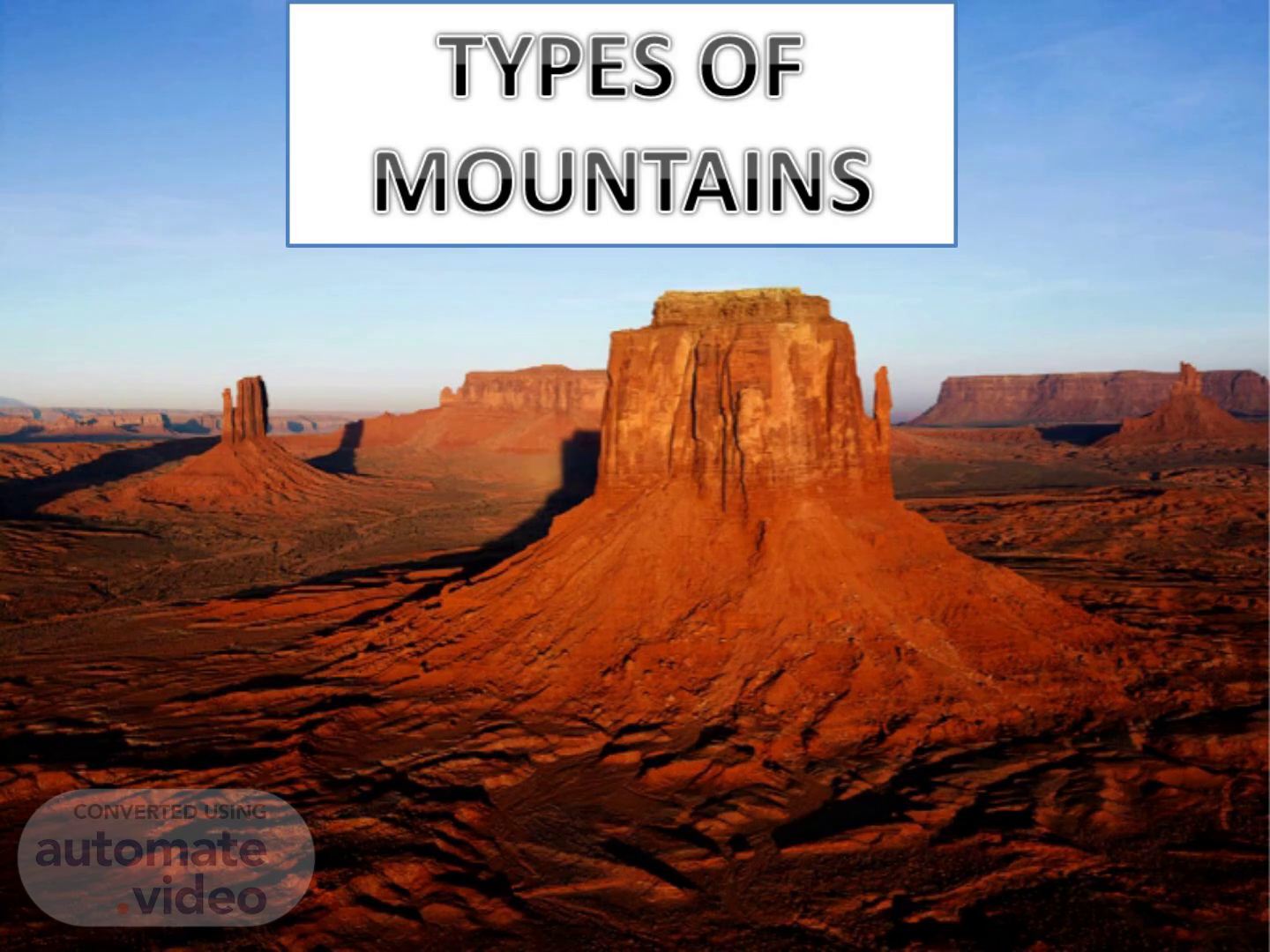
TYPES OF MOUNTAINS.
Scene 2 (1m 23s)
[Audio] The formation of different types of mountains can be attributed to various geological processes. These mountains are created when two tectonic plates collide, resulting in the Earth's crust being folded and crumpled. This process is known as orogenesis. For instance, the Himalayas, the Alps, and the Rockies are all prominent examples of fold mountains. They are characterized by their high peaks and ridges, which are formed from the intense pressure of colliding plates. In contrast, volcanic mountains are formed through the accumulation of lava and ash that erupt from a volcanic vent. Each eruption adds new material, gradually building up the mountain. We can see this process in action with Mount Fuji in Japan and Mount St Helens in the United States, both of which are classic examples of volcanic mountains. Their conical shapes are a result of the layering of volcanic materials. Another type of mountain is the fault-block mountains, which are formed by the movement of tectonic plates. When faults or cracks in the Earth's crust cause blocks of rock to be lifted or lowered, it results in steep, rugged landscapes. The Sierra Nevada in the United States and the Harz Mountains in Germany are notable examples of fault-block mountains. Understanding these different types of mountain formations is essential for geologists and anyone interested in the field of geography. By studying these processes, we can gain insights into the Earth's history and the forces that shape our planet..
Scene 3 (3m 0s)
[Audio] The formation of dome-shaped mountains occurs when magma rises through the Earth's crust and pushes it upwards without erupting. This results in a bulge or dome shape in the crust. Dome-shaped mountains can be found in various locations around the world, including the Black Hills in South Dakota and the Adirondack Mountains in New York. Residual mountains, on the other hand, are formed by the erosion of older mountain ranges. The process of erosion leaves behind remnants of the original peaks, resulting in lower and more rounded mountains. An example of residual mountains is the Appalachian Mountains in the United States, where the effects of extensive erosion over time are clearly visible. The understanding of the formation and characteristics of different types of mountains is crucial in geology and provides valuable insights into the history and development of our planet..
Scene 4 (3m 56s)
[Audio] The formation of mountains is a complex process involving multiple geological processes. Mountain building occurs through the movement of tectonic plates, which can cause the Earth's crust to buckle and deform. This deformation can lead to the creation of mountain ranges, such as the Himalayas, which were formed as a result of the collision between two continental plates. The process of mountain building is not limited to just one type of plate movement; it can involve multiple types of plate interactions, including divergent, convergent, and transform boundaries. Mountain building can also occur through volcanic activity, particularly during periods of intense magmatic activity. In some cases, the movement of magma can push up the Earth's surface, creating a dome-shaped mountain range. For example, the Sierra Nevada mountain range in California was formed as a result of volcanic activity. Similarly, the Appalachian Mountains in eastern North America were formed through the movement of magma. In addition to these processes, mountain building can also occur through the action of water and ice. Glaciers, for instance, can carve out valleys and create U-shaped profiles, while rivers and streams can erode the landscape over time. The combination of these processes can result in the creation of diverse mountain landscapes, ranging from the towering peaks of the Rockies to the gentle slopes of the Alps. The study of mountain building is essential for understanding the Earth's geological history and the processes that shape our planet. By studying the formation of mountains, scientists can gain insights into the Earth's internal dynamics and the forces that drive plate tectonics. Furthermore, the study of mountain building has practical applications in fields such as geology, engineering, and environmental science. For example, understanding the processes that form mountains can help engineers design safer bridges and tunnels, while knowledge of the Earth's geological history can inform strategies for mitigating natural disasters..