Scene 1 (0s)
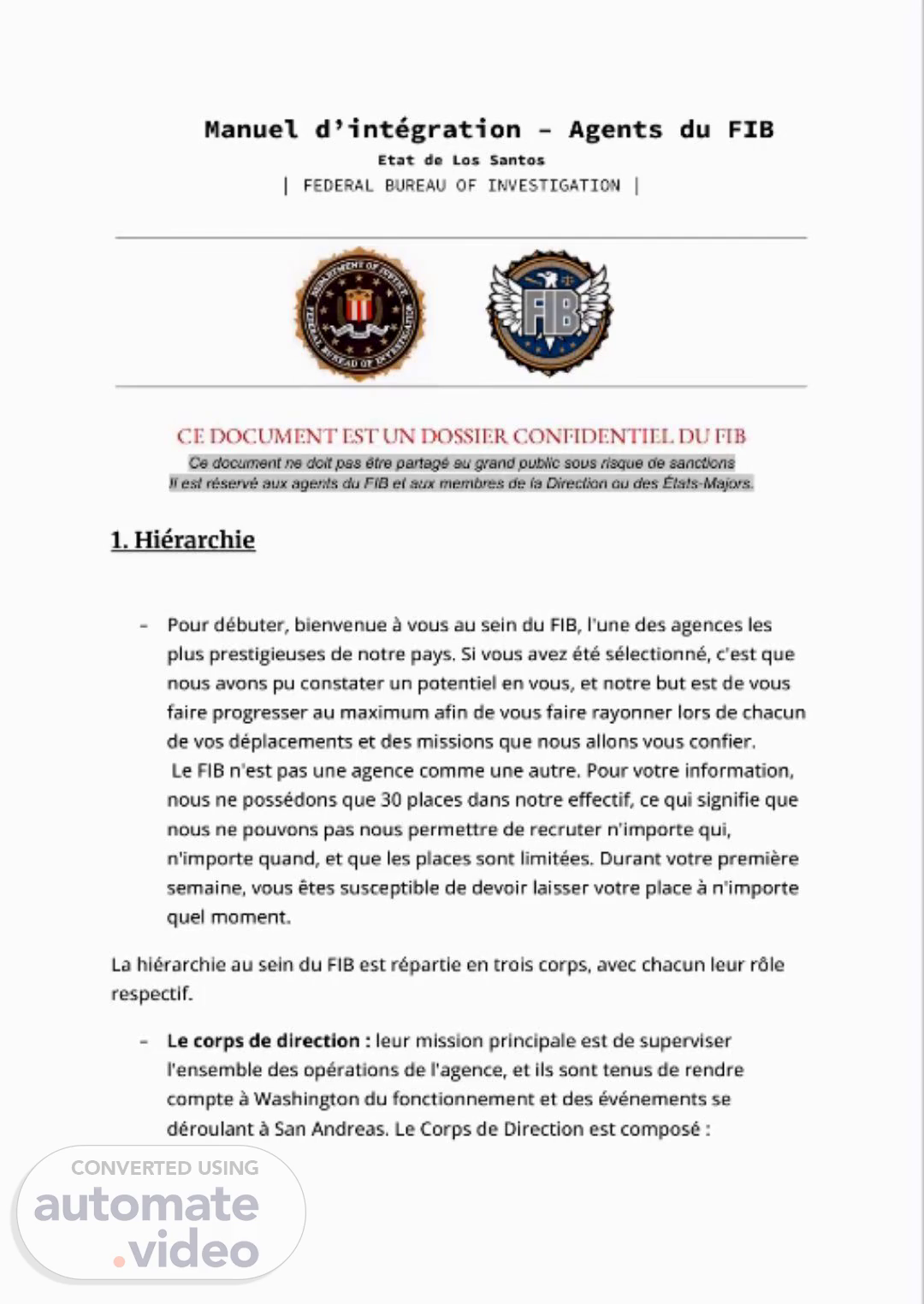
Manuel d’intégration – Agents du FIB Etat de Los Santos | FEDERAL BUREAU OF INVESTIGATION | CE DOCUMENT EST UN DOSSIER CONFIDENTIEL DU FIB Ce document ne doit pas être partagé au grand public sous risque de sanctions Il est réservé aux agents du FIB et aux membres de la Direction ou des États-Majors. 1. Hiérarchie - Pour débuter, bienvenue à vous au sein du FIB, l'une des agences les plus prestigieuses de notre pays. Si vous avez été sélectionné, c'est que nous avons pu constater un potentiel en vous, et notre but est de vous faire progresser au maximum afin de vous faire rayonner lors de chacun de vos déplacements et des missions que nous allons vous confier. Le FIB n'est pas une agence comme une autre. Pour votre information, nous ne possédons que 30 places dans notre effectif, ce qui signifie que nous ne pouvons pas nous permettre de recruter n'importe qui, n'importe quand, et que les places sont limitées. Durant votre première semaine, vous êtes susceptible de devoir laisser votre place à n'importe quel moment. La hiérarchie au sein du FIB est répartie en trois corps, avec chacun leur rôle respectif. - Le corps de direction : leur mission principale est de superviser l'ensemble des opérations de l'agence, et ils sont tenus de rendre compte à Washington du fonctionnement et des événements se déroulant à San Andreas. Le Corps de Direction est composé :.
Scene 2 (5s)
[Audio] The organisation employant le narrateur est probablement une agence gouvernementale chargée de la lutte contre le crime, compte tenu du contexte des diapositives et des rôles décrits. Le narrateur semble travailler dans cette organisation, car il discute divers aspects de son travail, comme l'entraînement, les promotions et les noms de code. Sur la base de ces informations, il peut être inféré que l'organisation est probablement une force policière ou une entité similaire. Cependant, la nature exacte de l'organisation ne peut pas être déterminée avec certitude à partir du contexte fourni..
Scene 3 (39s)
[Audio] The organization that employs the narrator is not explicitly stated, but based on the content it appears to be some sort of military or law enforcement agency. The narrator mentions being part of a " corps de commandement " and having a " grade ", suggesting a hierarchical structure typical of such organizations. Additionally, the mention of " codes radio ", " procédure judiciaire ", and " Code pénal " further supports this conclusion. Therefore, the most likely employer of the narrator is a military or law enforcement agency..
Scene 4 (1m 9s)
[Audio] The FIB is responsible for investigating crimes committed by individuals who are not citizens of France. This includes crimes such as murder, theft, and fraud. The FIB also investigates crimes committed against foreigners living in France. In addition, the FIB has jurisdiction over crimes committed within the country's borders, regardless of whether the perpetrator is a citizen of France or not. The FIB works closely with other law enforcement agencies around the world to share intelligence and coordinate efforts to combat organized crime. The FIB also provides training and support to local law enforcement agencies in France. The FIB is headquartered in Paris, and its director is appointed by the President of France. The FIB is an independent agency, meaning it operates outside of the normal chain of command. The FIB is funded by the French government, but it also receives funding from international organizations and private donors. The FIB has a significant impact on the fight against organized crime in France, and it plays a crucial role in maintaining public safety. The FIB is known for its professionalism and expertise in investigating complex cases. The FIB is also recognized for its commitment to transparency and accountability. The FIB has been involved in several high-profile investigations in recent years, including the investigation into the terrorist attacks in Paris in 2015. The FIB has also worked with international partners to investigate and prosecute crimes related to human trafficking and cybercrime. The FIB continues to evolve and adapt to new challenges and threats, ensuring that it remains effective in combating organized crime and promoting public safety..
Scene 5 (3m 5s)
[Audio] La Section E C U est une unité spéciale chargée de lutter contre le blanchiment d'argent et d'empêcher les entreprises de se livrer à des activités criminelles. Elle enquête sur les sociétés qui utilisent leurs ressources financières pour financer des activités illégales..
Scene 6 (4m 10s)
[Audio] The FIB is an integrated security fund, which means it provides financial support to various organizations involved in security-related activities. These organizations include police departments, fire departments, and other emergency services. The FIB also supports research and development projects related to security technologies. The FIB's main objective is to improve the overall safety and security of France by providing resources and expertise to its member organizations. The FIB works closely with the French government to ensure that its programs are aligned with national priorities and policies. The FIB has a strong partnership with the French National Police Force, which helps to coordinate efforts between different agencies and departments. The FIB also collaborates with international partners to share knowledge and best practices in security and law enforcement..
Scene 7 (5m 15s)
[Audio] The interrogator must inform the suspect of his rights, which include the right to remain silent, the right to a lawyer, and the right to have an attorney present during the questioning. The interrogator must also inform the suspect that everything he says will be recorded and used as evidence against him. The interrogator should not coerce or intimidate the suspect into making statements. The interrogator should also ensure that the suspect has access to a lawyer and that the lawyer can be present during the questioning. The interrogator should also provide the suspect with written information about the charges against him and the possible consequences of those charges. The interrogator should also explain the process of arrest and detention, and the procedures for handling the situation. The interrogator should also take care to maintain the integrity of the investigation by avoiding any actions that could compromise the evidence. The interrogator should also respect the suspect's dignity and personal space. The interrogator should also be aware of the laws and regulations governing the interrogation process. The interrogator should also be able to handle difficult situations and to remain calm under pressure. The interrogator should also be knowledgeable about the relevant laws and regulations governing the interrogation process. The interrogator should also be able to communicate effectively with the suspect and with other law enforcement officials. The interrogator should also be aware of the limitations of the interrogation process and the potential risks associated with it. The interrogator should also be able to document the evidence collected during the interrogation. The interrogator should also be able to analyze the evidence and draw conclusions based on that analysis. The interrogator should also be able to prepare the suspect for trial, if necessary. The interrogator should also be aware of the potential consequences of the interrogation process on the suspect's mental health. The interrogator should also be aware of the need to balance the need for effective investigation with the need to protect the suspect's rights. The interrogator should also be aware of the need to maintain confidentiality and to avoid revealing sensitive information. The interrogator should also be aware of the need to respect the suspect's cultural background and to be sensitive to their needs. The interrogator should also be aware of the need to provide support and resources to the suspect, if necessary. The interrogator should also be aware of the need to follow established protocols and procedures. The interrogator should also be aware of the need to stay up-to-date with new developments and changes in the laws and regulations governing the interrogation process. The interrogator should also be aware of the need to collaborate with other law enforcement agencies and to share information. The interrogator should also be aware of the need to prioritize the safety and well-being of all parties involved. The interrogator should also be aware of the need to maintain accurate records and to follow proper documentation procedures. The interrogator should also be aware of the need to respect the suspect's language and communication style. The interrogator should also be aware of the need to use non-verbal cues and body language to convey messages. The interrogator should also be aware of the need to be aware of the suspect's emotional state and to respond accordingly. The interrogator should also be aware of the need to use active listening skills and to show empathy towards the suspect. The interrogator should also be aware of the need to be aware of the suspect's cognitive abilities and to adapt the questioning technique accordingly. The interrogator should also be aware of.
Scene 8 (9m 15s)
[Audio] La radio est un outil essentiel pour les agents du FIB. Elle leur permet de communiquer efficacement avec leurs collègues et de coordonner leurs actions. Il s'agit d'une technologie avancée qui utilise des fréquences cryptées pour éviter les écoutes non autorisées. Les agents peuvent utiliser la radio pour transmettre des informations, demander de l'aide ou simplement discuter avec leurs collègues. La radio est également utilisée pour annuler les opérations ou pour signaler des problèmes. Enfin, la radio joue un rôle crucial dans la sécurité des agents, car elle leur permet de rester en contact avec leurs collègues même en cas d'urgence. La radio est un outil primordial dans n'importe quelle institution gouvernementale..
Scene 9 (10m 9s)
[Audio] The FIB est une organisation fictuelle similaire à la FBI en réalité. Le narrateur semble être un employé de l'organisation, peut-être membre du personnel de direction ou du personnel de supervision. La position exacte du narrateur au sein de l'organisation n'est pas claire, mais elle semble être d'un niveau intermédiaire ou supérieur basé sur les informations fournies..
Scene 10 (11m 0s)
[Audio] The FIB is a European police organization which has been active since 1921. Its headquarters are located in Paris, France. The FIB is responsible for coordinating international law enforcement efforts between member countries. The FIB's main objective is to combat organized crime and terrorism. The FIB works closely with other international organizations such as Interpol and Europol. The FIB also provides training and support to its member countries. The FIB's activities are coordinated by the General Secretariat, which is headed by the Secretary-General. The FIB's budget is allocated from the European Union's budget. The FIB's headquarters are equipped with modern technology and facilities. The FIB's staff consists of highly trained professionals who work together to achieve their objectives. The FIB's operations are carried out by specialized units, including the Cybercrime Unit and the Counter-Terrorism Unit. The FIB's members come from various countries and have different languages and cultures. The FIB's language is English, but many of its members speak multiple languages. The FIB's headquarters are open to visitors, and it offers guided tours. The FIB's website is available online, and it provides information on its activities and achievements. The FIB's social media accounts are used to disseminate information and engage with the public. The FIB's annual report is published annually, and it provides an overview of its activities and accomplishments. The FIB's financial reports are audited annually, and they provide detailed information on its expenses and revenues. The FIB's human resources policies are designed to promote diversity and inclusion. The FIB's organizational structure is based on a hierarchical system, with clear lines of authority and communication. The FIB's management style is collaborative and participatory, involving all stakeholders and employees. The FIB's performance evaluation process is rigorous and comprehensive, ensuring that all employees receive fair treatment and opportunities for growth. The FIB's research and development initiatives focus on improving policing practices and techniques. The FIB's partnerships with other organizations are built on mutual respect and trust. The FIB's commitment to excellence is unwavering, and it strives to be a leader in the field of international law enforcement. The FIB's vision is to create a safer and more secure world for all citizens. The FIB's values are centered around integrity, professionalism, and respect for diversity. The FIB's mission statement is: "To protect and serve the people of Europe, while promoting peace, justice, and security." The FIB's motto is: "United we stand, united we fight." The FIB's emblem is a stylized image of a globe, symbolizing unity and cooperation among nations. The FIB's flag features a blue background with white and red stripes, representing the colors of the European Union. The FIB's anthem is a song that celebrates the organization's history and achievements. The FIB's logo is a combination of the globe and the EU flag, representing the organization's connection to the European Union. The FIB's uniforms are designed to reflect the organization's values and mission. The FIB's vehicles are equipped with advanced technology and equipment. The FIB's personnel are highly trained and skilled, working together to achieve their objectives. The FIB's facilities are equipped with modern technology and equipment. The FIB's operations are carried out by specialized units, including the Cybercrime Unit and the Counter-Terrorism Unit. The FIB's members come from various countries and have different languages and cultures. The FIB's language is English, but many of its members speak multiple languages..
Scene 11 (15m 19s)
[Audio] The FIB is a fictional law enforcement agency in the United States. The FIB has different units, including the Command Center, the Corps of Commanders, the Corps of Investigation, and the Special Operations Unit. The narrator appears to be a member of the FIB, as they provide instructions on how to behave during certain situations. The LSPD (Local Police Department) and BCSO (County Sheriff's Office) are mentioned by the narrator, suggesting that there may be other law enforcement agencies involved with the FIB. The narrator works for the FIB..
Scene 12 (16m 24s)
[Audio] " L'organisation qui emploie le narrateur est probablement la FIB, car elle utilise des termes tels que « Commandement », « Formation TAF », « Formation FAC » et « Formation VDP » tout au long du document. Cependant, il est également possible qu'il travaille pour une autre organisation au sein de la structure de la FIB, mais cela n'est pas explicitement indiqué. Par conséquent, je ne sais pas le nom de l'organisation qui emploie le narrateur. "..
Scene 13 (17m 29s)
[Audio] La organisation qui emploie le narrateur est probablement la FIB (Agence d'intelligence française), compte tenu du contexte des diapositives et du contenu discuté. Cependant, je n'ai pas suffisamment d'informations pour confirmer cela avec certitude..