Scene 1 (0s)
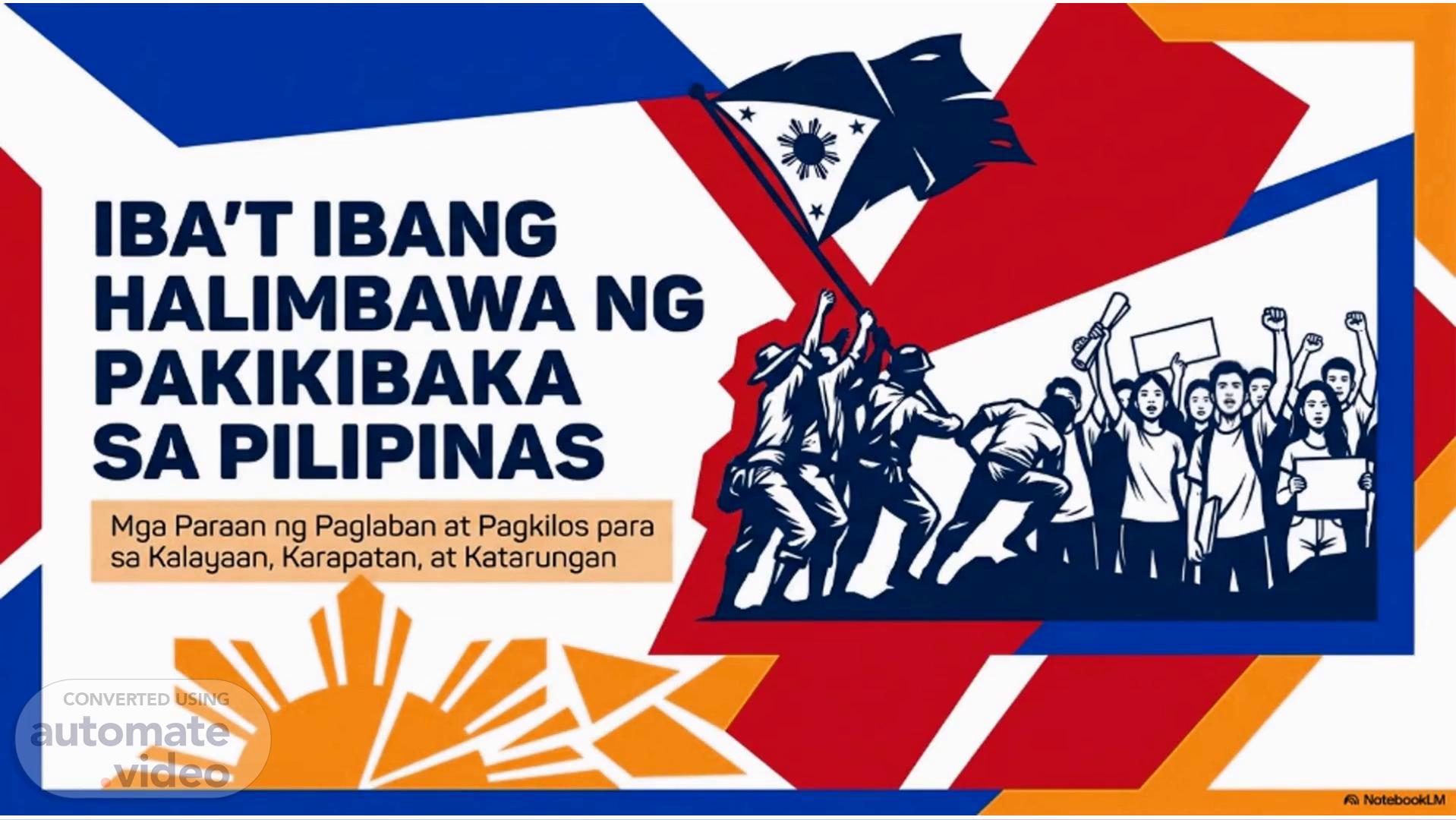
IBA'T IBANG HALIMBAWA NG PAKIKIBAKA SA PILIPINAS Mga Paraan ng Paglaban at Pagkilos para sa Kalayaan, Karapatan, at Katarungan.
Scene 2 (2m 7s)
[Audio] The struggle for freedom, rights, and justice in the Philippines has been ongoing since the country's early days. The term "pakikibaka" refers to this struggle. Pakikibaka literally means "struggle" in English, but it encompasses a wide range of actions taken by individuals and groups to fight for their rights and freedoms. These actions include protesting, rallying, marching, and using other forms of nonviolent resistance. Pakikibaka is not limited to physical acts alone; it also involves intellectual and artistic expressions. For example, writers like Jose Rizal used their works to challenge societal norms and advocate for change. Artists have also played a significant role in expressing dissent through their work. In addition, many Filipinos have used their voices to speak out against injustices and advocate for human rights. Pakikibaka is a collective effort towards a common goal, involving multiple individuals and groups working together to achieve a shared objective. It requires patience, perseverance, and determination..
Scene 3 (3m 19s)
[Audio] The struggle against the Japanese occupation during World War II was intense and widespread. Many people suffered greatly due to the harsh conditions imposed by the enemy. The war effort required immense sacrifices from individuals and communities across the country. The bravery of soldiers and civilians alike played a significant role in the ultimate victory. The impact of the war on the local population was devastating, with many lives lost and families torn apart. The aftermath saw a period of rebuilding and recovery, but also a sense of unease and uncertainty..
Scene 4 (3m 57s)
[Audio] The Armed Forces of the Philippines engaged in a battle with the Maute group in 2017 over control of Marawi city. This was an example of armed struggle in modern times. However, armed struggle is not a new concept in the Philippines. The Philippine Revolution against Spanish colonization began in 1896. The Katipunan, an armed group fighting for independence, emerged as a secret society before becoming a full-fledged army when discovered by the Spanish authorities. The Katipunan used various tactics including ambushes, raids, and guerrilla warfare to fight against their oppressors. They also employed propaganda to spread their message and gain support from the local population. The Philippine-American War took place from 1899 to 1902, as Filipinos fought against the American occupation of the country. This conflict marked another instance of armed struggle in the Philippines. The New People's Army, the armed wing of the communist movement, and the Moro National Liberation Front, advocating for rights and self-determination in Mindanae, are examples of armed groups that have employed similar tactics. These groups have used various forms of violence, including bombings, assassinations, and kidnappings, to achieve their goals. Armed struggle has been a recurring theme throughout the history of the Philippines, and it continues to play a significant role in the country's politics today..
Scene 5 (5m 30s)
[Audio] The cultural movement of resistance against oppression is rooted in the desire for freedom, justice, and equality. This can manifest in various forms such as art, literature, music, and technology. The use of social media has become a powerful tool for mobilization and awareness-raising. Through activism and advocacy, individuals can come together to challenge unjust systems and promote positive change. Andres Bonifacio was inspired by the novel 'Noli Me Tangere'. His actions demonstrate how cultural expression can ignite passion and drive action. By exploring the connections between culture, resistance, and social change, we can gain a deeper understanding of the complexities of human experience..
Scene 6 (6m 18s)
[Audio] The EDSA People Power Revolution in 1986 was a model of successful and bloodless overthrow of a dictator. The Million People March in 2013 against the PDAF was a protest against corruption. Climate strikes have been calling for environmental protection. Anti-terror law protests were peaceful demonstrations against the law. Prayer rallies and candle-light protests were peaceful forms of protest..
Scene 7 (6m 49s)
[Audio] The various forms of struggle and movements for freedom, equality, and justice in the Philippines encompass a wide range of sectors and activities. These include mass mobilizations across different industries, worker strikes, calls for fairer wages, labor unions, advocacy for agricultural reform, transportation strikes, protests against police brutality affecting livelihoods, community-led initiatives such as food banks, collective responses to crises, indigenous resistance, and defense of ancestral lands. These diverse efforts demonstrate the complexity and diversity of the Filipino people's struggles for their rights and freedoms..
Scene 8 (7m 35s)
[Audio] The Philippines was invaded by Japan in December 1941. The invasion led to widespread destruction and loss of life. The Japanese occupation lasted until August 1945 when the Allies liberated the country. During this period, the Japanese army used various tactics to maintain control over the population. One of these tactics was the use of gerilla warfare. The Japanese army employed a network of spies and informants to gather intelligence on the resistance movements. The Japanese also used propaganda to demoralize the population and undermine the morale of the resistance fighters. The Japanese army's strategy was to create a sense of fear and uncertainty among the population, making it difficult for the resistance fighters to organize and coordinate their efforts. The Japanese army's use of gerilla warfare was effective in maintaining its control over the population, but it also created resentment among the population towards the Japanese occupation..
Scene 9 (8m 37s)
[Audio] The underground press played a significant role in disseminating information during martial law, providing alternative sources of news and challenging censorship. Mosquito Press was one of such publications that emerged during this period, publishing small but bold statements that were critical of the government's actions. The student activism movement also gained momentum in the 1970s, with students taking a stand against the regime. Secret organizations began to organize activists, offering protection and support to those who dared to speak out. The Catholic Church also provided sanctuary to these groups, offering safe havens and protection from persecution. These various forms of resistance helped to shape the country's history and paved the way for future movements..
Scene 10 (9m 25s)
[Audio] The use of violence as a means of resistance is often viewed negatively by many people. However, some argue that it may be necessary in certain situations. The effectiveness of violent resistance depends on several factors including the level of support from the population, the military's response, and the goals of the resistance movement..
Scene 11 (9m 51s)
[Audio] The role of activism varies greatly depending on the current situation. As a student, one can participate in various forms of activism to make a positive impact on society. One way to do this is by conducting fact-checks on social media, which helps to spread accurate information and combat misinformation. Joining volunteer groups is another option, allowing individuals to give back to their community and make a difference in people's lives. Engaging in thorough research to become more aware of social issues is also an effective way to take action. Additionally, assisting others during times of crisis, such as natural disasters or public health emergencies, demonstrates a strong sense of commitment to creating positive change. By participating in these activities, students can contribute to the betterment of society as a whole..
Scene 12 (10m 42s)
[Audio] The speaker's message was conveyed effectively through the use of rhetorical devices such as metaphors and allusions. The speaker used vivid imagery to paint a picture of the power of resistance, drawing parallels between the struggles of marginalized groups and those who fought for civil rights in the United States during the 1960s. The speaker also employed a range of literary devices including similes, hyperbole, and personification to create a sense of urgency and emphasize the importance of collective action. The speaker's use of repetition, particularly the repeated phrase "various forms of resistance," served to drive home the point that resistance comes in many forms and that each form has its own unique value. The speaker's ability to weave together seemingly disparate elements into a cohesive narrative was impressive. Overall, the speaker's message was clear, concise, and well-delivered..