Scene 1 (0s)
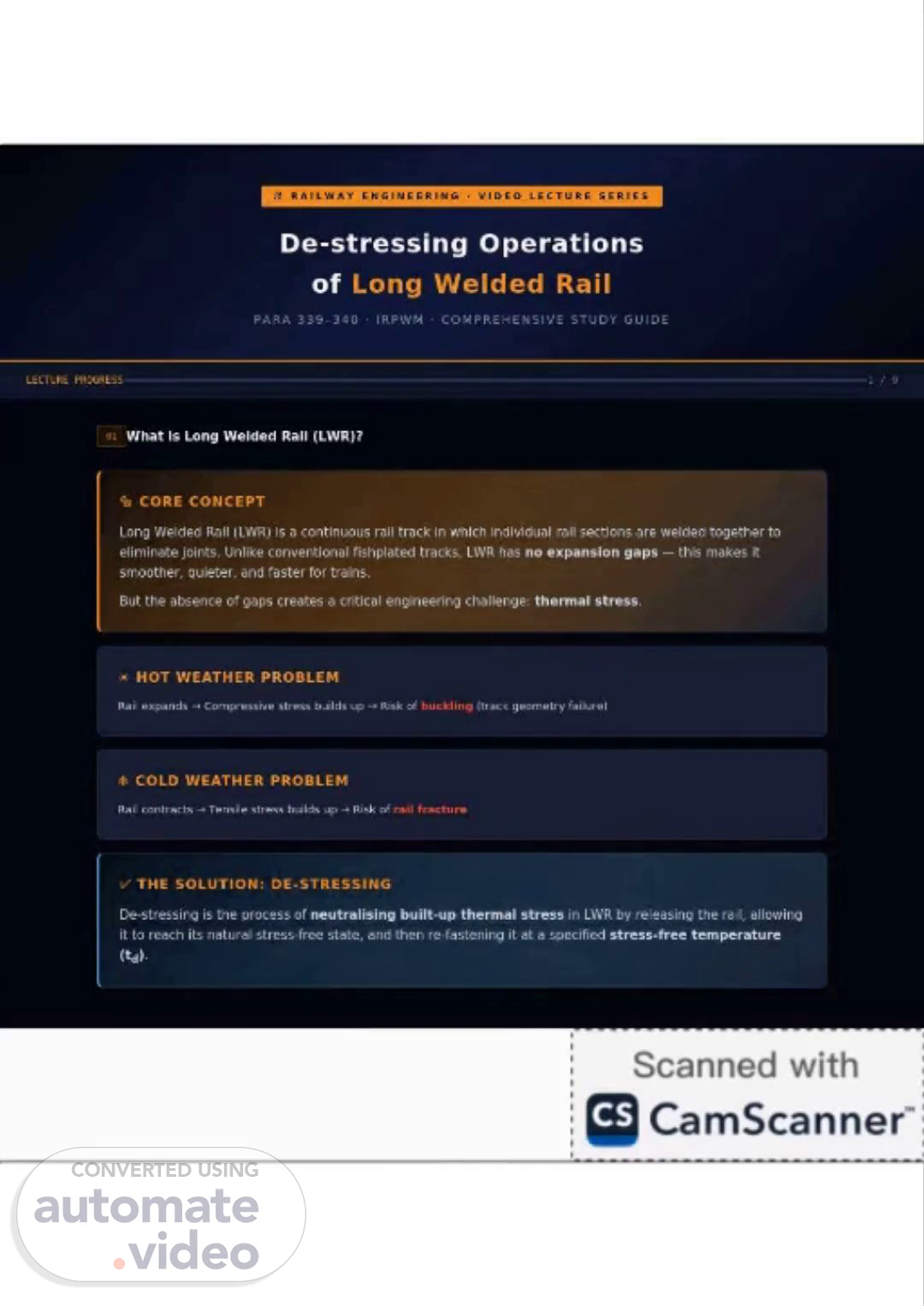
RAILWAY ENGINEERING • VIDEO LECTURE SERIES De-stressing Operations of Long Welded Rail PARA 339-340 • IRPWM • COMPREHENSIVE STUDY GUIDE LECTURE PROGRESS hat is Long Welded Rail (LWR)? CORE CONCEPT Long Welded Rail (LWR) is a continuous rail track in which individual rail sections are welded together to eliminate joints. Unlike conventional fishplated tracks, LWR has no expansion gaps — this makes it smoother, quieter, and faster for trains. But the absence of gaps creates a critical engineering challenge: thermal stress. HOT WEATHER PROBLEM Rail expands -o Compressive stress builds up -w Risk of buckling (track geometry failure) * COLD WEATHER PROBLEM Rail contracts —i Tensile stress builds up —i Risk of rail fracture v' THE SOLUTION: DE-STRESSING De-stressing is the process of neutralising built-up thermal stress in LWR by releasing the rail, allowing it to reach its natural stress-free state, and then re-fastening it at a specified stress-free temperature Scanned with @CamScanner-.
Scene 2 (53s)
[Audio] The company has been working on a new project for several years, but it has not yet reached its full potential. The project involves developing a new type of aircraft that can fly at high speeds and make long-distance flights more efficient. The company has made significant progress in this area, but there are still many challenges to overcome. One major challenge is the development of advanced materials that can withstand the stresses of flight. Another challenge is the need for more efficient engines. The company is currently exploring various options for addressing these challenges, including the use of advanced composites and hybrid propulsion systems..
Scene 3 (1m 35s)
[Audio] The de-stressing operations are performed only when there is a traffic block in place, where the railway line is completely shut down to all trains for the entire duration of the operation. The personal supervision of junior engineers, senior section engineers, and permanent ways personnel is required at all times during the operation. All the data collected during these operations is meticulously documented in a specific register that includes details such as the temperature range during the fastening process, the time and date of the operation, and other relevant information. Before the traffic block can be initiated, a speed limit of 30 kilometers per hour must be enforced on the affected section of the railway line, and the fasteners on every other sleeper must be loosened. This measure ensures that the rails are properly prepared for smooth movement once the block is lifted..