Scene 1 (0s)
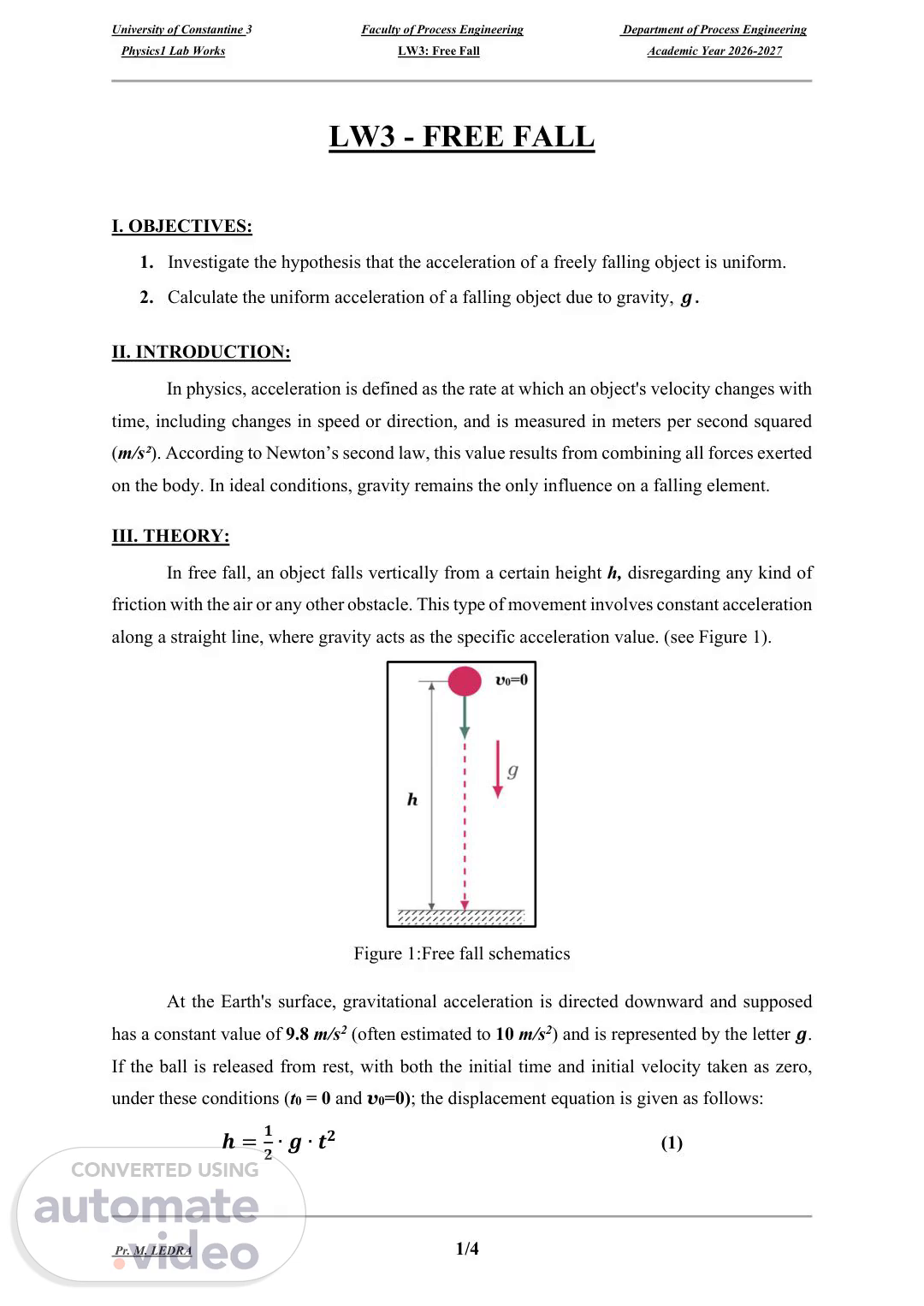
[Audio] University of Constantine 3 Faculty of Process Engineering Department of Process Engineering Physics1 Lab Works LW3: Free Fall Academic Year 2026-2027 LW3 - FREE FALL I. OBJECTIVES: 1. Investigate the hypothesis that the acceleration of a freely falling object is uniform. 2. Calculate the uniform acceleration of a falling object due to gravity, 𝒈. II. INTRODUCTION: In physics, acceleration is defined as the rate at which an object's velocity changes with time, including changes in speed or direction, and is measured in meters per second squared (m/s²). According to Newton's second law, this value results from combining all forces exerted on the body. In ideal conditions, gravity remains the only influence on a falling element. III. THEORY: In free fall, an object falls vertically from a certain height h, disregarding any kind of friction with the air or any other obstacle. This type of movement involves constant acceleration along a straight line, where gravity acts as the specific acceleration value. (see Figure 1). Figure 1:Free fall schematics At the Earth's surface, gravitational acceleration is directed downward and supposed has a constant value of 9.8 m/s2 (often estimated to 10 m/s2) and is represented by the letter 𝒈. If the ball is released from rest, with both the initial time and initial velocity taken as zero, under these conditions (t0 = 0 and v0=0); the displacement equation is given as follows: 𝟏 𝒉 = 𝟐 ∙ 𝒈 ∙ 𝒕𝟐 (1).
Scene 2 (1m 56s)
[Audio] University of Constantine 3 Faculty of Process Engineering Department of Process Engineering Physics1 Lab Works LW3: Free Fall Academic Year 2026-2027 𝑻𝒆𝒔𝒕 𝑯𝒐𝒎𝒆𝒘𝒐𝒓𝒌 Full Name Gr. 𝟐 𝑹𝒆𝒑𝒐𝒓𝒕 𝟏𝟕 𝑻𝒐𝒕𝒂𝒍 𝑴𝒂𝒓𝒌𝒔 𝟏 𝟐𝟎 Date: …………………………………… ……………….…Time: ……………………………Lab No.……………… IV. PROCEDURE AND DATA ANALYSIS: 1. Measure the duration (t) of a particle's free fall without initial velocity at various heights 𝒕𝟏�𝒕𝟐 (h), then record the results in the following table, knowing that 𝒕̅ = 𝟐 . �𝒎 𝑺𝟐� �𝒉 𝒕𝟐� ����� 𝑺𝟐� h (cm) h (m) t1 (ms) t2 (ms) 𝒕 = 𝒕̅ (ms) t(s) t2 (s2) 𝒉 𝒕𝟐 �𝒎 2. Plot the graph h = f (t2), taking t2 (s2) along the x-axis and h (m) along the y-axis. Title :……………………………………………………………………. Pr. M. LEDRA.
Scene 3 (3m 13s)
[Audio] University of Constantine 3 Faculty of Process Engineering Department of Process Engineering Physics1 Lab Works LW3: Free Fall Academic Year 2026-2027 3. Add a best-fit line to the plot and determine the slope (S) of the graph and its SI unit? 4. Find the relation between the slope (S) of the graph and the gravity acceleration (𝒈) ? 5. Deduce the gravity acceleration gexp value and its SI unit? | 𝓰𝒕𝒉𝒆 � 𝓰𝒆𝒙𝒑 | 6. Determine the percent relative error ε (%) = 𝟏𝟎𝟎 × 𝓰𝒕𝒉𝒆 𝓰the �𝒎 𝒔𝟐 ⁄ � 𝓰𝒆𝒙𝒑�𝒎 𝒔𝟐 ⁄ � | 𝓰the – 𝓰exp | �𝒎 𝒔𝟐 ⁄ � ε (%) 9.80 7. What would happen if we selected an object with a different mass? V. CONCLUSION: Pr. M. LEDRA 3/4.
Scene 4 (4m 21s)
[Audio] University of Constantine 3 Faculty of Process Engineering Department of Process Engineering Physics1 Lab Works LW3: Free Fall Academic Year 2026-2027 VI. REFERENCES: 1. www.3bscientific.com 2. https://lehman.edu/faculty/dgaranin/Introductory_Physics/PHY166-lab-freefall.pdf 3. https://www.austincc.edu/physci_tf/Physics/labs/riogrande/phys1401/exp2.pdf 4. https://www.fisicalab.com/en/section/free-fall 5. https://www.studysmarter.co.uk/explanations/physics/kinematics-physics/free-falling-object/ Pr. M. LEDRA 4/4.