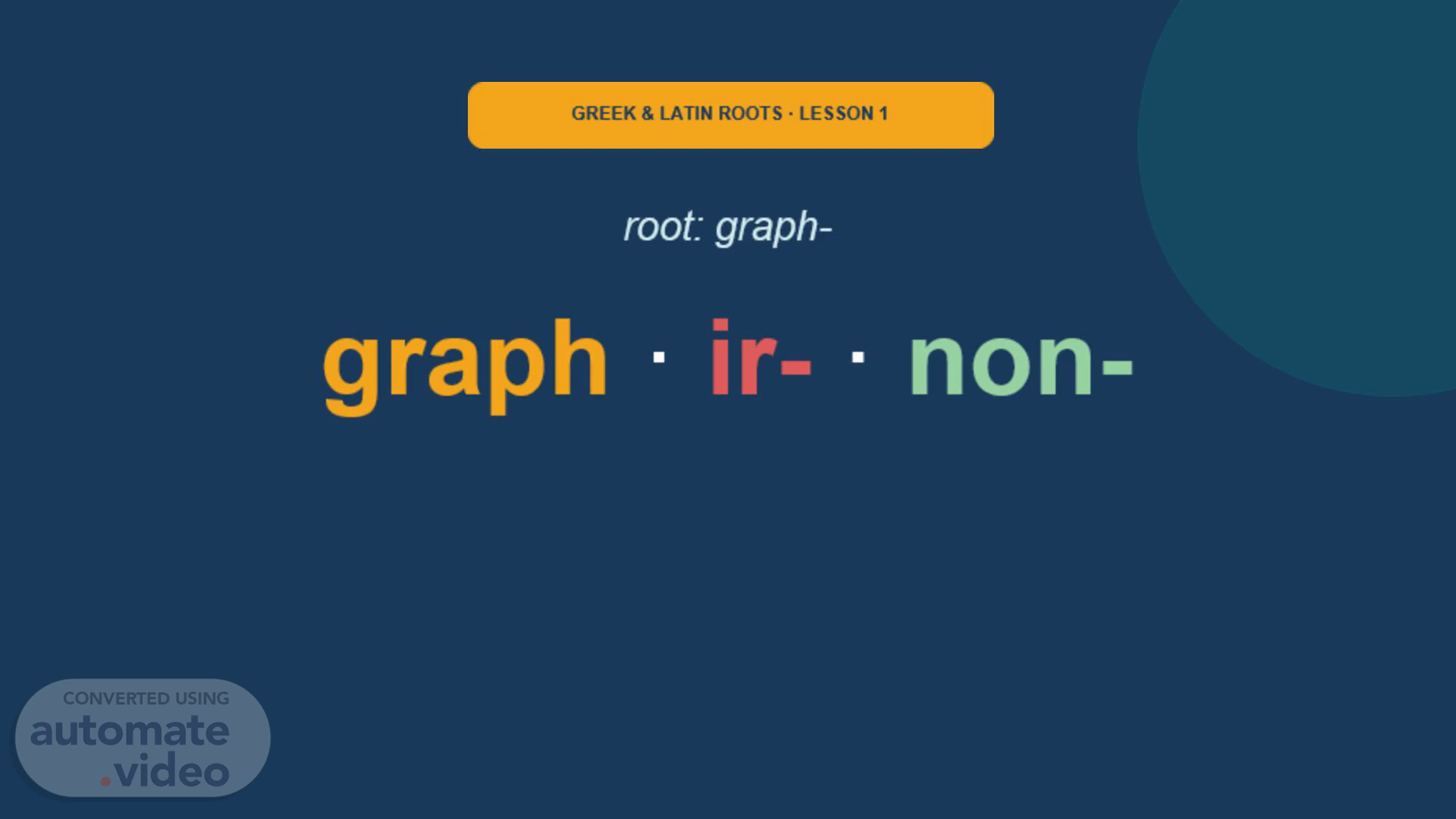
Scene 1 (0s)
[Audio] Welcome slide. Introduce the three word parts students will study today: graph- (root meaning 'write'), ir- (prefix meaning 'not,' used before r), and non- (prefix meaning 'not' or 'without'). Ask students: What do these three things have in common? Let them predict before revealing..
Scene 2 (22s)
[Audio] Spend 3-4 minutes on this slide. Key teaching point: morphemes are the smallest units of meaning in words. Graph- comes from Greek graphein (to write). Ir- is a variant of in- that appears before the letter r — this is called assimilation. Non- is a Latin prefix meaning 'not.' Ask: Can you think of any other words with these parts? (photograph, nonfiction, irresponsible...).
Scene 3 (50s)
[Audio] Graph- word set. Point out: auto+graph = self-write; tele+graph = far-write; para+graph = alongside the writing. Graphite gets its name because it was used for writing. Ask students: what do all these words have to do with writing? Have them discuss with a partner before revealing the morpheme connection..
Scene 4 (1m 37s)
[Audio] Prefix comparison slide. Key teaching: ir- is actually a form of 'in-' (meaning not) that changed spelling to match the r in words like rational, regular, relevant — this is called assimilation. Have students say 'inrational' — it's hard to say! The language changed for ease of pronunciation. Non- stays the same before any word. Quick check: which prefix goes with 'responsible'? (ir-) Which goes with 'fiction'? (non-).
Scene 5 (2m 19s)
[Audio] Morpheme breakdown slide. Have students copy the equation for each word on mini-whiteboards or a sticky note. Emphasize: knowing the parts helps you DECODE unknown words. If you see 'telekinesis' — tele means far, kinesis means movement — moving things from far away! This is exactly why morphology matters. Extension: have students generate their OWN words using these parts..
Scene 6 (2m 48s)
[Audio] Intro slide for the parts-of-speech section. Key teaching point: morphology works in both directions — we add prefixes to change MEANING (ir-/non-) and suffixes to change PART OF SPEECH (-ly, -ity, -ize, -ic, -ed). A single vocabulary word becomes a whole word family. Pose to students: 'If you know the word irrational (adj.), how could you use it in a sentence where you need an adverb? A noun?'.
Scene 7 (3m 24s)
[Audio] Suffix reference chart — consider printing as a bookmark or posting in the room. Walk through each suffix before students begin the word-family activity. Key connections: -ly almost always makes an adverb; -ity/-ance/-ence almost always makes an noun. Ask: 'Can you think of other words that use -ity?' (ability, activity, curiosity). This builds morphemic transfer to new words..
Scene 8 (4m 7s)
[Audio] graph- word families. Teaching tip: 'telegraph' is the richest word in this family for POS changes — walk through telegraph (n.) → telegraph (v.) → telegraphed → telegraphic → telegraphically as a complete chain. Students often don't realize a noun can become a verb just by using it differently in a sentence (denominal verbs). Graphite note: some words have limited POS families — that's normal and worth discussing..
Scene 9 (4m 53s)
[Audio] ir-/non- word families. This is the most morphologically rich part of the lesson. Key discussion: notice how 'rational' spawns rationalize, rationality, rationally — understanding one prefix/suffix at a time lets students decode an entire family. Some forms (nonverbality, nonexistently) are technically possible but rare — this is a good chance to discuss how dictionaries record words only when they're commonly used. Ask: What does it mean for a word to 'count' as a real word? (Usage!).
Scene 10 (5m 32s)
[Audio] POS transformation practice. Answers: 1-irrationally, 2-irregularity, 3-irrelevantly, 4-nonexistence, 5-nonverbally, 6-rationalize, 7-telegraphic, 8-autographed. Give students 4-5 minutes to work independently, then pair-share. Common errors: students may write 'irrational-ly' (hyphen) — discuss that these are written as one word. Item 6 and 7 are the most challenging — expect to spend extra discussion time here..
Scene 11 (6m 27s)
[Audio] Word chain conclusion slide. The key insight: building these chains is exactly what fluent readers do automatically. Research shows that vocabulary depth (knowing multiple forms of a word) predicts reading comprehension better than vocabulary breadth (knowing many unrelated words). Extension idea: have students create their OWN word chain posters using one vocabulary word from any current unit — show as many POS forms as they can..
Scene 12 (7m 12s)
[Audio] This parallels Activity 3 from the student packet. Read sentences aloud and pause at the blank — give students 20 seconds to discuss with a partner before calling on someone. The hint tags show which word-family each answer comes from; encourage students to use that as a decoding strategy. Reveal answers after class discussion: 1-irrational, 2-irrelevant, 3-autograph, 4-nonexistent, 5-nonverbal, 6-paragraph..
Scene 13 (7m 49s)
[Audio] T/F activity — great for whole-class engagement. Don't reveal the answers immediately! After each question, have students defend their answer using the word's definition or the meaning of the word part. For 'graphite is more dangerous than lead': the word 'graphite' comes from graph (write) and was used as the writing material — it replaced actual lead in pencils because lead IS toxic. Pair discussion works well here..
Scene 14 (8m 25s)
[Audio] Word matrix slide. This directly supports Activity 4 (Adding Prefixes). Key discussion: why can't we use ir- with 'existent'? Because it doesn't start with r! The matrix helps students see the SYSTEM behind prefix use. Bonus words (nonfiction, irresponsible, nontoxic) are from Activity 4's prefix-adding exercise. Have students suggest MORE words that could go in each column..
Scene 15 (8m 55s)
[Audio] Analogies come directly from Activity 4. Before showing the answers, have students work independently for 60 seconds, then share out. Analogies build flexible, relational thinking about word meaning — they push beyond simple definition recall. After the activity, ask: What strategy did you use? (Word part knowledge? Process of elimination? Context from definition?) All valid strategies..
Scene 16 (9m 31s)
[Audio] Wrap-up slide. Exit ticket gives you formative data on all three levels: recall (definitions of word parts), application (writing a sentence), and extension (generating new examples). Collect on an index card or sticky note. Preview for next lesson: connect to any upcoming morphology lesson or tell students to notice these word parts 'in the wild' — in their independent reading, on signs, in other classes..