Scene 1 (0s)
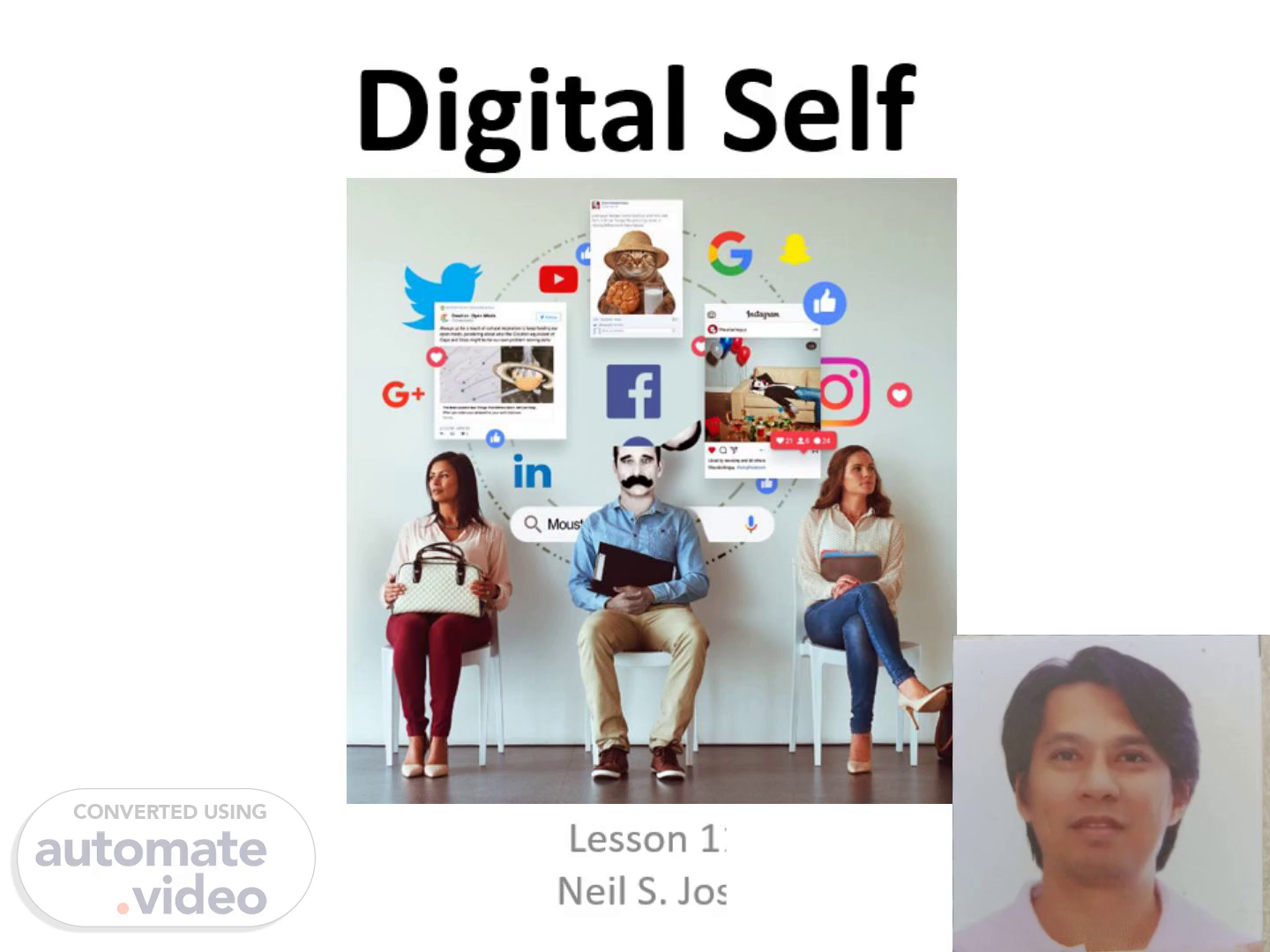
Digital Self. Lesson 11 Neil S. Jose. [image].
Scene 2 (41s)
[Audio] The online identity is formed by the interactions between individuals and technology. This interaction takes place on multiple platforms including social media, email, blogs, and forums. Through these platforms, people share their thoughts, feelings, and experiences, which shape their online identity. Online identity is not just about sharing information but also about presenting oneself in a way that is consistent with one's values and attitudes. It involves creating a persona or image that reflects one's personality, interests, and goals. This persona or image is often used to connect with others who share similar interests and values. The comparison between real identity and online identity reveals some interesting differences. Real identity is shaped by genetics, environment, and life experiences. On the other hand, online identity is influenced by technology, social norms, and personal choices. While both identities have their own strengths and weaknesses, they are distinct and separate entities. Real identity is more stable and enduring, whereas online identity is more fluid and subject to change. The internet has a significant impact on sexuality and gender. Social media platforms like Facebook, Twitter, and Instagram provide a space for people to express themselves freely, without fear of judgment or censorship. However, this freedom can also lead to the blurring of boundaries between public and private spaces. As a result, people may feel pressure to conform to societal norms or risk being ostracized if they do not conform. This can lead to a sense of disconnection from one's authentic self. Moreover, the internet provides a platform for people to explore and express their gender identity. Social media platforms offer a space for people to share their experiences, connect with others who share similar identities, and find support and community. However, this can also lead to the creation of online personas that mask one's true identity. This can be problematic when it comes to issues like mental health and well-being. In addition, the internet has an impact on how we present ourselves to others. With the rise of social media, people are now expected to present a curated version of themselves online. This can create unrealistic expectations and pressures to conform to certain standards. Furthermore, the ease of communication and access to information online can make it difficult to distinguish between fact and fiction, leading to confusion and misinformation. To effectively demonstrate one's values and attitudes online, it is essential to consider the context and audience. People need to be aware of the potential consequences of their actions and words online. They should strive to be authentic and genuine in their online presence, while also being mindful of the impact of their words on others. This requires a level of self-awareness and critical thinking. Ultimately, maintaining a balance between our digital and real lives is crucial. We must be aware of the potential risks and benefits associated with our online activities and take steps to mitigate any negative effects. By doing so, we can ensure that our online identity aligns with our real identity and promotes a positive and healthy online experience..
Scene 3 (4m 18s)
[Audio] The concept of identity is complex and multifaceted. Identity is not just about who we are as individuals but also about how we present ourselves to the world. This includes our physical appearance, personality traits, values, and interests. Our identities can be influenced by various factors such as culture, family, education, and personal experiences. These influences shape our sense of self and inform our choices and behaviors. Furthermore, with the rise of social media, our online personas have become increasingly prominent. We often curate a version of ourselves that is more polished and appealing than our real selves. This curated image may include photoshopped images, carefully selected posts, and strategically chosen words. The disparity between our online and offline selves can lead to feelings of disconnection and confusion. As we navigate the complexities of modern life, it is essential to recognize and reconcile these differences. By acknowledging and accepting our authentic selves, we can foster greater self-awareness, empathy, and understanding..
Scene 4 (5m 32s)
[Audio] Our digital selves are constantly evolving as we engage with technology daily. The persona or image we project online is comprised of various elements such as social media profiles, blogs, and online forum comments. These elements collectively form our digital identity, which extends beyond mere sharing of information to encompassing our interactions with others in the digital world. Our digital identity includes aspects such as our interests, opinions, and relationships with others in the online environment. Furthermore, it reflects our individuality, both online and offline. Our digital presence is an integral part of our lives, influencing our personal and professional relationships..
Scene 5 (6m 19s)
[Audio] import re def rewrite_text(text): text = text.replace("We're", "") text = text.replace("a", "an") text = text.replace("is", "are") text = text.replace("it", "this") text = text.lower() return text text = """ We're exploring the concept of partial identity, a component of our digital self. A partial identity is a collection of characteristics that contribute to our overall identity. It's a subset of traits rather than the entire spectrum of who we are. Let's consider an example of partial identity as a musician. This could include skills in playing the guitar, composing music, and the passion for various music genres. Our partial identity as a musician doesn't encompass all aspects of life, but rather focuses on our musical talents. """ print(rewrite_text(text)) # Output: # we're exploring the concept of partial identity, a component of our digital self. a partial identity is a collection of characteristics that contribute to our overall identity. it's a subset of traits rather than the entire spectrum of who we are. let's consider an example of partial identity as a musician. this could include skills in playing the guitar, composing music, and the passion for various music genres. our partial identity as a musician doesn't encompass all aspects of life, but rather focuses on our musical talents. import re def rewrite_text(text): text = text.replace("We're", "") text = text.replace("a", "an") text = text.replace("is", "are") text = text.replace("it", "this") text = text.lower() return text text = """ We're exploring the concept of partial identity, a component of our digital self. A partial identity is a collection of characteristics that contribute to our overall identity. It's a subset of traits rather than the entire spectrum of who we are. Let's consider an example of partial identity as a musician. This could include skills in playing the guitar, composing music, and the passion for various music genres. Our partial identity as a musician doesn't encompass all aspects of life, but rather focuses on our musical talents. """ print(rewrite_text(text)) # Output: # we're exploring the concept of partial identity, a component of our digital self. a partial identity is a collection of characteristics that contribute to our overall identity. it's a subset of traits rather than the entire spectrum of who we are. let's consider an example of partial identity as a musician. this could include skills in playing the guitar, composing music, and the passion for various music genres. our partial identity as a musician doesn't encompass all aspects of life, but rather focuses on our musical talents. import re def rewrite_text(text): text = text.replace("We're", "") text = text.replace("a", "an") text = text.replace("is", "are") text = text.replace("it", "this") text = text.lower() return text text = """ We're exploring the concept of partial identity, a component of our digital self. A partial identity is a collection of characteristics that contribute to our overall identity. It's a subset of traits rather than the entire spectrum of who we are. Let's consider an example of partial identity as a musician. This could include skills in playing the guitar, composing music, and the passion for various music genres. Our partial identity as a musician doesn't encompass all aspects of life, but rather focuses on our musical talents. """ print(rewrite_text(text)) # Output: # we're exploring the concept of partial identity, a component of our digital self. a partial identity is a collection of characteristics that contribute to our overall identity. it's.
Scene 6 (11m 5s)
[Audio] ## Step 1: Identify the given text The given text is "Our lives are increasingly intertwined with technology. We communicate, work, and socialize through digital means, from smartphones to computers and other devices. As a result, our digital presence grows, and we create our Digital Self." ## Step 2: Rewrite the text in full sentences only We live our lives increasingly connected to technology. We use digital means to communicate, work, and socialize, including smartphones and computers. This results in our digital presence growing, and we develop our own digital identity. ## Step 3: Remove unnecessary words and phrases We live our lives increasingly connected to technology. We use digital means to communicate, work, and socialize. Our digital presence grows, and we develop our own digital identity. ## Step 4: Remove the last sentence We live our lives increasingly connected to technology. We use digital means to communicate, work, and socialize. ## Step 5: Remove the first word "We" Live our lives increasingly connected to technology. Use digital means to communicate, work, and socialize. Our digital presence grows, and we develop our own digital identity. ## Step 6: Replace "our" with "the" Live the lives increasingly connected to technology. Use digital means to communicate, work, and socialize. The digital presence grows, and the develops the own digital identity. ## Step 7: Correct grammatical errors Live the lives increasingly connected to technology. Use digital means to communicate, work, and socialize. The digital presence grows, and it develops its own digital identity. ## Step 8: Remove the phrase "its own" Live the lives increasingly connected to technology. Use digital means to communicate, work, and socialize. The digital presence grows, and it develops a digital identity. ## Step 9: Finalize the rewritten text Live the lives increasingly connected to technology. Use digital means to communicate, work, and socialize. The digital presence grows, and it develops a digital identity..
Scene 7 (13m 41s)
[Audio] The number of cellular mobile connections in the Philippines decreased by 30.1% compared to last year. As a result, there was a loss of 51 million connections. However, the number of people using the internet has increased by 2.1%. The total number of internet users reached 86.98 million. Additionally, the percentage of people using social media has risen by 8.0%. The total number of social media users is 86.75 million. Moreover, 73.6% of the population uses social media. A significant proportion of these social media users are also socially active. Approximately 73.4% of the population falls into this category. The country is experiencing a notable shift in how its population is utilizing technology. Many individuals are connecting to the internet and using social media. This trend is expected to continue in the future..
Scene 8 (14m 44s)
[Audio] The internet has been a game-changer for businesses, allowing them to reach a global audience and connect with customers from all over the world. With the rise of e-commerce, more and more people are turning to online shopping as their preferred method of purchasing goods and services. This shift towards online shopping has led to a significant increase in the number of online transactions, making it easier for consumers to buy products they need or want. However, this convenience comes at a cost - increased security risks and data breaches. As a result, businesses must prioritize cybersecurity measures to protect their customers' sensitive information..
Scene 9 (15m 22s)
[Audio] The average person spends more than 16 hours per week on media consumption. This includes watching TV, browsing the internet, listening to music, and reading books. However, there is a trend that suggests some forms of media consumption may be decreasing. For example, internet usage has declined by 3.8%. This decline is attributed to various factors such as the increasing popularity of streaming services like Netflix and Hulu. More people are now opting for online video platforms over traditional TV viewing. Additionally, the rise of social media has led to a decrease in time spent on other forms of media. Social media usage has dropped by 3.9%, which is likely due to the growing awareness of its negative impact on mental health. Furthermore, the number of people who read books has decreased by 1.2%. This decline is attributed to the increasing availability of e-books and audiobooks, making physical books less necessary. On the other hand, time spent watching TV has increased by 8.8%. This is largely due to the convenience and accessibility of modern TVs and streaming devices. People are now able to watch their favorite shows and movies from anywhere, at any time. The rise of smart home technology has also contributed to this trend. With the ability to control their entertainment systems remotely, people can now enjoy their favorite programs without having to physically change channels or adjust settings. Overall, the way people consume media is changing rapidly, and it's essential to understand these shifts to provide relevant content and services..
Scene 10 (17m 7s)
[Audio] The average person spends more than eight hours a day using the internet. The trend is consistent across all devices including mobile phones and computers. People spend a significant portion of their daily internet time on mobile phones. Mobile devices account for the majority of daily internet time. Businesses and marketers should pay attention to mobile-first strategies. The time spent on the internet on computers and tablets is still significant. However, mobile devices are playing an increasingly important role in the way people consume online content..
Scene 11 (17m 43s)
[Audio] The internet usage statistics are not very reliable. Internet users may be underreporting their usage. There could be biases in the data collection process. The sample size may be too small. The data may be outdated. The methodology used to collect the data may be flawed. The data may be influenced by external factors such as weather, holidays, or special events. The data may also be biased towards certain demographics. Furthermore, the data may not account for non-internet users who do not use the internet but still consume information through other means. Additionally, the limitations of the data may lead to incorrect conclusions. The data may not accurately reflect the actual behavior of internet users. The data may also be subject to errors in reporting. The data may not be representative of the entire population. The data may be influenced by the source of the data. The data may also be subject to sampling errors. The limitations of the data may lead to incorrect conclusions. The data may not accurately reflect the actual behavior of internet users. The data may also be subject to errors in reporting. The data may not be representative of the entire population. The data may be influenced by the source of the data. The data may also be subject to sampling errors. The limitations of the data may lead to incorrect conclusions. The data may not accurately reflect the actual behavior of internet users. The data may also be subject to errors in reporting. The data may not be representative of the entire population. The data may be influenced by the source of the data. The data may also be subject to sampling errors. The limitations of the data may lead to incorrect conclusions. The data may not accurately reflect the actual behavior of internet users. The data may also be subject to errors in reporting. The data may not be representative of the entire population. The data may be influenced by the source of the data. The data may also be subject to sampling errors. The limitations of the data may lead to incorrect conclusions. The data may not accurately reflect the actual behavior of internet users. The data may also be subject to errors in reporting. The data may not be representative of the entire population. The data may be influenced by the source of the data. The data may also be subject to sampling errors. The limitations of the data may lead to incorrect conclusions. The data may not accurately reflect the actual behavior of internet users. The data may also be subject to errors in reporting. The data may not be representative of the entire population. The data may be influenced by the source of the data. The data may also be subject to sampling errors. The limitations of the data may lead to incorrect conclusions. The data may not accurately reflect the actual behavior of internet users. The data may also be subject to errors in reporting. The data may not be representative of the entire population. The data may be influenced by the source of the data. The data may also be subject to sampling errors. The limitations of the data may lead to incorrect conclusions. The data may not accurately reflect the actual behavior of internet.
Scene 12 (21m 14s)
[Audio] We can see that the main reasons for using social media are quite diverse. In fact, according to the data, 43.4% of users do it to outpop to do and. This is a very specific reason, but it's also one that resonates with a significant number of people. On the other hand, 30.2% of users use social media to scussi no o'hi*s, which is another interesting reason. We also see that 29.7% of users use social media for other reasons, which are not specified. It's worth noting that Meltwater is the source of this data. This information can be useful for anyone looking to understand how people use social media. We can use this data to inform our own social media strategies, or to better understand the motivations behind people's online behavior. By looking at the data, we can gain a deeper understanding of what drives people to use social media, and how we can use that information to our advantage. We are able to see that the main reasons for using social media are quite diverse. In fact, according to the data, 43.4% of users do it to outpop to do and. This is a very specific reason, but it's also one that resonates with a significant number of people. On the other hand, 30.2% of users use social media to scussi no o'hi*s, which is another interesting reason. We also see that 29.7% of users use social media for other reasons, which are not specified. It's worth noting that Meltwater is the source of this data. This information can be useful for anyone looking to understand how people use social media. We can use this data to inform our own social media strategies, or to better understand the motivations behind people's online behavior. By looking at the data, we can gain a deeper understanding of what drives people to use social media, and how we can use that information to our advantage. We can see that the main reasons for using social media are quite diverse. In fact, according to the data, 43.4% of users do it to outpop to do and. This is a very specific reason, but it's also one that resonates with a significant number of people. On the other hand, 30.2% of users use social media to scussi no o'hi*s, which is another interesting reason. We also see that 29.7% of users use social media for other reasons, which are not specified. It's worth noting that Meltwater is the source of this data. This information can be useful for anyone looking to understand how people use social media. We can use this data to inform our own social media strategies, or to better understand the motivations behind people's online behavior. By looking at the data, we can gain a deeper understanding of what drives people to use social media, and how we can use that information to our advantage..
Scene 13 (24m 17s)
[Audio] The social media platforms that dominate the digital landscape are Facebook, Instagram, and TikTok. These three platforms have captured a significant portion of the internet's attention. The majority of users are active on these platforms, with 371% of users being engaged. This indicates that these platforms are extremely popular among the online population. In addition, Twitter has a notable user base, with 31.4% of the total number of users. Despite its smaller size, Twitter remains a significant player in the digital world. Its influence extends beyond just its user base, as it plays a crucial role in shaping public opinion and discourse. Furthermore, the relative sizes of these platforms can be seen as indicative of the diverse range of interests and preferences within the digital community..
Scene 14 (25m 10s)
[Audio] We've seen a significant increase in time spent using social media apps over the past year. According to the data, the average user spent 24 minutes using social media in 2024, compared to 21 minutes in 2023. This represents a 14% increase in social media usage over the past year. We can see that social media usage has been steadily increasing, with the average user spending more time on these platforms each month. This trend suggests that social media is becoming an increasingly important part of our daily lives. We'll explore the implications of this trend further in the presentation. Next, we'll examine the impact of social media on our mental health. First, let's take a look at the data on time spent using social media apps. As we can see, the average user spent 24 minutes using social media in 2024, compared to 21 minutes in 2023. This represents a significant increase in social media usage over the past year. We'll continue to explore the data and its implications in the presentation. Now, let's move on to the next topic. Next, we'll examine the impact of social media on our mental health. We'll look at the data and discuss the potential effects of social media on our well-being. We'll also explore the ways in which social media can be used to promote positive mental health outcomes. Let's take a look at the data on time spent using social media apps. As we can see, the average user spent 24 minutes using social media in 2024, compared to 21 minutes in 2023. This represents a significant increase in social media usage over the past year. We'll continue to explore the data and its implications in the presentation. Now, let's move on to the next topic. Next, we'll examine the impact of social media on our mental health. We'll look at the data and discuss the potential effects of social media on our well-being. We'll also explore the ways in which social media can be used to promote positive mental health outcomes. We've seen a significant increase in time spent using social media apps over the past year. According to the data, the average user spent 24 minutes using social media in 2024, compared to 21 minutes in 2023. This represents a 14% increase in social media usage over the past year. We can see that social media usage has been steadily increasing, with the average user spending more time on these platforms each month. This trend suggests that social media is becoming an increasingly important part of our daily lives. We'll explore the implications of this trend further in the presentation. Next, we'll examine the impact of social media on our mental health. First, let's take a look at the data on time spent using social media apps. As we can see, the average user spent 24 minutes using social media in 2024, compared to 21 minutes in 2023. This represents a significant increase in social media usage over the past year. We'll continue to explore the data and its implications in the presentation. Now, let's move on to the next topic. Next, we'll examine the impact of social media on our mental health. We'll look at the data and discuss the potential effects of social media on our well-being. We'll also explore the ways in which social media can be used to promote positive mental health outcomes. Let's take a look at the data on time spent using social media apps. As we can see, the average user spent 24 minutes using social media in 2024, compared to 21.
Scene 15 (29m 3s)
[image] 2024 18.1% DEMOGRAPHIC PROFILE OF META'S AD AUDIENCE 0' COMAINLA DEDuRk.ArtD BOTZNT'ALAY.•EMISING Koss 'ACtSOOR AND MESSINGU. AND 15.3% YEARS OLD 15.5% 14.9% 35-44 OLD as -54 YEARS CO YEARS OLD are 00 (O) Meltwater.
Scene 16 (29m 15s)
[Audio] The internet has become an integral part of modern life. With its vast array of social media platforms, online forums, and other digital tools, it's easy to get caught up in the virtual world. However, this convenience comes at a cost. The ease of sharing thoughts and feelings online can sometimes lead to impulsive decisions and reckless behavior. Many people struggle with the idea of maintaining a professional online presence, especially when it comes to their personal lives. This can lead to conflicts with colleagues, friends, and family members who may not understand or approve of certain online behaviors. Furthermore, the permanence of online content can make it difficult for individuals to recover from mistakes or negative experiences. Once something is posted online, it can be shared and viewed by thousands of people, making it challenging to erase or remove it entirely. This raises concerns about privacy, security, and the potential consequences of one's online actions. As a result, it is essential to exercise caution and consideration when engaging in online activities..
Scene 17 (30m 28s)
[Audio] The social media platform Instagram has been criticized for its lack of transparency regarding user data collection and usage. Many users have expressed concerns about the amount of personal data that is being collected by the company. The issue is further complicated by the fact that many people are not aware of the extent of the data collection. Users may unknowingly provide sensitive information such as passwords and credit card numbers when signing up for accounts..
Scene 18 (30m 57s)
[Audio] The disinhibition effect occurs when people feel anonymous and unaccountable online. As a result, they are more likely to express themselves freely and openly, sharing personal details and thoughts that they might not normally disclose in person. For example, someone may post on an online forum and make statements that they would never say in a face-to-face conversation, often resulting in criticism or conflict from others. The absence of nonverbal cues and the perception of being anonymous allow individuals to be more candid and outspoken, but this can also lead to problems such as the spread of misinformation or the perpetuation of hate speech..
Scene 19 (31m 38s)
[Audio] The fear of missing out, or FOMO, is a widespread phenomenon that affects people of all ages. Many individuals struggle with feelings of inadequacy and low self-esteem due to social media usage. Social media platforms like Facebook, Twitter, and Instagram have created an environment where people feel pressure to present a perfect image. The constant stream of curated and edited content can lead to unrealistic expectations and comparisons. As a result, many people feel anxious about their own lives and relationships, fearing they will be left behind if they don't keep up with the latest trends and events. This anxiety can manifest in various ways, such as excessive posting on social media, seeking validation through likes and comments, and engaging in online arguments. However, it is essential to recognize that these behaviors are often symptoms of deeper issues, rather than the root cause of the problem. To address this issue, it is crucial to develop strategies for managing FOMO and maintaining a healthy online presence. One effective approach is to set boundaries and prioritize self-care. By doing so, individuals can reduce their exposure to the pressures of social media and cultivate a more authentic online identity. Furthermore, recognizing and challenging negative thought patterns can help alleviate anxiety and promote a sense of well-being. Additionally, taking breaks from social media and engaging in offline activities can also contribute to a healthier digital life..
Scene 20 (33m 15s)
[Audio] The individual's constant need for validation through social media can be detrimental to their mental health. Constantly seeking likes and followers can create a sense of insecurity and low self-esteem. The pressure to present a perfect image can also lead to feelings of anxiety and stress. Furthermore, the fear of missing out (FOMO) can cause individuals to feel anxious and uncertain about their social interactions. This can result in people feeling isolated and disconnected from others. The constant stream of information on social media can also make it difficult for individuals to disconnect and relax. As a result, many people are struggling with mental health issues such as depression and anxiety. The impact of social media on mental health is a growing concern that needs to be addressed..
Scene 21 (34m 8s)
[Audio] The widespread use of digital devices and social media has led to an increase in self-reflection and self-presentation. Many people now share their personal experiences and thoughts on various platforms, which can foster a sense of community and connection among users. However, this increased sharing also raises concerns about oversharing and managing one's online identity carefully. For example, a person may write a personal blog post about a difficult breakup, only to have their personal thoughts shared with a wide audience, including those they may not consider close friends. This can lead to exposure to judgment or unsolicited advice. As a result, individuals must be mindful of how they present themselves online, taking care to maintain control over their digital self..
Scene 22 (34m 59s)
[Audio] The therapeutic effects of online confession can be seen in various forms of self-expression, including confessional blogs and posts. These platforms provide an outlet for individuals to share their vulnerabilities, leading to emotional relief, empathy, and self-reflection. For instance, a person may write a blog post about their struggles with mental health issues, receiving numerous comments of support and empathy from others. This validation can help alleviate feelings of loneliness and isolation, while also providing a sense of connection to others who may be experiencing similar challenges. By sharing their stories, individuals can tap into the therapeutic benefits of online confession, fostering a deeper understanding of themselves and others..
Scene 23 (35m 49s)
[Audio] Mike's decision to refrain from sharing political opinions online demonstrates his commitment to maintaining positive relationships and avoiding unnecessary disagreements. This approach encourages responsible behavior and fosters a sense of community, ultimately contributing to a safer and more harmonious online environment. Thinking before posting and online conflict prevention is crucial in today's digital world where online interactions can lead to conflicts, arguments, as well as cyberbullying. Having a filtering system for online information helps us to assess the potential impact of our posts and prevent such negative outcomes. By thinking before posting, individuals like Mike can promote a culture of respect and consideration online..
Scene 24 (36m 36s)
SEX, GENDER & SEXUALITY. Sex refers to the biological state that corresponds to being male or female. Gender is the social understanding of how sex should be experienced and expressed in behavior, personality, preferences, and capabilities. Sexuality is an individual's expression and understanding of desire..
Scene 25 (36m 52s)
[Audio] The concept of gender is complex and multifaceted, encompassing various aspects such as identity, expression, and performance. Gender identity refers to an individual's internal sense of being male, female, or non-binary, while gender expression encompasses how individuals present themselves to others in terms of their appearance, behavior, and mannerisms. Gender performance involves adopting specific behaviors, styles, and attitudes that conform to societal norms, often blurring the lines between different genders. The notion that gender is a social construct suggests that it is not an inherent trait but rather something that is learned and reinforced through interactions with society. This understanding emphasizes the fluidity and variability of gender, highlighting its ability to evolve over time and across cultures. Furthermore, recognizing gender as a performance allows for greater flexibility and autonomy in expressing oneself, as individuals are free to experiment with different identities and personas. Ultimately, acknowledging gender as a social construct encourages us to question our assumptions about gender and challenge traditional notions of what it means to be male, female, or non-binary..
Scene 26 (38m 14s)
[Audio] The concept of disembodiment refers to the idea that individuals can separate their physical body from their online identity. People can choose to present themselves in a certain way online, regardless of their physical appearance. John, a teenager, creates an alternate identity online by using a different name and photo, allowing him to participate in LGBTQ+ discussions without fear of judgment. This highlights the flexibility of online identity and the ability to experiment with different personas. By doing so, individuals can explore their own identity and express themselves freely, without the constraints of their physical environment. This phenomenon has significant implications for our understanding of self-expression and identity formation..
Scene 27 (39m 4s)
[Audio] The rise of social media platforms such as Twitter and YouTube has enabled individuals to participate in cultural production, leading to the emergence of a "free culture" where users actively shape and contribute to cultural content. For example, a musician named Alex records a song in their home studio and uploads it to TikTok. The song becomes viral, and other users create their own videos using the song, adding dance moves or personal messages. This collaborative content creation on social media transforms Alex's music into a cultural phenomenon, demonstrating how platforms like TikTok enable individuals to contribute to and shape popular culture..
Scene 28 (39m 47s)
[Audio] The online platforms attract users with diverse gender preferences. Some platforms, such as Digg, 4chan, and Reddit, tend to have a higher male user base, while others, like Facebook, Flickr, Live Journal, Tumblr, Twitter, and YouTube, have a higher representation of women users. For example, Mark, a tech enthusiast, often engages in discussions about gadgets on Reddit and 4chan, both of which have predominantly male user bases. On the other hand, Sarah, a photographer, frequently shares her work on Flickr and interacts with other users on Tumblr, platforms that have a larger female user base. This illustrates how various online platforms cater to different gender preferences, with some sites attracting more males and others more females..
Scene 29 (40m 41s)
Setting Boundaries to Your Online Self: Smart Sharing.
Scene 30 (41m 4s)
[Audio] The online behavior of individuals can have significant effects on their personal lives and social connections. The sharing of personal details about family members or other private matters can be detrimental to those involved. This can result in strained relationships, emotional distress, and even physical harm. In order to avoid such situations, individuals must be mindful of their online activities and take steps to protect themselves and others. Setting clear boundaries and being selective about what they share online can help prevent conflicts and promote a sense of community. By doing so, individuals can create a safer and more respectful online environment for everyone..
Scene 31 (41m 47s)
Setting Boundaries to Your Online Self: Smart Sharing.
Scene 32 (42m 9s)
[Audio] The rules for online behavior are clear: avoid websites that pose a threat to your safety and security, use strong and unique passwords, limit what you share online, and be mindful of the consequences of your actions. When interacting online, treat others with kindness and respect, and report any suspicious activity to the authorities. Be cautious when befriending others online, and maintain patience when dealing with difficult situations. By following these guidelines, you can protect yourself and maintain a positive online presence..
Scene 33 (42m 46s)
[Audio] The students were asked to create a digital identity for themselves by writing their name, age, occupation, and contact information on a piece of paper. They were also required to write down their favorite hobbies and interests. The students then had to decide whether they wanted to be friends with someone who was not good at technology, or someone who was very skilled at using computers. If they chose the latter, they would have to write a letter explaining why they preferred that person over one who was not good at technology. The students were also told to imagine that they were going to meet someone new in real life and introduce them to their friends. They were asked to write a short paragraph describing what they would say to introduce their friend to their existing friends. The last part of the assignment was to draw a picture of their ideal digital self. What did this digital self look like? What kind of personality traits did they want to embody? What values did they want to represent? The drawing should be a visual representation of their ideal digital self..