Scene 1 (0s)
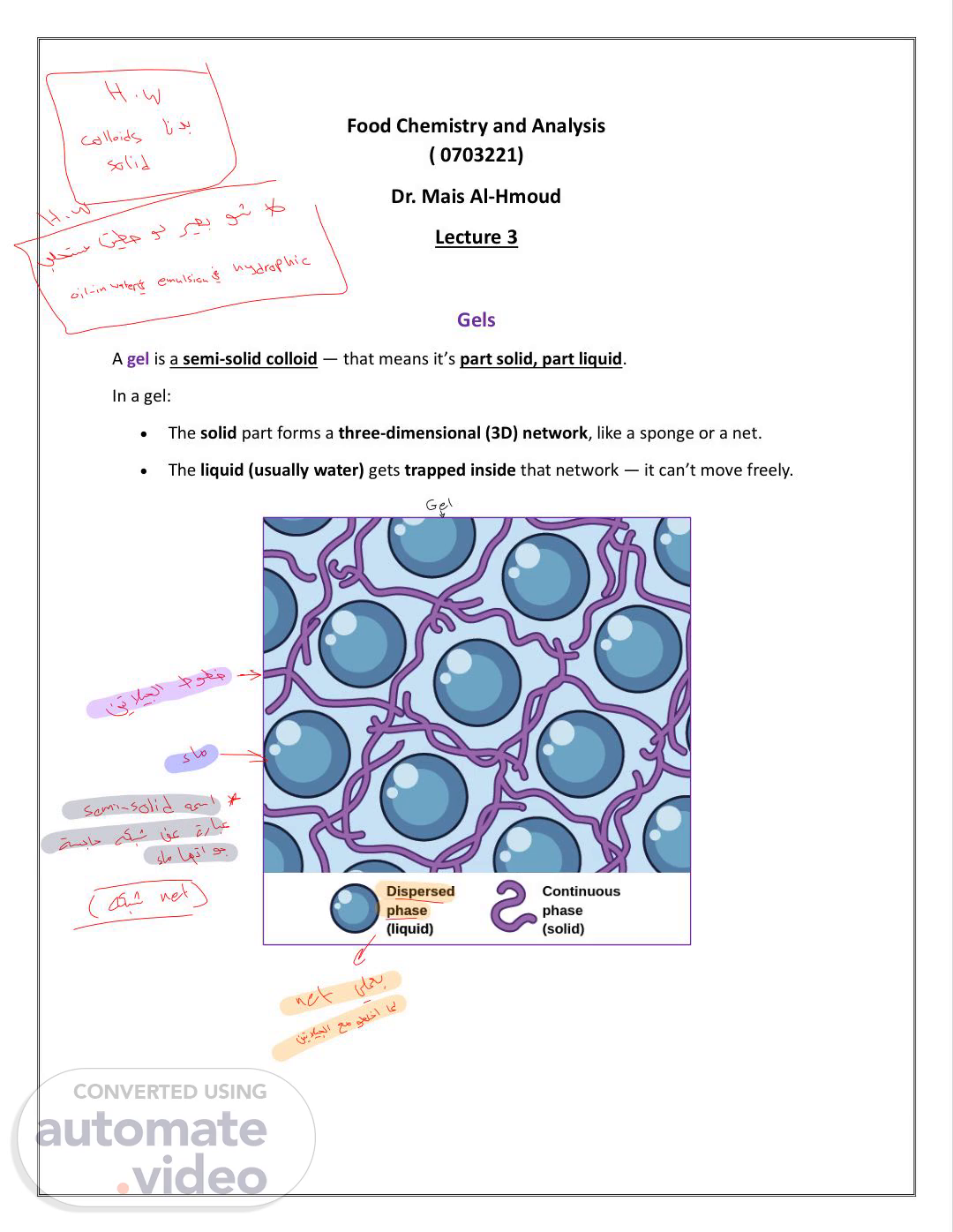
Food Chemistry and Analysis ( 0703221) Dr. Mais Al-Hmoud Lecture 3 Gels A gel is a semi-solid colloid — that means it’s part solid, part liquid. In a gel: The solid part forms a three-dimensional (3D) network, like a sponge or a net. The liquid (usually water) gets trapped inside that network — it can’t move freely..
Scene 2 (10s)
Properties of Gels Gels are special because they have both solid and liquid properties: Property Type Behavior Example Solid-like Keep their shape and can support light weight Jelly sits on a plate without flowing Liquid-like Contain water, conduct electricity, and allow reactions Jelly can dry out (water can evaporate), and ions can move through it Factors Affecting Gel Formation 1. Type of Dispersed Phase (What Makes the Network) Different substances can form gels — but some need more concentration than others. Pectin or gelatin can form a firm gel even at very low concentration (around 1%). Example: Jam and jelly can set even when you use a small amount of pectin. Globular proteins (like egg white proteins) need higher concentrations around 10% to form a solid gel. Example: You need more egg white to make a firm custard than gelatin to make jelly. So, the type of material affects how easily a gel can form. 2. Nature of the Colloid (Water-Loving or Not) Hydrophilic colloids (water-loving) — like gelatin, pectin, starch — easily interact with water and form gels. They attract water and trap it inside their network. Hydrophobic colloids (water-hating) — like oil particles — do not form gels easily because they don’t hold onto water..
Scene 3 (43s)
3. Temperature Temperature has a big effect on gels: Cooling helps form gels. → When you cool down a gelatin dessert, the gelatin molecules slow down and link together, forming a solid network that traps water. Heating breaks the gel. → When you heat jelly, the gelatin structure loosens and the gel melts into liquid again. → So, a gel can be reversible — it forms when cold and melts when warm. 4. pH and Salts The pH (acidity) and the presence of salts can change the charge and hydration of the particles in a gel — and this affects its texture. In fruit jams, the ideal pH is between 3.0 and 3.8 → slightly acidic. →This acidity helps the pectin molecules come close enough to bond and form a firm gel. → If pH is too high (not acidic enough), the jam stays runny. → If too low (too acidic), the gel becomes too stiff or may separate. Salts can also change how strong the gel is, some ions strengthen it, while others weaken it..
Scene 4 (1m 11s)
Emulsions An emulsion is a colloid where both the dispersed phase and the dispersion medium are liquids — but they do not mix naturally (immiscible). Types of Emulsions There are two main types of emulsions, depending on which liquid is the continuous phase and which is dispersed: 1. Oil-in-Water (O/W) Emulsion Oil droplets are dispersed (spread out) in water. Water is the main continuous phase. Common when the emulsifier is water-loving (hydrophilic). Examples: Milk (fat in water) Mayonnaise (oil in water with lecithin from egg yolk).
Scene 5 (1m 28s)
2. Water-in-Oil (W/O) Emulsion Water droplets are dispersed in oil (fat). Fat is the continuous phase. Common when the emulsifier is oil-loving (hydrophobic). Examples: Butter Margarine Cream cheese Emulsion Type Description Milk Tiny fat droplets (oil) are dispersed in water → Oil-in-water (O/W) emulsion. Butter Tiny water droplets are dispersed in fat → Water-in-oil (W/O) emulsion. Preparation of emulsions: Emulsions are made by shaking the two liquids together with an emulsifier. Role of Emulsifiers: An emulsifier has a special structure — it’s part water-loving and part oil-loving. One end of the molecule is hydrophilic (loves water). The other end is hydrophobic (loves oil). Why Don’t Oil and Water Mix? Water molecules love other water molecules (they are polar — they have positive and negative ends that attract each other). Oil molecules are non-polar — they don’t have charges, so they don’t mix with water..
Scene 6 (1m 54s)
An emulsifier can 1. Reduce surface tension between oil and water. Surface tension is the invisible “barrier” that makes oil and water separate. It’s the reason oil forms round droplets instead of spreading into the water. The emulsifier lowers this surface tension — it makes it easier for the oil to break into very tiny droplets that can spread evenly in water. When the oil droplets are small enough: They stay suspended in the water, They move less, And it becomes harder for them to merge together again. Example: When making mayonnaise, oil and vinegar (water-based) don’t mix on their own. When you add egg yolk (which contains lecithin, a natural emulsifier), the lecithin molecules surround the oil droplets → the oil breaks into tiny droplets that stay evenly spread in the water. An emulsifier can 2. Increase viscosity for stability. Viscosity means how thick a liquid is. When an emulsifier is added, it can make the liquid thicker — this helps in two ways: 1. The oil droplets move more slowly through the thick liquid. → So they have less chance to collide and stick together. 2. The thicker texture makes the emulsion more stable — it doesn’t separate quickly. Example: In salad dressing, if you add a little mustard (which acts as an emulsifier), the dressing becomes thicker — the oil droplets move slowly, and the mixture stays blended longer..
Scene 7 (2m 31s)
Emulsion Breakdown (Destabilization) Even with an emulsifier, emulsions don’t always stay mixed forever. Over time, the small droplets can join together, causing separation, this is called emulsion breakdown or instability. Main Ways Emulsions Break Down 1. Coalescence Small droplets merge together to form larger droplets. Eventually, all the droplets join into one big layer — complete separation happens (like oil floating on top of water). 2. Flocculation Droplets stick together loosely, but don’t fully merge. The emulsion looks slightly thicker or clumpy, but hasn’t completely separated yet. Type Cause What Happens Physical Heating, freezing, centrifugation (spinning), filtration Droplets move, collide, or melt, causing coalescence Chemical Adding salts, acids, or substances that react with the emulsifier Weakens the emulsifier’s protective layer, causing droplets to join Examples Heating mayonnaise: destroys the lecithin structure → oil and water separate. Freezing milk: ice crystals break the fat globules → milk “curdles.” Adding salt to cream: can change the charge on fat droplets, causing them to clump..