Scene 1 (0s)
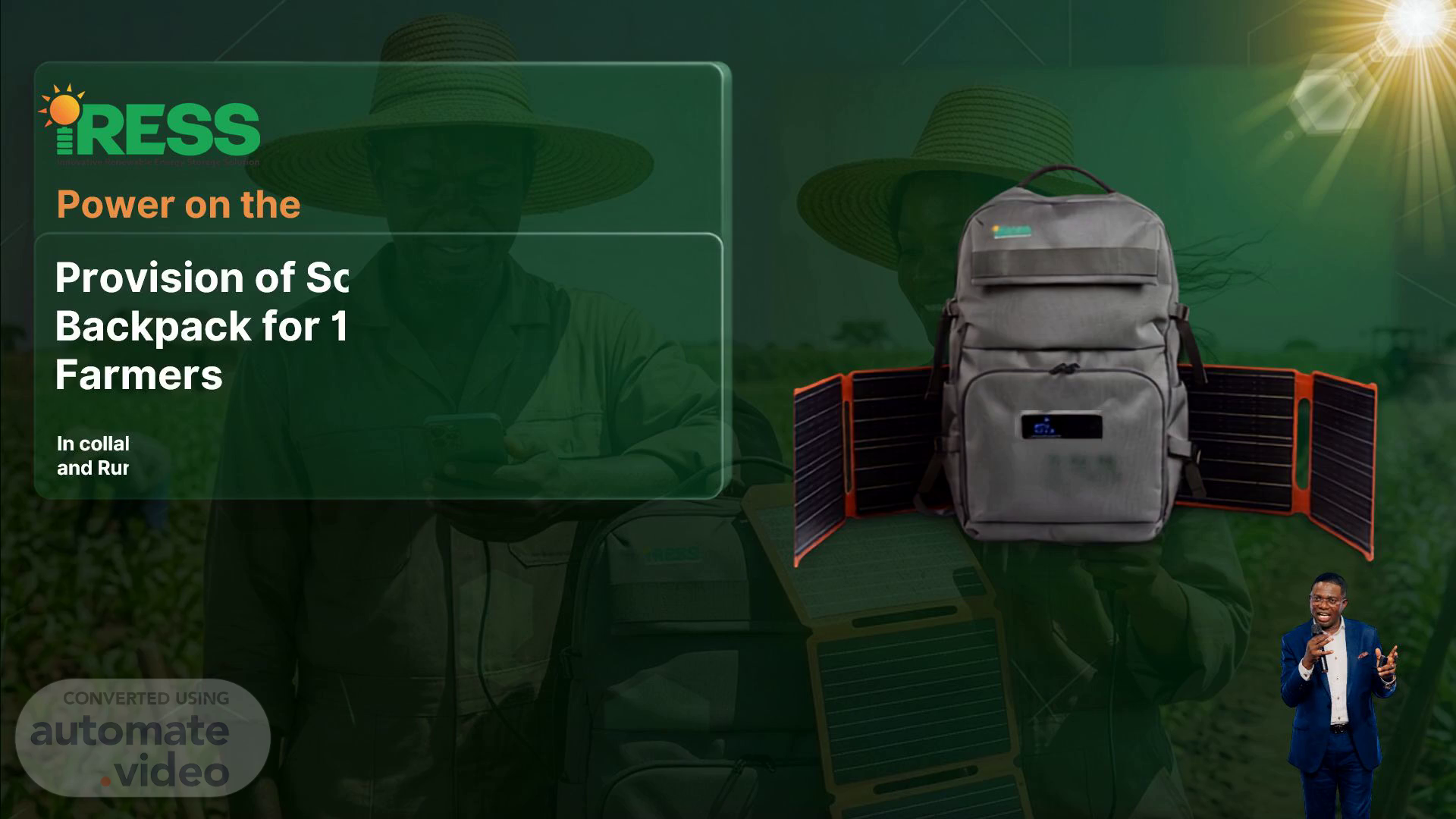
Provision of Solar Inverter Backpack for 1 Million Nigerian Farmers.
Scene 2 (41s)
[Audio] The agricultural sector in Nigeria is facing significant challenges due to climate change, soil degradation, and lack of investment in infrastructure. The government has implemented policies aimed at improving the sector's productivity and competitiveness. However, despite these efforts, the sector remains vulnerable to external shocks such as droughts and floods. The agricultural sector is a vital component of Nigeria's economy, accounting for approximately 40% of the country's GDP. The agricultural sector is characterized by small-scale farming, with many farmers relying on rainwater harvesting and traditional irrigation systems. The use of modern technology, such as precision agriculture and drones, is limited due to high costs and lack of access to credit facilities. Many farmers lack formal education and training, making it difficult for them to adopt new technologies and practices. The government has launched initiatives aimed at promoting sustainable agriculture and reducing greenhouse gas emissions. These initiatives include the development of organic farming practices, the promotion of agroforestry, and the implementation of conservation tillage. Additionally, the government has established programs to support small-scale farmers, including the National Farmers' Organization and the Small-Scale Farmers' Development Program. Despite these efforts, the agricultural sector still faces numerous challenges, including inadequate funding, poor infrastructure, and limited access to markets. The sector also requires more investment in research and development to improve its productivity and competitiveness. Furthermore, there is a need for greater policy coordination among different government ministries and agencies to address the sector's needs..
Scene 3 (2m 35s)
[Audio] The Programme Pillars include a Specialized Scheme to provide farmers with a Solar Inverter Backpack, targeting 1 million farmers across 36 states, with a total portfolio size of N350 billion. The funding structure consists of three main components: outright purchase, government subsidy, and corporate financing through partnerships with BOA, BOI, JAIZ Bank, and WEMA Bank. Furthermore, the program offers a "Buy Now Pay Later" option with harvest-linked quarterly repayments..
Scene 4 (3m 10s)
[Audio] The framework aims to provide a sustainable source of energy for farmers through the use of solar power. The framework will utilize existing infrastructure such as agricultural cooperatives and ministries to facilitate the acquisition of solar inverter backpacks. The solar inverter backpacks will be purchased outright by these organizations, with the goal of providing a reliable source of energy for farmers. The framework also includes government subsidies, financing options, and buy-now-pay-later mechanisms to make the purchase more accessible to farmers. The framework addresses several key challenges faced by farmers, including the lack of electricity, high fuel costs, and low productivity. Many farmers lack access to the electrical grid, which can limit their ability to perform tasks that require electricity. Fuel generators are often expensive and unreliable, making it difficult for farmers to maintain their farms. Additionally, the cost of fuel can be prohibitively expensive, reducing the overall productivity of the farm. By addressing these challenges, the framework aims to increase the productivity of farmers and improve their quality of life. By providing a reliable source of energy, farmers will be able to perform tasks more efficiently, leading to increased productivity and better economic outcomes. The framework also aims to promote sustainability and reduce the environmental impact of farming practices..
Scene 5 (4m 37s)
[Audio] The project aims to provide clean energy access to one million farmers, increasing their agricultural productivity by forty percent. The goal is to enable financial inclusion via digital payments, reducing post-harvest losses through processing, and supporting climate-smart agricultural practices. The project will also support farmers in adopting new technologies such as precision agriculture and drones for monitoring and management..
Scene 6 (5m 5s)
[Audio] The program offers four main financing options to support farmers in acquiring solar inverter backpacks. Outright purchase allows direct acquisition at full cost. The government provides a subsidy to support farmers. Corporate financing is provided by partner banks such as BOA, BOI, JAIZ BANK, and WEMA BANK. A "buy now pay later" option with harvest-linked quarterly repayments is available. These financing options enable farmers to acquire the necessary tools to increase their agricultural productivity..
Scene 7 (5m 40s)
[Audio] Solar Inverter Backpacks are designed to increase productivity by powering portable farm equipment such as tractors, pumps, and other machinery that can be used on-the-go. These backpacks have a built-in solar panel that converts sunlight into electrical energy, which is then stored in batteries and used to power the equipment. This allows farmers to work more efficiently and effectively, reducing their reliance on fossil fuels and lowering their energy costs. The solar inverter backpacks also enable farmers to access valuable information and resources, such as weather forecasts, extension services, and agronomic advice, which can help them make informed decisions about their crops and livestock. Additionally, these backpacks provide lighting and power essential household devices, making life easier for farmers and their families. By using solar inverter backpacks, farmers can expand their market access and stay connected with customers through mobile payments and digital transactions. They can also use the internet to access online platforms and marketplaces, increasing their sales and revenue. Furthermore, solar inverter backpacks can help farmers improve their living standards by providing power for fans, lights, and other essential household devices. This can lead to better health, hygiene, and overall well-being for farmers and their families. In summary, solar inverter backpacks offer a range of benefits for farmers, including increased productivity, reduced energy costs, expanded market access, smarter farming practices, and improved living standards. By harnessing the power of the sun, these backpacks can help farmers achieve greater efficiency, profitability, and success in their agricultural endeavors..
Scene 8 (7m 32s)
[Audio] The solar inverter backpacks have a large storage compartment which can hold various items such as laptops, tablets, and other electronic devices. This compartment is made of durable materials like Oxford cloth and microfiber, ensuring it remains intact even when subjected to rough handling. The backpack itself is also built to withstand harsh weather conditions, including extreme temperatures and heavy rainfall. The solar panel on top of the backpack converts sunlight into electrical energy, providing power for the user's devices. The lithium-ion battery powers the customized inverter, allowing users to charge their devices using the three-prong AC outlet, two USB ports, and one Type-C port. The capacity of these backpacks varies between 40W to 180W, with a maximum capacity of 128Wh and a cycle life of 6000 hours. This enables efficient and reliable energy generation and utilization..
Scene 9 (8m 33s)
[Audio] The farmer has a loan of N350000 with an equity contribution of 10%. This means that the farmer pays 90% of the loan amount as interest, which is N315000. The farmer will repay the loan over a period of 6-12 months through quarterly installments. The first installment is paid at the end of Q1, followed by quarterly payments until the final payment is made at the end of Q4. The total repayment amount is N78,750. The farmer can choose between two repayment schedules: one for 12 months, where payments are made every quarter starting from Q1, and another for 6 months, where payments are made every other quarter starting from Q2. In both cases, the repayment amount is N78,750. The farmer must make monthly payments of N2,500 towards the principal amount of N315000. This is in addition to the quarterly repayment of N78,750. The farmer also pays a service charge of 5% on the outstanding balance, which is calculated daily. The farmer's loan is secured by a mortgage on their land. The loan is used to finance the purchase of new equipment and tools. The loan term is 3 years, but the farmer can repay the loan early if they wish. The farmer can also use the loan to refinance existing debts..
Scene 10 (10m 10s)
[Audio] The increased agricultural productivity will lead to higher crop yields due to the use of powered tools and irrigation systems. This will result in a significant reduction in food shortages and improved food security. The availability of off-grid energy access will enable one million farmers to reduce their dependence on fossil fuels for electricity generation. As a direct consequence, the cost of fuel used for powering farms will decrease substantially. Consequently, the savings from reduced fuel costs will amount to approximately 60% of the total fuel costs associated with farming operations. Moreover, the implementation of this project will prevent an estimated 2 million tons of carbon dioxide emissions from being released into the atmosphere. This reduction in greenhouse gas emissions will contribute significantly to mitigating climate change. The successful completion of this project will also support the advancement of the Renewed Hope Agenda and promote sustainable agricultural practices that are aligned with climate-smart agriculture..
Scene 11 (11m 17s)
[Audio] The stakeholder alignment process ensures that the program's goals and objectives are met through a collaborative effort between various stakeholders. The process involves identifying key stakeholders such as the Federal Ministry of Agriculture and Rural Development (FMARD), financial institutions, and state governments. These stakeholders must be engaged and committed to support the program's success. Their commitment is crucial for finalizing the program structure and securing funding commitments. Cooperative mobilization is necessary to register and onboard farming cooperatives across all 36 states. This enables the structured deployment and repayment tracking of these cooperatives. The registration process helps to build trust among farmers and increases the likelihood of successful project implementation. The deployment of solar inverter backpacks will start with priority states, followed by a nationwide rollout. This approach allows for efficient use of resources and maximizes the impact of the program on the target population. By prioritizing certain states, the program can focus its efforts on areas where the greatest need exists..
Scene 13 (12m 39s)
[Audio] The initiative aims to provide farmers with clean energy solutions through the use of solar inverter backpacks. These backpacks are designed to increase agricultural productivity, reduce post-harvest losses, and support climate-smart agricultural practices. The goal is to enable financial inclusion and improve the overall quality of life for farmers. The organization believes that every farmer should have access to modern technology and resources to enhance their livelihoods. The objective is to make a significant positive impact on the lives of millions of people in Nigeria..