Scene 1 (0s)
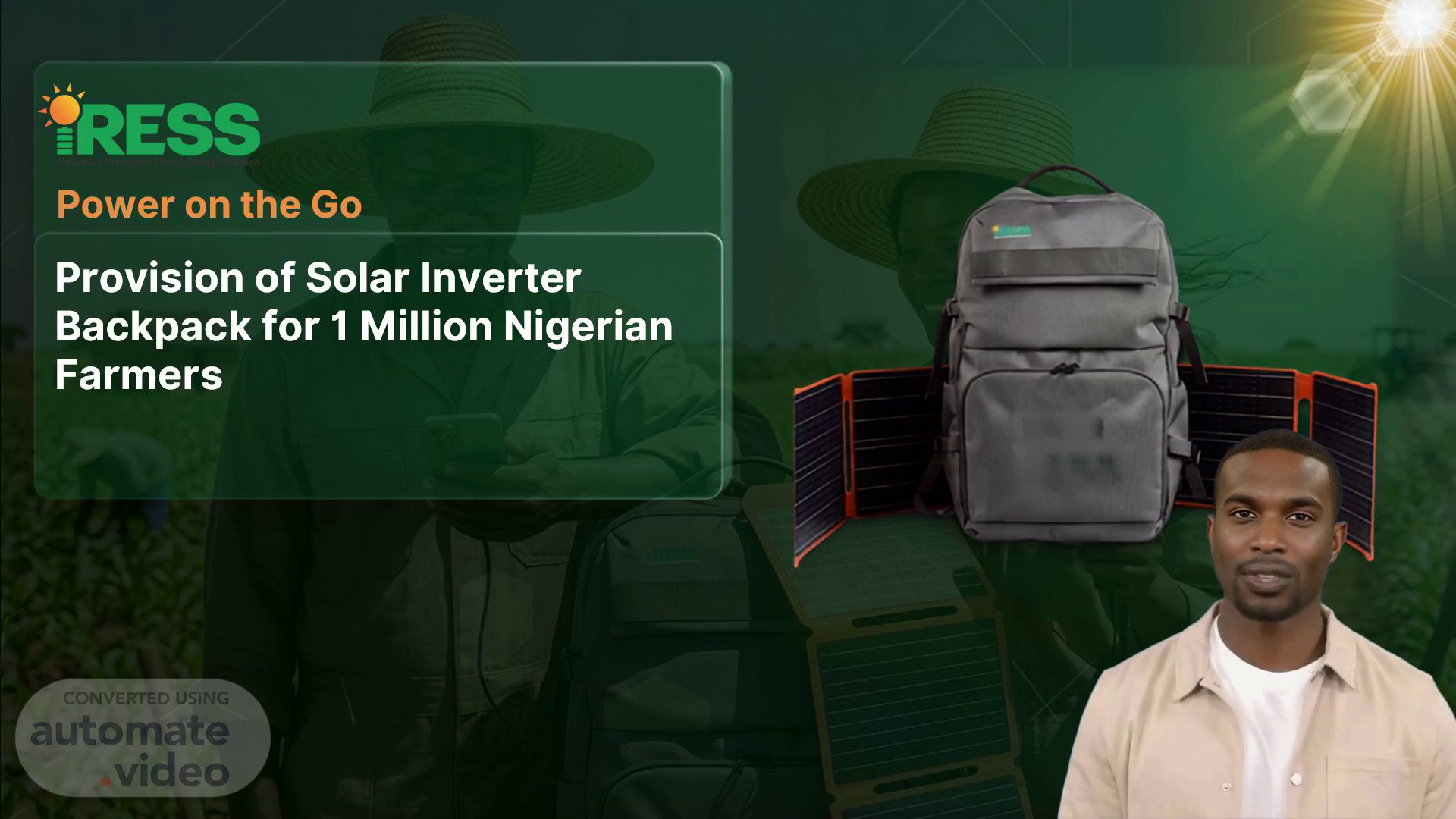
[Virtual Presenter] The Federal Ministry of Agriculture and Rural Development has formed a partnership with various stakeholders to distribute solar inverter backpacks to approximately one million Nigerian farmers. This initiative aims to empower these farmers by providing them with portable power sources that can be used to process their crops more efficiently. The solar inverter backpacks are designed to offer farmers a convenient way to access electricity while they are working outdoors. They can use this power to perform tasks such as harvesting, processing, and storing their crops. By having access to electricity, farmers can increase their productivity and efficiency, ultimately leading to better economic outcomes. The partnership between the Federal Ministry of Agriculture and Rural Development and its stakeholders involves several key components. Firstly, the ministry is responsible for promoting agricultural development and improving rural living standards. Secondly, the stakeholders involved in the partnership include organizations that specialize in renewable energy and agriculture. These solar inverter backpacks are an innovative solution to the challenges faced by many Nigerian farmers. They provide a reliable source of power that can be easily transported and used in remote areas where traditional infrastructure may not be available. By addressing the need for portable power, these backpacks can help to improve the overall quality of life for farmers and their families..
Scene 2 (1m 35s)
[Audio] The speaker is a member of the team working on the Renewed Hope Agenda, which aims to improve the lives of rural communities through sustainable agriculture practices. As a representative of the government, they have been instrumental in shaping the agenda's policies and decisions. The speaker emphasizes their close relationship with key stakeholders, including farmers, researchers, and policymakers, who have contributed significantly to the development of the agenda. The speaker highlights their leadership role within the agricultural sector, where they have worked closely with these stakeholders to drive innovation and progress. The speaker also underscores the importance of collaboration and cooperation among all parties involved in achieving the agenda's objectives..
Scene 3 (1m 40s)
[Audio] The program's core components are outlined by its four pillars. The first pillar is the specialized scheme for farmers that provides them with a solar inverter backpack. This scheme aims to provide farmers with a reliable source of energy, enabling them to power their farms more efficiently. The second pillar is the total portfolio size, which outlines the overall scope of the program. The third pillar is the targeted states, which indicates the specific regions where the program will be implemented. The fourth pillar is the outright purchase, which involves the government purchasing goods and services from local suppliers. The fifth pillar is the government subsidy, which provides financial assistance to farmers who participate in the program. The sixth pillar is corporate financing, which offers loans to farmers at competitive interest rates. The seventh pillar is buy now pay later, which allows farmers to make payments over time..
Scene 4 (2m 36s)
[Audio] The framework provides a range of benefits for farmers. Firstly, it offers a cost-effective way to obtain solar inverter backpacks. Secondly, it addresses the issue of limited access to electricity in rural areas. Thirdly, it helps farmers to increase their productivity by reducing fuel costs and providing them with necessary tools. Fourthly, it offers flexible payment options..
Scene 5 (3m 3s)
[Audio] The goal of this project is to provide clean energy access to one million farmers, thereby increasing their income and improving their quality of life. The objective is to increase agricultural productivity by forty percent, which will enable farmers to produce more food with less effort. This can be achieved through the use of renewable energy sources such as solar and wind power. By providing clean energy access to farmers, we can help them reduce their reliance on fossil fuels, lower their energy costs, and improve their overall well-being. Furthermore, increased productivity will lead to higher yields, better nutrition, and improved health outcomes for farmers and their families..
Scene 6 (3m 48s)
[Audio] The four financing options available to farmers are: Outright Purchase, Government Subsidy, Corporate Financing, and Buy Now Pay Later. These options provide different levels of financial assistance to farmers, depending on their needs and circumstances. Outright Purchase offers a low-risk investment opportunity for farmers who want to buy equipment or tools outright, using cash. Government Subsidy provides financial assistance to farmers through various forms of support, including subsidies on inputs and other benefits. Corporate Financing offers financing options to farmers through partnerships with commercial banks, providing various types of loans and credit facilities. Buy Now Pay Later allows farmers to purchase equipment or tools now and pay for them later, often in quarterly installments..
Scene 7 (3m 53s)
[Audio] Solar inverter backpacks can increase productivity by powering portable farm equipment, enabling faster and more efficient operations. They also reduce energy costs by using solar power, allowing farmers to allocate resources more effectively. These backpacks enable farmers to sell their products online, thereby growing their profitability. Keeping phones and other digital devices charged allows farmers to conduct transactions, set prices, and expand their customer base. Access to weather forecasts, extension services, and agronomic information makes farming smarter. The backpacks also provide lighting and power essential household devices such as fans..
Scene 8 (4m 37s)
[Audio] The backpack's design is centered around the farmer's needs. The farmer's primary concern is the safety of their family and livestock. The farmer wants to ensure that they have access to essential resources at all times. The farmer's goal is to maintain productivity while minimizing risks. The farmer's ideal situation would be having a reliable source of power and water. The farmer's main priority is to protect their crops from pests and diseases. The farmer's objective is to minimize waste and maximize efficiency. The farmer's ultimate goal is to increase their income through sustainable practices. The farmer's key performance indicators (KPIs) include crop yield, soil health, and pest management. The farmer's desired outcome is to achieve a balance between economic viability and environmental sustainability. The farmer's target market is the global agricultural sector. The farmer's competitive advantage lies in their ability to adapt to changing climate conditions. The farmer's business model is based on sustainable agriculture practices. The farmer's marketing strategy involves using social media platforms to reach a wider audience. The farmer's sales strategy focuses on building relationships with customers. The farmer's customer service is centered around providing excellent support and resolving issues promptly. The farmer's revenue streams come from selling products and services related to sustainable agriculture. The farmer's pricing strategy is based on the value proposition of their products and services. The farmer's cost structure includes labor costs, material costs, and overhead expenses. The farmer's profit margins are influenced by the demand for sustainable agriculture products and services. The farmer's growth strategy involves expanding into new markets and increasing production capacity. The farmer's risk management approach involves diversifying investments and managing supply chain risks. The farmer's organizational structure is flat, with clear communication channels. The farmer's human resource management system prioritizes employee development and retention. The farmer's financial management system uses a combination of cash flow management and budgeting. The farmer's operational management system emphasizes efficiency and productivity. The farmer's quality control measures involve regular inspections and monitoring. The farmer's regulatory compliance is ensured through adherence to industry standards and regulations. The farmer's innovation strategy involves investing in research and development. The farmer's technology adoption rate is high, with a focus on digitalization and automation. The farmer's knowledge management system relies on sharing best practices and expertise. The farmer's leadership style is collaborative and participatory. The farmer's change management process involves identifying and addressing cultural and behavioral barriers. The farmer's strategic planning process involves setting clear goals and objectives. The farmer's decision-making process is data-driven and transparent. The farmer's problem-solving approach involves analyzing problems and developing solutions. The farmer's communication skills are effective and clear. The farmer's conflict resolution strategies involve active listening and empathy. The farmer's negotiation skills are strong, with a focus on finding mutually beneficial agreements. The farmer's relationship-building skills are essential for establishing trust and credibility. The farmer's time management skills are critical for prioritizing tasks and meeting deadlines. The farmer's adaptability is crucial for responding to changes in the market and environment. The farmer's resilience is vital for coping with unexpected setbacks and challenges. The farmer's emotional intelligence is essential for understanding and managing emotions. The farmer's self-awareness is critical for recognizing strengths and weaknesses. The farmer's continuous learning is necessary for staying up-to-date with industry trends and developments. The farmer's reflection and evaluation processes involve regularly assessing progress and outcomes. The farmer's feedback mechanisms involve soliciting input from stakeholders and customers. The farmer's accountability is ensured through regular reporting and transparency. The farmer's sustainability initiatives involve reducing waste and promoting environmentally friendly practices. The farmer's community engagement is essential for building.
Scene 9 (9m 16s)
[Audio] The farmer receives a loan of N350000 at a 10% equity contribution. This means that the farmer must pay back N300000, as the remaining N50000 is covered by the financier. The farmer pays back the loan through quarterly repayments of N35000. The repayments are made over a period of 6-12 months. There are two possible repayment schedules. One schedule involves paying back the entire loan in 12 months, with repayments made every quarter. The other schedule involves repaying the loan in 6 months, with payments split between quarters. In both cases, the total repayment amount remains the same, but the payment frequency differs. The farmer has more flexibility in terms of repayment periods, allowing them to better manage their finances..
Scene 10 (10m 10s)
[Audio] The project aims to electrify one million farmers across the region, providing them with off-grid energy access. This will enable them to power their homes using renewable energy sources such as solar panels. The project also seeks to reduce fuel costs by 60% through the use of clean solar energy. Additionally, it plans to increase productivity by 40% due to higher yields through the use of powered tools and irrigation systems. Furthermore, the project's overall impact will be a significant reduction in carbon dioxide emissions, specifically two million tonnes..
Scene 11 (10m 49s)
[Audio] The stakeholders will work together to finalize the program structure and secure funding commitments from key partners such as the Federal Ministry of Agriculture and Rural Development (FMARD), financial institutions, and state governments. Cooperative mobilization efforts will be made to register and onboard farming cooperatives across all 36 states to ensure structured deployment and repayment tracking. The deployment phase will begin with the phased distribution of solar inverter backpacks to priority states, gradually expanding nationwide..
Scene 13 (11m 30s)
[Audio] Our solar inverter backpacks are designed for farmers who want to increase their energy independence. They offer a range of benefits including improved energy efficiency, reduced costs, and enhanced productivity. By using our solar inverter backpacks, farmers can reduce their reliance on external power sources and minimize their carbon footprint. This allows them to focus on what matters most - growing high-quality crops..